On this page
- A worked example: attributed results versus incremental lift
- Start with the business decision and counterfactual
- Define data, owners, windows, and workflow before launch
- Compare five experiment and measurement methods
- Separate causal experiments from attribution and observation
- Budget sample, media, tooling, analyst time, and opportunity cost
- Choose metrics, segments, confidence checks, and reporting rules
- Know when the available scale cannot answer the question
- Use intent, identity, and activation data without treating them as proof
- Control selection, contamination, privacy, and overclaiming risk
- Turn experiment evidence into agency decisions and renewal reporting
- BrandWell: MarketPulse intent data and connected growth automation
- Frequently asked questions
- Put buyer intent to work with MarketPulse
Direct answer: Design an incrementality test for intent-based advertising by pre-registering the business decision, eligible population, experimental unit, treatment, counterfactual, primary outcome, conversion lag, sample and power assumptions, contamination controls, analysis and stopping rule. Intent data may define eligibility or planned strata; it is not evidence that the ads caused pipeline.
Who is this for? Marketing analytics leaders, RevOps teams, paid-media directors and agencies deciding whether to launch, retain or expand intent-driven ad spend. The guide also shows when a valid test is too small to answer the decision and should be reported as inconclusive.
Current MarketPulse plans are starting at $500/mo. Review the product, demo and standard plans. Eligible early-access offers are separate and time limited.
A worked example: attributed results versus incremental lift
This hypothetical example explains the calculation; it is not a BrandWell customer result. Suppose 1,000 eligible accounts are assigned to treatment and another 1,000 to control. Under the declared outcome window, treatment produces 60 qualified opportunities and control produces 40.
- Treatment outcome rate: 60 / 1,000 = 6%.
- Control outcome rate: 40 / 1,000 = 4%.
- Estimated difference: 2 percentage points, equivalent to 20 additional opportunities per 1,000 assigned accounts.
- Relative lift: (6% – 4%) / 4% = 50%.
The point estimate is not the whole result. Report its uncertainty, assignment integrity, contamination and outcome definition. The example provides no confidence interval and is not sufficient to decide whether to expand spending. Calling all 60 treatment opportunities incremental would ignore the control outcome.
If treatment costs $4,000 more than control, dividing that cost by the estimated 20 additional opportunities gives $200 per estimated incremental opportunity. An opportunity is not won revenue. Use actual revenue outcomes and an appropriate causal estimate when calculating incremental return on ad spend.
Start with the business decision and counterfactual
Write the decision before the method. Examples are: expand the intent-based campaign to all eligible accounts; renew the data and media program; shift budget from ICP-only targeting; or stop a creative and audience combination. Each decision needs a threshold for action, the cost of a wrong decision, and the period over which the effect matters.
Then define the estimand – the exact causal quantity. A useful form is: ‘Among eligible high-fit accounts with recent research in approved topics, what is the incremental probability of a sales-accepted opportunity within 120 days from offering the declared advertising treatment, compared with the existing non-ad treatment?’ This states population, treatment, comparison, outcome and window. ‘Did intent ads work?’ does not.
The counterfactual is what would have happened to the same eligible population without the additional treatment. Attribution reports do not observe that state. A randomized holdout approximates it by making treatment assignment independent of the potential outcome. A matched comparison tries to approximate it with assumptions. A pre/post comparison assumes other changes did not matter. Make the assumption visible.
Choose one primary outcome close enough to the revenue decision and frequent enough to measure. Won revenue may be economically ideal but too rare or delayed; qualified meetings or sales-accepted opportunities may be usable intermediates when their definition is stable. Add guardrails such as unsubscribes, complaint rate, cost, sales capacity and low-quality conversions.
Define data, owners, windows, and workflow before launch
Freeze the protocol before launch. Record the hypothesis, eligible and excluded units, assignment and stratification, treatment, control experience, budget, start and end, lag, primary and secondary outcomes, minimum detectable effect, power target, data sources, missing-data handling, analysis, multiplicity rules, stopping conditions, owners and approval. Store a versioned copy that cannot be silently rewritten after results appear.
Build a unit ledger from raw intent and fit evidence. Preserve account, domain and person candidates; source; topic; observed and received time; freshness; identity confidence; customer and opportunity status; suppression; geography; and planned stratum. Remove ineligible units before randomization. If eligibility is updated after treatment based on engagement, the analysis becomes selected on a post-treatment variable.
Name owners for protocol, media delivery, audience construction, CRM outcome, data engineering, privacy or legal escalation, analysis and client communication. Separate the analyst who monitors data integrity from the executive who wants an early win. Establish a deviation process: a broken feed or policy issue can justify a change, but the change must be logged and its effect assessed.
Run preflight checks: expected eligible units, baseline outcome, intraclass correlation if randomizing groups, likely match and delivery, conversion lag, required duration, sales capacity, contamination paths and feasibility. Google’s experiments guidance notes that interference, power and inconclusive results matter. A calendar deadline is not a substitute for statistical information.
Compare five experiment and measurement methods
The five methods below are ordered from stronger direct control of the counterfactual to a diagnostic that does not establish incrementality. The best choice depends on the available assignment mechanism, unit independence, sample, data rights and business decision. No method earns causal language merely because software labels a report ‘lift.’
1. Randomized person or account holdout
Best fit: Use when the platform and data architecture can assign eligible people or accounts to treatment and control before exposure, the unit can be kept reasonably independent, and both groups can be measured through the declared outcome window. Account randomization is often more defensible than person randomization for B2B programs because several people at one company may influence the same opportunity.
Experimental unit: Choose person, cookie, account, buying group or another unit based on how treatment is delivered and how the outcome occurs. Randomize at the highest level needed to limit spillover. If one account’s employees can enter both groups, person-level assignment may contaminate the result.
Required data: A frozen eligible population, stable intent and fit strata, assignment record, exposure and campaign receipts, suppression list, cost, primary and guardrail outcomes, conversion lag, CRM reconciliation, and a rule for accounts entering or leaving during the test.
Implementation: Pre-register the hypothesis, minimum detectable effect, allocation, exclusions, duration and stopping rule; stratify or block on a few important pre-treatment factors; randomize; verify balance; prevent cross-group activation; monitor data quality without peeking for a winner; and analyze all assigned units under the declared rule.
Primary analysis: Estimate the difference in outcome rate or value between assigned treatment and control, with uncertainty and cost. Use intent strata to evaluate planned heterogeneity only when the sample can support it. Report intent-to-treat as the default so selective exposure does not silently redefine the groups.
Proof to request: Preserve the randomization code or platform receipt, unit list, balance checks, treatment integrity, excluded records, outcome definitions, missing-data handling, analysis code, confidence interval and deviation log. A dashboard screenshot is insufficient.
Meaningful limitation: Small B2B populations, account overlap, sales contact outside the ad program, shared devices and long conversion lag can reduce power or contaminate groups. A valid design can still return an inconclusive result; randomization does not guarantee a decisive answer.
2. Randomized geo experiment
Best fit: Use when individual or account assignment is unavailable but media can be varied across geographic units with limited spillover, adequate historical stability and enough comparable regions. This is common when the channel or privacy design supports geography more readily than user-level holdout.
Experimental unit: The unit is a market, state, city group, designated market area or another non-overlapping geography. Pair or stratify geographies using pre-treatment outcome and spend patterns, size, vertical mix and other declared factors before random assignment.
Required data: Consistent geo-level media cost and outcomes, sufficient pre-period history, the treatment schedule, boundaries, account or revenue geography rules, conversion lag, cross-border or travel indicators, and a definition for national accounts whose outcomes span several regions.
Implementation: Select eligible geographies, test pre-period comparability, form pairs or blocks, randomize treatment, hold other material activity stable where practical, run for the declared duration, monitor delivery and spillover, and use a model specified before results are inspected.
Primary analysis: Estimate incremental outcome and incremental return on ad spend across randomized geo pairs or strata. Google Research has published geo-experiment methods and work on paired-geo incremental return; the appropriate model still depends on the buyer’s data.
Proof to request: Request the geo eligibility rules, pairing variables, assignment record, pre-period fit, delivery and spillover checks, outcome mapping, model specification, uncertainty, sensitivity analysis and a complete list of concurrent geo-specific campaigns or sales changes.
Meaningful limitation: B2B markets may be too heterogeneous or too few, and company headquarters may not represent where buying activity occurs. National campaigns, sales territories and cross-geo exposure can weaken separation. A poorly matched geo test can be more misleading than a clearly labeled observational analysis.
3. Matched-market quasi-experiment
Best fit: Use only when randomization is genuinely unavailable and the team has several untreated markets or account cohorts with credible pre-treatment similarity. It can inform a decision, but it is a quasi-experiment and should not be described as equivalent to random assignment.
Experimental unit: Use geographies, accounts, industries or time-series panels that can be matched using pre-treatment variables unaffected by the campaign. Do not match on post-treatment engagement, conversions or intent changes because that conditions on consequences of treatment.
Required data: Long enough pre-period history, treatment timing, outcomes, costs, fit and baseline intent, concurrent campaigns, sales coverage, market changes, and a documented reason each comparison remained untreated. Preserve the candidate pool before selecting the best-looking matches.
Implementation: Predeclare matching variables and tolerances; build the comparison without viewing post-period results; inspect pre-trends; set the analysis and placebo tests; track concurrent changes; and run sensitivity analyses with alternate credible matches. Treat unexplained pre-trend divergence as a stop signal.
Primary analysis: Estimate the difference in change between treated and matched comparison units, with uncertainty and sensitivity to the match. Synthetic-control or regression adjustments may help in appropriate settings, but model complexity cannot remove unobserved confounding by assertion.
Proof to request: Ask for the full candidate pool, matching code, balance and pre-trend plots, excluded units and reasons, concurrent-event log, placebo and sensitivity tests, model outputs, confidence intervals and the exact claim language proposed for stakeholders.
Meaningful limitation: Selection bias remains: treated markets or accounts may differ in unobserved ways, and choosing comparisons after seeing results can manufacture a lift. Use causal language cautiously and explain why randomization was not feasible.
4. Platform conversion-lift study
Best fit: Use when an ad platform offers a conversion-lift study for the account, campaign, region and outcome, and its feasibility check indicates enough scale. Platform studies can provide a randomized holdout within the platform’s delivery system with less custom engineering.
Experimental unit: The platform determines eligible users or another supported unit and assigns a control that is withheld from the experimental campaign. Confirm how identity, cross-device exposure, other campaigns and conversions are handled before accepting the result.
Required data: Eligible campaigns, sufficient expected conversions, reliable conversion tracking or qualified offline events, study dates, budget, audience and geographic scope, conversion lag, and an account-level record of other activity that can reach the same users.
Attributed conversions and incremental conversions answer different questions. Google’s user-based Conversion Lift setup guidance describes account eligibility and feasibility checks. Verify the current requirements for your account before planning a study.
Primary analysis: Report the platform’s incremental conversions or conversion lift, uncertainty and study population, then connect the conversion definition to qualified pipeline. Do not automatically generalize a platform-specific result to every channel, audience or future period.
Proof to request: Retain the official study setup, feasibility result, eligibility and control definitions, campaign scope, outcome, dates, budget, other-campaign conflicts, result, confidence and platform documentation. Reconcile the measured event with CRM quality.
Meaningful limitation: Eligibility and minimum scale can exclude many B2B programs. The platform controls parts of assignment and reporting, cross-channel exposure may remain, and the measured conversion may occur well before pipeline. The study answers a bounded question, not the entire go-to-market impact.
5. Observational attribution diagnostic
Best fit: Use as an operational diagnostic when experimentation is unavailable, when a team needs journey context, or when deciding whether a future experiment is worth funding. Attribution can describe observed paths and allocation under a model; it should not be called incrementality.
Experimental unit: The records are observed people, accounts, sessions, opportunities or touches rather than randomized units. Define identity resolution and attribution rules explicitly, because changing either can change the result without changing buyer behavior.
Required data: Timestamped exposures and interactions, identity and account confidence, campaign cost, CRM stages, outcome values, attribution window, model definition, missing-channel assessment, topic and fit cohorts, and sales activity. Preserve untracked exposure and unknown identity as limitations.
Implementation: Reconcile sources, deduplicate events, freeze attribution definitions, analyze cohorts and lag, compare with historical or matched baselines, and label the result observational. Use the findings to identify plausible mechanisms, data gaps and candidate units for a later experiment.
Primary analysis: Report observed conversion and pipeline rates, attributed credit under the named model, account journeys and sensitivity to alternate windows or rules. Avoid converting attributed revenue into incremental revenue. Correlation can prioritize action without proving causation.
Proof to request: Request event lineage, identity logic, missing-channel analysis, attribution rules, alternate-model sensitivity, outcome reconciliation, cohort definitions and a visible caveat explaining why the comparison does not establish a counterfactual.
Meaningful limitation: Selection, unobserved demand, sales effort, seasonality and identity gaps can explain apparent lift. A sophisticated dashboard does not solve the missing counterfactual and must not be used to overstate causality in a client renewal.
Separate causal experiments from attribution and observation
Randomized experiments estimate an effect under the declared assignment and implementation. Quasi-experiments estimate an effect under additional assumptions about comparability and trends. Attribution distributes observed outcome credit among recorded touches under a rule or model. Observational cohort analysis describes association. All can be useful; they answer different questions.
Use attribution to debug paths and reconcile data, not to replace the counterfactual. Use observational differences to size a hypothesis or find segments, not to claim lift. Use matched markets when randomization is impossible and the assumptions survive pre-trend and sensitivity checks. Use randomized account or geo designs when exposure can be separated and the sample supports the decision.
A common failure is method switching after the result. A randomized test is underpowered, so the report substitutes an attributed pipeline number and calls the program successful. Keep the planned primary result, including an inconclusive interval, and present secondary diagnostic evidence as secondary. Decision-makers deserve to know what was and was not learned.
Budget sample, media, tooling, analyst time, and opportunity cost
Budget five resources. Sample is the number of independent units and expected events. Media is the spend needed to deliver meaningful treatment. Data and tooling covers eligible audiences, assignment, exposure, outcome and analysis. Analyst and engineering time covers protocol, QA, reconciliation and sensitivity. Opportunity cost includes withheld advertising, delayed rollout and sales capacity.
Power planning begins with the baseline outcome rate or value, smallest effect worth acting on, variation, clustering, allocation, expected delivery and attrition. A sample-size calculator can produce a number only after those inputs are defensible. For account-randomized B2B tests, several people share one outcome, so counting cookies as independent units exaggerates information.
Do not increase spend solely to obtain significance if the incremental opportunity could not repay the test. Conversely, a cheap underpowered test can waste all of its budget by producing an interval too wide for the decision. Report the range of plausible effects and whether each side would change the decision.
Choose metrics, segments, confidence checks, and reporting rules
The primary metric should match the decision. Common choices are incremental qualified conversion rate, incremental opportunities per eligible account, incremental pipeline value or incremental return on ad spend. Secondary metrics explain mechanism: reach, exposure, clicks, engaged visits, meetings and stage movement. Guardrails capture cost, complaints, low-quality volume, sales workload and customer suppression failures.
Plan a small number of segments before launch: fit tier, intent recency, topic cluster, existing engagement or account size. Randomize within important strata when practical. Do not search dozens of slices for one favorable result. Adjust for multiple comparisons or label segment results exploratory and use them to design the next test.
Confidence reporting should include the point estimate, interval, sample and event counts, assignment balance, treatment delivery, missing data, contamination and practical decision threshold. Statistical significance is not the same as commercial importance. An estimate can be statistically detectable but too small to fund, or commercially promising but too uncertain to expand.
Use the predeclared duration and stopping rule. Stop early for safety, policy or severe implementation failure; otherwise avoid weekly winner checks. If a sequential design is used, specify its monitoring boundaries in advance. Add conversion lag after the final exposure before closing the outcome window.
Know when the available scale cannot answer the question
The test is decision-useful when it has enough independent units and expected outcomes, assignment can be maintained, treatment differs meaningfully, instrumentation is stable, outcome lag fits the planning horizon, and a plausible result would change the budget decision. Run the power analysis before launch, not after the test misses significance.
It is too small when the minimum detectable effect is larger than any believable business benefit, when only a handful of accounts or opportunities determine the result, or when geographies cannot be separated. It is also infeasible when nearly every eligible account is already exposed by other campaigns, when sales changes treatment based on group status, or when the qualified outcome arrives after the renewal decision.
Options for insufficient scale are to aggregate carefully across time or clients only when definitions and rights permit; use a more frequent, still meaningful intermediate outcome; test a larger eligible universe; evaluate creative or delivery mechanics instead of pipeline; or document that the question cannot currently be answered. Do not weaken the outcome to a click merely to obtain a favorable result.
Use intent, identity, and activation data without treating them as proof
Intent can support the design in four legitimate ways: define an eligible research cohort before assignment; stratify randomization by topic or recency; create treatment messages aligned with declared needs; and measure whether effects differ across a small number of planned cohorts. Fit can restrict the population to accounts able to buy. Identity data can connect outcomes when permitted. Activation records show whether assigned treatment was deliverable.
None of those inputs proves intent or exposure. Offsite topic activity may be account-level and probabilistic. Person resolution may be wrong. An uploaded audience may have a low match rate. An assigned unit may never receive an impression. Preserve the full chain: raw evidence, eligibility decision, assignment, audience receipt, exposure where available, qualified outcome and analysis inclusion.
Analyze intent-to-treat as the main randomized estimate: compare units as assigned. A treatment-on-the-treated estimate asks a different question and can be biased if exposure is selective. If shown, use an appropriate method and explain its assumptions. Do not simply discard treatment accounts that received no impression and compare only the easiest-to-reach users.
AIMEE helps prepare account research and next steps through configured tools in BrandWell. Account permissions and workflow approvals determine what can execute. Experiment assignment, statistical analysis and outcome reconciliation require a documented process; do not assume the product provides a native experiment engine.
Control selection, contamination, privacy, and overclaiming risk
Selection bias appears when high-intent or high-fit accounts receive treatment and are compared with an unmatched general population. Avoid it by randomizing within the eligible universe or using a defensible pre-treatment comparison. Do not condition on post-treatment clicks, visits, seller actions or opportunity creation.
Contamination occurs when control accounts see other campaigns, treatment and control employees share an account, sales contacts the groups differently, geographies overlap, or audiences are reused elsewhere. Map every path before launch, measure known spillover and use cluster assignment when it reduces interference. Some contamination attenuates a true effect; selective contamination can bias in either direction.
Privacy controls include data minimization, source and rights review, purpose limitation, client separation, access, retention, deletion, suppression and clear treatment of identity uncertainty. The experiment protocol should never encourage an upload that violates platform rules. Avoid sensitive topics and do not reveal inferred behavior in creative or outreach.
Overclaiming includes calling attributed revenue incremental, generalizing beyond the eligible population, hiding an inconclusive interval, omitting concurrent sales changes, and reporting subgroup winners discovered after the fact. Use an evidence ladder: randomized causal estimate; quasi-experimental estimate with assumptions; observational association; operational metric. Label each accurately.
Turn experiment evidence into agency decisions and renewal reporting
An agency should incorporate experiment design as a decision service: quarterly question selection, feasibility and power review, protocol and approvals, audience and data QA, test administration, deviation logging, qualified-outcome reconciliation, analysis, and an executive decision memo. It should not promise a positive lift; it should promise a transparent process within the written scope.
The report opens with the decision and primary result, including uncertainty. It then shows implementation integrity, cohort and exposure, guardrails, secondary diagnostics, limitations, financial scenarios and the recommended action. Renewal can be supported by credible evidence of incremental value, but an inconclusive test may recommend improving scale or instrumentation rather than renewing unchanged.
Start with MarketPulse intent data starting at $500/mo. Review a relevant topic and its matching audience, then use configured BrandWell tools and AIMEE to prepare the next action. Keep agency services, client permissions and measurement responsibilities explicit.
The most valuable experiment is not the one with the largest reported lift. It is the one that gives the client a defensible next decision, records uncertainty and prevents an attractive correlation from becoming an expensive recurring assumption.
BrandWell: MarketPulse intent data and connected growth automation
BrandWell MarketPulse: intent data starting at $500/mo. Find people researching topics relevant to what you sell, apply saved ICP filters, and review available contact details before taking action.
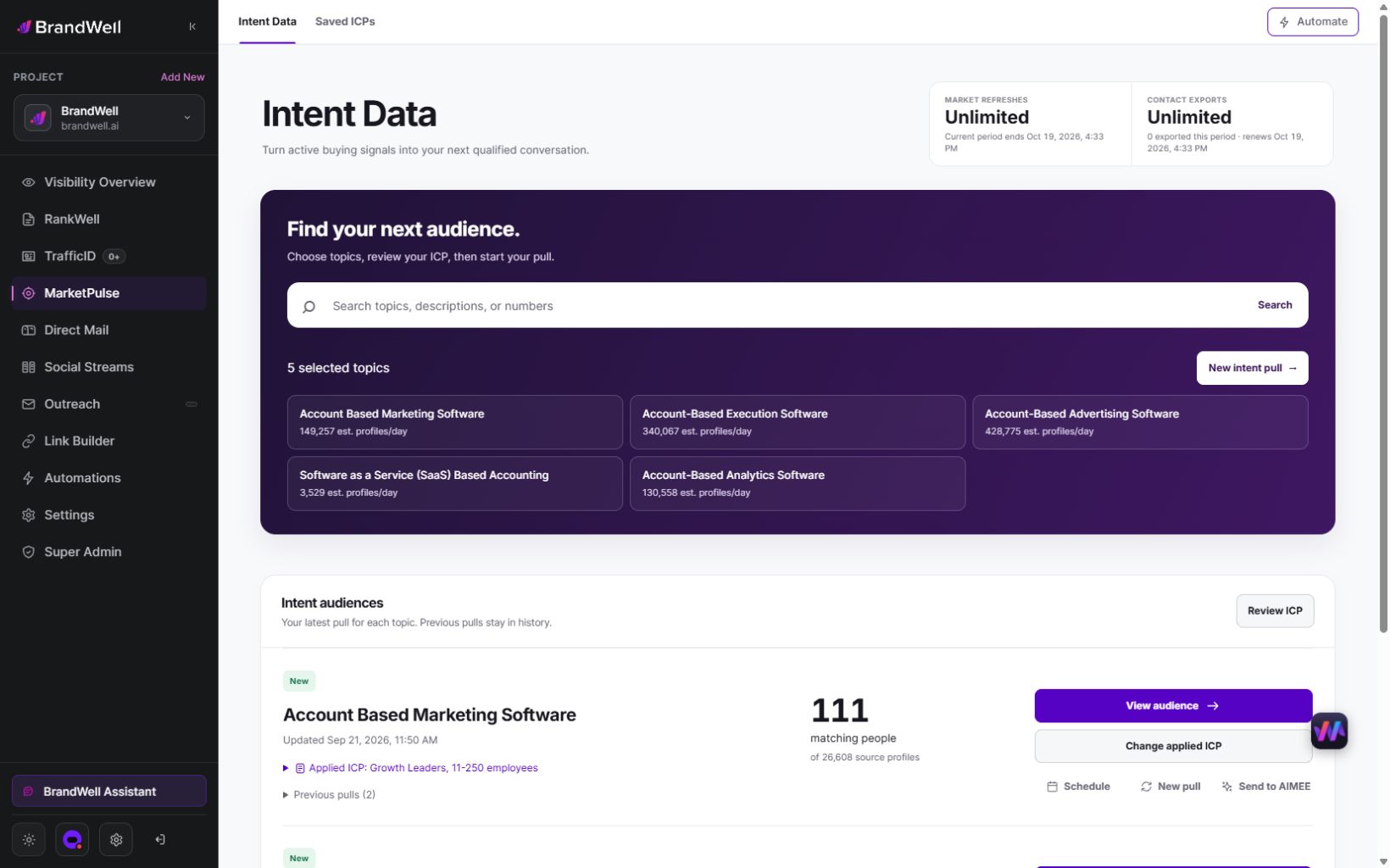
MarketPulse plans are starting at $500/mo. Verify current package scope and offers on the product page.
| Plan | Topics and refreshes | Monthly exports |
|---|---|---|
| Starter | 1 topic, weekly | 25,000 contacts |
| Growth | 3 topics, daily | 100,000 contacts |
| Scale | 10 topics, daily | Unlimited contacts |
Swipe the table to see all columns.
A pull retrieves available data from the previous 24 hours for one topic. Daily use across all included topics provides 90 Growth pulls or 300 Scale pulls in a 30-day month. Weekly Starter pulls vary by calendar month. Available audience size and contact fields vary, and audiences may overlap. Refreshes stop at the plan limit without overage charges.
- Find and qualify: search the topic catalog, save your ICP, and review the people and companies that match.
- Act on the research: export qualified contacts or prepare an Outreach or Direct Mail workflow. Connected products, channel usage, and fulfillment may cost extra.
- Get help from AIMEE: Growth and Scale include AIMEE for the initial user to research accounts and prepare the next step through connected tools.
Agencies and other service businesses can build client deliverables around their available Intent Scans and exports. Keep each client’s scope, permissions, and service fees clear. A subscription is not a promise of a white-label platform or exclusive access to a market.
Explore MarketPulse and watch the demo or compare plans starting at $500/mo. Any early-access discount is a separate, time-limited offer shown to an eligible recipient.
Frequently asked questions
Does intent data prove advertising caused a conversion?
No. Intent data can define a relevant eligible population or planned segment. A causal claim still needs an appropriate comparison, stable measurement and a defensible analysis.
Can a small B2B campaign run an incrementality test?
Assess the independent units, expected outcomes, minimum effect worth acting on and conversion lag first. A campaign may be able to test delivery or instrumentation while lacking enough information to estimate pipeline lift usefully.
What if the result is inconclusive?
Report the estimate and uncertainty, explain the implementation and state what remains unknown. Do not substitute an attribution number and label the campaign incrementally successful.
Does MarketPulse run the experiment for me?
MarketPulse supplies the topic-lookup and audience workflow described here. Assignment, holdout enforcement, outcome reconciliation and statistical analysis need appropriate configured systems and accountable owners. Do not assume native lift-study functionality.
Put buyer intent to work with MarketPulse
Find people researching your market, focus the audience with your ICP, and turn relevant signals into a useful next conversation. MarketPulse plans are starting at $500/mo.
Explore MarketPulse and watch the demo. Compare the topic coverage, refresh cadence, and exports included in each plan, then choose the one that fits your business or client work.
Reviewed and updated October 3, 2026.

Written by