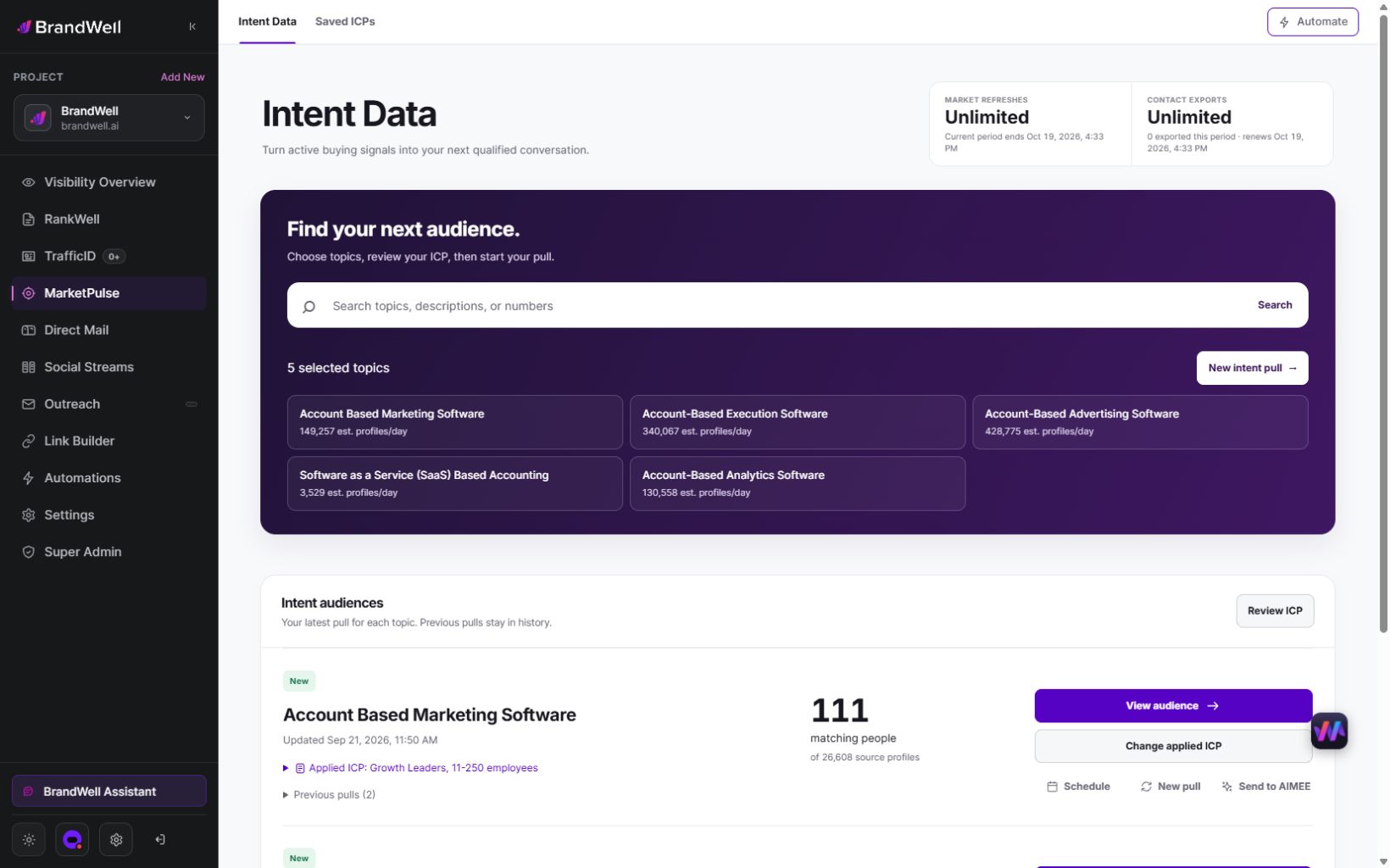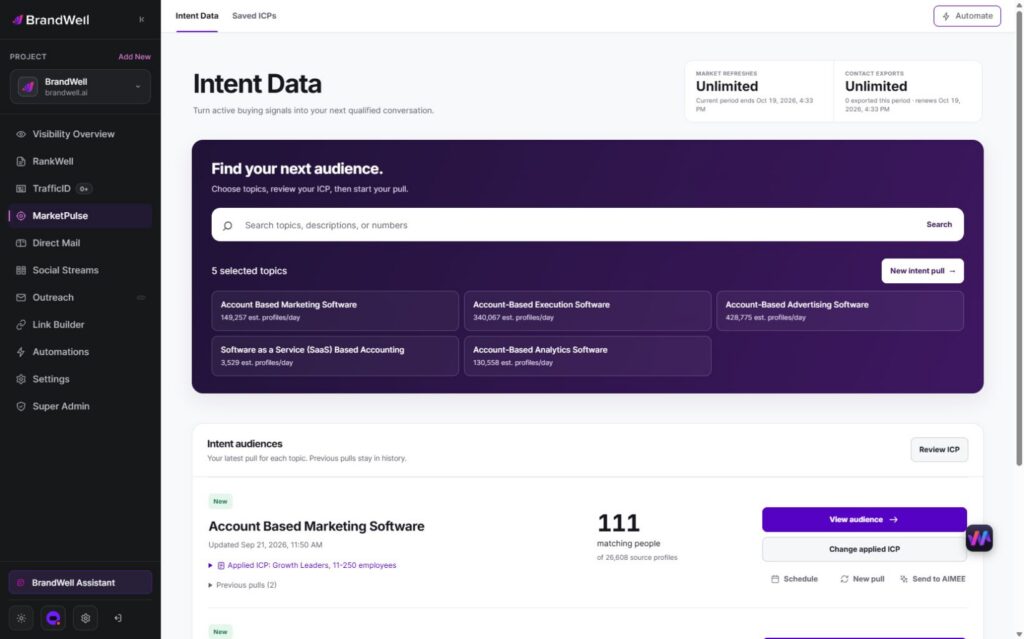
Direct answer: Build an intent-based prospect list by starting with an eligible ideal-customer account universe, adding recent and explainable account signals, resolving relevant contacts separately, validating every outreach field, deduplicating and suppressing records, and scoring fit, evidence and freshness as distinct dimensions. An account showing research does not identify the person who researched or prove a purchase decision.
Who is this for? SDR leaders, account executives, B2B founders, sales operations teams and agencies that need a repeatable path from intent evidence to a reviewed prospect list. It is not for teams seeking permission to mass-message every contact at a signaled company.
Build the list from a fit universe, not an intent flag
The safest sequence is market, account, evidence, role, person, validation, permission, action. Reversing it creates a common failure: a provider reports account-level research, an enrichment tool returns dozens of employees, and automation treats them all as in-market buyers. The result is inflated list size, weak relevance and avoidable compliance and deliverability risk.
Define the fit universe first. Include industry, geography, company size, technology or operating characteristics, buying authority, disqualifiers, customers, open opportunities and excluded accounts. State whether a parent and subsidiary are separate buying units. A good list can include fit-only accounts for comparison; intent is evidence within the universe, not the definition of the market.
Preserve the raw signal. Record source category, observed time, received time, topic or behavior, account candidate, account-match method and confidence, baseline or score context, and permitted use. Do not replace this evidence with one ‘hot’ label. Independent signals may corroborate one another; duplicated delivery records should not multiply the score.
Choose target roles from the buying problem, not from whichever titles are easy to find. A recent topic at a company may justify research into likely problem owners, evaluators and approvers, but every person’s role and employment still needs validation. The list should explain why each contact is relevant without claiming that person generated the intent signal.
Run a ten-step intent-to-prospect workflow
Use this ten-step operational workflow:
- Freeze the account universe. Version the ICP and exclusions before viewing outcomes.
- Ingest raw signals. Preserve source, event and receipt times, topic, account candidate, baseline and usage rights.
- Resolve accounts. Normalize domains and legal entities; keep parent, subsidiary, branch and shared domains separate unless a written rule says otherwise.
- Deduplicate events. Collapse repeated delivery of one observation while retaining independent corroboration and conflicting evidence.
- Apply freshness. Use topic- and source-specific decay windows; never let a past event remain permanently ‘in market.’
- Prioritize accounts. Score fit, evidence strength, source independence, recency, existing relationship and negative signals as visible components.
- Resolve roles and people. Research the buying group separately; record role fit, employment confidence and source provenance.
- Validate and suppress. Verify contact routes close to use, remove duplicates, customers, active opportunities, opt-outs and client-specific exclusions.
- Approve activation. A human reviews the evidence, message, channel, jurisdiction and volume before CRM write, ad use or outreach.
- Return outcomes. Record accepted, rejected, contacted, positive reply, meeting, opportunity, disqualification and correction so the rules can improve.
The minimum data stack may include an intent source, company and contact enrichment, email or phone validation, workflow or spreadsheet, CRM and outreach tools. Fewer integrated tools can reduce handoffs, while best-of-breed sources can improve coverage. Either architecture needs field-level lineage, cost and failure handling. Never let the final sheet erase which provider supplied a field.
Team roles include list owner, data operator, SDR or seller reviewer, RevOps owner, compliance or privacy escalation and client approver. Agent-ready instructions can normalize inputs, propose title mappings, flag duplicates and assemble research briefs. Claude, ChatGPT or an optional separate Moxby browser workflow can assist, but people approve person-level activation and public claims.
Compare five systems that can support the workflow
Disclosure: This is a Brandwell-owned resource. Brandwell is the publisher’s product; all options are evaluated using the same disclosed criteria.
The shortlist is ordered for an agency that needs white-label intent delivery plus list operations. It is not a universal market ranking. Each option uses the same visible criteria, current vendor claims need a scope-matched demonstration, and competitor sites are not linked.
1. BrandWell

Best fit and use case: Best for agencies that want to resell a branded topic-intent service, produce client-ready reports, and translate approved account evidence into prospect-research and activation instructions. BrandWell is particularly relevant when the agency wants to control its client relationship, retail price and delivery narrative rather than hand the client a vendor login.
Inputs and prerequisites: Define each client’s ideal-customer profile, excluded accounts, approved topics, freshness windows, target roles, person and account identity thresholds, validation rules, lawful use, suppressions, CRM stages, routing, and disposition feedback. Keep an account signal separate from the contacts later selected at that account.
Implementation effort: BrandWell describes a complete white-label sales-and-delivery engine, agency-set retail pricing and client billing, a $70 seven-day reseller pilot for branded topic reports, and agent-ready instructions for Claude or ChatGPT. Moxby is a separate optional browser execution path. Confirm current product, export and activation entitlements before promising a workflow.
Privacy and governance: Treat intent and identity as probabilistic; preserve source, time and confidence; minimize person-level fields; isolate clients; honor suppressions and deletion; and require human review before outreach. A website or offsite signal does not prove that a named person researched a topic or consented to every channel.
Verified pricing and total cost: Public pricing is quote-based. BrandWell agency plans range from $2,500 to $5,000 per month, depending on topic count, term, and available contractually scoped topic exclusivity. The current written quote and Order Form control. The lower figure is not a verified public starting price. Add enrichment, contact validation, operations, outreach tools and agency labor.
Measurement: Measure accepted accounts, verified role coverage, invalid and duplicate rates, freshness, seller follow-through, positive replies, held meetings, qualified opportunities and pipeline. Compare against an ICP-only or historical process with stable definitions; do not credit topic evidence for every later outcome.
Proof to request: Request a representative branded topic report, field-level provenance, account and person match explanations, freshness, topic coverage, sample validation, export and activation rights, workflow instructions, pilot acceptance criteria, and written topic-protection terms if offered.
Meaningful limitation: BrandWell cannot make probabilistic intent certain, turn account research into a named buyer, or guarantee response. Product and pricing statements are approval-gated; the agency still needs enrichment, validation, compliance, deliverability, sales capacity and human research.
2. ZoomInfo

Best fit and use case: Best for teams evaluating an integrated sales-intelligence dataset with intent positioning and contact information. It may reduce tool handoffs when the buyer wants company, contact and research signals in one commercial relationship, subject to scope and regional coverage.
Inputs and prerequisites: The buyer needs a written ICP, target roles, territories, account hierarchy, intent topics, freshness and score rules, CRM ownership, suppression lists, validation requirements, outreach policy and seller dispositions. Test actual coverage in the intended market rather than relying on aggregate claims.
Implementation effort: Expect CRM integration or export setup, field mapping, duplicate and hierarchy rules, topic and alert configuration, user training, validation, routing and recurring governance. A representative sample should be tested before a large list is activated.
Privacy and governance: Review source categories, notices, permitted uses, regional restrictions, opt-out and deletion, access, retention and downstream sharing. Keep account intent distinct from person contact data and document the basis for each outreach channel.
Verified pricing and total cost: No current, scope-matched numeric public price was verified in this review. Obtain a written quote for the precise data, intent, seats, credits or usage, integrations, onboarding, support and term; include email validation, operations and seller time.
Measurement: Track representative account coverage, required-role coverage, match and validation rates, duplicates, freshness, accepted leads, reply and meeting quality, opportunities and data cost per qualified outcome. Segment results by region and source category.
Proof to request: Ask for a sample using known accounts and roles, field provenance, update timing, match and confidence behavior, invalid and opt-out handling, CRM deduplication, export limits, contract terms and references from a similar market.
Meaningful limitation: An integrated dataset can encourage teams to treat every available contact as outreach-ready. Coverage and accuracy vary, account-level intent does not identify the researcher, and a broad platform may cost more operationally than a focused service requires.
3. 6sense

Best fit and use case: Best for account-based revenue teams considering modeled buying stages, intent and sales activation within a coordinated platform. It can help prioritize accounts before contact selection when sales and marketing already share lifecycle definitions.
Inputs and prerequisites: Prepare canonical accounts and domains, firmographic fit, topic taxonomy, CRM and marketing automation stages, ownership, target roles, contact-resolution rules, destinations, suppressions, sales capacity and qualified disposition feedback.
Implementation effort: Plan integrations, account and identity mapping, model and topic setup, list and workflow configuration, user enablement, validation and ongoing governance. Test the exact record path from account evidence to contact research and CRM task.
Privacy and governance: Review source and model documentation, permitted uses, regional scope, identity inference, access, retention, deletion, suppression and export. Explain modeled stages and intent as probabilistic evidence rather than observed purchase decisions.
Verified pricing and total cost: No verified, scope-matched numeric public price was established here. Request pricing for required modules, data, seats, credits or usage, implementation, support, integrations and term, then include validation, operations and outreach costs.
Measurement: Evaluate account prioritization separately from contact data accuracy. Track account coverage, accepted priorities, contact verification, seller use, meetings, opportunities and lift through a controlled or defensible comparison where scale allows.
Proof to request: Request official intent-model documentation, field and match explanations, freshness, account-list construction, contact path, CRM feedback, export restrictions, sample accuracy and a proof using the buyer’s own known accounts.
Meaningful limitation: A modeled account stage does not reveal the individual researcher or guarantee a suitable contact. Deployment can require significant process maturity, and a seller may still need manual research before outreach.
4. Bombora

Best fit and use case: Best for teams that specifically want account-level third-party research signals to prioritize markets, accounts or topics. Bombora’s official positioning describes Company Surge intent at the company level; it can complement a separate contact and activation stack.
Inputs and prerequisites: Define ICP accounts, approved topics, baseline and surge interpretation, geographic coverage, freshness, account-domain matching, contact-selection rules, destination rights, CRM stages, suppressions and the outcome used to validate the signal.
Implementation effort: Expect topic selection, account mapping, delivery or partner integration, score and freshness interpretation, list QA, contact enrichment through another source, routing, sales enablement and recurring calibration. Validate coverage on representative accounts.
Privacy and governance: Review collection and aggregation, permitted uses, regional scope, account resolution, retention, sharing and suppression. Do not infer that a specific employee performed the research from an account-level surge.
Verified pricing and total cost: No current scope-matched numeric public price was verified. Obtain a quote for the intended topic, account, delivery, integration and term scope, then add contact enrichment, validation, CRM operations, outreach and analyst time.
Measurement: Compare account-level signal cohorts on accepted priority, verified role coverage, seller follow-through, qualified conversion and opportunity movement. Control for fit and prior engagement so existing demand is not misreported as incremental value.
Proof to request: Ask for topic definitions, source and baseline methodology, score explanation, freshness, account matching, geographic coverage, sample records, destination rights, correction handling and a scoped pilot against known outcomes.
Meaningful limitation: Account-level research is not a person-level prospect list. A second source and operating process are needed to identify, validate and lawfully contact relevant roles, and topic coverage may not fit every niche market.
5. Clay

Best fit and use case: Best for teams that want a flexible workflow layer for list building, enrichment, signals and scoring across selected data sources. It can operationalize the transformation from an approved account set to researched and validated contacts when the team is comfortable designing the workflow.
Inputs and prerequisites: Provide a source account list, canonical domains, target-role rules, selected enrichment providers, field-level provenance, deduplication, validation thresholds, credits or usage controls, suppression lists, CRM schema, approval steps and outcome feedback.
Implementation effort: Expect workflow design, provider selection, column and formula logic, enrichment waterfalls, identity and duplicate rules, validation, API or CRM mapping, test records, cost controls, monitoring and documentation. Flexible workflows need an owner who understands failure modes.
Privacy and governance: Review every underlying source and use, minimize fields, protect credentials, separate clients, restrict exports, apply retention and suppression, and log automated actions. A workflow platform does not transfer responsibility for the data selected by the user.
Verified pricing and total cost: No scope-matched total price was verified for this article. Obtain current platform and usage pricing and model the cost of every enrichment, validation, AI or API step, plus implementation, monitoring and rework. A cheap row can become expensive after multiple failed provider calls.
Measurement: Track cost and success at each step: account accepted, contact found, role fit, email or phone validation, duplicate prevented, CRM acceptance, seller action, positive reply, meeting and opportunity. Compare provider paths on quality, not just fill rate.
Proof to request: Request a representative workflow, row-level source and cost trace, retry and error handling, deduplication, validation, suppression, CRM write controls, permission model and a small live test with known good and bad records.
Meaningful limitation: Flexibility can create brittle or opaque workflows, unexpected usage costs and privacy risk if each source is not governed. Clay is an orchestration choice; it does not make weak intent evidence or inaccurate contact data reliable by itself.
Choose intent-based, ICP-only, or manual list research
Use intent-based lists when the team has a clear account universe, enough fresh signal coverage, capacity for timely follow-up, a lawful and policy-compliant activation path, and a need to prioritize. Use ICP-only lists for broad market coverage, new categories with weak intent taxonomy, control cohorts, and long-cycle awareness. Use manual research for strategic named accounts, unusual roles, executive outreach, regulated markets and evidence too nuanced for automation.
A hybrid often works best. Use fit to define the eligible market, intent to rank account research, automated enrichment to propose roles and contacts, validation to screen contact routes, and human research to approve priority records. Maintain an ICP-only comparison group to see whether the added intent evidence improves accepted-list and qualified-outcome rates.
Do not compare an intent list prepared by analysts with a raw ICP export and conclude that intent caused the improvement. The analyst attention, validation, account size and sales follow-up may differ. Standardize the service level or use a randomized allocation among similarly eligible accounts when the goal is causal evidence.
Budget data, enrichment, validation, operations, and waste
Budget at the field and decision level. Lines include intent topics or usage, company enrichment, person discovery, email and phone validation, workflow or API execution, CRM operations, seller research, compliance review, outreach infrastructure and rework. Add the cost of false positives: wasted seller time, complaints, damaged domains and distorted reporting.
Create a funnel for cost: raw signaled accounts, fit-approved accounts, resolved accounts, accounts with target-role coverage, validated contacts, human-approved prospects, activated prospects, positive responses, held meetings and qualified opportunities. Cost per raw row is not comparable across systems when one includes validation and another does not.
BrandWell agency plans range from $2,500 to $5,000 per month, depending on topic count, term, and available contractually scoped topic exclusivity. The current written quote and Order Form control. It is quote-based and not a verified public starting price. Competitor blanket price claims are omitted; obtain current quotes using the same account, contact, topic, region, integration, service and term assumptions.
Agency pricing can use a recurring platform-and-operations retainer, per accepted account, per validated contact, or a hybrid. Avoid paying only per delivered row because it rewards volume. Define acceptance tests, replacement policy, maximum volume, included research, change requests, client dependencies and the outcome review.
Measure list quality and qualified pipeline contribution
List quality metrics include fit acceptance, account resolution, target-role coverage, verified email and phone rate, duplicate and suppression rate, freshness distribution, provenance completeness, seller acceptance, time to action and correction rate. Report unknowns. A 90% fill rate can be worse than a 60% rate if the extra fields are stale or untraceable.
Commercial metrics include positive reply, qualified conversation, held meeting, opportunity creation, pipeline value and won revenue, each with a declared denominator and lag. Add negative outcomes such as complaint, opt-out, invalid destination, wrong person and disqualification. Track sales follow-through so the data service is not blamed for records that waited three weeks.
Measure contribution with a credible comparison. Randomly allocate similarly ranked accounts to intent-prioritized and standard research when possible. Otherwise compare matched ICP and recency cohorts with stable service levels and state the assumptions. Do not credit every deal from a signaled account to the list; the signal may have identified existing demand rather than caused it.
Identify the sales teams and use cases that fit
Good fits include SDR teams with defined territories and dispositions, founder-led teams that need a small high-context account set, account executives researching priority accounts, agencies offering appointment setting or data operations, and RevOps teams coordinating marketing signals with seller action. High-consideration offers benefit when account context changes the research and message.
Poor fits include organizations without a defined ICP, sellers unable to follow up within the freshness window, companies sending undifferentiated bulk email, markets with weak company-domain resolution, sensitive topics that should not guide outreach, and teams that cannot maintain suppressions or authenticate sending domains. Fix the operating foundation first.
Use cases should determine the list unit. Advertising may require an eligible account audience; seller alerts may need an account and recommended research action; outbound may need one or two validated roles; executive research may need a buying-group map. Do not force every use case into a flat contact spreadsheet.
Combine fit, identity, freshness, activation, and outcomes
Use a transparent scorecard. Fit can include firmographic and operational eligibility. Intent evidence includes source, topic, strength and independence. Identity includes account and person match methods. Freshness uses observed time and decay. Relationship includes customer, opportunity and prior contact. Activation readiness includes validation, permissions and suppressions. Outcome records what happened later.
A recommended priority can be produced from those components, but display the components and rule version. A high-intent, poor-fit account should not outrank a high-fit account automatically. A perfect-fit account with old evidence may remain useful for account planning but not for a time-sensitive sequence. A verified contact at the wrong role should not become qualified through data completeness.
Preserve a sheet-to-outcome chain: raw account evidence, resolved company, role candidates, validated people, human approval, CRM record, seller action, message or audience version, disposition, meeting, opportunity and revenue. This enables corrections, client reporting and cost analysis without pretending the initial signal caused every later step.
Avoid false positives, stale data, privacy, and deliverability risk
False positives arise from broad topics, syndicated content, shared IP addresses, domain errors, parent-subsidiary confusion, consultants researching for clients, bots, duplicate delivery and stale records. Reduce them with source-aware rules, confidence bands, freshness, corroboration, negative evidence and human review. Do not solve uncertainty by simply increasing a hidden score threshold.
Privacy and legal requirements depend on jurisdiction, channel, data role and relationship. The FTC’s CAN-SPAM compliance guide states that the U.S. law applies to commercial email, including B2B. Gmail’s sender guidelines address authentication, spam and unsubscribe practices. The UK’s ICO B2B marketing guidance explains distinctions and obligations in that regime. These sources are starting points, not legal advice for every campaign.
Deliverability risk increases with stale addresses, sudden volume, weak authentication, poor complaint handling, misleading identity, irrelevant messages and failure to honor opt-outs. Validate close to send, warm infrastructure legitimately, monitor complaints and bounces, include an effective unsubscribe, and stop channels that lack a defensible basis. A fresh intent signal does not repair a damaged sender reputation.
Data-quality mistakes include overwriting raw fields, blending account and person intent, treating receipt time as observation time, losing provider provenance, re-enriching suppressed records, and writing to the CRM before deduplication. Use staging, deterministic and probabilistic match labels, reversible transformations and a human approval queue.
Package prospect-list operations as a recurring agency service
An agency can offer monthly topic governance, signal ingestion, account resolution, prioritization, contact research, validation, suppression, CRM delivery, seller briefs, workflow instructions, outcome reconciliation and rule calibration. Separate onboarding, new markets, custom integrations and outbound campaign management so the recurring list retainer does not become unlimited work.
BrandWell’s intended position is a complete white-label engine that helps agencies sell and deliver topic-intent services under their own brand, set retail pricing and manage client billing. Those claims need product review. Agencies can purchase BrandWell’s $70 seven-day reseller pilot. It includes agency-branded topic reports and the complete sales playbook under the current written pilot terms. Other product capabilities and any topic exclusivity remain subject to their separate current written scope.
Agent-ready workflow instructions can make recurring delivery more consistent: prepare account research, validate required fields, assemble seller briefs, or propose CRM actions in Claude or ChatGPT. Moxby can be an optional separate browser-based execution surface. Automations should stop before irreversible outreach, spend, data sharing or public posting unless an authorized person approves.
The monthly client report should show what evidence arrived, what passed fit and quality gates, what was activated, what sellers accepted, what outcomes matured, what corrections were made, and what rules will change. That evidence makes the service renewable without turning probabilistic buyer intent into a promise of meetings or revenue.
Test the reseller model before full enrollment
Agencies enter the BrandWell reseller pilot by paying $70 for seven days of access. The deliverables include agency-branded topic reports and a complete sales playbook for explaining the service and seeking client commitments before selecting a full plan.
The agency uses that evidence to test demand, assess whether expected commitments offset its costs, and decide whether the service merits a profit-center rollout. There is no guarantee of commitments, cost recovery, or profitability. Review the $70 seven-day reseller pilot.