On this page
- Current MarketPulse research workflow
- Define the recurring client decision
- Compare five agency service models
- Map actual scope and renewal ownership
- Compare manual and configured delivery
- Budget full costs and retail contribution
- Measure adoption, costs and renewal
- Check client action capacity
- Preserve the evidence-to-outcome chain
- Review scope and data requirements
- Scope current BrandWell capabilities
- Test client-count scenarios
- Frequently asked recurring-service questions
- Copyable recurring-service decision
Build an agency service around a named recurring client decision, actual research inputs, review, approved handoff and buyer feedback. Model setup, data, labor, support and correction costs before pricing. A subscription feed, report opening or pipeline association does not establish a renewal case, collected cash or incremental profit.
Who is this for? Agency owners, founders, GTM and RevOps consultants, demand-generation leaders, and lead-generation operators evaluating a separately scoped recurring intent-data service. This guide provides a strategy, implementation framework, planning checklist, pricing and cost model, ROI and KPI map, examples, benchmarks, mistakes, alternatives, and templates without pretending signals guarantee demand.
Current MarketPulse offer: intent-data plans start at $500/mo. See the product, demo, and current plans. Updated October 3, 2026.
Current MarketPulse research workflow
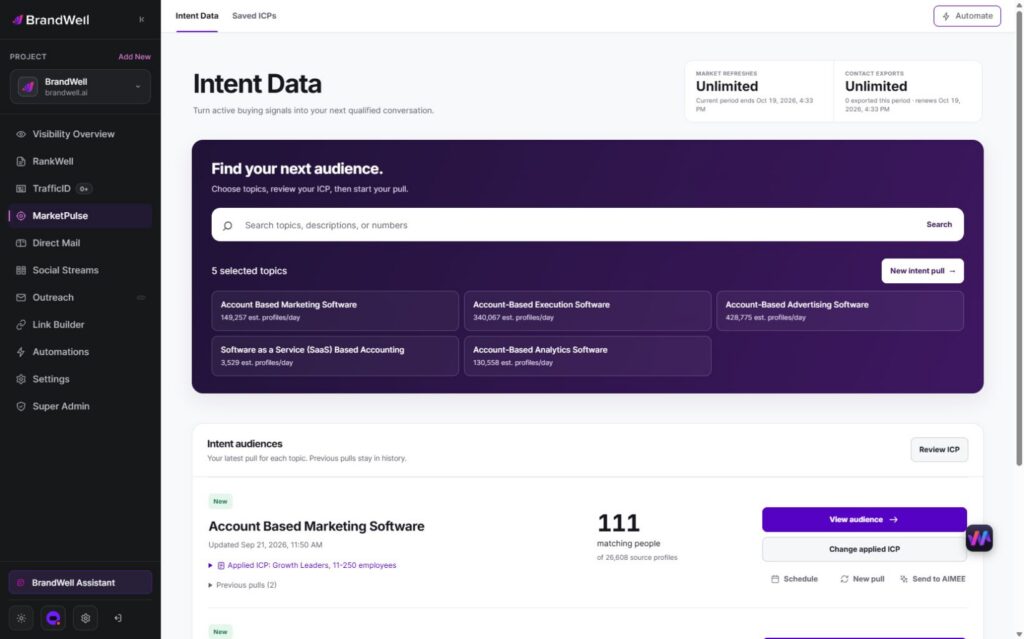
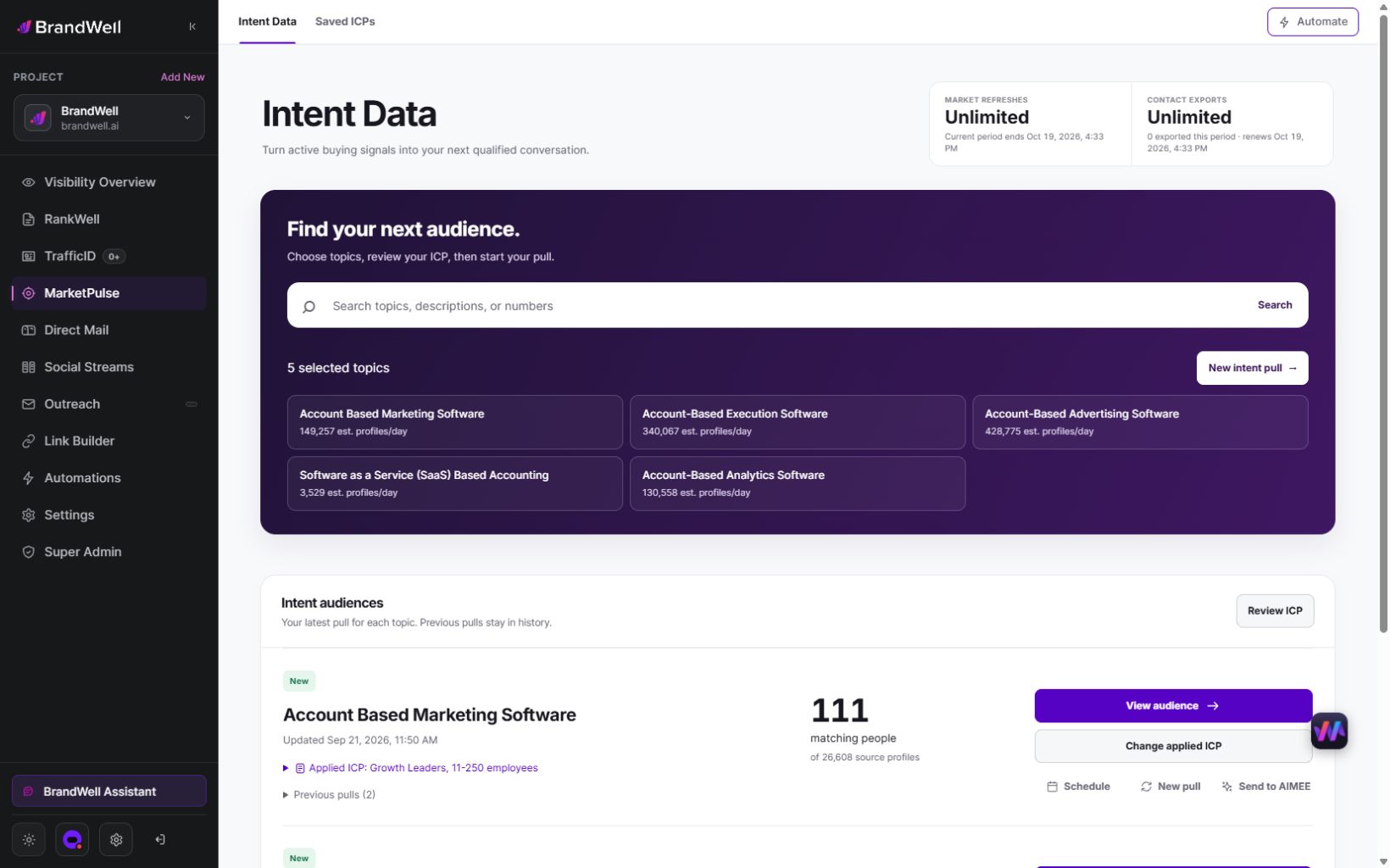
BrandWell MarketPulse: intent data starting at $500/mo. Find people researching topics relevant to what you sell, apply saved ICP filters, and review available contact details before taking action.
| Plan | Topics and refreshes | Monthly exports |
|---|---|---|
| Starter | 1 topic, weekly | 25,000 contacts |
| Growth | 3 topics, daily | 100,000 contacts |
| Scale | 10 topics, daily | Unlimited contacts |
Swipe the table to see all columns.
A pull retrieves available data from the previous 24 hours for one topic. Daily use across all included topics provides 90 Growth pulls or 300 Scale pulls in a 30-day month. Weekly Starter pulls vary by calendar month. Available audience size and contact fields vary, and audiences may overlap. Refreshes stop at the plan limit without overage charges.
- Find and qualify: search the topic catalog, save your ICP, and review the people and companies that match.
- Act on the research: export qualified contacts or prepare an Outreach or Direct Mail workflow. Connected products, channel usage, and fulfillment may cost extra.
- Get help from AIMEE: Growth and Scale include AIMEE for the initial user to research accounts and prepare the next step through connected tools.
Agencies and other service businesses can build client deliverables around their available Intent Scans and exports. Keep each client’s scope, permissions, and service fees clear. A subscription is not a promise of a white-label platform or exclusive access to a market.
Explore MarketPulse and watch the demo or compare plans starting at $500/mo. Any early-access discount is a separate, time-limited offer shown to an eligible recipient.
Define the recurring client decision
Recurring revenue becomes defensible when the client can name the decision it buys each cycle. That may be which topics deserve attention, which accounts merit research, which audiences are eligible for activation, which sellers should review an evidence card, or which module should expand. ‘More intent data’ is not a decision and does not create a renewal reason.
Write a one-page revenue canvas with the client problem, service unit, evidence inputs, output, required action, time to first usable decision, service cadence, excluded work, wholesale unit, retail unit, setup boundary, margin hypothesis, adoption signal, outcome signal, and renewal test. Every proposed feature should connect to one of those boxes.
Keep uncertainty in the commercial design. Topic research, account identification, visitor matching, contact enrichment, and in-market classification are all evidence with different confidence and rights. They can prioritize work; they do not prove who performed an action or who will buy. Review claims against actual scope and evidence before delivery and renewal.
Compare five agency service models
The five service models below form a practical agency intent data revenue stream comparison. Each uses the same criteria so an owner can assess fit, workflow, governance, economics, measurement, and limitation rather than choosing the model with the most features.
1. Branded topic-report subscription
Best fit and exclusions: Best for clients that need a recurring view of relevant research themes and can review accounts or topics on a fixed cadence. Exclude buyers who expect named-person certainty, guaranteed opportunities, or a passive report that no owner will use.
Inputs, workflow, and ownership: The agency defines topics, account universe, evidence window, negative terms, report format, reviewer, and response SLA. Strategy owns interpretation; operations produces and checks the report; the client names the action owner and supplies dispositions.
Data, privacy, and governance risk: Topic evidence is probabilistic and can be noisy or unrelated. Preserve provenance, recency, geography, permitted purpose, access, retention, and plain-language limitations. Do not expose another client’s topics or imply surveillance in client-facing copy.
Cost and commercial effect: Cost comes from topic scope, data access, research, normalization, QA, branding, analyst review, client support, and renewal preparation. A predictable subscription works only when custom research and exceptions are limited or explicitly priced.
Measurement and meaningful limitation: Track report adoption, accepted accounts or themes, review latency, rejected evidence, actions completed, qualified progression, delivery hours, and contribution. The limitation is that a report creates decision support, not pipeline by itself.
2. Signal-and-enrichment service
Best fit and exclusions: Best when a client has a defined ICP and needs accepted account signals converted into usable company or contact context. Exclude clients with no contact policy, no CRM hygiene, or no capacity to review ambiguous matches.
Inputs, workflow, and ownership: Define account normalization, fit, identity states, enrichment fields, contact validation, suppressions, destinations, and exception owners. Data operations prepares records; QA samples matches; RevOps maps fields; the client approves eligible uses and corrects outcomes.
Data, privacy, and governance risk: Identity resolution and enrichment are probabilistic and sourced from multiple contexts. A company match is not proof that a named person researched a topic. Minimize data, separate confidence from fact, document source and rights, and support correction and deletion paths.
Cost and commercial effect: Add resolution, enrichment, validation, destination setup, manual review, suppression, storage, correction, and support to wholesale usage. Price low-confidence investigation and new fields separately rather than absorbing them as unlimited enrichment.
Measurement and meaningful limitation: Measure fit acceptance, confidence distribution, match review, unresolved records, valid-contact yield, seller acceptance, corrections, cost per accepted record, and qualified outcomes. Higher match volume is not useful if error and handling rise.
3. Activated audience service
Best fit and exclusions: Best for clients with advertiser authority, adequate audience volume, a compliant first-party activation path, and enough media budget to learn. Exclude tiny segments, prohibited categories, or licensed data that cannot be used for the destination.
Inputs, workflow, and ownership: The client identifies the ad account and authority; the agency documents source eligibility, audience rule, consent or notice requirements, suppressions, minimum size, budget, creative, approval, test, and rollback. Paid media owns launch; QA reconciles acceptance.
Data, privacy, and governance risk: Offsite intent or licensed identity data is not automatically eligible for direct ad targeting. Apply platform policy, sensitive-category restrictions, lawful basis, consent where required, advertiser responsibilities, retention, and audience minimization before upload or use.
Cost and commercial effect: Costs include data, audience construction, matching loss, connector setup, campaign labor, creative, QA, reporting, and media spend. Service fees and media budget should remain distinct so margin does not depend on hidden pass-through assumptions.
Measurement and meaningful limitation: Track eligible-to-accepted match, audience size, reach, frequency, qualified visits, conversions, opportunities, holdout or incrementality evidence where feasible, delivery cost, and client contribution. Association alone does not prove the audience caused revenue.
4. Managed signal-to-outreach service
Best fit and exclusions: Best when the client has a narrow ICP, verified contacts, a relevant offer, responsible outreach rules, and reps who can use context. Exclude customers seeking indiscriminate volume, fully autonomous messaging, or guaranteed meetings.
Inputs, workflow, and ownership: Map accepted signal types to plays, evidence cards, identity and contact checks, suppressions, channel eligibility, owner, timing, human approval, reply handling, and CRM disposition. The agency can prepare; an authorized person approves consequential outreach.
Data, privacy, and governance risk: False positives, stale evidence, mistaken identity, unapproved channels, and over-specific language can damage trust and deliverability. Do not tell a prospect that the agency knows what an individual researched. Respect opt-outs and jurisdictional rules.
Cost and commercial effect: Add research, enrichment, validation, copy preparation, deliverability, rep review, response handling, CRM work, and QA. Price by governed capacity and service scope rather than raw emails or meetings without quality controls.
Measurement and meaningful limitation: Measure approved plays, speed to review, reply classification, accepted conversations, qualified progression, opt-outs, complaints, corrections, rep time, and contribution. SDR execution and offer fit remain confounders, so intent cannot claim sole credit.
5. Separately implemented multi-service delivery
Best fit and exclusions: Best for agencies that want branded delivery, several modules, their own retail pricing, and a recurring operating system without building every data and workflow primitive. Exclude enterprises that need a full direct ABM suite or agencies unable to govern multiple modules.
Inputs, workflow, and ownership: Create a module catalog, enablement rules, wholesale ledger, client configurations, branded portal and report, approval matrix, support boundary, billing unit, change control, and renewal review. The agency owns positioning, client contract, retail billing, and delivery quality.
Data, privacy, and governance risk: A broader engine expands tenant isolation, access, integration, data-rights, subprocessors, client expectations, and incident surface. Verify enabled components, maintain client-specific authority, and keep human review for outreach or activation rather than treating white label as transferred responsibility.
Cost and commercial effect: Model the platform range, module and usage charges, onboarding, configuration, training, QA, support, exceptions, sales cost, and reserve for correction. Retail price should reflect client value and delivery load, not a fixed markup alone.
Measurement and meaningful limitation: Track module adoption, active use, client-level margin, support, exception hours, actions, qualified outcomes, renewal evidence, and churn reasons. Test whether the implemented workflow improves repeatability when the agency constrains scope and acts on operating data.
Map actual scope and renewal ownership
Operationalize the service as a chain from scope to renewal. Sales hands over a signed decision and assumptions. Strategy defines fit and topics. Operations validates sources and creates records. QA checks confidence, rights, and release rules. Activation or client delivery sends only approved outputs. The account owner collects adoption and outcome evidence. Finance compares retail revenue with wholesale usage and delivery cost.
- Define the client decision, owner, evidence, exclusions, and accepted outcome.
- Configure topics, fit, identity states, destinations, suppressions, access, and billing units.
- Preflight representative positive, negative, ambiguous, and ineligible examples before recurring delivery.
- Run the cadence with reconciled inputs, review states, approved actions, client handoff, and exception logs.
- Use adoption, outcome, cost, and trust evidence to renew, narrow, expand, pause, or stop the module.
An SLA should name the object and state: time from accepted signal to reviewed evidence, from approval to client delivery, or from destination response to reconciliation. Do not promise a pipeline SLA when timing depends on the client’s sales cycle, rep behavior, budget, offer, and market.
Compare manual and configured delivery
Manual delivery is useful while definitions and failure modes are still changing. It supports judgment and high-touch discovery, but analyst hours rise quickly and decisions can disappear into spreadsheets. Manual work should produce a documented rule, template, or reason – not become invisible recurring labor.
Automated delivery fits deterministic checks, routing, report assembly, and scheduled handoffs after the agency has stable rules. Automation can reduce latency but can also amplify a bad source, wrong field map, cross-client leak, or overbroad activation. Keep monitoring, samples, exception queues, approvals, and rollback.
A separately implemented branded client interface needs actual rights, tenant isolation, access, support and delivery ownership. Verify its scope, full cost and behavior. Do not infer a native white-label platform from a MarketPulse subscription.
Budget full costs and retail contribution
Define contribution for the actual period as service revenue less the stated data, assigned delivery, QA, report, support, payment, credit and correction expenses. Keep unused reserves separate from incurred costs. Setup needs a distinct scope and cost ledger. The defined remainder is not net profit when overhead, tax or other costs are excluded.
Build client-count scenarios with conservative adoption. One client may require the same portal setup and training as several; five clients may share automation but add support and exception load; a larger portfolio may need a delivery lead, stronger isolation, monitoring, and finance controls. State each staffing and usage threshold rather than assuming margin automatically improves with volume.
Retail price can be fixed, tiered by modules, scoped by topics and usage, or combined with paid implementation. Choose the unit the client can understand and the agency can reconcile. Do not bundle ad spend, custom research, new integrations, manual investigations, or unlimited contacts into a fee unless cost and limits are explicit.
Measure adoption, costs and renewal
Measure time to first configured feed, first defensible report, first accepted account, and first completed action separately. Adoption includes portal use, report review, seller acceptance, workflow completion, and feedback coverage. Quality includes provenance, freshness, topic relevance, match confidence, valid contacts, destination acceptance, correction, and complaints.
Revenue quality includes qualified conversations or opportunities under the client’s definition, progression, contribution margin, expansion evidence, renewal evidence, and churn reasons. Use cohort comparisons or controlled tests where feasible, but label association honestly. Intent signals rarely deserve sole attribution for pipeline or revenue.
Operational benchmarks should begin with the agency’s own baseline: hours per client, exception rate, approval latency, cost per accepted output, support volume, action completion, and verified outcome coverage. External benchmarks can provide context but should not become guarantees or substitute for a client-specific starting point.
Check client action capacity
Check whether actual clients know their ICP, have someone who can review evidence, can act in CRM or media systems, will share dispositions, and accept a bounded learning period. A mature stack can support richer automation; an earlier client may need a narrower report and guided operating rhythm. Service design should follow capacity, not logo size alone.
Poor-fit buyers want anonymous signals turned into certain named buyers, guarantee-based meetings, unrestricted exports, instant causal ROI, or a fully managed outcome without granting access or feedback. Nurture, narrow the scope, offer a diagnostic, or decline rather than pricing around an impossible promise.
Preserve the evidence-to-outcome chain
Keep a signal-to-revenue evidence chain: source and topic evidence; account fit; identity or contact state; freshness; permitted use; approval; destination result; human action; disposition; qualified outcome; and cost. Missing stages should remain missing rather than filled with assumptions.
A useful client record explains what is known, what is inferred, how recent it is, why it fits, what action is allowed, and who must approve. The report can rank work by evidence without claiming that a matched person researched the topic or that the account has entered an active purchase cycle.
Outcome feedback should update topic definitions, fit rules, thresholds, routes, delivery capacity, and pricing. The revenue stream becomes more valuable when the agency learns which evidence leads to accepted action and which creates noise, not when it simply accumulates more rows.
Review scope and data requirements
Verify actual source, recipient, purpose, jurisdiction, contract responsibilities, necessary fields, permissions, access, retention, correction, deletion, security and suppression. Resolve unanswered requirements before data movement. A managed service does not transfer every responsibility to the vendor.
Verify actual source, recipient, purpose, jurisdiction, contract responsibilities, necessary fields, permissions, access, retention, correction, deletion, security and suppression. Resolve unanswered requirements before data movement. A managed service does not transfer every responsibility to the vendor.
Commercial controls matter too: a scope register, change order, usage ledger, exception pricing, support boundary, output definition, claim language, and a stop decision. A recurring fee should not hide custom consulting or a data use the client did not authorize. Use the NIST Privacy Framework to structure privacy-risk identification and governance.
Scope current BrandWell capabilities
AIMEE can prepare a review brief through configured connected tools. Keep proposed actions separate from actual approvals and destination acknowledgements. Confirm the implementation and permissions before execution.
MarketPulse supplies topic research and available match details; TrafficID is separate own-site visitor work. AIMEE can organize supplied context through configured tools. Custom branded reporting, client portals, agency services and connectors require separately verified implementation, rights, approvals and fees.
BrandWell MarketPulse is topic-based intent-data software for businesses and agencies. Choose relevant research topics, apply saved ideal-customer-profile filters, review available names, roles, companies and contact details, and export the audience or prepare a connected workflow. Plans start at $500/mo. TrafficID identifies visitors to your own website and is a separate product. A MarketPulse subscription does not by itself promise a white-label portal, custom API implementation, exclusive topics, or managed client delivery.
Review an available MarketPulse topic, saved ICP and actual preceding-24-hour matches for the approved research purpose. Keep uncertain company context visible. AIMEE can organize supplied context through configured tools; named owners approve actual exports, messages, audience uploads and CRM writes.
Test client-count scenarios
Validate one narrow module with a client who can act. Freeze the baseline, cap topics and destinations, measure delivery hours and exceptions, observe adoption, collect outcomes, and decide whether the model is repeatable. Expand only when the next module removes an observed constraint and preserves contribution after usage and support.
- Scenario A: one client, manual review, one deliverable, one action owner.
- Scenario B: several clients, shared automation, isolated configuration, scheduled QA and support.
- Scenario C: a portfolio with module tiers, usage monitoring, delivery management, finance controls, and change governance.
- At every stage, define the client count or usage level that triggers new staffing, monitoring, security, or pricing.
Frequently asked recurring-service questions
Should an agency sell intent data as a feed or a managed service?
A feed can fit a mature client with strong RevOps and clear action ownership. Test whether managing interpretation, QA, handoff and feedback changes actual adoption, costs and renewal. The right answer depends on client capability, access, risk, and the margin required to support delivery.
What should the initial package include?
Include a decision, defined topic or signal scope, account universe, evidence fields, cadence, branded output, client owner, review and approval path, one allowed activation or handoff, outcome definitions, limitations, support boundary, and a change process. Leave unrelated integrations and unlimited custom research out.
How quickly should the agency promise results?
Promise only the operational milestone the agency controls, such as configuration, an initial report, or an accepted workflow within the written scope. Pipeline timing depends on signal volume, client action, sales cycle, budget, offer, and market. A pilot should create decision evidence, not a guaranteed revenue claim.
Does the subscription establish exclusive topics?
No. Do not imply topic protection or exclusive access from a research subscription. Any separately proposed commercial term needs actual written availability, scope, rights and approval before inclusion in a client promise.
What is the most important renewal metric?
There is no universal metric. Combine adoption, accepted action, evidence quality, a qualified client outcome, delivery contribution, and trust indicators. Renewal is weak when reports are opened but no decision changes, or when outcomes appear while delivery remains unprofitable and ungoverned.
When is a custom stack better?
A custom stack can be rational when the agency has sustained volume, engineers, data governance, security operations, integration ownership, and a differentiated method worth encoding. Include maintenance, platform changes, incident response, and opportunity cost in the comparison – not only the first build.
Copyable recurring-service decision
Question: [Actual recurring client decision.] Scope: [Clients, deliverables, period and exclusions.] Evidence: [Source, uncertainty, review and buyer feedback.] Ownership: [Approver, delivery, support and renewal.] Economics: [Actual fees, costs, cash and missing inputs.] Outcome: [Adoption, unique actions and unresolved cases.] Decision rule: [Full contribution, capacity and renewal or stop conditions.]
Cash, revenue and operating contribution are distinct
The SEC’s financial-statement guide distinguishes income reporting from cash-flow reporting. Its basic accounting context is not an agency margin benchmark. Keep actual collected cash, recurring scope, revenue period and costs separate; verify accounting treatment with the responsible professional.
A fictional agency collects $12,000 for 12 months of service. That is $12,000 cash received and a simple $1,000 monthly contract-equivalent amount, not $12,000 monthly recurring revenue. Actual revenue recognition, refund obligations, fees and delivery periods depend on the agreement and applicable accounting rules.
Renewal and expansion need a named original cohort
Ten fictional clients start at $1,000 monthly each: $10,000. Two leave; the remaining eight expand by $250 each. Ending recurring value for that original cohort is $10,000, so gross retention is 80% and net retention including expansion is 100%. Client retention is still eight of 10, or 80%. Two new clients are separate acquisition, not renewal of the original cohort.
Sharing research costs does not make support free
A fictional client pays $2,500 against $500 research, $700 delivery, $300 QA and $300 support: $1,800 defined cost, $700 remainder and 28%. A second client does not imply the same margin. Confirm actual rights, allowed use and plan capacity before sharing research expense; count each client’s review, support and exceptions. Another $800 correction makes the first client’s remainder negative $100.
A portfolio needs specialist capacity as well as hours
Five fictional clients need two routine hours and one specialist hour each: 10 routine and five specialist hours. With 12 routine and four specialist hours available, total capacity of 16 exceeds 15 required hours, but the specialist gap is one hour. Roles are not assumed interchangeable; narrow or staff the actual work before adding a client.
Report adoption without inventing buyer results
Suppose 10 clients receive a report, eight acknowledge it, five act and four provide feedback, including two qualified opportunities. Acknowledgement is 80% of delivered clients; action is 50%; feedback coverage is 80% of acting clients. Opportunities are 50% of reported clients or 40% of acting clients, with one unresolved. A report open is not an action, and repeated mentions of the same opportunity cannot be summed.
Keep current research and managed delivery separate
MarketPulse research starts at $500/mo. Review topics, saved ICP filters and available matches against the actual client purpose. TrafficID is separate own-site visitor work. AIMEE can organize supplied context through configured tools; owners approve exports, messages, audience uploads and CRM writes. Custom portals, reports and managed services need separately verified rights and implementation. The invented service costs above are not BrandWell prices or typical results; general overhead, tax and financing are excluded.
Review current research: explore MarketPulse and current plans.
Reviewed and updated October 3, 2026.

Written by