On this page
- Current MarketPulse research workflow
- Choose a documented discovery route
- Review five evidence blocks
- Run the call and record the handoff
- Compare qualification, diagnostic and pilot
- Scope distinct commercial work
- Measure actual deal quality and costs
- Check prospect readiness
- Test one actual evidence-to-outcome example
- Review scope and data requirements
- Scope current BrandWell capabilities
- Create the decision brief
- Frequently asked discovery questions
- Copyable discovery decision brief
Use discovery to verify the prospect’s market, actual decision, evidence, permitted action, owner, capacity and full costs. Preserve client statements separately from checked facts and open assumptions. Route to a scoped proposal, bounded pilot, defined diagnostic, nurture or decline based on the documented gaps rather than treating every call as a closing event.
Who is this for? Agency owners, founders, GTM and RevOps consultants, sales leaders, and demand-generation strategists selling a recurring buyer-intent service. This intent service discovery call framework includes questions, templates, calculators, benchmarks, systems, pricing, costs, ROI and KPIs, checklists, examples, comparisons, alternatives, mistakes, activation workflows, and trust controls.
Current MarketPulse offer: intent-data plans start at $500/mo. See the product, demo, and current plans. Updated October 3, 2026.
Current MarketPulse research workflow
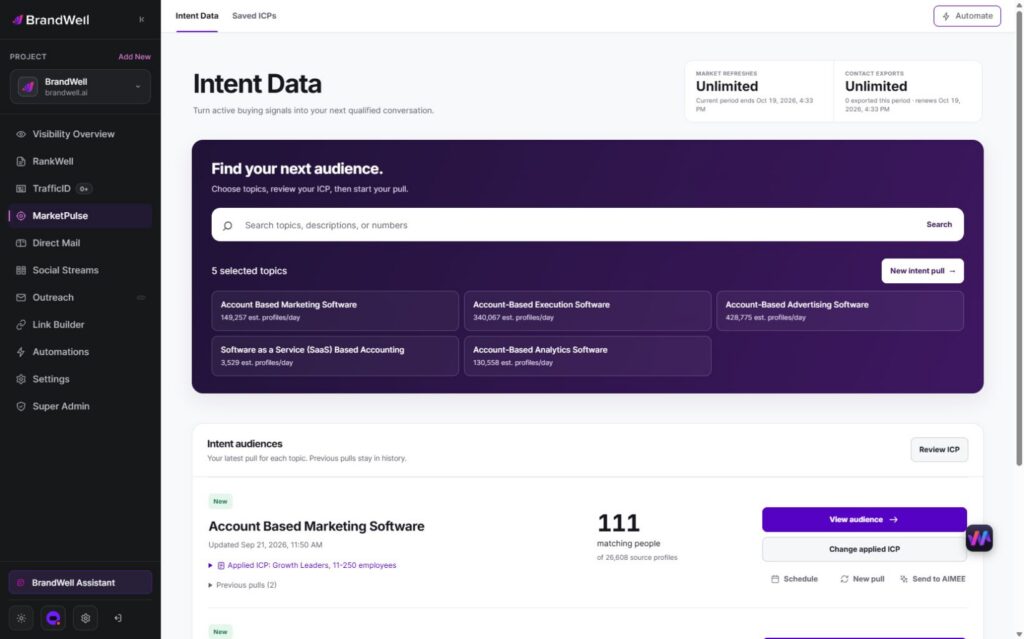
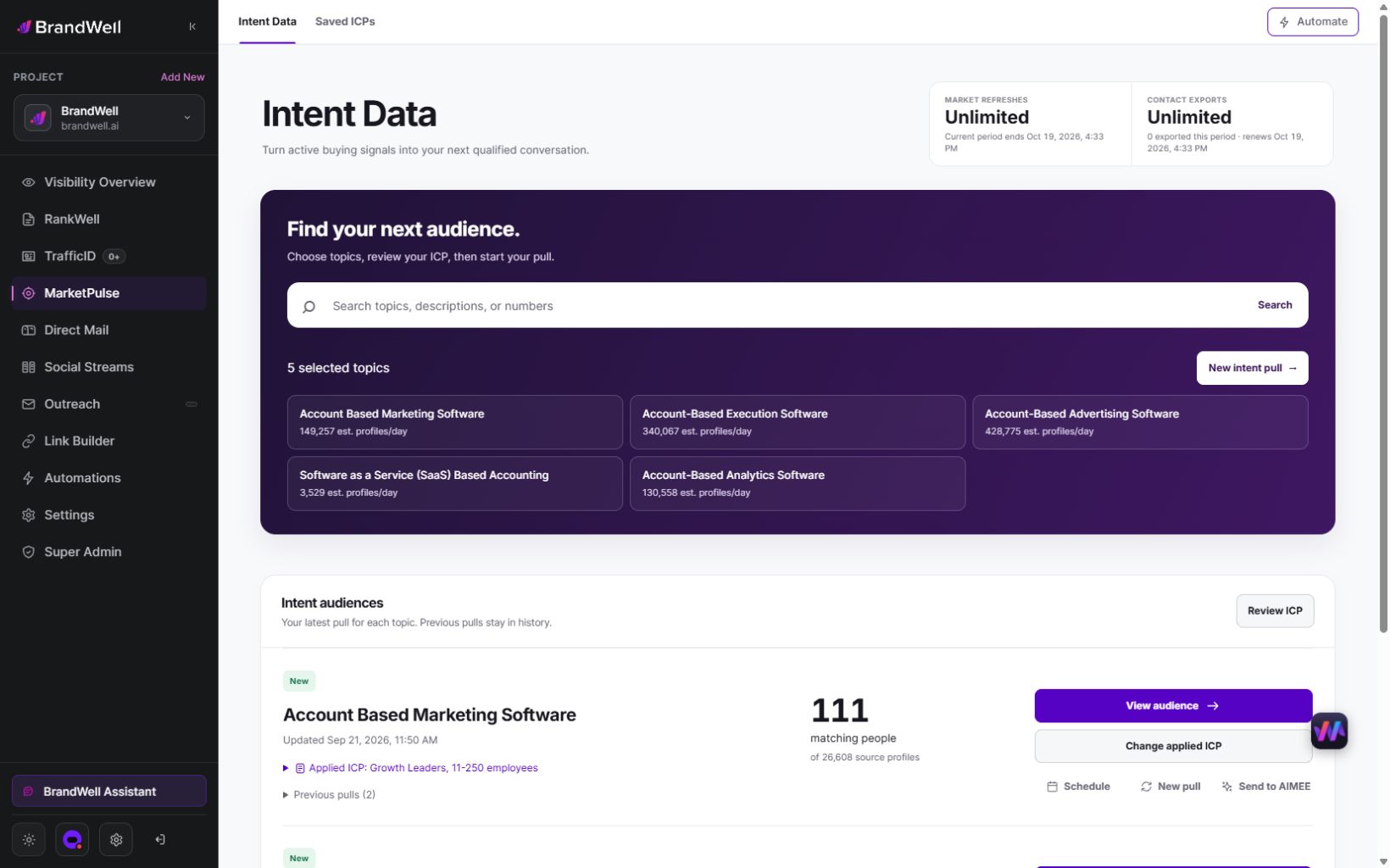
BrandWell MarketPulse: intent data starting at $500/mo. Find people researching topics relevant to what you sell, apply saved ICP filters, and review available contact details before taking action.
| Plan | Topics and refreshes | Monthly exports |
|---|---|---|
| Starter | 1 topic, weekly | 25,000 contacts |
| Growth | 3 topics, daily | 100,000 contacts |
| Scale | 10 topics, daily | Unlimited contacts |
Swipe the table to see all columns.
A pull retrieves available data from the previous 24 hours for one topic. Daily use across all included topics provides 90 Growth pulls or 300 Scale pulls in a 30-day month. Weekly Starter pulls vary by calendar month. Available audience size and contact fields vary, and audiences may overlap. Refreshes stop at the plan limit without overage charges.
- Find and qualify: search the topic catalog, save your ICP, and review the people and companies that match.
- Act on the research: export qualified contacts or prepare an Outreach or Direct Mail workflow. Connected products, channel usage, and fulfillment may cost extra.
- Get help from AIMEE: Growth and Scale include AIMEE for the initial user to research accounts and prepare the next step through connected tools.
Agencies and other service businesses can build client deliverables around their available Intent Scans and exports. Keep each client’s scope, permissions, and service fees clear. A subscription is not a promise of a white-label platform or exclusive access to a market.
Explore MarketPulse and watch the demo or compare plans starting at $500/mo. Any early-access discount is a separate, time-limited offer shown to an eligible recipient.
Choose a documented discovery route
The discovery objective is a routing decision. A qualified buyer might need a written proposal because inputs and authority are ready. Another might need a small pilot to test one uncertain assumption. A complex buyer might need a paid diagnostic. A promising but immature buyer belongs in nurture. A prospect seeking certainty, unrestricted data, or guaranteed meetings may need to be declined.
Open with a hypothesis: ‘You believe account or visitor evidence can help this team choose who to research, advertise to, or contact sooner.’ Then test each noun. Which evidence? Which team? Which action? What does sooner mean? What is the current baseline? Who approves? What outcome is qualified? What would make the service unnecessary?
Check whether discovery reveals actual custom work before pricing, and compare forecast effort with incurred costs. Discuss limitations, data rights, identity uncertainty, platform eligibility and client responsibilities before the proposal. Record readiness gaps and route the prospect accordingly.
Review five evidence blocks
Use these five evidence blocks as the discovery agenda and qualification rubric. They apply the same criteria to the buyer’s situation so the team can see which assumption is ready, which needs work, and which should stop the deal.
1. Outcome and ICP evidence
Best fit and exclusions: Best at the start of every conversation. The goal is to learn which commercial decision the buyer wants to improve, for which market, with what action and baseline. Exclude goals such as ‘more leads’ that lack an owner or accepted outcome.
Inputs, workflow, and ownership: Ask for the ICP, account universe, buying problems, current channels, sales cycle, baseline volumes, qualified outcome, decision owner, and examples of accepted and rejected accounts. The strategist leads; the client revenue owner validates definitions.
Data, privacy, and governance risk: Discovery can encourage the buyer to disclose unnecessary personal or confidential data. Request only representative, authorized examples, use secure transfer where needed, restrict access, and avoid recording sensitive inferences in the call notes.
Cost and commercial effect: Poor qualification creates unpaid solution design and low-margin proposals. Time-box the initial review, price a deeper diagnostic when analysis is required, and state which research or data testing is not included before an agreement.
Measurement and meaningful limitation: Measure whether the call produces a clear decision, viable ICP, action owner, and next route. The limitation is that confident answers in a meeting do not prove operational readiness; request evidence and samples before committing.
2. Signal-source and topic evidence
Best fit and exclusions: Best when the prospect can explain relevant problems, topics, triggers, or research behavior and wants to know whether evidence can be monitored. Exclude broad topics chosen only to maximize volume or topics that reveal little about a business decision.
Inputs, workflow, and ownership: Inventory first-party activity, licensed or offsite sources, topic definitions, freshness, account coverage, negative terms, provenance, geography, and expected volume. Strategy evaluates meaning; data operations checks format and source documentation; the client approves purpose.
Data, privacy, and governance risk: A source description is not proof of accuracy, lawful use, or person-level behavior. Separate company and person evidence, document purpose, rights, notice, retention, correction, and limitations, and never state that a named person researched a topic without evidence.
Cost and commercial effect: Cost drivers include source access, topic research, normalization, sampling, volume, refresh, and analyst review. A prospect asking for hundreds of custom topics or continuous manual interpretation needs explicit setup and recurring scope.
Measurement and meaningful limitation: Measure source completeness, freshness, topic ambiguity, fit acceptance, duplicate and noise rate, and estimated actionable volume. A discovery sample can show feasibility but cannot guarantee future signal volume or pipeline.
3. Identity, contact, and data-use evidence
Best fit and exclusions: Best when the service may resolve accounts, identify website visitors, enrich profiles, validate contacts, or support outreach. Exclude buyers who want certainty, unrestricted exports, sensitive inference, or contact without a permitted and responsible use.
Inputs, workflow, and ownership: Ask what entity must be identified, which confidence states are usable, required fields, validation, suppressions, first-party relationship, destination, authorized users, data retention, corrections, and opt-out handling. Privacy, security, and channel owners join when relevant.
Data, privacy, and governance risk: Identity resolution is probabilistic. A company match may reflect shared devices or networks, and a contact record does not establish individual intent. Minimize collection, preserve confidence and provenance, limit access, and use counsel for applicable privacy and marketing rules.
Cost and commercial effect: Resolution, enrichment, validation, manual investigation, storage, secure transfer, destination setup, and rights handling all affect cost. Price ambiguous-match review and custom fields instead of hiding them in an unlimited record promise.
Measurement and meaningful limitation: Measure match-confidence distribution, unresolved rate, representative sample error, required-field completeness, valid-contact yield, suppression, correction, and approved use. The limitation is that discovery samples may not match the production population.
4. Activation and workflow evidence
Best fit and exclusions: Best when the buyer knows what should happen after an accepted signal: seller review, CRM task, audience qualification, campaign brief, report, or approved outreach. Exclude workflows with no owner, no capacity, no client authority, or no stop mechanism.
Inputs, workflow, and ownership: Map inputs, fit and freshness rules, approval thresholds, destinations, credentials, field maps, response SLAs, suppressions, budget or volume limits, rollback, and disposition codes. RevOps and channel owners confirm feasibility; the client names approvers.
Data, privacy, and governance risk: Each destination has its own data, access, platform, consent, and messaging constraints. Do not assume licensed data can be uploaded or contacted. Use least privilege, representative test records, approval logs, rollback, and a human gate for consequential actions.
Cost and commercial effect: Integration, credentials, mapping, tests, monitoring, destination rejection, client training, exception handling, and maintenance drive setup and monthly cost. One new destination can add more work than many additional topics.
Measurement and meaningful limitation: Measure preflight completion, approval latency, destination acceptance, action capacity, exception rate, rollback readiness, and disposition coverage. A technical connection does not prove the client will act or the workflow will create value.
5. Economics, evidence, and pilot readiness
Best fit and exclusions: Best after the other evidence blocks show a feasible decision and workflow. It determines whether the buyer should receive a proposal, a bounded pilot, a paid diagnostic, nurture, or disqualification. Exclude pilots requested only to obtain free production work.
Inputs, workflow, and ownership: Build a unit-economics calculator with wholesale usage, setup, labor, QA, support, activation, reporting, and exception assumptions. Define baseline, scope cap, outputs, client inputs, success and stop evidence, decision date, and ownership before proposing any pilot.
Data, privacy, and governance risk: A short test can pressure teams to skip privacy, security, platform, or contract review. Preserve required approvals, use the minimum data and destinations, label demonstration-only features, and avoid a causal pipeline promise inside a window too short for the sales process.
Cost and commercial effect: Discovery, setup, pilot, and recurring service are separate cost objects. Credit a diagnostic or pilot toward implementation only when written terms and reusable work support it. Model retail price after delivery and risk rather than using a wholesale markup alone.
Measurement and meaningful limitation: Measure completeness of buyer inputs, forecast-versus-actual delivery hours, exception load, time to first usable output, client adoption, qualified decision evidence, margin, and next-step conversion. A successful pilot supports a decision; it does not guarantee future revenue.
Run the call and record the handoff
Before the call, record the prospect’s stated goal, market, current stack, likely activation, known sources, and unanswered risks. Invite only owners who can validate the decision. Do not turn a discovery call into a product demonstration before the agency understands the buyer’s work and constraints.
- Frame the desired decision, baseline, owner, and commercial consequence.
- Map the ICP, account universe, relevant topics or triggers, sources, freshness, and expected volume.
- Clarify identity confidence, required fields, data rights, suppressions, destinations, and authorized users.
- Test workflow ownership, access, integrations, approvals, capacity, reporting, and outcome definitions.
- Summarize evidence, assumptions, red flags, economics, route, owner, required next input, and stop conditions.
After the call, send a decision brief rather than generic notes. Label facts, client statements, unverified assumptions, agency recommendations, and open questions separately. A handoff to solution design should include scope boundaries and evidence; a nurture path should name what readiness signal would justify another conversation.
Compare qualification, diagnostic and pilot
A short qualification call is simplest and least costly. Use it when the agency needs to confirm basic fit, authority, timing, and next route. It should not include custom data analysis, technical architecture, or detailed solution design. The risk is false confidence when a persuasive buyer has not supplied evidence.
A paid diagnostic fits multi-source data, complex identity or security review, several destinations, unclear economics, or a high-value decision. It can include samples, data maps, workflow design, a risk register, and a cost model. The agency must define the deliverable so diagnostic work does not become an open-ended pre-sales project.
Pilot discovery fits one narrow uncertain assumption that can be tested safely with bounded topics, accounts, outputs, users, usage, and support. It is not a substitute for required legal, privacy, security, platform, or product review. A standard marketing discovery call may still be enough when intent data does not materially change the audience or decision.
Scope distinct commercial work
Keep qualification, diagnostic, setup, pilot and recurring operation as five distinct scope and cost objects. State the actual deliverable, inputs, exclusions, approvals, period and fee for each. A discovery call does not include unlimited solution design.
Count actual data, setup, research, identity checks, integration, analyst, QA, channel operation, support and correction expense. An unused exception reserve is separate from costs already incurred. Model the actual contribution after costs and preserve exclusions.
Do not quote a setup fee or monthly price from the number of questions asked on the call. Price from the service objects and risk. New destinations, geographies, data uses, security evidence, custom reporting, and client-specific exceptions should trigger a written scope and cost review.
Measure actual deal quality and costs
Discovery quality measures include complete decision definition, verified ICP, named owner, evidence supplied, activation feasibility, risk review, and next-route clarity. Commercial measures include qualified-opportunity rate, proposal acceptance, paid diagnostic conversion, sales cycle, forecast-versus-actual setup work, delivery contribution, expansion, and early churn.
Track disqualification and nurture reasons. A high proposal rate can signal strong demand or weak qualification. A high win rate can still be unhealthy if discovery misses integration work and delivery loses margin. A lower close rate may be good when the process stops buyers who demand unsafe or impossible outcomes.
Use internal benchmarks by prospect type, service model, and route. Compare how much evidence was complete, how accurately discovery predicted setup effort, and whether early adoption matched the call. Do not invent industry benchmarks or claim that a discovery script alone produces revenue.
Check prospect readiness
Ready prospects can describe an ICP and business problem, name an action owner, grant appropriate access, explain existing sources and destinations, share outcome definitions, support feedback, accept uncertainty, and fund a bounded test. Maturity is demonstrated by ownership and evidence, not the number of tools in the stack.
Red flags include no action capacity, no data authority, sensitive targeting, ambiguous controller or advertiser roles, refusal to use suppressions, missing security ownership, demand for named-buyer certainty, unrealistic volume, guaranteed pipeline, hidden stakeholders, or a budget that excludes the work required to operate responsibly.
Test one actual evidence-to-outcome example
Ask the buyer to walk through one real example from signal to outcome: the source event, topic, account fit, identity state, contact or audience eligibility, approval, destination, human action, disposition, qualified outcome, and elapsed time. Mark every missing step. Use that example to expose actual missing steps rather than assuming a checked integration list is sufficient.
For signal quality, request representative positive, negative, and ambiguous examples and the topic definitions behind them. For identity, request confidence states and correction examples. For activation, request an approved destination, sample mapping, suppressions, and authority. For reporting, request the qualified outcome and system of record.
The purpose is not to collect production data on a sales call. Use masked or synthetic examples where possible, secure approved files when actual samples are necessary, minimize fields, set deletion expectations, and limit access. Discovery should model the data behavior the agency expects in delivery.
Review scope and data requirements
Verify actual source, recipient, purpose, jurisdiction, necessary fields, permissions, access, retention, correction, deletion, security, suppression and incident ownership. Document unresolved questions for qualified review before action. A prospect or vendor assurance does not settle every requirement.
Verify actual source, recipient, purpose, jurisdiction, necessary fields, permissions, access, retention, correction, deletion, security, suppression and incident ownership. Document unresolved questions for qualified review before action. A prospect or vendor assurance does not settle every requirement.
Verify actual source, recipient, purpose, jurisdiction, necessary fields, permissions, access, retention, correction, deletion, security, suppression and incident ownership. Document unresolved questions for qualified review before action. A prospect or vendor assurance does not settle every requirement.
Scope current BrandWell capabilities
AIMEE can prepare a review brief through configured connected tools. Keep proposed actions separate from actual approvals and destination acknowledgements. Confirm the implementation and permissions before execution.
Use MarketPulse topic research only after clarifying the actual decision and operating scope. TrafficID is separate own-site visitor work. AIMEE can organize supplied context through configured tools. Branded reports, client interfaces, integrations and managed agency delivery need separately verified implementation, rights and fees; an intended reseller model does not establish available capabilities.
BrandWell MarketPulse is topic-based intent-data software for businesses and agencies. Choose relevant research topics, apply saved ideal-customer-profile filters, review available names, roles, companies and contact details, and export the audience or prepare a connected workflow. Plans start at $500/mo. TrafficID identifies visitors to your own website and is a separate product. A MarketPulse subscription does not by itself promise a white-label portal, custom API implementation, exclusive topics, or managed client delivery.
Review an available MarketPulse topic, saved ICP and actual preceding-24-hour matches for the approved research purpose. Keep uncertain company context visible. AIMEE can organize supplied context through configured tools; named owners approve actual exports, messages, audience uploads and CRM writes.
Create the decision brief
The brief should end with one route and the evidence that supports it. For a proposal, attach a scope outline and assumptions. For a pilot, define the one uncertain assumption and decision rule. For a diagnostic, define the artifact and fee. For nurture, name the readiness event. For disqualification, record the reason so sales does not reopen the same risk without new evidence.
- Decision and baseline
- ICP, topics, signals, sources, and evidence window
- Identity, data rights, suppressions, access, and destinations
- Workflow, owners, SLAs, approvals, and capacity
- Setup, recurring scope, usage, support, and commercial assumptions
- Success, stop, correction, and next-step evidence
Frequently asked discovery questions
Should the agency charge for discovery?
A short qualification call can remain part of sales. Charge for a defined diagnostic when the buyer needs analysis, samples, architecture, risk review, or a reusable operating design. State the deliverable, inputs, boundaries, and whether any fee may be credited to implementation.
What should block a pilot?
Unknown authority, unclear source rights, sensitive inference, missing suppressions, no owner, no secure access path, no rollback, no qualified outcome, impossible timing, or a promise that requires certainty should block the pilot until corrected. A pilot is not permission to bypass controls.
How many questions should the call include?
Use enough questions to resolve the five evidence blocks, then follow material gaps. A rigid script can waste time on irrelevant details and miss a critical risk. The decision brief, not the question count, is the output.
What is a good pilot outcome?
A good outcome is a decision supported by evidence: the source and workflow are usable, need correction, require narrower scope, or should stop. Operational milestones, adoption, quality, cost, and client action are usually more credible inside a short test than promised pipeline.
When should a prospect be nurtured instead of disqualified?
Nurture when the underlying market and use case fit but a solvable readiness item is missing, such as a clean account universe, action owner, conversion definition, access, or budget. Disqualify when the requested promise or data use is incompatible with a responsible service.
Who should attend?
Bring the agency strategist or commercial owner and the client owner of the decision. Add RevOps, paid media, sales, privacy, security, procurement, or IT only when their authority is necessary. Too many observers without decision rights can make discovery broad but inconclusive.
Copyable discovery decision brief
Question: [Actual buyer decision.] Scope: [Market, account unit, period and exclusions.] Evidence: [Checked facts, client statements and open assumptions.] Capacity: [Actual review and action owners.] Requirements: [Source, channel, access and destination checks.] Economics: [Full costs and missing inputs.] Route: [Proposal, pilot, diagnostic, nurture or decline with next evidence and stop criteria.]
Ask for a real example rather than hypothetical agreement
GOV.UK’s interview guidance recommends neutral questions and real examples. Its user-research context is not a sales-conversion benchmark. Ask the prospect to describe the last actual accepted account, approval, destination response and buyer outcome; preserve missing steps instead of treating enthusiasm as proof.
A readiness score must not override a blocking gap
A fictional prospect answers nine of 10 checklist items but has no approved destination owner. A 90% completion score does not establish activation readiness. Record the missing owner, required approval and next input. A pilot may test topic relevance; it cannot substitute for the authority needed to run it.
Route and denominators must reconcile
From 20 fictional calls, five receive proposals, four pilots, three diagnostics, six nurture and two decline: 20 distinct primary routes. Two of five proposals become contracts, or 40% of proposals and 10% of all calls. If a diagnostic later advances to proposal, keep the transition and original cohort rather than counting a new prospect. Unknown late outcomes remain visible.
Requested review volume is not action capacity
A fictional prospect requests 100 weekly reviews at 12 minutes each: 20 hours. With 12 available hours, the eight-hour gap needs narrower scope, staffing or a different process. That does not establish capacity for 60 completed seller actions, because review, approval and action require different work.
Check forecast costs and scope credits
A fictional pilot fee is $2,500 against $500 research, $400 setup, $600 review and $300 support: $1,800 costs and $700 remainder, or 28% of the fee. An extra $800 integration makes the remainder negative $100. Tax, general overhead and financing are excluded; invented labor is not BrandWell pricing or typical margin. If a $300 diagnostic is credited against a later $2,000 setup fee, record $300 already collected and $1,700 remaining, not $2,300 total revenue. Verify actual contract terms and reusable work.
Connect the current product to the actual decision
MarketPulse research is starting at $500/mo. Review a topic, saved ICP and available matches for the documented purpose. Keep TrafficID own-site visitor evidence separate. AIMEE can organize supplied context through configured tools; owners approve exports, messages, audience uploads and CRM writes. Custom reports and agency delivery need separately verified implementation and rights.
Review current research: explore MarketPulse and current plans.
Reviewed and updated October 3, 2026.

Written by