On this page
- Eight criteria for an outbound intent-data platform
- MarketPulse for topic-focused outbound research
- Platform, point tool, broker, or in-house model
- Workflow, data, integrations, and team required
- Connect signals to fit, identity, freshness, action, and outcome
- Pricing and total operating cost
- Which teams and use cases fit
- Measure outbound platform ROI
- Data-quality, privacy, and governance risks
- Package the platform inside a recurring agency service
- Common questions
- A fictional acceptance and cost example
- Choose the scope the team can operate
The best intent-data platform for an outbound team is the one that supplies relevant, usable evidence for the team’s actual market and supports a controlled handoff. Test topic fit, freshness, identity source, contact fields, permitted use, ownership and outcomes before choosing. There is no universal winner for every sales motion.
This is a BrandWell-owned guide. It explains the current MarketPulse workflow and a selection framework, rather than presenting an unsupported independent vendor ranking. Use the same requirements when evaluating any proposed solution.
Eight criteria for an outbound intent-data platform
- Signal: Identify the topic, observation unit, source and what the evidence supports.
- Coverage: Test relevant accounts and people in the actual ICP, geography and roles.
- Identity: Distinguish direct identifiers, resolved matches, company evidence and added stakeholders.
- Activation: Test the destination, owner, required fields and feedback path.
- Controls: Demonstrate suppression, deduplication, approval and stopping rules.
- Rights and security: Confirm intended use, access, retention and client boundaries.
- Adoption: Give reps a useful explanation and a way to reject incorrect or stale evidence.
- Cost: Include software, validation, integration, research, support and exit work.
Define one segment, one play and an accepted outcome before the test. Freeze the criteria and preserve rejected or unresolved records. Changing the denominator to make a demonstration look better undermines the decision.
MarketPulse for topic-focused outbound research
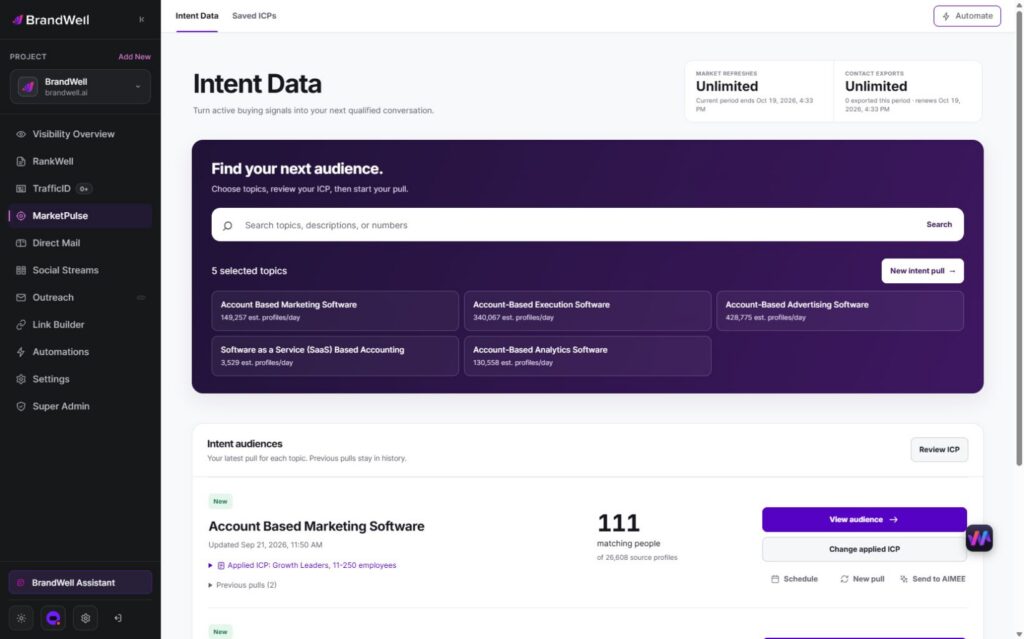
MarketPulse helps you find people researching topics relevant to what you sell. Search the catalog, apply a saved ICP and review available people, companies and contact details. A topic match supports further research; it does not prove buying authority, urgency or permission to contact the person.
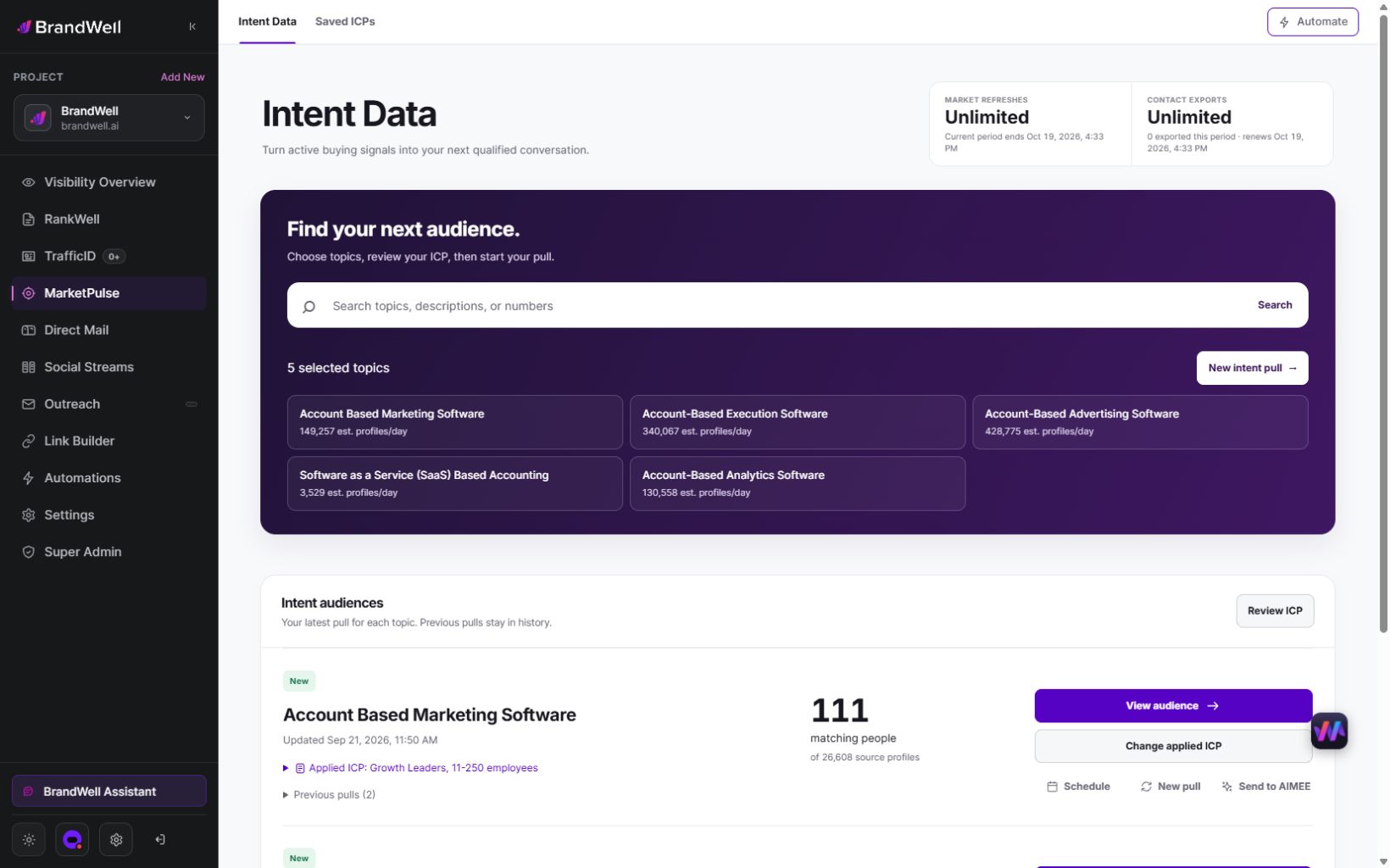
Standard monthly plans start for one weekly topic and 25,000 exports. Growth includes three daily topics and 100,000 exports; Scale includes ten daily topics and unlimited exports. Daily use across included topics gives 90 or 300 pulls in a 30-day month. Each pull retrieves available data for the previous 24 hours; audience size, fields and overlap vary. Weekly Starter pulls vary with the calendar.
Review current plan scope and any separately eligible early-access offer. Additional products and fulfillment may cost extra. Growth and Scale include AIMEE for the initial user. A subscription does not establish a white-label portal, exclusive topics or a custom native API.
For your own authorized website activity, use TrafficID as a separate product and signal source. Keep website visits and topic research distinct in the seller’s evidence card.
Platform, point tool, broker, or in-house model
Choose a workflow-led or agency platform when an operator must configure signals, clients, branded delivery, routing, and recurring service. Choose an enterprise ABM suite when marketing and sales need common account stages, advertising, orchestration, and change management. Choose a point intent source when the team already owns identity and activation. Choose a sales-intelligence platform when company/contact discovery is the primary bottleneck. Build in-house only when proprietary signals, governance, engineering capacity, and strategic control justify the maintenance.
A data broker or enrichment API may be lower-level and more flexible, but the buyer assumes topic modeling, identity rules, permissions, workflow, UI, QA, support, and measurement. A manual account-research program is a sound benchmark for a small market. If trained researchers outperform the platform on qualified actions at lower total cost, more software is not the answer.
Workflow, data, integrations, and team required
- Freeze the ICP, exclusions, account universe, buying roles, topics, signal window, permitted plays, and qualified outcome.
- Test a representative sample for account coverage, topic relevance, freshness, identity, required fields, validation, and corrections.
- Map source, confidence, rights, suppression, ownership, CRM fields, seller queue, SLAs, approvals, and feedback before enabling automation.
- Pilot one segment and one play with a holdout or phased baseline; reconcile every source row through activation and opportunity disposition.
- Train reps on what the signal proves, what it does not prove, how to research, how to personalize without surveillance language, and when to stop.
- Review quality, cost, adoption, qualified outcomes, privacy/security, and contract assumptions before expansion or renewal.
RevOps owns schemas, routing, CRM reconciliation, and deduplication. Demand generation or sales strategy owns the topic and play. Data operations owns source and quality. Sales managers own capacity and adoption. Reps own research and disposition. Privacy, security, and counsel review the actual workflow. Procurement normalizes price, usage, term, and exit rights.
Connect signals to fit, identity, freshness, action, and outcome
Keep fit, intent, identity, freshness, activation, and outcome as independent fields. A fresh signal at a low-fit account should not reach a rep. A high-fit account with unknown person identity may justify account research or advertising, not an automated email. A validated contact is a delivery input, not proof of consent or topic interest. Outcomes should update the model without rewriting history.
Store an evidence card with account, source, topic, time, score semantics, confidence, entity resolution, likely role, validation, permitted use, suppressions, owner, play, approval, action, disposition, opportunity, cost, and limitation. Reps should see enough context to exercise judgment, while access to personal data remains limited.
Pricing and total operating cost
Total cost is platform/license + topics and account universe + seats and credits + enrichment and validation + exports/API + implementation and integration + admin and QA + rep research time + enablement + privacy/security/legal review + adjacent tools + media + overages + change and exit work. Normalize every quote to the same client count, markets, users, volume, destinations, support, and term.
Normalize quotes to the same markets, users, volumes, destinations, support and term. Ask for written usage, renewal and exit conditions. Compare cost per usable account and accepted outcome rather than rewarding raw record volume.
Which teams and use cases fit
The strongest fit is an outbound team with a stable ICP, a meaningful account universe, enough deal value to justify research, timely follow-up capacity, measurable opportunity stages, and a real prioritization problem. Enterprise ABM platforms fit multi-stakeholder accounts and coordinated marketing/sales programs; focused sources fit mature stacks; agency engines fit repeatable client delivery.
Poor fits include an unsettled offer, tiny or inaccessible market, weak contact rights, no CRM discipline, no action owner, generic messaging, topics dominated by nonbuyers, and leadership expecting certainty. Start with manual research, first-party demand capture, or a smaller data test until the system can absorb more signals.
Measure outbound platform ROI
Measure eligible accounts, usable signals, accepted identities, valid contacts, permitted plays, rep acceptance, time to action, responses, meetings, accepted opportunities, stage progression, wins, gross profit, corrections, suppression, and cost. Show denominators and compare by topic, segment, source, freshness, rep, and play.
For ROI, use incremental gross profit where a credible holdout or phased comparison supports it. Platform-attributed pipeline and influenced pipeline are diagnostic, not automatically causal. Deduplicate the same account across ads, outbound, feeds, and opportunities. A short pilot can validate coverage, integration, adoption, and early outcomes; it may not prove long-cycle revenue.
Data-quality, privacy, and governance risks
The ICO’s brokered-marketing-data guidance emphasizes the buyer’s due diligence. It is UK-specific and currently under review following legislative changes. Use appropriate advice for the actual jurisdiction and channel.
Review notices, lawful basis or consent where applicable, direct-marketing and telemarketing rules, data rights, platform terms, contracts, access, retention, deletion, security, subprocessors, cross-border transfers, tenant isolation, AI-agent access, and incident responsibilities for the actual jurisdictions and roles. This is operational education, not legal advice.
Package the platform inside a recurring agency service
An agency service should sell the decision and workflow, not a feed. Package ICP/topic governance, source operations, identity and validation, seller queues, reviewed playbooks, CRM integration, QA, weekly exceptions, monthly outcomes, and quarterly coverage/TCO review. State which platform costs, usage, media, custom integrations, and seller operations are outside the base fee.
Evaluate MarketPulse with a relevant topic and a defined ICP. Review available audience fields and the proposed next action. AIMEE can help prepare account research through connected tools; product scope, permissions and approval rules determine execution. Measure usefulness and effort before expanding.
Common questions
Should intent go directly into an outbound sequence?
Not by default. First require fit, identity confidence, validation, permitted use, suppression, owner, capacity, and human review. Many signals are better used for research, account prioritization, ads, nurture, or no action.
Which platform has the best data?
There is no defensible universal answer. Run the same real-ICP sample through finalists and evaluate relevant, fresh, usable, permitted, activated coverage by segment. The strongest provider for one geography or role can be weak for another.
Can a platform replace RevOps?
No. Platforms can supply signals, data, routing, and automation; someone must define fields, ownership, quality, permissions, outcomes, experiments, costs, and changes. Unowned automation scales ambiguity.
How often should the shortlist be reviewed?
Review when the ICP, geography, product, source, destination, workflow, pricing, contract, policy, or quality materially changes, and before renewal. Current written evidence should control every purchase.
A fictional acceptance and cost example
Suppose a test starts with 200 records, 120 meet the audience criteria and 60 are accepted by reps for research. Audience acceptance is 60% of the input. Rep acceptance is 50% of the qualifying set, or 30% of all input records. None is a meeting or purchase rate.
If software costs $500 and review and routing cost another $500, listed operating cost is $1,000. That is $16.67 per rep-accepted research record. Counting only the software would give $8.33 and omit half the listed cost. These fictional calculations are not a benchmark, customer result or customer-acquisition cost.
When outcomes arrive, preserve the original evidence and timing. Report the attribution rule and comparison design. A record associated with an opportunity is not automatically the cause of it.
Choose the scope the team can operate
Explore MarketPulse and its current plans starting at $500/mo. Review the topic catalog and available audience against your requirements, then select coverage that your team can research and act on responsibly.
Reviewed and updated October 3, 2026.

Written by