On this page
- Current TrafficID visitor workflow
- Treat a visit as research evidence
- Use five prospect qualification gates
- Define the workflow and actual data units
- Compare alternative research methods
- Budget full visitor-review costs
- Measure actual evidence and pipeline
- Check actual operating prerequisites
- Review data and action requirements
- Scope a separate agency service
- Frequently asked visitor questions
- Copyable visitor-research review
Website visitor prospecting reviews actual own-site events, available identity and company context, fit, freshness and permitted next steps. Keep sessions, visitors, accounts, stakeholder contacts and buyer outcomes distinct. An observed visit can support research; it does not establish a purchase, every visitor identity or permission to message.
Who is this for? B2B sales, marketing, RevOps, lead-generation teams, and agencies that receive more website activity than their sellers can investigate manually and want to turn the strongest evidence into responsible prospect research, advertising, or outreach.
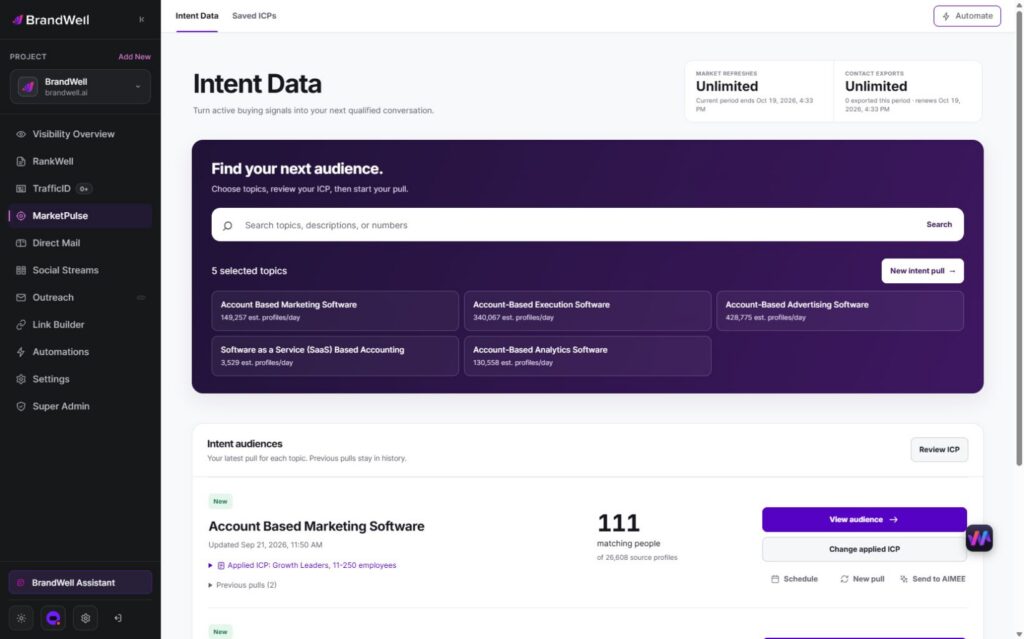
Current MarketPulse offer: intent-data plans start at $500/mo. See the product, demo, and current plans. Updated October 3, 2026.
Current TrafficID visitor workflow
TrafficID addresses identifiable visitors to your own authorized site. Its views keep observed visitors, submitted form identities and added company stakeholders distinct. It does not identify every visitor or make an added stakeholder the person who visited.
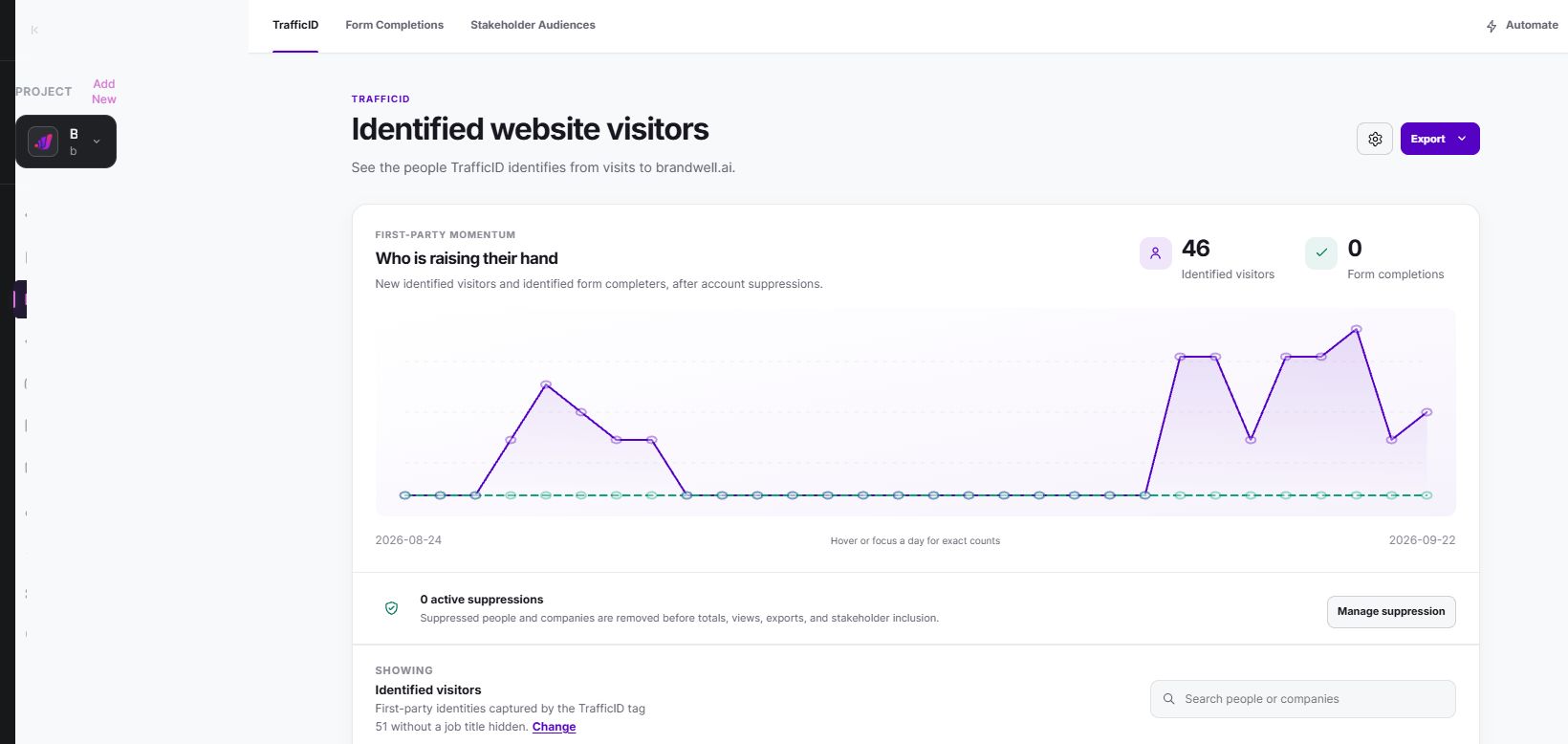
Review current TrafficID plans, eligible identified-visitor volume and the selected fixed or dynamic billing mode before budgeting. TrafficID and MarketPulse have separate product scope. Verify current allowances and included tools on the product page.
MarketPulse is separate external topic research starting at $500/mo. Topic audiences do not establish a visit to the client’s site. Agency setup, analysis, reporting, custom portals and integrations need separate scope and fees.
Treat a visit as research evidence
Website visitor prospecting works when it narrows a research queue. It fails when a team treats every recognized company or possible person as a buyer. A website event can tell you that a device loaded a page at a particular time. Depending on the method and permissions, a provider may infer a company, resolve a likely profile, or match an authenticated first-party record. Those states are not interchangeable.
Write the evidence chain before designing a sequence: event, page context, source, time, account match, identity method, confidence, fit, contact validation, suppression status, permitted use, recommended action, reviewer, and outcome. Preserve the rejected records too. A reliable website visitor prospecting framework makes it possible to explain why a record advanced, why another stopped, and what the team learned after follow-up.
Define the eligible prospect universe and actual review capacity. If 600 candidate accounts arrive but only 40 can be investigated, name the selection rule and unresolved queue. Capacity for 40 does not establish that the selected accounts are the best 40 or that any unreviewed account is sales-ready.
Use five prospect qualification gates
Apply the same six questions at every gate: what decision is being made, what evidence is required, who owns it, what can go wrong, how it is measured, and what the method cannot establish. This creates a useful website visitor prospecting checklist without pretending that one universal score works for every company.
1. Confirm page and session relevance
Decision: Decide whether the observed activity merits account research. Pricing, comparison, integration, security, implementation, and high-value resource pages may support a stronger hypothesis than a brief home-page load, career visit, support lookup, or accidental referral.
Required evidence: Keep the page or content category, event time, session depth, repeat behavior, referral context, bot and employee filters, geography, and consent or notice state where applicable. Use a defined evidence window rather than a permanent “interested” flag.
Owner and effort: Marketing operations owns event definitions and exclusions; demand generation or product marketing owns page-stage hypotheses. Review unusual spikes and crawler patterns before changing thresholds.
Risk and governance: URL paths can expose context that was never intended for person-level inference. Avoid sensitive topics, minimize retained data, and separate ordinary analytics from uses that create a new marketing or identity purpose.
Measurement: Track eligible-session rate, bot or internal-traffic rejection, repeat-visit rate, research acceptance, and downstream qualified outcomes by page category.
Meaningful limitation: Page behavior shows observable activity, not motivation. A competitor, student, vendor, customer, applicant, or researcher may visit the same high-value page as a buyer.
2. Resolve the account with an explicit confidence state
Decision: Decide whether the activity can be associated with a target organization strongly enough to prioritize the account. Label the result as observed, deterministic, modeled, ambiguous, or unmatched rather than collapsing it into a yes/no field.
Required evidence: Record the resolution method, domain or network evidence, provider, timestamp, confidence, conflicting candidates, known remote-work or shared-network limitations, and the account’s place in the approved ICP.
Owner and effort: Data operations maintains account normalization and parent-child rules. RevOps decides how CRM accounts, domains, subsidiaries, franchises, and agencies are represented.
Risk and governance: IP-to-company and identity-resolution methods can be probabilistic. Shared networks, VPNs, home offices, mobile connections, and service providers can create false matches. Do not convert account evidence into a named-person claim.
Measurement: Sample precision, unmatched rate, multi-candidate rate, ICP-fit rate, seller acceptance, and reversals after manual research. Measure by segment because accuracy may vary by geography, company size, or traffic source.
Meaningful limitation: Even a correct company match does not reveal who visited, whether the visit related to a purchase, or whether the account has an active project.
3. Add fit, recency, and independent intent context
Decision: Decide how urgently the account deserves research relative to all other accounts. Combine first-party behavior with firmographic fit, current relationship, recent off-site topic evidence where contractually permitted, and sales capacity.
Required evidence: Maintain an ICP score with explainable components, last meaningful activity, approved topic dictionary, signal source and lineage, evidence window, customer or open-opportunity state, exclusions, and any conflicting negative evidence.
Owner and effort: GTM strategy owns fit and topic definitions; data operations validates freshness; account owners contribute known context. Revisit the model when acceptance or conversion changes materially.
Risk and governance: Topic intent is commonly account-level and modeled. It should prioritize investigation, not support a statement that a named person researched a topic. Stacking several weak signals does not automatically create certainty.
Measurement: Compare accepted research, qualified conversations, opportunity creation, and stage progression across evidence tiers. Monitor false-positive samples and stale-signal release.
Meaningful limitation: High fit plus recent signals still cannot establish timing, authority, budget, or need. It only improves the order in which scarce attention is allocated.
4. Select and validate a relevant contact
Decision: Decide whether there is a person whom the team can reach for a relevant, permitted reason. Choose a role in the buying committee based on the business problem, not simply the most senior profile available.
Required evidence: Keep role rationale, current employment, business-email or phone validation status, source and permitted use, recency, geography, suppression and opt-out checks, existing relationship, account ownership, and channel eligibility.
Owner and effort: Research or SDR operations proposes contacts; data operations handles validation; RevOps enforces routing and deduplication; privacy or legal reviewers define restricted uses. A human resolves ambiguous employment or role matches.
Risk and governance: A probable profile is not proof that the person generated the visit. Avoid creepy language, sensitive inference, and claims that the company “saw” an individual browsing. Use observable business context and an honest reason for relevance.
Measurement: Valid-contact rate, role-fit acceptance, duplicate and suppression rate, bounce or invalid rate, research minutes, and qualified response – not raw contacts appended.
Meaningful limitation: Contact data can be current and still identify the wrong stakeholder. Buying committees change, job titles vary, and the right first conversation may be with a practitioner rather than an executive.
5. Approve the action and close the feedback loop
Decision: Choose research only, seller alert, account-ad audience, personalized outreach, nurture, customer-success routing, or no action. Consequence should determine the approval level: spending money or contacting a person needs more evidence than adding an account to a research queue.
Required evidence: Store the evidence card, approved channel, message premise, account owner, SLA hypothesis, budget or volume limit, destination acceptance, suppression result, reviewer, rollback path, and outcome taxonomy.
Owner and effort: The account owner approves contact; campaign owners approve audience activation; RevOps reconciles CRM outcomes; a service owner reviews exceptions. Automation may prepare a recommendation but should not silently authorize a high-consequence action.
Risk and governance: Platform upload rules, advertiser authority, direct-marketing requirements, retention, deletion, and client contracts may all affect activation. A supplier’s data rights do not automatically transfer every possible use to the buyer.
Measurement: Time from signal to review, action acceptance, follow-up completion, qualified reply, meeting acceptance, opportunity progression, audience match, cost per accepted action, and suppression effectiveness.
Meaningful limitation: Fast follow-up is not inherently better. A poorly supported immediate message can damage trust faster than a careful team can create it.
Define the workflow and actual data units
A disciplined implementation guide moves through intake, normalization, scoring, research, approval, activation, reconciliation, and learning. Start with one use case and one destination. Define the event contract, account-resolution states, fit rules, evidence windows, contact-choice logic, suppressions, outcome fields, and owner before enabling alerts.
The minimum data model has separate objects for the visit, session, account candidate, identity candidate, validated contact, activation decision, action, and outcome. Each object needs a timestamp and provenance. Never overwrite the raw evidence with a final score. Teams need to reconstruct what was known when a decision was made.
Core integrations usually include the website tag or first-party event system, consent and preference controls, account and profile resolution, enrichment and contact validation, CRM, sales-engagement or alert destination, and analytics. Add advertising destinations only after confirming eligibility and match requirements. Use scoped credentials, tenant isolation, least privilege, deletion procedures, and destination-specific reconciliation.
A small team can combine roles, but ownership must remain explicit: marketing operations for events, data operations for quality, RevOps for CRM and routing, sales leadership for capacity, an account owner for action, and privacy, security, legal, or platform-policy escalation as applicable. The operational resources that matter most are a page-intent dictionary, qualification ladder, evidence card, suppression register, contact-choice tree, approval matrix, outcome taxonomy, and weekly exception review.
Compare alternative research methods
Compare manual research for actual volume, complexity, checklist quality and expert time. Static lists can support a separately governed market definition but lack current own-site activity. Platform-native audiences require verified eligibility and may offer different visibility and reconciliation. Choose against the operating gap rather than assuming a universally best method.
Website visitor prospecting adds recent first-party context and can focus research on accounts already interacting with owned properties. Its coverage depends on traffic, consent, resolution method, matchability, and ICP density. Off-site topic intent can surface accounts before they visit, but it is often account-level, modeled, and subject to supplier coverage and activation rights. A blended system uses static universe design for coverage, off-site evidence for early prioritization, website behavior for owned-context recency, and manual research for the final decision.
Choose the alternative by the decision it supports. If the team needs a territory universe, start with fit data. If it needs ad reach, verify platform eligibility and minimum audience size. If it needs timely seller research, combine recent evidence with role and contact checks. No single source should be allowed to masquerade as the entire buyer journey.
Budget full visitor-review costs
Website visitor prospecting pricing may be based on tracked traffic, domains resolved, profiles revealed, credits, contact fields, seats, destinations, or a managed-service scope. Software price is only one line. Add implementation, tag and consent work, source licensing, enrichment, validation, CRM administration, analyst or SDR research, quality sampling, reporting, client support, security review, and rejected-record handling.
Count actual platform/data, setup, review, integration, administration, quality checks, activation and support expense. Track an unused contingency reserve separately from an incurred expense. Divide by a named accepted unit and period, preserving missing outcomes and all excluded costs.
The cheapest source can be expensive if it produces ambiguity that sellers must resolve. A higher-resolution service can still fail economically if a client lacks follow-up capacity. Run a bounded pilot with a stratified sample, record every rejection reason, estimate labor per accepted account, and require evidence that the workflow creates a useful decision before expanding.
Measure actual evidence and pipeline
A website visitor prospecting KPI system should cover five layers. Input quality: eligible event rate, provenance completeness, account-match state, freshness, and contact validity. Process: review latency, rejection reasons, duplicate handling, approval rate, and destination acceptance. Adoption: alerts opened, research completed, seller acceptance, and follow-up adherence. Outcomes: qualified replies, accepted meetings, opportunity creation, stage progression, and customer or expansion outcomes. Economics: total cost per accepted account, cost per qualified action, labor hours, contribution margin, and renewal evidence.
Do not attribute revenue to a signal because the account later entered pipeline. Record the sequence of evidence and actions, compare cohorts, and use holdouts or phased rollouts when practical. Look for incremental improvement over the prior prioritization process. A strong result is not “we identified 3,000 visitors”; it is “the reviewed cohort produced more accepted work and qualified outcomes per unit of seller capacity, with known error and suppression rates.”
Check actual operating prerequisites
Check whether the actual organization has meaningful target-account traffic, a defined ICP, enough market density for matching, an observable sales process, a CRM, an owner for follow-up, and the capacity to act while evidence is fresh. Useful cases include enterprise account research, pricing-page follow-up, partner routing, customer expansion, event or content follow-up, high-value anonymous demand analysis, and agency-managed visitor-intelligence services.
Poor fits include low-traffic businesses, consumer-heavy sites without a defensible B2B account motion, teams seeking proof of a named visitor, companies with no suppression or lawful-use process, and sellers measured only on activity volume. If the business cannot define an acceptable action or outcome, visitor identification will create more ambiguity rather than pipeline.
Review data and action requirements
The largest mistakes are treating probabilities as facts, contacting someone solely because a provider suggested a profile, retaining events indefinitely, ignoring bot and employee traffic, failing to distinguish customers from prospects, and using language that reveals hidden tracking. Additional failures include unreviewed uploads to ad platforms, missing client authority, stale contact data, inconsistent parent-account mapping, and optimizing for meetings regardless of quality.
Verify actual source, recipient, purpose, jurisdiction, necessary fields, access, retention, correction, deletion, security and suppression. Document the actual responsibilities and obtain qualified advice for unresolved requirements. An enriched contact does not establish channel permission or SMS opt-in.
Scope a separate agency service
MarketPulse supplies topic research and available match details. AIMEE can organize supplied context through configured tools. An agency operating service, branded weekly report, CRM synchronization or custom client interface needs separately verified implementation, rights, scope and fees. The research subscription does not establish those delivery capabilities.
TrafficID supports own-site visitor research with available identity and company context. MarketPulse is separate topic research. A custom client portal, branded report, connector or managed agency service requires separately verified implementation, rights, approvals, fees and support; the subscription does not establish a white-label sales-and-delivery platform.
AIMEE can prepare a review brief through configured connected tools. Keep proposed actions separate from actual approvals and destination acknowledgements. Confirm the implementation and permissions before execution.
Frequently asked visitor questions
What does visitor prospecting establish?
Start with the approved market and available follow-up capacity. Release only visits that pass relevance, account fit, recency, identity-confidence, validation, suppression, and action-eligibility checks. Optimize for accepted research and qualified outcomes rather than the number of revealed records.
Which evidence should be reviewed?
Use event collection, consent controls, account or profile resolution, enrichment, validation, CRM routing, approval, activation, and outcome reconciliation. Assign owners for event definitions, data quality, CRM, seller action, and privacy or platform escalation. Preserve provenance and timestamps at every handoff.
What tools and owners are required?
The most useful stack is the one that covers the entire decision: first-party events, confidence-labeled resolution, firmographic fit, contact validation, CRM and alert routing, suppression, and outcome feedback. Pair it with a page-intent dictionary, qualification ladder, evidence card, contact-choice tree, and release checklist.
How should research methods be compared?
Use manual research for low-volume complex decisions, static lists for broad universe design, platform-native audiences for eligible in-platform reach, and visitor prospecting for recent owned-context prioritization. Test a blended model against actual complexity, full costs and useful outcomes.
Which full costs belong in the model?
Expect software or data charges plus implementation, consent work, enrichment, validation, research labor, CRM administration, QA, reporting, and support. Price and compare the service using cost per accepted account or qualified action at realistic traffic and usage levels.
How should actual outcomes be measured?
Measure input quality, review and acceptance, seller adoption, qualified outcomes, and total cost. Join evidence to CRM progression, compare with the prior prioritization method, and use holdouts or staged rollouts when practical rather than claiming that a visit caused revenue.
Which operating prerequisites matter?
Check for meaningful B2B traffic, a defined ICP, sufficient matchable accounts, a functioning CRM, an action owner, and observable qualified outcomes. High-value account research, partner routing, customer expansion, and managed agency services require purpose, channel, evidence and outcome review.
How should visitor and topic evidence be combined?
Keep those factors as distinct fields and gates. Fit determines relevance, identity carries a confidence state, freshness limits the useful window, activation requires permission and validation, and downstream outcomes teach the model which evidence actually helped prioritize work.
Which risks should hold an action?
The biggest mistakes are claiming a named person visited without proof, retaining weak signals indefinitely, skipping suppressions, using stale contacts, contacting customers as prospects, ignoring platform rules, and writing surveillance-like messages. Sample accuracy and document permitted use before scale.
How should an agency scope the service?
Package it as a monitored signal-to-action service with clear modules: evidence collection, qualification, research, validation, alerts or audiences, client approvals, reporting, and optimization. Define included volume, destinations, SLAs, rejection rules, client duties, and outcome measures so margin and trust do not depend on hidden labor.
Copyable visitor-research review
Question: [Actual next decision.] Scope: [Own site, event unit, accounts and period.] Evidence: [Source, identity level, uncertainty and timestamps.] Capacity: [Review and exception work.] Ownership: [Approver, destination and acknowledgement.] Outcome: [Actual buyer feedback and unresolved cases.] Decision rule: [Full costs, eligible actions, expiry and stop conditions.]
Sessions, people and accounts are different units
Google Analytics defines a session as a period of interaction. Its session number tracks repeated sessions for a user. A session count therefore cannot be treated as a unique person count or an identified account count.
A fictional site records 1,000 sessions associated with 400 distinct visitor identifiers and 100 identified accounts. The account count is 25% of the visitor-identifier count, but it is not a 25% session identity rate or proof that the identifiers represent 400 different people. A company association and six possible stakeholder contacts do not establish six observed visitors. Record the actual identifier, match method, uncertainty and unmatched observations.
Approval is not destination acknowledgement or buyer interest
From 100 candidate accounts, suppose 40 receive review, 30 approval and 20 destination acknowledgement. Approval is 75% of reviewed accounts or 30% of all candidates; acknowledgement is 66.7% of approved accounts. Only 15 acknowledged accounts return feedback, including three qualified opportunities: 20% of reported accounts or 15% of acknowledged accounts, with five unknown. Neither an approved action nor an acknowledgement proves buyer interest.
Preserve event time and expire unresolved context
A fictional Monday 9 a.m. visit reviewed Thursday 10 a.m. is 73 hours old, even if an enrichment field was written Thursday at 9 a.m. A provisional 72-hour review policy would hold it; that policy is an internal example, not a BrandWell promise or evidence that demand disappeared. Missing clocks and uncertain identity stay visible. An enriched mobile number must not be treated as an opted-in reminder number.
Budget the actual visitor workflow
A fictional pilot uses $99 TrafficID, $300 setup and $400 review: $799, or $26.63 per 30 approved accounts and $39.95 per 20 acknowledged accounts. Another $300 in correction raises total cost to $1,099, or $36.63 per approved account. With no qualified outcomes the corresponding cost ratio is undefined. Service labor is invented, not BrandWell pricing or typical performance. Tax, general overhead and financing are excluded. Check current TrafficID scope and billing before purchase.
Keep the current products separate
Use TrafficID for available own-site visitor identity and company context; review uncertain matches before action. MarketPulse supplies separate topic research, starting at $500/mo. AIMEE can organize supplied context through configured tools. Owners approve messages, exports, audience uploads and CRM writes. Custom client reports and managed delivery require separately verified rights and implementation.
Review own-site visitor work: explore TrafficID and current plans.
Reviewed and updated October 3, 2026.

Written by