On this page
- Current MarketPulse research workflow
- Diagnose evidence before campaign changes
- Run five diagnostic reviews
- Use defined operating review windows
- Assign data and decision owners
- Keep tools and decision templates accountable
- Compare broad media and research layers
- Budget a separately scoped agency service
- Measure qualified outcomes and full costs
- Check actual client prerequisites
- Avoid unsupported optimization conclusions
- Review supported BrandWell research
- Frequently asked optimization questions
- Copyable campaign-review test
Review an intent campaign in distinct layers: source and fit, identity and eligibility, destination acceptance and matching, delivery, actual conversion quality, seller capacity and mature buyer outcomes. Test the observed failure before changing bids, targeting, creative or goals. Record the rule, owner, approval, exact change, outcome window, full cost and rollback. Topic research and platform conversions do not themselves establish incremental pipeline.
Who is this for? Performance-marketing directors, paid-media agencies, demand-generation teams, RevOps leaders, and client-service owners responsible for recurring intent-based advertising across Google Ads, LinkedIn, display, retargeting, or coordinated account programs.
Current MarketPulse offer: intent-data plans start at $500/mo. See the product, demo, and current plans. Updated October 3, 2026.
Current MarketPulse research workflow
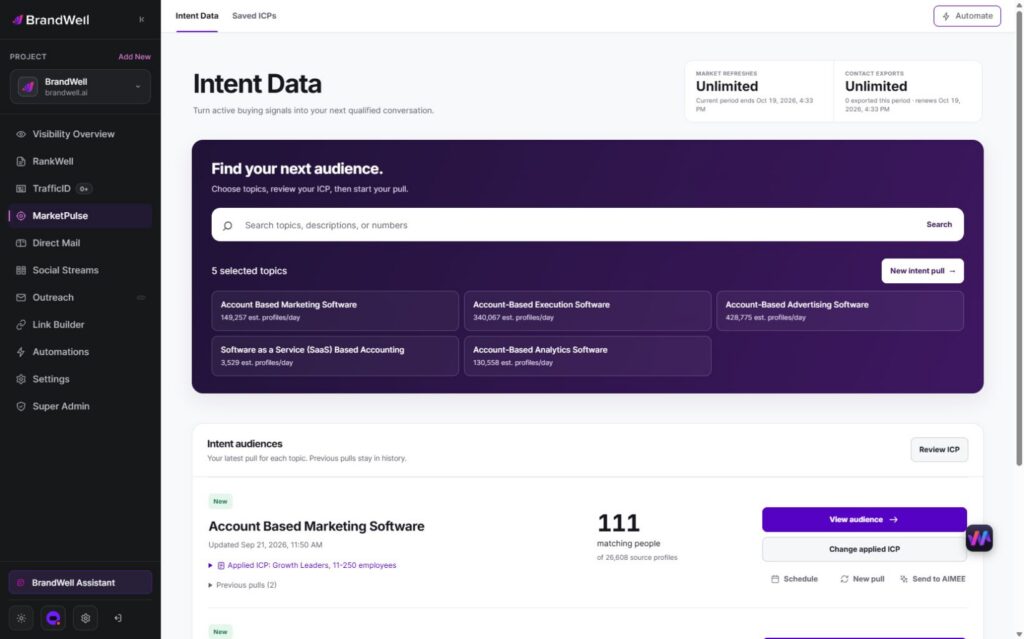
BrandWell MarketPulse: intent data starting at $500/mo. Find people researching topics relevant to what you sell, apply saved ICP filters, and review available contact details before taking action.
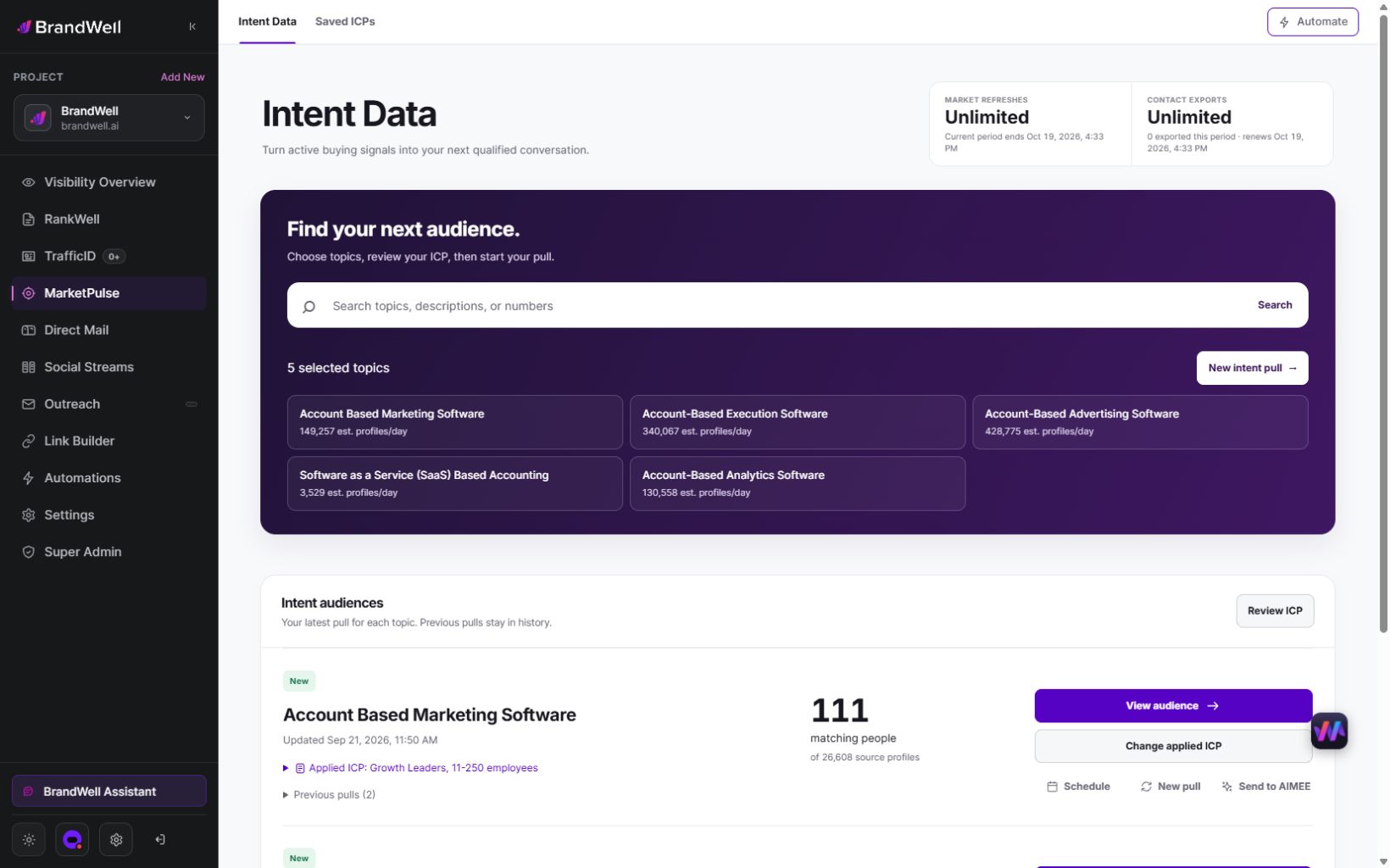
MarketPulse plans are starting at $500/mo. Verify current package scope and offers on the product page.
| Plan | Topics and refreshes | Monthly exports |
|---|---|---|
| Starter | 1 topic, weekly | 25,000 contacts |
| Growth | 3 topics, daily | 100,000 contacts |
| Scale | 10 topics, daily | Unlimited contacts |
Swipe the table to see all columns.
A pull retrieves available data from the previous 24 hours for one topic. Daily use across all included topics provides 90 Growth pulls or 300 Scale pulls in a 30-day month. Weekly Starter pulls vary by calendar month. Available audience size and contact fields vary, and audiences may overlap. Refreshes stop at the plan limit without overage charges.
- Find and qualify: search the topic catalog, save your ICP, and review the people and companies that match.
- Act on the research: export qualified contacts or prepare an Outreach or Direct Mail workflow. Connected products, channel usage, and fulfillment may cost extra.
- Get help from AIMEE: Growth and Scale include AIMEE for the initial user to research accounts and prepare the next step through connected tools.
Agencies and other service businesses can build client deliverables around their available Intent Scans and exports. Keep each client’s scope, permissions, and service fees clear. A subscription is not a promise of a white-label platform or exclusive access to a market.
Explore MarketPulse and watch the demo or compare plans starting at $500/mo. Any early-access discount is a separate, time-limited offer shown to an eligible recipient.
Diagnose evidence before campaign changes
Standard paid-media optimization often starts with spend, delivery, creative, and conversion metrics. Intent campaign optimization has extra upstream dependencies. A topic feed may not cover the client’s market. An account can be a poor fit. A company match can fail at the destination. A matched audience can be too small. A conversion can be a weak proxy. Sales can reject the leads the platform celebrates.
That is why an agency needs a cross-layer decision tree. If source evidence is weak, a bid change cannot repair it. If audience eligibility is low, a creative refresh cannot create matchability. If the CRM definition is wrong, a lower cost per conversion may simply accelerate unqualified volume. The playbook should make the first failing constraint visible before the team allocates more budget.
Write one client decision contract with the ICP, approved topics, evidence windows, identity states, destinations, audience eligibility, conversion hierarchy, sales capacity, qualified outcome, budget guardrails, change authority, and reporting lag. Treat account intent and person identity as probabilistic unless the underlying method establishes otherwise. Never imply that a named person researched a topic merely because an account appeared in an intent cohort.
Run five diagnostic reviews
Use the same criteria for each review: purpose, evidence, owner and cadence, common failure, decision, and limitation. This diagnostic order keeps channel metrics separate from source quality and gives an agency a repeatable optimization framework across clients.
1. Review signal supply, relevance, and freshness
Purpose: Determine whether the cohort represents the market and buying problem the campaign is meant to address. Check topic ambiguity, account fit, coverage, source lineage, evidence age, repeat behavior, and negative evidence.
Evidence: Require an account universe, topic dictionary, source and observed time, freshness window, confidence state, geography, company size, existing-customer status, exclusions, and a record of why each account was eligible.
Owner and cadence: Data or intent operations reviews weekly anomalies and monthly coverage. Client strategy owns topic relevance; RevOps owns account normalization. Any topic expansion requires client and service-owner approval.
Common failure: Teams enlarge a cohort by adding broad topics or old observations without measuring how acceptance changes. A bigger audience hides lower relevance and increases activation cost.
Decision: Keep, narrow, broaden with a bounded test, pause a source, revise a topic, or move uncertain accounts to a research-only tier. Document the expected effect and sample plan.
Meaningful limitation: A high-quality signal still does not prove purchase intent, budget, authority, or causation. Test whether it changes a useful review decision.
2. Review identity, eligibility, match, and suppressions
Purpose: Establish how many source records can lawfully and technically become an audience, which identity state supports the use, and where accounts or contacts are lost.
Evidence: Reconcile source accounts, resolved companies, profile candidates, validated contacts, customer and opt-out suppressions, platform formatting, advertiser authority, upload acceptance, match status, and final eligible audience size.
Owner and cadence: Marketing operations and data operations run preflight for every material audience change. Privacy, legal, security, or platform reviewers own restricted uses. The client approves new destinations and data types.
Common failure: Agencies report the number of records supplied as the reachable audience. They ignore invalid contacts, parent-child mapping, geography filters, platform minimums, consent, and destination-specific matching.
Decision: Release, hold, enrich, validate, aggregate to account level, use a different destination, widen only a role filter, or stop activation. Keep the rejection reason for every stage.
Meaningful limitation: A destination match does not prove the intended person will see an ad or that the source identity was correct. Platform delivery remains probabilistic and policy-controlled.
3. Review delivery, spend, reach, and creative pressure
Purpose: Determine whether the eligible cohort is receiving the intended media without overspending, underdelivering, or exhausting a small audience. Separate data problems from auction and creative problems.
Evidence: Use budget, bid strategy, impressions, reach, frequency, auction or delivery status, placements, search terms where applicable, audience size, creative rotation, landing-page experience, pacing, and geographic or device distribution.
Owner and cadence: Paid-media owners review pacing and exceptions several times per week; creative owners monitor fatigue; account leads approve material budget or targeting changes. Client-specific limits govern frequency and spend.
Common failure: Teams respond to weak delivery by removing every audience constraint, which destroys the intent hypothesis. Or they raise spend in a narrow cohort without enough creative variation and interpret repeated exposure as market demand.
Decision: Adjust budget, bid or goal only within the approved experiment; refresh creative; change offer; broaden a single controlled dimension; rotate or suppress saturated segments; or pause until match and size recover.
Meaningful limitation: Impressions, clicks, and platform-reported conversions do not establish pipeline quality. Strong delivery can efficiently distribute the wrong message to the wrong cohort.
4. Review conversion quality and sales acceptance
Purpose: Test whether the campaign produces actions that the business values and whether sales or customer teams can use them. The platform event and CRM outcome must remain distinct.
Evidence: Maintain conversion action, source, timestamp, form or event quality, validation, spam or duplicate state, account fit, sales disposition, contact attempt, accepted meeting, opportunity, disqualification, and lag. Reconcile counts in both directions.
Owner and cadence: RevOps owns the conversion contract and CRM mapping; sales leadership owns acceptance criteria; paid media owns platform implementation; the agency documents discrepancies. Review qualified outcomes weekly once volume permits.
Common failure: A page view, button click, content download, or unqualified form is treated as the primary optimization goal. Sales rejects the records while the campaign’s cost per conversion appears to improve.
Decision: Remove weak events from primary bidding, send qualified offline outcomes where permitted, repair deduplication, change the offer, update routing, add a nurture path, or stop a source that cannot meet the agreed outcome.
Meaningful limitation: Sales acceptance is itself imperfect. Reps may ignore good accounts or apply inconsistent standards, so audit a sample and combine disposition with later outcomes.
5. Review qualified pipeline, incrementality, and service economics
Purpose: Decide whether the intent campaign is creating useful incremental outcomes at a sustainable client and agency cost. Tie media, data, and delivery work to one transparent economic view.
Evidence: Preserve exposure, eligible non-exposure where possible, qualified conversations, opportunities, stage movement, revenue or expansion events, time lag, total media and data cost, agency labor, client labor, and contribution assumptions.
Owner and cadence: Analytics or RevOps runs the monthly outcome review; finance validates cost; sales explains stage changes; the account lead translates findings into client decisions. Quarterly reviews handle strategic allocation.
Common failure: Every opportunity from an exposed account is attributed to intent media, even when sales was already active. Data fees and labor disappear from ROAS, and a small favorable sample becomes a growth guarantee.
Decision: Scale a controlled cell, preserve, redesign, pause, narrow, move a cohort to sales research, or retire the service element. Record what evidence would reverse the decision.
Meaningful limitation: B2B samples are often small and lagged. A documented review can expose unanswered questions, but cannot create statistical certainty from insufficient observations.
Use defined operating review windows
The weekly meeting should be a short exception review, not a dashboard recital. Confirm data delivery, freshness, eligible counts, destination match, pacing, material frequency or query issues, conversion diagnostics, sales acceptance, and open approvals. Every red or amber item receives an owner, due point, and stop or rollback rule. Avoid changing multiple layers at once unless a safety or policy issue requires an immediate stop.
The monthly review follows the full evidence chain. Reconcile source to eligibility, eligibility to delivery, delivery to qualified conversion, and conversion to pipeline. Compare cohorts, account for lag, calculate total operating cost, inspect false-positive and rejection samples, and propose only the changes supported by the evidence. Maintain a change log with hypothesis, prior state, new state, affected campaigns and clients, approver, expected metric, observation window, and result.
The quarterly review revalidates strategy. Revisit market segments, topics, sources, data rights, destination mix, offer, creative system, conversion hierarchy, sales capacity, pricing, and renewal evidence. A client may outgrow a manual workflow, lose the capacity to act, or discover that a topic is too ambiguous. The playbook should permit a clean redesign rather than defend sunk cost.
Assign data and decision owners
The core data model links signal observation, account, identity candidate, audience eligibility, platform segment, campaign exposure, conversion, CRM record, seller disposition, and qualified outcome. Every object carries timestamps and provenance. Counts at each transition make match loss and data-quality problems diagnosable.
Typical integrations include the intent or event source, account and profile enrichment, validation, consent and preference controls, CRM, advertising platforms, analytics, offline or qualified-outcome feedback, and client reporting. Use separate client credentials and workspaces, least privilege, approval records, and a tested rollback. Reconcile platform and CRM identifiers without treating a successful technical match as proof of a person-level claim.
A practical RACI assigns the agency strategist to ICP and topic hypotheses, data operations to source and quality, paid media to campaign changes, creative to asset cadence, RevOps to CRM and conversions, sales to disposition, the client to advertiser authority and material approvals, and privacy/security/legal specialists to applicable risk decisions. Automation can prepare diagnostics, but a named person should authorize spend, targeting, uploads, and client-facing recommendations.
Keep tools and decision templates accountable
The useful tool categories are signal and event data, account or identity resolution, enrichment and validation, audience operations, campaign management, analytics, CRM, reporting, consent and preference controls, and work management. Evaluate each on source transparency, coverage, freshness, confidence states, destination support, client isolation, usage pricing, auditability, and deletion or suppression handling.
Templates turn those tools into an operating system. Use a signal-to-spend diagnostic, audience waterfall, platform preflight, creative inventory, conversion-goal register, sales-acceptance log, weekly decision tree, monthly outcome scorecard, change log, client approval matrix, total-cost model, and stop/scale/escalate sheet. A template should record the reason for the decision, not merely copy metrics into another document.
Verify actual Google conversion value rules before changes: they affect reporting and eligible value-based bidding. A modified reported value does not establish extra collected revenue, buyer quality or incrementality. Keep the actual event, valuation rule and financial ledger distinct.
Compare broad media and research layers
Both models need reliable conversion goals, campaign structure, pacing, creative testing, landing-page quality, and budget discipline. Intent optimization adds source coverage, topic and signal review, identity confidence, audience eligibility, match waterfalls, client-specific data rights, and a stronger requirement to separate account evidence from person claims.
A standard broad-reach program may optimize creative and bids across a large eligible audience and let the platform learn from conversion outcomes. An intent program begins with a narrower or prioritized cohort and must test whether that upstream restriction creates better qualified outcomes after total cost. Neither should be declared superior in advance.
Use standard optimization when the offer has broad demand, platform-native learning has sufficient qualified conversion data, and external evidence does not improve decisions. Use intent layers when the market is finite, human research is costly, topic or first-party evidence is relevant and sufficiently covered, and the client can act on account-level insights. Use a controlled hybrid when the answer is uncertain.
Budget a separately scoped agency service
An intent campaign optimization fee should cover more than campaign management. Include data and platform costs, source and topic review, enrichment and validation, audience operations, CRM and conversion work, creative planning, quality sampling, reporting, client approvals, security or privacy work, incident reserve, and senior strategy. Media spend remains separate unless the contract explicitly says otherwise.
Model a setup component for discovery, account and topic configuration, permissions, integrations, baseline validation, conversion architecture, branded reporting, and initial assets. Recurring scope can be based on channels, active cohorts, topic count, media complexity, client workspaces, creative cadence, usage, or included analyst hours. Define overages and change requests before launch.
Calculate agency contribution after all direct delivery labor and source cost. Check how matching failures, exceptions, review effort and actual buyer needs change the defined operating remainder. Report total operating cost to the client and the service’s accepted outcomes; do not hide data fees outside the economic narrative.
Measure qualified outcomes and full costs
Primary operating measures include source freshness, coverage, eligible rate, match rate, delivery, frequency, qualified conversion, sales acceptance, opportunity creation, and total cost per accepted outcome. Secondary diagnostics include click and conversion rate, cost per platform conversion, landing-page behavior, creative rotation, rejection reasons, and time to action.
Revenue reporting should distinguish influenced, sourced, and incremental hypotheses. Preserve pre-existing opportunity state, sales activity, exposure, and timing. Use holdouts, geographic or account cells, staggered rollouts, or matched comparisons where feasible. When scale is small, report ranges and decision evidence rather than a spurious precise lift.
The service is improving when evidence quality rises, match loss falls without weakening eligibility, sales accepts more of the work, qualified outcomes improve relative to comparable accounts, and total operating cost remains sustainable. More audience records or a lower click price alone do not establish success.
Check actual client prerequisites
Check the actual market, usable evidence, destination eligibility, outcomes, review ownership, seller and creative capacity, advertiser authority and funded test before release. Enterprise, mid-market, contract value or an industry label does not establish a universally best client or guaranteed benefit.
Poor fits include clients who demand guaranteed person-level identification, lack authority to upload data, cannot follow up, have no conversion hierarchy, or expect a small audience to spend like broad prospecting. A new ad account with no reliable conversion feedback may need foundational measurement and offer work before an intent layer.
Start with one campaign family and a bounded cohort. Establish the baseline, observe the audience waterfall, confirm delivery, and verify outcome feedback. Expand only after the client can explain what the evidence changes and who owns the next action.
Avoid unsupported optimization conclusions
Do not broaden ambiguous topics to solve underdelivery, remove suppressions to increase audience size, or optimize weak conversions because qualified outcomes arrive slowly. Do not compare platform ROAS with a total-cost intent service calculation unless the denominators match. Do not let an automated recommendation change budget or personal-data use without the required approval.
Check actual source rights, recipient, jurisdiction, purpose, channel, fields, advertiser authority, retention, correction, deletion, security responsibilities and suppression before activation. Resolve missing approvals or requirements with qualified owners rather than assuming a data provider or destination has completed all checks.
Review supported BrandWell research
MarketPulse supplies topic research and available match details. AIMEE can organize supplied context through configured tools. An agency operating service, branded weekly report, CRM synchronization or custom client interface needs separately verified implementation, rights, scope and fees. The research subscription does not establish those delivery capabilities.
Review actual MarketPulse topics, saved ICP filters and available match details as research inputs. An audience waterfall, branded report, connector, campaign or client service needs separately verified implementation, sources, rights, permissions, fees and responsibilities. A subscription does not establish managed media execution or a native client interface.
AIMEE can prepare a review brief through configured connected tools. Keep proposed actions separate from actual approvals and destination acknowledgements. Confirm the implementation and permissions before execution.
Frequently asked optimization questions
How should the team prioritize diagnostic work?
Use a fixed diagnostic order from signal quality through qualified outcomes, assign owners and change authority, and sell the recurring decision process – not a promise that intent automatically improves media. Scale only where the client can act and total-cost evidence supports it.
What data and owners are required?
Connect signal, identity, eligibility, platform exposure, conversion, CRM, seller disposition, and outcome records. Staff strategy, data operations, paid media, creative, RevOps, sales feedback, client approval, and applicable risk review.
Which tools and templates support review?
Use source and event data, enrichment and validation, audience operations, ad platforms, CRM, analytics, and reporting. Operationalize them with an audience waterfall, weekly decision tree, conversion register, change log, approval matrix, and total-cost scorecard.
How should broad media and intent layers be compared?
Standard optimization fits broad eligible demand with sufficient qualified platform feedback. Intent optimization fits finite markets where upstream evidence can improve prioritization. Manual analysis fits early ambiguity. Controlled hybrid tests are appropriate when lift is unknown.
What costs belong in the service model?
Include setup, data, platforms, audience operations, media management, creative, CRM and conversion work, reporting, governance, and client support. Define the usage unit, included changes, media spend, approvals, and overages in writing.
How should outcomes be measured?
Measure each transition from source to eligible audience, delivery, qualified conversion, sales acceptance, opportunity, and total cost. Preserve exposure and prior sales state, then use credible comparisons instead of assigning every outcome to intent.
Which operating prerequisites should be checked?
Check actual prerequisites: a finite ICP, sufficient signal and eligible audience supply, qualified conversion feedback, creative and sales capacity, advertiser authority, and a client owner who can approve decisions. Weak foundations should be fixed first.
How should the evidence stages be combined?
Keep each as a separate gate and diagnostic. Fit sets relevance, identity carries confidence, freshness limits the useful window, activation depends on eligibility and match, and outcomes determine whether the original hypothesis deserves more allocation.
Which mistakes need a stop or repair rule?
Major failures include broadening weak topics, hiding match loss, optimizing unqualified events, overstating person identity, ignoring suppressions or upload authority, changing several layers at once, and reporting influenced pipeline as caused revenue.
How should an agency scope recurring work?
Package the source review, audience operations, paid-media cadence, creative decisions, conversion QA, sales feedback, reporting, and quarterly strategy as one governed service. Make client responsibilities, approvals, data rights, pricing units, and stop rules explicit.
Copyable campaign-review test
Question: [Actual decision and comparator.] Scope: [Unique account and opportunity units, cohort, period and exclusions.] Evidence: [Actual source, rule versions, uncertainty and maturity.] Capacity: [Review, creative, seller and destination constraints.] Ownership: [Approver, exact change, acknowledgement and rollback.] Outcome: [Actual qualified events, buyer evidence and unresolved cases.] Decision rule: [Full costs, quality limits, repair and expansion criteria.]
Improved click rate can conceal fewer opportunities
Two fictional campaigns each have 10,000 impressions and $1,000 media cost. A records 100 clicks and 10 qualified opportunities; B records 200 clicks and five. CTR is 1% versus 2%, but media cost per opportunity is $100 versus $200, and opportunities per click are 10% versus 2.5%. Report the equal outcome window and buyer definition; these invented observations do not prove which creative or research caused the difference.
Changed values are not extra collected revenue
Ten fictional conversion events valued at $100 each total $1,000 reported value. A hypothetical rule multiplying those values by two reports $2,000 while event count remains 10. That change does not establish another $1,000 collected, higher-quality buyers or incremental revenue. Verify the actual supported rule and bidding implications before applying it. No campaign settings were changed by this article review.
Platform ROAS and full-cost economics differ
A fictional campaign reports $5,000 attributed revenue on $1,000 media: media ROAS is 5. Include $500 Growth research, $400 setup, $300 review and $300 creative to obtain $2,500 defined total cost. Reported revenue divided by that cost is two, a separately named revenue-to-defined-cost ratio. It is not incremental profit or ROI. If a separately supported counterfactual yields $1,000 incremental contribution before those costs, net contribution is negative $1,500 and defined ROI is negative 60%. These invented values are not BrandWell performance. Selling, overhead, tax and financing are excluded; finance must verify the contribution definition and avoid counting costs twice.
Events, people and opportunities need separate identifiers
A fictional 100 form events represent 80 unique people, 40 eligible accounts, 20 seller-accepted accounts and 10 opportunities. Do not call 100 events 100 buyers or divide opportunity counts by an account denominator without explaining the relationship and window. Preserve account, person, event and opportunity IDs and reconcile duplicates before combining channels.
Equal follow-up and missing feedback matter
Suppose one fictional cohort reports four opportunities after seven days and another six after 30 days. Compare equal maturity before declaring deterioration. If 15 of 20 accepted accounts return feedback and five remain unresolved, coverage is 75%; missing feedback does not prove failure or justify inventing revenue.
Budget and log the actual repair
The fictional $2,500 full-cost campaign above divided by 10 qualified opportunities is $250 each. Another $500 correction raises total cost to $3,000, or $300 each. With no opportunities the ratio is undefined. Record the actual hypothesis, prior state, changed control, approver, acknowledgment, period and repair effort. A before-and-after difference with changing offers, staff or audiences does not by itself prove a causal optimization effect.
Use supported research under actual approvals
Review an available MarketPulse topic, saved ICP and actual previous-24-hour matches under the approved purpose. Keep uncertain identity, company context, research, seller acceptance and buyer response distinct. AIMEE can organize supplied context through configured tools. A named owner verifies exports, messages, audience uploads and CRM writes. Custom connectors, campaigns, branded reporting and managed agency services need separately verified implementation, rights and scope.
Review the research input: explore MarketPulse and current plans.
Reviewed and updated October 3, 2026.

Written by