On this page
- Current MarketPulse research workflow
- Verify an actual eligible activation path
- Compare five activation methods
- Assign owners and handoffs
- Choose tools for the actual gates
- Use nine release questions
- Keep audience methods and delivered reach distinct
- Separate six evidence and outcome dimensions
- Budget full activation costs
- Review supported BrandWell research
- Check actual campaign prerequisites
- Measure delivery and incremental outcomes
- Review actual source and destination requirements
- Scope a separate agency activation service
- Frequently asked activation questions
- Copyable audience-activation test
Treat off-site topic research as evidence for review, then verify actual ICP fit, age, identity, source rights, suppression, destination eligibility and approval before activation. Technical upload acceptance does not prove permitted use, correct matching, reach or buying intent. Keep each stage, observation unit, destination rule and actual outcome distinct. Hold unresolved records rather than assuming an export is an approved ad audience.
Who this is for: Marketing operations and RevOps leaders, paid media directors, and agency operations teams building a governed off-site topic intent audience activation service. The guide covers strategy, implementation, tools, alternatives, pricing, ROI, fit, signal quality, and recurring delivery.
Current MarketPulse offer: intent-data plans start at $500/mo. See the product, demo, and current plans. Updated October 3, 2026.
Current MarketPulse research workflow
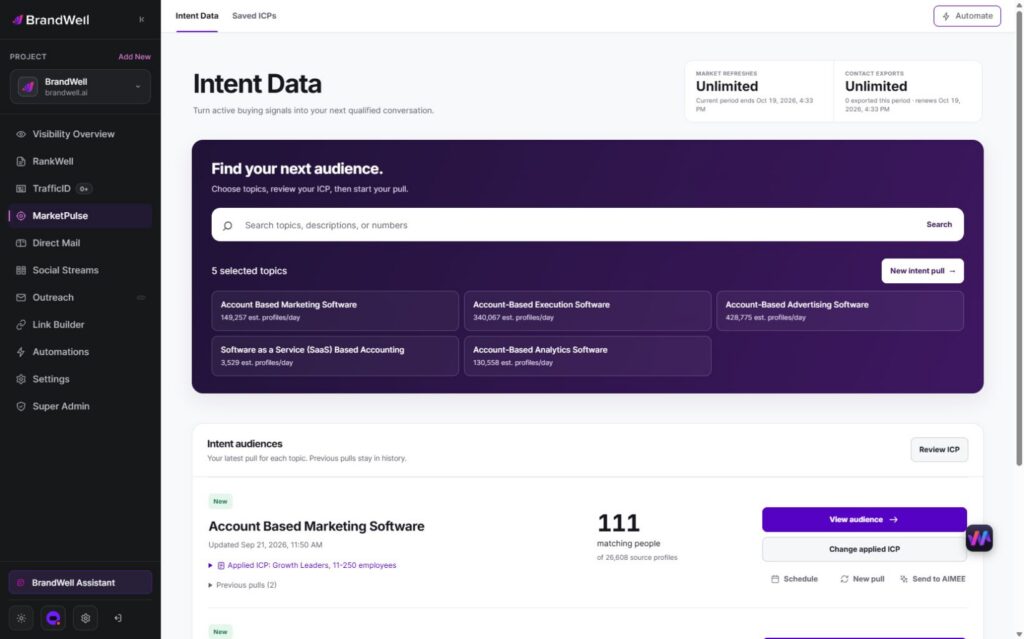
BrandWell MarketPulse: intent data starting at $500/mo. Find people researching topics relevant to what you sell, apply saved ICP filters, and review available contact details before taking action.
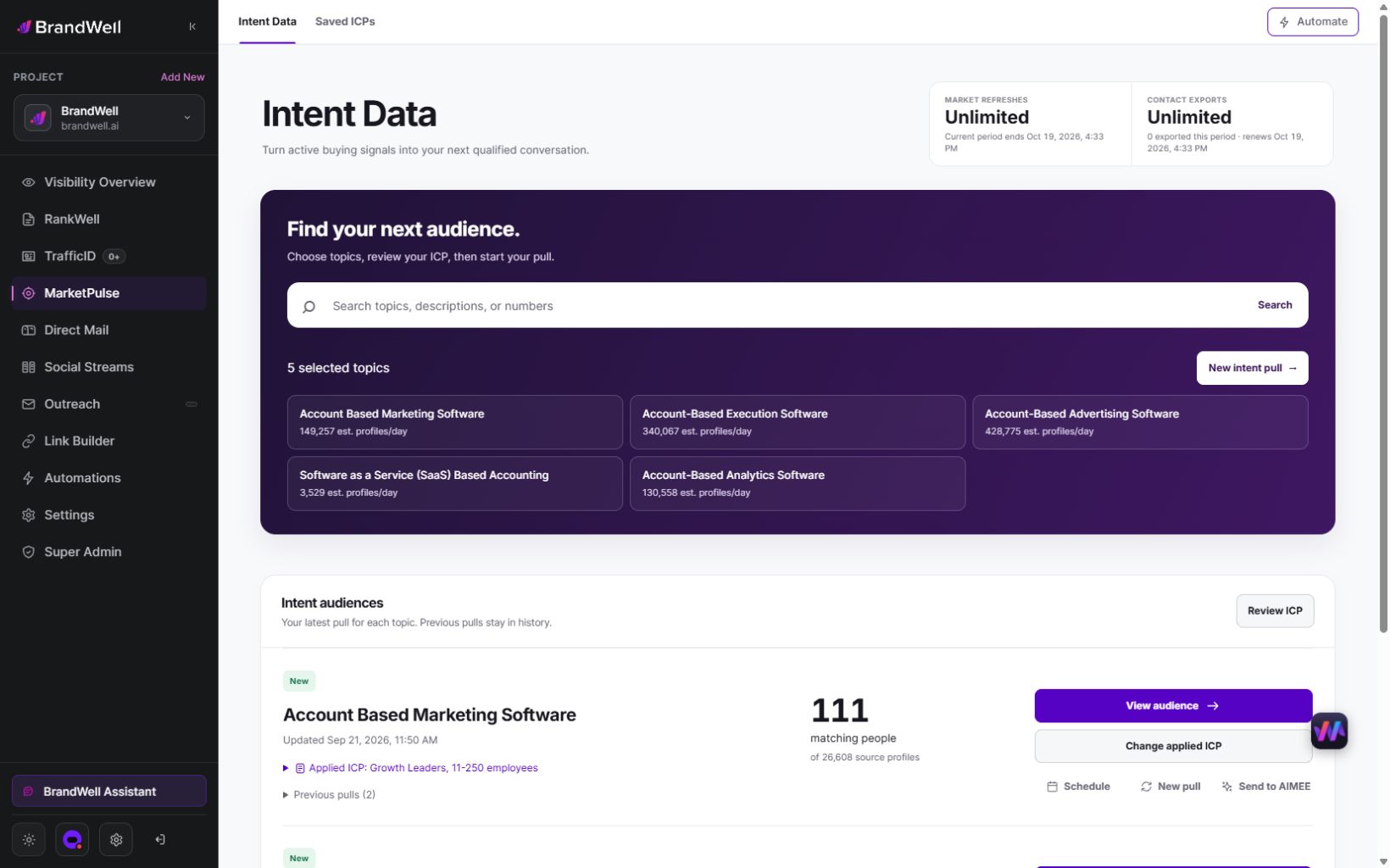
MarketPulse plans are starting at $500/mo. Verify current package scope and offers on the product page.
| Plan | Topics and refreshes | Monthly exports |
|---|---|---|
| Starter | 1 topic, weekly | 25,000 contacts |
| Growth | 3 topics, daily | 100,000 contacts |
| Scale | 10 topics, daily | Unlimited contacts |
Swipe the table to see all columns.
A pull retrieves available data from the previous 24 hours for one topic. Daily use across all included topics provides 90 Growth pulls or 300 Scale pulls in a 30-day month. Weekly Starter pulls vary by calendar month. Available audience size and contact fields vary, and audiences may overlap. Refreshes stop at the plan limit without overage charges.
- Find and qualify: search the topic catalog, save your ICP, and review the people and companies that match.
- Act on the research: export qualified contacts or prepare an Outreach or Direct Mail workflow. Connected products, channel usage, and fulfillment may cost extra.
- Get help from AIMEE: Growth and Scale include AIMEE for the initial user to research accounts and prepare the next step through connected tools.
Agencies and other service businesses can build client deliverables around their available Intent Scans and exports. Keep each client’s scope, permissions, and service fees clear. A subscription is not a promise of a white-label platform or exclusive access to a market.
Explore MarketPulse and watch the demo or compare plans starting at $500/mo. Any early-access discount is a separate, time-limited offer shown to an eligible recipient.
Verify an actual eligible activation path
Off-site topic research answers a narrow question: which companies appear to be consuming more content about a defined business subject away from the advertiser’s properties? It does not establish that a named employee performed the research, that the activity represents a purchase, that a supplied email can be used for advertising, or that an ad platform will accept or match the record.
The operating decision is therefore not “Which list do we upload?” It is “Which permitted activation path can turn this account-level evidence into a useful, sufficiently large, reviewable audience without overstating identity or intent?” Preserve the source, topic definition, observation window, account resolution, confidence, and permitted uses. Join the signal to the client’s explicit ICP and exclusions before spending media.
A practical release rule is: eligible audience = relevant topic evidence + qualified account fit + acceptable freshness + sufficient identity or company match + documented rights + destination eligibility + suppression clearance + accountable approval. If any term is unknown, hold the cohort, choose a non-personalized account or contextual use, or stop.
Compare five activation methods
These five methods cover the main off-site topic intent audience activation models. They are operating paths, not a company ranking. Evaluate each on signal granularity, required identity, rights and platform eligibility, audience scale, controllability, measurement, total cost, and the limitation stated for the method.
1. Account-list matching
Operating prerequisite: Named-account programs where the destination supports company-list targeting or an ABM environment can resolve companies without pretending to know the researching person. Workflow: Filter topic-active companies by ICP, freshness, geography, exclusions, account ownership, and campaign thesis; normalize domains and company names; then test the destination’s company match.
Tools and controls: Topic taxonomy, account master, domain normalization, suppression registry, company-list template, match report, and campaign holdout. Measurement: Report eligible accounts, uploaded accounts, matched accounts, reachable accounts, spend, engagement, qualified actions, and account-level outcomes. Meaningful limitation: Account research neither identifies a person nor guarantees sufficient platform match or delivery.
2. Contact-enriched customer-list activation
Operating prerequisite: A client has a documented relationship or other valid basis for the specific records and the destination explicitly allows the proposed customer-list use. Workflow: Resolve likely buying roles only after account qualification; validate fields; record provenance, rights, consent signals where required, opt-outs, and advertiser ownership; hash or transfer data using the destination’s approved process.
Tools and controls: Identity/enrichment provider, field validator, rights ledger, suppression service, secure hashing/upload job, match diagnostics, deletion workflow, and approval log. Measurement: Separate source-row acceptance, platform match, audience eligibility, delivery, and outcome. Meaningful limitation: A valid email is not consent, a customer relationship, or person-level intent; a purchased third-party list may be ineligible even if technically uploadable.
3. Programmatic or ABM-platform activation
Operating prerequisite: Larger account programs that need off-site research, account identification, orchestration, advertising, and revenue-system feedback under a negotiated data-use model. Workflow: Contractually define the signal, audience construction, destinations, controller/processor or advertiser roles, campaign controls, data retention, reporting, and service ownership; pilot a bounded account segment before wider rollout.
Tools and controls: Account graph, destination connectors, role-based access, campaign preflight, spend controls, CRM sync, evidence store, and reconciliation. Measurement: Compare activated eligible accounts with a similar holdout and inspect pipeline quality by topic, segment, and freshness. Meaningful limitation: Enterprise orchestration can add license, services, integration, media, governance, and adoption cost without solving a weak ICP or offer.
4. Social-platform audience activation
Operating prerequisite: B2B campaigns whose qualified audience is large enough for platform minimums and where job, company, or approved list inputs match the planned use. Workflow: create a platform-specific segment, apply location and other required facets, upload only eligible records, inspect match and estimated reach, define whether inputs are strict controls or suggestions, and obtain campaign-owner approval.
Verify the exact current destination, account, campaign, list schema, matching, audience threshold, exclusions and delivered reach before release. A remembered threshold or an advertising-specification page is not sufficient evidence for every audience feature.
5. Agency-managed multi-platform activation
Operating prerequisite: Agencies that can own data review, destination setup, media operations, client reporting, and improvement across several approved channels. Workflow: maintain one evidence model but create a separate eligibility decision, transfer process, audience ID, exclusions, refresh cadence, spend guardrail, and outcome reconciliation for every client and platform.
Tools and controls: Tenant-separated workspace, source and rights register, activation queue, client approval matrix, media account access, cost ledger, and cross-channel outcome taxonomy. Measurement: deduplicate accounts and opportunities before aggregating performance. Meaningful limitation: a unified report cannot eliminate platform attribution bias, cross-channel contamination, or the need for a holdout.
Assign owners and handoffs
A documented topic-research activation workflow is a sequence of reversible decisions with named owners. Marketing operations owns schemas and integrations; demand generation owns the campaign thesis and budget; paid media owns destination compliance and delivery; RevOps owns account/opportunity reconciliation; privacy, security, and counsel review the relevant uses; the agency or client product owner accepts residual risk.
- Define the commercial decision, ICP, exclusions, topic meaning, acceptable evidence window, action, and qualified outcome.
- Ingest the signal with source, topic, account, timestamp or window, score semantics, confidence, geography, and contractual-use metadata.
- Resolve the account, deduplicate subsidiaries and domains, and join fit without promoting account intent to a person.
- Choose company-level, contact-list, programmatic, contextual, or no-audience activation; document why the path is permitted.
- Apply do-not-target, customer, employee, competitor, sensitive-category, geography, and client-specific suppressions.
- Validate fields, advertiser relationship, consent signals where required, hashing/transfer, retention, and deletion before upload.
- Run a destination preflight: account eligibility, minimum audience, match schema, expansion behavior, restricted categories, and advertiser authorization.
- Launch a bounded campaign with spend limits, creative that does not reveal inferred research, a holdout or phased baseline, and a rollback owner.
- Reconcile source rows, accepted rows, matched members or companies, reach, qualified actions, opportunities, cost, and corrections.
- Refresh or expire membership by evidence age; feed outcomes and false positives back into topics, ICP, identity, and routing rules.
Use an evidence card for every released cohort: source and rights; topic and semantics; account fit; identity state; signal age; field validation; suppressions; destination rule; approver; audience identifier; membership window; spend; outcomes; and limitations. This gives operators, auditors, and clients a common object instead of a spreadsheet with unexplained rows.
Choose tools for the actual gates
Choose a verified implementation that preserves actual sources, identifiers, rights, missing fields, eligibility, suppression, approvals, destination acknowledgements and outcome joins. A connector, branded report or multi-client operating service needs separately verified implementation, permissions, isolation, support, fees and recovery.
- Topic dictionary with inclusions, exclusions, examples, ambiguity notes, and retirement criteria.
- Audience eligibility checklist that is versioned by destination, jurisdiction, source, and advertiser role.
- Match ladder separating source rows, technically valid rows, accepted rows, matched entities, eligible members, reached entities, and qualified outcomes.
- Cost model covering signal, enrichment, validation, integration, media, operations, QA, privacy/security review, reporting, and change work.
- Campaign evidence brief containing hypothesis, cohort, control, budget, action, KPI, stop rule, and attribution limitation.
Use nine release questions
Before release, the operator should be able to answer nine questions with evidence: What exactly was observed? At what entity level? Which ICP rule qualified the account? How old is the signal? What identity or company match is available? What right and destination rule permits the use? Which suppressions ran? Who approved the cohort? Which outcome and stop rule will be measured? A blank answer keeps the cohort out of production.
Run a negative-control review as well. Include accounts with similar firmographics but irrelevant topics, expired evidence, known nonbuyers, ambiguous domains, and suppressed relationships. If the workflow cannot reliably stop those records, scaling the positive cohort will amplify false positives. Reconcile the export checksum and destination row counts so silent drops or duplicate uploads are visible.
Keep audience methods and delivered reach distinct
Use off-site topic intent to find qualified accounts researching a relevant problem before or beyond a visit to the advertiser. Use website retargeting when the client has a legitimate first-party site interaction and wants to re-engage that audience. Use a platform lookalike or predictive audience when an eligible seed is strong and the goal is controlled expansion. Use broad ICP or contextual targeting when identity rights, match scale, or signal quality are insufficient.
Check whether the exact campaign inputs act as enforceable controls or suggestions, and reconcile actual delivered audiences against the approved scope. Eligibility, expansion and restrictions differ by product and account. A seed list does not prove who actually receives ads.
Separate six evidence and outcome dimensions
Keep six scores separate: fit asks whether the account belongs in the market; intent describes the observed topic pattern; identity records account or person match confidence; freshness measures elapsed time and decay; activation records eligibility, match, and action; outcome records what happened in the system of record. Do not collapse them into one opaque “hot lead” score.
A high-fit account with fresh research and no permitted person-level path may still support company advertising or sales research. A low-fit account with a perfect email match should be suppressed. A reached account with no qualified outcome is not proof the signal failed; the offer, creative, landing experience, sales follow-up, sample size, and observation window may be responsible. Preserve the chain so the team can diagnose rather than guess.
Budget full activation costs
Total cost includes the topic signal, account resolution, contact enrichment, validation, consent or rights operations, connectors, data engineering, audience administration, media spend, creative, analytics, CRM reconciliation, client service, privacy/security review, and exception handling. Quote separately for setup, ongoing data and platform usage, agency operations, and media; otherwise a seemingly low signal price can hide the work needed to activate it.
Count actual data, verification, setup, media, creative, review, monitoring and correction costs. Distinguish incurred expenses from optional authorization or a contingency reserve. Calculate costs per a stated eligible, accepted, matched, reached or qualified unit, with the time window and exclusions named. A supplied row is not automatically a usable audience member.
Review supported BrandWell research
MarketPulse supplies topic research and available match details. AIMEE can organize supplied context through configured tools. An agency operating service, branded weekly report, CRM synchronization or custom client interface needs separately verified implementation, rights, scope and fees. The research subscription does not establish those delivery capabilities.
MarketPulse plans are starting at $500/mo. Starter includes 1 topic, weekly refreshes, and 25,000 exportable contacts per month. Growth includes 3 topics, daily refreshes, and 100,000 exportable contacts. Scale includes 10 topics, daily refreshes, and unlimited contact exports. AIMEE for the initial user is included with Growth and Scale. Compare MarketPulse plans and current offers.
Review an available MarketPulse topic, saved ICP and actual preceding-24-hour matches for the approved research purpose. Keep uncertain company context visible. AIMEE can organize supplied context through configured tools; named owners approve actual exports, messages, audience uploads and CRM writes.
Check actual campaign prerequisites
Consider a bounded pilot when the company has a defined account universe, relevant research, an eligible destination, review and seller capacity, actual approvals, mature outcomes and a funded test. Industry, contract value or first-party traffic alone does not establish a universally strongest fit.
Poor fits include a consumer-sensitive use case, tiny audience below practical delivery thresholds, undifferentiated offer, no account list, no action capacity, no lawful or permitted activation path, topics dominated by students or job seekers, very short test with a long sales cycle, or a team expecting a named-buyer notification. Use contextual media, manual account research, demand creation, or first-party measurement until the missing condition changes.
Measure delivery and incremental outcomes
Build the funnel with denominators: signaled accounts; ICP-qualified accounts; eligible source rows; accepted rows; matched entities; reachable audience; impressions and spend; qualified site or lead actions; accepted opportunities; wins; and gross profit. Report match rate as matched divided by eligible uploaded rows – not the original unfiltered feed – and show freshness and segment cuts.
Keep platform-attributed revenue, observed pipeline, collected revenue, contribution and incremental effects distinct. Use suitable account assignment, a comparator, equal outcome maturity, exposure checks and uncertainty before claiming causality. For percentage ROI, divide defined net incremental contribution by its positive full-cost base; do not count an account appearance, ad exposure and opportunity as three wins.
Useful early KPIs are eligibility yield, match rate, reachable accounts, cost per reached qualified account, action rate, suppression and correction rate, seller adoption, and time to action. Downstream KPIs include accepted-opportunity rate, stage progression, win rate, sales-cycle change, gross profit, and renewal evidence. A short pilot can inspect the actual workflow and expose defects, but may not observe enough mature, independent outcomes to establish incremental revenue.
Review actual source and destination requirements
Check actual source, observation unit, jurisdiction, necessary fields, recipient, purpose, rights, retention, deletion, correction and suppression. Inferred research or matching does not establish a person’s action, consent, purchasing authority or readiness. Resolve unanswered requirements before activation.
Verify the current terms for the exact destination feature, advertiser relationship, data source, account, campaign, transfer method and recipient. General privacy review and platform eligibility are separate checks. A valid field or successful upload does not establish that either check has passed.
- Stale topics or scores that keep accounts active after the commercial window has passed.
- False company resolution, subsidiary confusion, wrong employment, duplicate contacts, or invalid identifiers.
- Uploading third-party data through a first-party feature without documented advertiser rights.
- Leaking one client’s audience, exclusion, campaign, results, or pricing into another tenant.
- Creative or outreach that tells people an unseen system observed their off-site research.
- Platform expansion, modeled attribution, or small samples being reported as causal intent performance.
Scope a separate agency activation service
An agency can sell a recurring service with five workstreams: topic and ICP governance; cohort production and quality review; destination-specific audience activation; paid-media operations; and outcome reconciliation. Define what is included in the base fee, what is usage- or media-based, which client approvals are required, and which data uses are excluded.
A credible monthly deliverable contains a topic-change log, eligible-account cohort, suppression and correction summary, destination match ladder, campaign actions, spend, qualified outcomes, cost, experiments, limitations, and next decision. Renewal should depend on coverage, adoption, usable activation, qualified evidence, and contribution – not on the number of rows delivered.
Frequently asked activation questions
Can a third-party intent list be uploaded directly to every ad platform?
No. Eligibility depends on the source, advertiser relationship, rights, jurisdiction, platform product, account status, consent requirements, and transfer method. Some policies prohibit third-party data from directly creating audiences even when third-party information may segment an advertiser’s first-party audience. Review each path.
Should the ad mention the topic the account researched?
Usually use the topic to choose a helpful problem, proof point, or offer – not to reveal that the organization was observed. Specific wording needs brand, privacy, legal, and channel review. Avoid any claim that a named person researched the topic.
What if the match rate is low?
First verify formatting, normalization, permissions, field quality, geography, minimums, and destination diagnostics. Then widen only within the approved ICP or use account/contextual activation. A smaller honest cohort is better than adding weak-fit contacts solely to make delivery possible.
Is platform-reported pipeline enough to prove ROI?
No. Platform attribution can help diagnose delivery but does not by itself establish incrementality. Reconcile unique accounts and opportunities in the system of record, include total cost, and use a credible counterfactual.
Copyable audience-activation test
Question: [Actual decision and comparator.] Scope: [Unique account unit, source, destination, period and exclusions.] Evidence: [Actual rights, age, identity, uncertainty and destination feature.] Capacity: [Eligible audience, review, creative and seller limits.] Ownership: [Approver, transfer, acknowledgement and correction.] Outcome: [Actual reach, qualified action and unresolved cases.] Decision rule: [Full costs, expiry, stop and expansion criteria.]
Technical acceptance does not clear every gate
Google’s data-collection policy addresses secure handling and disclosures; additional personalized-ad requirements apply. Check the actual feature and source separately. A hash, valid email, successful upload or research subscription does not by itself establish an eligible advertising use.
Use one observation unit through the ladder
A fictional 100-account cohort has 80 meeting source requirements, 60 eligible for a stated destination, 50 accepted, 30 matched and 20 actually reached. Acceptance is 83.3% of eligible accounts; matching is 60% of accepted accounts or 50% of eligible accounts. Reach is 66.7% of matched accounts or 20% of the original cohort. These are distinct technical and delivery stages, not proven buyers. Row, member, person and impression counts must not silently replace account counts.
A seed does not define delivered exposure
Suppose a fictional approved seed contains 30 accounts. A campaign report shows 20 within-seed accounts and 10 outside-seed accounts exposed under its actual configuration. The total is 30, but it is not 100% seed coverage: observed coverage is 20 of 30, or 66.7%. Verify the account-level report and actual expansion controls before making that claim. This example is not a rule or performance promise for every ad platform.
Deduplicate audiences and business outcomes
Two fictional channels reach 20 and 15 unique accounts, with 10 in both. The union is 25 accounts, not 35. If each report credits the same three opportunities, reconcile actual opportunity IDs before aggregation. Parallel platform credits do not create six independent opportunities or prove incremental revenue.
Unknown feedback stays visible
Of 20 reached accounts, suppose 15 have buyer-outcome feedback and three have qualified opportunities. That is 20% of reported reached accounts or 15% of all reached accounts, with five unresolved. It is also 3% of the original 100-account cohort. Report the period, unit, buyer definition and missing outcomes; lack of feedback is not automatically a negative result.
Include the actual operating cost
A fictional test costs $500 Growth research, $400 setup, $300 review, $1,000 media and $300 creative: $2,500. Thirty matched accounts make cost about $83.33 each; 20 reached accounts make it $125 each; three qualified opportunities make it about $833.33 each. Another $500 correction raises total cost to $3,000, or $1,000 per opportunity. Zero opportunities leave that ratio undefined. These invented inputs are not BrandWell ad performance or service prices. Selling, overhead, tax and financing are excluded, and incremental value needs a suitable comparator and equal outcome maturity.
Use current topic research under actual approvals
Review an available MarketPulse topic, saved ICP and actual previous-24-hour matches for the approved purpose. Preserve identity uncertainty, missing fields and website context without asserting a named person’s private action. AIMEE can organize supplied context through configured tools. A named owner verifies any actual export, message, audience upload or CRM write. Custom connectors, campaigns, branded reports and managed client delivery require separately verified implementation, rights and scope.
Review current research: explore MarketPulse and current plans.
Reviewed and updated October 3, 2026.

Written by