On this page
- The short answer: Choose a mid-market or enterprise agency motion by ACV, labor, procurement, security, and margin.
- 7 decision rules
- Compare alternatives and decide where this approach fits
- Build the workflow: data, evidence, integrations, roles, and approvals
- Model cost, pricing, and total operating effort
- Measure qualified outcomes – not signal volume alone
- Control data quality, privacy, trust, and automation risk
- Package it as an agency service – and where BrandWell fits
- Implementation checklist
- Frequently asked questions
- Compare the economics with a worked example
- Use primary control references
- Start with a bounded MarketPulse review
Segment definition: This guide uses mid-market and enterprise as agency delivery lanes, not standardized employee or revenue thresholds. Define your own eligibility and complexity criteria before comparing cohorts. The models below are proposed operating choices, not evidence that all firms in either segment behave alike.
Direct answer: An agency should serve mid-market and enterprise intent-data clients with different operating lanes, not the same package at different prices. Mid-market delivery should favor bounded modules, fast onboarding, repeatable reports or activation, and a small owner group. Enterprise delivery needs paid discovery, governance, integrations, acceptance tests, change control, and executive alignment. Choose the segment whose total sales, onboarding, delivery, support, and risk load produces healthy contribution – not the one with the largest contract value.
Who is this for? Agency owners, growth leads, paid-media directors, GTM consultants, RevOps leaders, and delivery executives deciding which intent-data clients to target and how to operate the service. The guide covers strategy, people, process, systems, cadence, tools, templates, managed-versus-in-house alternatives, pricing, cost, margin, retention, metrics, use cases, signal quality, security, privacy, and client trust.
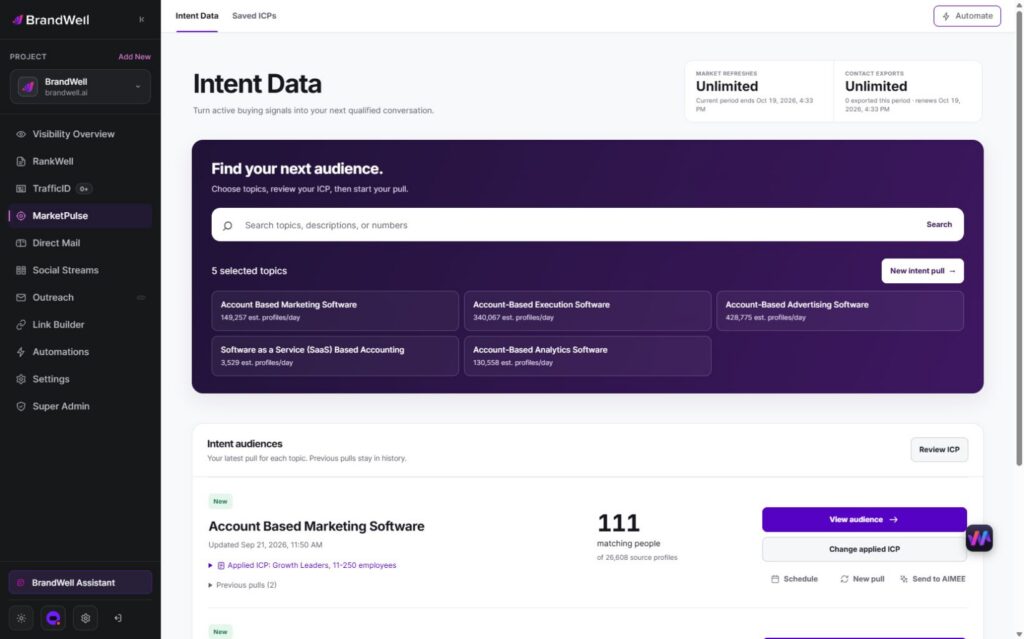
Current MarketPulse offer: intent-data plans start at $500/mo. See the product, demo, and current plans. Updated October 1, 2026.
The short answer: Choose a mid-market or enterprise agency motion by ACV, labor, procurement, security, and margin.
Company size is a weak proxy for service complexity. A mid-market company can have demanding security and fragmented systems; an enterprise business unit can run a narrow pilot with one owner. Qualify the operating profile: number of stakeholders, business units and regions, data sensitivity, procurement, integration depth, approval path, activation capacity, reporting needs, support expectations, and sales cycle.
Build two scorecards. The mid-market scorecard asks whether a standard module can produce a usable client decision quickly, with limited configuration and one accountable owner. The enterprise scorecard asks whether the opportunity can fund discovery, governance, integration, change management, and support. A deal that fails both belongs in a diagnostic, nurture, partner referral, or decline path – not in a bespoke discount.
The proposed service records the topic or signal, fit, identity method, freshness, allowed use, evidence, handoff and feedback. Inspect which fields are observed and which are inferred; not every method is probabilistic. Neither a deterministic match nor an inferred association establishes a named buyer’s purchase plan, guaranteed opportunity or revenue causality.
7 decision rules
The models below are delivery choices, not vendor rankings. Each uses the same visible criteria: best fit and poor-fit case; inputs, workflow, and owner; cost and commercial effect; measurement and evidence; and governance and a meaningful limitation. An agency can offer more than one model only if it keeps scope, staffing, contracts, and economics separate.
1. ACV and gross margin
Best fit and poor-fit case: Use this model for mid-market clients with a clear ICP, one or two activation teams, limited integration needs, and an owner who can review a recurring branded report or queue. It is a poor fit for clients expecting bespoke data engineering, many business units, global security exceptions, or named-person certainty from account signals.
Inputs, workflow, and owner: The agency defines a limited topic set, account universe, fit rules, evidence fields, cadence, branded output, one primary destination, client owner, and response SLA. A shared delivery pod can handle configuration, QA, report production, and a structured monthly review. Client-specific overrides remain documented and capped; the client owns action and dispositions.
Cost and commercial effect: Standardization reduces setup and delivery hours, making a fixed module tier or topic-based subscription workable. Include data licensing, platform, setup, analyst review, support, corrections, and renewal preparation. Margin erodes when every client receives unique fields, meetings, and integrations inside the base price, so publish an exception menu and change-order process.
Measurement and evidence: Track time to first usable report, reviewed signals, accepted accounts, action completion, qualified outcomes, support hours, exceptions, contribution, and renewal evidence. The model succeeds when clients use the same repeatable decision rhythm. It does not prove that more signals create more pipeline, and a client without action capacity may still churn despite accurate delivery.
Governance and meaningful limitation: Separate clients, restrict access, label sources and freshness, and retain suppression and correction paths. An account association is not proof that a particular employee researched the topic. A standardized service should decline custom work that breaks its economics or controls.
2. Procurement load
Best fit and poor-fit case: Use this model for enterprise clients where procurement, security, privacy, legal, data architecture, regional rules, and business-unit ownership are material to delivery. It fits high-value programs that can fund discovery and governance. It is a poor fit when the agency lacks enterprise controls or the client wants immediate activation before stakeholders approve the operating model.
Inputs, workflow, and owner: Begin with discovery, data-flow mapping, role and responsibility matrices, security and privacy review, source approval, account hierarchy, access, retention, incident handling, and success definitions. Establish a steering owner, operational owners, and a change board. Run a controlled pilot in one business unit before expanding. Delivery cadence may include operating reviews, risk reviews, and executive evidence separately.
Cost and commercial effect: Enterprise cost includes procurement, security documentation, solution architecture, legal review, integrations, tenant and access design, data residency questions, custom reporting, support, training, change management, and longer sales cycles. Charge for discovery and implementation; price recurring scope by modules, business units, usage, and service level. Carry a realistic sales and onboarding cost in margin models.
Measurement and evidence: Track gate completion, time to approved use, configuration defects, access and incident events, business-unit adoption, accepted signals, workflow completion, qualified outcomes, support load, expansion, and net contribution after onboarding. The limitation is payback timing: a large contract can still be unattractive if unpaid pre-sales work, customization, and delayed deployment consume the margin.
Governance and meaningful limitation: Document controller, processor, client, and subprocessor roles; least privilege; auditability; deletion and correction; incident responsibilities; and cross-border or regional requirements. Evidence cannot outrun its source or identity confidence. The limitation is governance drag, but bypassing governance creates far greater contract, trust, and delivery risk.
3. Security requirements
Best fit and poor-fit case: Use security requirements as a separate qualification decision because client size alone does not predict diligence. It fits any engagement moving client or personal data. It is a poor fit when the agency plans to answer questionnaires aspirationally or let sales promise controls that do not exist.
Inputs, workflow, and owner: Map data, systems, access, isolation, encryption, vendors, logs, retention, deletion, incidents, recovery, and client evidence. Security owns truthful control statements; delivery maps the workflow; legal and privacy review obligations; sales can promise only approved capabilities.
Cost and commercial effect: Cost includes documentation, assessments, remediation, secure configuration, monitoring, incident readiness, and client-specific evidence. Price exceptional requirements and include their lead time before committing to launch.
Measurement and evidence: Measure review completion, open risks, access exceptions, incidents, time to remediate, client acceptance, and ongoing evidence work. A signed questionnaire is not proof that controls operate.
Governance and meaningful limitation: Never fabricate certification, coverage, or legal compliance. Use least privilege and approved test data. The limitation is that some client requirements will exceed the current offer; the right answer may be a partner, a future roadmap item, or no bid.
4. Integration depth
Best fit and poor-fit case: Use this model when the enterprise already has data, warehouse, CRM, marketing automation, advertising, and sales systems and needs intent evidence integrated into existing controls. It is a poor fit when the client’s foundational identifiers and lifecycle are unresolved or when the agency is being asked to become an unlimited systems integrator under a recurring data fee.
Inputs, workflow, and owner: Map system of record, identifiers, account hierarchy, fields, events, identity states, destinations, permissions, SLAs, error queues, rollback, and outcomes. Assign a solution architect, data engineer, agency operator, security reviewer, and client system owners. Release integration stages with acceptance tests: source, normalization, decision rule, destination, action, and reconciliation.
Cost and commercial effect: Cost is driven by discovery, engineering, connectors, environments, testing, monitoring, change management, vendor APIs, data egress, support, and client release processes. Separate implementation statements of work from recurring data and operations. Require change orders for new objects, regions, systems, and custom logic; otherwise integration work can erase apparent contract value.
Measurement and evidence: Measure data completeness, latency, match and reject states, destination reconciliation, failed jobs, mean time to resolution, rule acceptance, user action, qualified outcomes, and change effort. A technically complete integration is not adoption. The limitation is fragility: upstream schema or platform changes can disrupt delivery even when the intent source remains stable.
Governance and meaningful limitation: Use environment separation, secret management, least privilege, audit logs, client-specific data boundaries, monitoring, incident plans, and approved test records. Never test with unnecessary personal data or infer certainty from a successful join. The meaningful limitation is dependence on client systems and release calendars, which must be explicit in any service level or performance commitment.
5. Customization boundary
Best fit and poor-fit case: Use this model when an agency wants both a repeatable mid-market offer and selected enterprise engagements without mixing their economics. It fits agencies willing to enforce qualification and route deals to different teams. It is a poor fit when sales can promise enterprise customization on a mid-market tier or when shared staff cannot protect delivery capacity.
Inputs, workflow, and owner: Create separate qualification scorecards, service catalogs, onboarding paths, pods, approval levels, change processes, and financial models. Define escalation triggers such as business units, regions, custom integrations, security requirements, service levels, and stakeholder count. Sales cannot bypass the trigger without delivery and finance approval. Leadership reviews portfolio capacity and exceptions regularly.
Cost and commercial effect: The mid-market lane earns leverage through standardization; the enterprise lane earns price through complexity and control. Track pre-sales, onboarding, delivery, support, and change labor separately. Use setup fees, minimum terms, module and usage tiers, and paid custom work where appropriate. Do not average the two lanes into a margin that hides a loss-making enterprise account.
Measurement and evidence: Measure win rate, sales-cycle effort, time to value, contribution, exceptions, support, adoption, qualified outcomes, retention, and expansion by lane. Analyze client cohorts and pod capacity. The limitation is managerial complexity: two offers require disciplined positioning and may not suit a small agency until the standardized lane is stable.
Governance and meaningful limitation: Maintain common evidence, privacy, security, and human-approval standards while allowing enterprise controls to be stricter. Prevent cross-client data leakage and privilege inheritance. The limitation is commercial temptation: a large logo can encourage unsupported promises, so deal review must protect scope and the probabilistic evidence boundary.
6. Service cadence
Best fit and poor-fit case: Use this model when the client can act in CRM, paid media, or sales workflows but needs the agency to prepare evidence, routing, and experiments. It fits a focused revenue team with short approval paths. It is a poor fit when the client has no reliable ownership, inadequate media or sales capacity, or expects the agency to control revenue outcomes.
Inputs, workflow, and owner: Create a pod with an agency strategist, operator, QA owner, and client RevOps or demand owner. Define signal acceptance, identity states, enrichment, destinations, campaign or seller capacity, approvals, feedback, and a weekly operating cadence. The agency prepares and monitors; authorized client or agency staff approve consequential outreach, audience activation, and material budget changes.
Cost and commercial effect: Cost adds workflow configuration, destination connectors, campaign or seller operations, creative or message preparation, monitoring, and more frequent meetings. Price by enabled modules, governed capacity, and activation scope rather than raw records. Keep media spend, custom creative, new integrations, and sales execution distinct so contribution is measurable.
Measurement and evidence: Measure accepted-to-activated rate, response time, destination acceptance, seller or media utilization, qualified visits or conversations, opportunities under the client’s definition, handling cost, and client contribution. Compare activated cohorts with a suitable baseline and report association honestly. The limitation is dependency: client delays and weak offers can dominate results even when the signal workflow performs correctly.
Governance and meaningful limitation: Confirm platform eligibility, contact rules, client authority, suppressions, sensitive categories, and data rights before activation. Do not upload data merely because a connector exists. Maintain approval and rollback. The meaningful limitation is operational load: co-management delivers more action but supports fewer clients per pod than a report-only subscription.
7. Capacity and sales cycle
Best fit and poor-fit case: Use this decision to compare the complete time and staffing demand of each client lane. It fits agencies choosing a portfolio rather than chasing contract size. It is a poor fit when pre-sales, onboarding, leadership, and support hours are excluded.
Inputs, workflow, and owner: Map sales stages, required specialists, probability and time to close, onboarding gates, steady-state pod capacity, exception load, support, and renewal. Finance and delivery jointly approve capacity; sales receives explicit qualification and escalation rules.
Cost and commercial effect: Model payback from contribution after sales and onboarding effort. Mid-market volume can overload support, while a single enterprise deal can consume architecture and leadership for months. Staff only against realistic conversion and activation scenarios.
Measurement and evidence: Measure sales effort, cycle, time to value, pod utilization, wait time, delivery hours, contribution, retention, and expansion by lane. Use cohorts instead of blended averages.
Governance and meaningful limitation: Capacity pressure must not remove QA, privacy, security, or human approvals. The limitation is forecast uncertainty; scenarios should support a stop or hiring decision rather than imply precision.
Compare alternatives and decide where this approach fits
Mid-market buyers often value speed, clarity, guided activation, and a predictable monthly decision. They may have fewer specialists, so the agency does more interpretation and enablement. The operating advantage is a shorter route from evidence to action. The risk is over-servicing: a modest contract can acquire enterprise-style meetings, custom reports, and manual exceptions if boundaries are weak.
Enterprise buyers often value control, integration, auditability, regional consistency, and stakeholder confidence. They may perform more work internally but require the agency to document and integrate every step. The advantage is larger strategic scope and potential expansion. The risks are long pre-sales cycles, delayed deployment, security and legal exceptions, complex account hierarchies, and custom work that is never recovered.
A manual service can fit initial discovery or a narrow executive report, but analyst effort grows with every account, topic, and client rule. A managed platform or white-label engine supports repeatability when workflows are stable. An in-house enterprise build offers control but adds engineering, maintenance, vendor, and governance burden. Compare total ownership and client capability, not only software price.
Build the workflow: data, evidence, integrations, roles, and approvals
A mid-market pod may combine strategy, operations, QA, and client success across several clients. An enterprise team often adds solution architecture, engineering, security, privacy, legal coordination, procurement support, and executive sponsorship. Name accountable individuals and decision rights. A RACI that lists everyone as consulted without an approver will stall at the first ambiguity.
- Qualify the client operating profile and choose the lane before proposal design.
- Define the client decision, topic and account scope, evidence states, destinations, owners, approvals, exclusions, and feedback.
- Price discovery, onboarding, recurring modules, usage, support, and custom change independently.
- Preflight source, identity, privacy, security, integration, activation, reporting, and failure cases with approved test data.
- Launch a narrow workflow; measure time to usable evidence, adoption, outcomes, delivery hours, and exceptions.
- Renew, expand, narrow, reprice, or exit based on contribution and client evidence – not contract size alone.
Cadence follows the decision. A smaller client may need a weekly action queue and a monthly evidence review. An enterprise may need operational reviews, change-control reviews, security reporting, and an executive business review on different schedules. Do not sell meetings as value; each meeting should resolve a decision, exception, learning, or change.
Model cost, pricing, and total operating effort
Create a client contribution ledger with retail revenue; platform licensing and usage; sales and solution effort; onboarding; data operations; analyst, QA, client success, engineering, security, and leadership time; reporting; support; credits; and correction reserve. Track setup separately from recurring delivery. A positive gross margin that excludes recurring executive and engineering labor is not decision-grade.
Mid-market pricing can be modular: topic or signal tier, branded report or portal, one activation path, support level, and governed capacity. Enterprise pricing can add paid discovery, implementation, integrations, environments, business units, regions, service levels, and change orders. Minimum terms may be justified by onboarding and procurement cost, but term should never hide a poor-fit service.
Build conservative scenarios for client count and capacity. Ask when a shared operator, QA reviewer, client-success lead, or engineer becomes dedicated. Model rejection and exception rates, not just records processed. Include sales-cycle and proposal effort in segment payback. An enterprise contract can have lower contribution and slower payback than several standardized mid-market clients.
Measure qualified outcomes – not signal volume alone
Service metrics include time to configured workflow, first usable report, accepted signal, completed action, issue resolution, and change request. Adoption metrics include active owners, reviews completed, workflow use, dispositions returned, and stale queues. Quality metrics include topic relevance, freshness, account and identity states, destination acceptance, corrections, and complaints.
Commercial metrics include client contribution, delivery hours, exception burden, support, renewal evidence, expansion, contraction, churn reasons, and payback. Client outcome metrics include qualified conversations, opportunities, progression, and revenue under agreed definitions. Separate attributable association from causal evidence and show missing or delayed outcome data.
Compare cohorts within each lane. A high enterprise retention rate may reflect long contracts, not adoption. A fast mid-market launch may hide unused outputs. A growing pipeline figure may reflect the client’s existing demand. The strongest renewal packet links source evidence to accepted workflow use, qualified outcomes, cost, limitations, and the next change being proposed.
Control data quality, privacy, trust, and automation risk
Contract scope should define data and topic units, account universe, evidence fields, output, cadence, destinations, owners, client dependencies, acceptance tests, support, change process, permitted uses, retention, incident responsibilities, and exclusions. Avoid revenue guarantees. If service credits exist, tie them to an operational deliverable the agency controls, not the client’s sales outcome.
Before data moves, document controller, processor, client, and subprocessor roles; source and rights; access; isolation; encryption; secrets; logs; retention; correction and deletion; incident notice; and approved destinations. Enterprise diligence will examine these controls more deeply, but mid-market clients deserve the same truthfulness and baseline safeguards.
Client trust is damaged when a report implies a named person researched a topic, when offsite data appears unexpectedly in outreach, when a cross-client configuration leaks, or when the agency cannot explain a match. Use evidence cards, confidence states, plain-language limitations, human approvals, and a correction route. Strong governance is part of the service, not a procurement obstacle.
Package it as an agency service – and where BrandWell fits
AIMEE can help draft a bounded research brief through configured tools. Have a named owner check references, unknowns and actual permitted actions. Agency pricing, deliverables and client support remain the agency’s responsibility; this workflow does not establish native white-label hosting or enterprise API entitlements.
Implementation checklist
- Inputs: stakeholder count, business units, regions, systems, security and privacy requirements, topic and account scope, destinations, support, budget, term, and client action capacity.
- Classification: standardized mid-market, co-managed mid-market, governance-first enterprise, integration enterprise, diagnostic, nurture, partner, or decline.
- Output: rationale, assumptions, delivery pod, modules, cadence, acceptance tests, dependencies, cost drivers, risks, change triggers, and missing approvals.
- Fail-closed rules: unclear data rights, unsupported identity promise, unpriced integration, missing client owner, unbounded support, cross-client overlap, or prohibited activation.
- Human stops: proposal, pricing exception, exclusivity, security commitment, legal term, data transfer, outreach, advertising, budget, and final go-live.
Frequently asked questions
Should an agency start with mid-market or enterprise clients?
Start with the lane the agency can deliver repeatedly and profitably. A standardized mid-market offer usually provides faster learning; a focused enterprise pilot can work when the agency already has governance and integration capability. Do not pursue enterprise logos simply for contract size.
What is the biggest mid-market delivery risk?
Over-servicing. Custom fields, meetings, research, integrations, and exceptions can consume the contribution from a modest fee. Use a bounded catalog, shared pod, change orders, and clear support and activation limits.
What is the biggest enterprise delivery risk?
Unpaid complexity. Long pre-sales, procurement, security, custom architecture, and delayed rollout can undermine payback. Charge for discovery and implementation, define client dependencies, and prevent custom work from entering the recurring fee silently.
Which tools are required?
The service needs account normalization, a source ledger, identity and freshness states, workflow and approvals, secure client separation, delivery, monitoring, and outcomes. The exact stack depends on the lane. A tool should implement the operating model rather than substitute for one.
How should client retention be evaluated?
Evaluate adoption, accepted decisions, action completion, outcome evidence, service quality, support burden, contribution, and the client’s next unmet constraint. Contract length alone is not retention quality, and reported pipeline alone is not product adoption.
When should the agency move a client to another lane?
Escalate when business units, integrations, regions, security, service levels, or stakeholders exceed the standard package. Narrow or exit when action capacity, data rights, outcomes, contribution, or trust fall below the acceptance threshold. Reprice before hidden complexity becomes permanent.
Compare the economics with a worked example
In a fictional monthly model, a standardized client pays $3,000. Data and software cost $600, delivery labor costs $1,200 and support costs $300. The remaining $900 is 30% of revenue before other overhead, sales and onboarding costs. An enterprise client pays $12,000, with $2,000 in data and software, $6,000 in delivery and $2,000 in support, leaving $2,000, or 16.7%, before the same excluded costs.
The larger client contributes more dollars here but a lower percentage. This invented comparison is not a benchmark, full profit measure or forecast. Include allocation rules, actual hours and one-time costs before choosing a lane.
Use primary control references
NIST’s Privacy Framework is a voluntary privacy-risk reference. OWASP’s multi-tenant guidance discusses tenant isolation. Neither reference certifies a provider or proves its controls operate.
Start with a bounded MarketPulse review
MarketPulse standard plans are starting at $500/mo for one topic with weekly refreshes. Growth includes three topics with daily pulls; Scale includes ten topics with daily pulls. Fields, audience sizes and overlap vary.
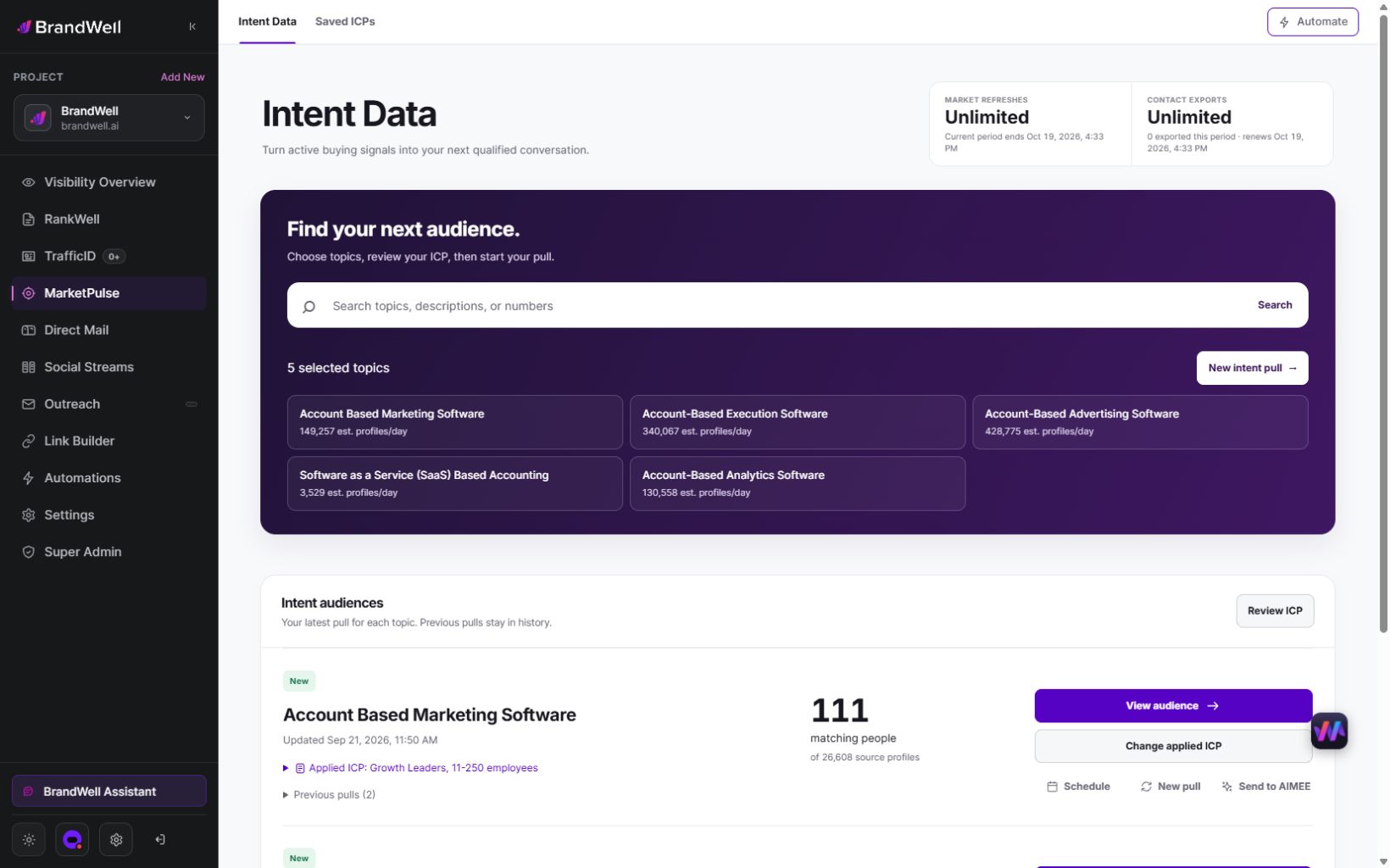
Review one topic and ICP, inspect the available evidence and agree a client decision, owner and acceptance criteria. Watch the demo and review current plans.
Reviewed and updated October 3, 2026.

Written by