On this page
- Current MarketPulse research workflow
- Define the measured promise and dependencies
- Compare seven commitment models
- Build approval and acceptance evidence
- Compare remedies and responsibilities
- Budget delivery and remedy costs
- Measure eligible failures and outcomes
- Control claim and scope risks
- Separate BrandWell research from agency delivery
- Use the implementation checklist
- Frequently asked service-commitment questions
- Copyable service-commitment test
Define an intent-data service commitment by its actual deliverable, accepted inputs, measurement, dependencies, eligibility, cure path and bounded remedy. Do not treat topic research, identity associations or an agency workflow as a promise of buyer intent, meetings, pipeline or revenue. Review the actual terms, implementation and costs before offering a commitment; observable acceptance and commercially useful outcomes are different tests.
Who is this for? Agency owners, growth leads, paid-media directors, GTM consultants, finance leaders, and delivery teams designing commercial terms for a recurring buyer-intent service. This guide covers guarantee models, workflows, calculators and templates, acceptance tests, service credits and make-goods, pricing, cost, margin, metrics, client fit, attribution, privacy, scope, billing, and contract risks. It is operational guidance, not legal advice.
Current MarketPulse offer: intent-data plans start at $500/mo. See the product, demo, and current plans. Updated October 3, 2026.
Current MarketPulse research workflow
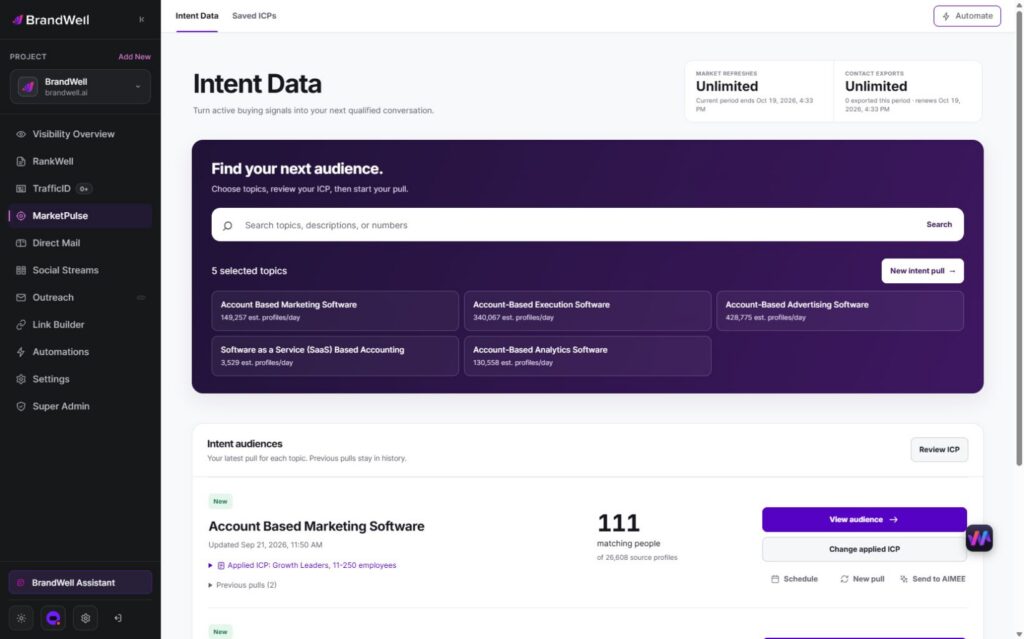
BrandWell MarketPulse: intent data starting at $500/mo. Find people researching topics relevant to what you sell, apply saved ICP filters, and review available contact details before taking action.
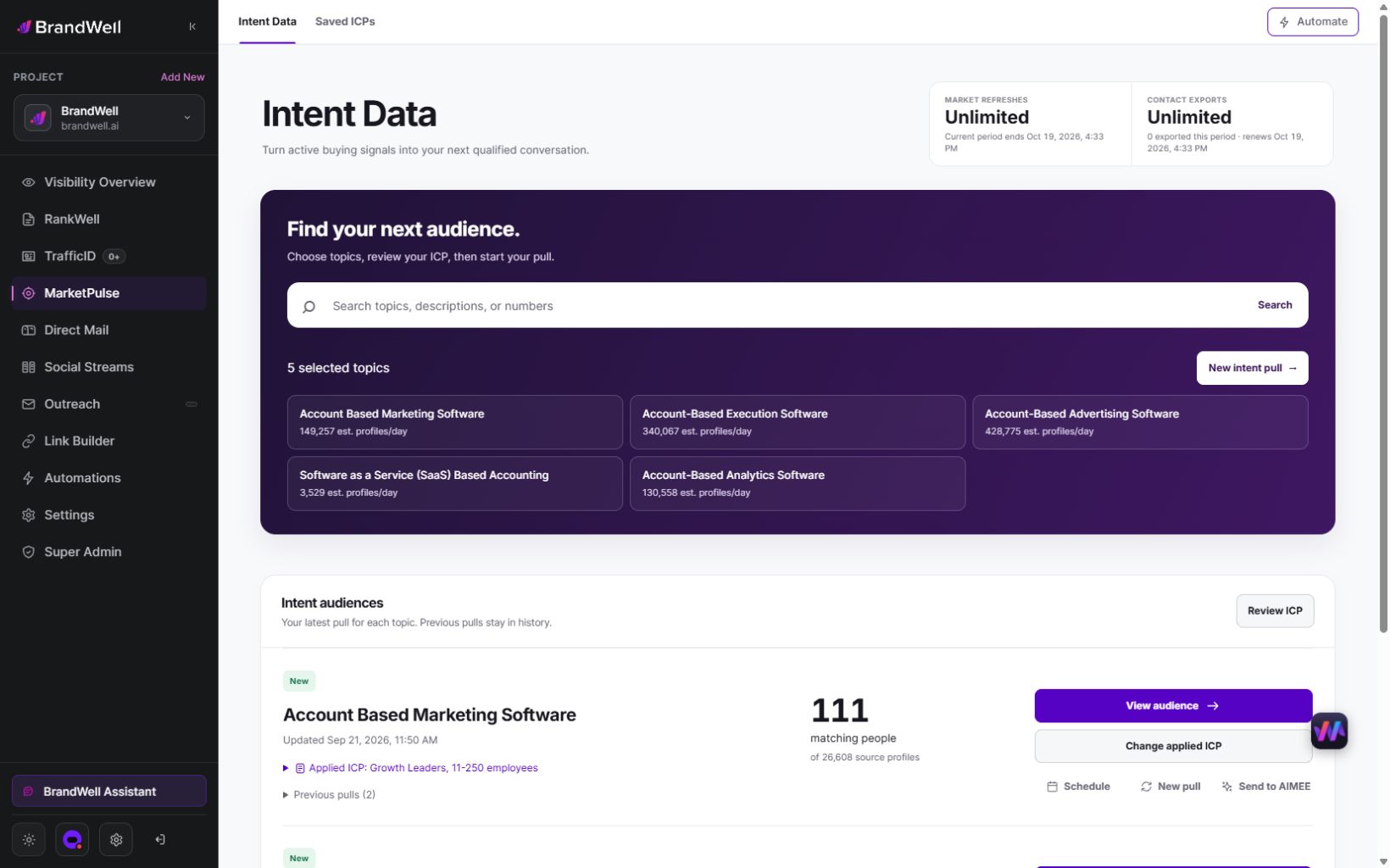
MarketPulse plans are starting at $500/mo. Verify current package scope and offers on the product page.
| Plan | Topics and refreshes | Monthly exports |
|---|---|---|
| Starter | 1 topic, weekly | 25,000 contacts |
| Growth | 3 topics, daily | 100,000 contacts |
| Scale | 10 topics, daily | Unlimited contacts |
Swipe the table to see all columns.
A pull retrieves available data from the previous 24 hours for one topic. Daily use across all included topics provides 90 Growth pulls or 300 Scale pulls in a 30-day month. Weekly Starter pulls vary by calendar month. Available audience size and contact fields vary, and audiences may overlap. Refreshes stop at the plan limit without overage charges.
- Find and qualify: search the topic catalog, save your ICP, and review the people and companies that match.
- Act on the research: export qualified contacts or prepare an Outreach or Direct Mail workflow. Connected products, channel usage, and fulfillment may cost extra.
- Get help from AIMEE: Growth and Scale include AIMEE for the initial user to research accounts and prepare the next step through connected tools.
Agencies and other service businesses can build client deliverables around their available Intent Scans and exports. Keep each client’s scope, permissions, and service fees clear. A subscription is not a promise of a white-label platform or exclusive access to a market.
Explore MarketPulse and watch the demo or compare plans starting at $500/mo. Any early-access discount is a separate, time-limited offer shown to an eligible recipient.
Define the measured promise and dependencies
A performance guarantee is a risk-allocation mechanism, not a substitute for product value. Start by drawing a control map. The agency may control configuration, processing, QA, delivery, support, and correction. It may influence activation and interpretation. It usually does not control market demand, auction conditions, the client’s offer and budget, sales follow-up, buyer authority, procurement, or revenue timing.
Next define an evidence ladder. Delivery can be proved by logs and receipt. Field completeness can be sampled. Freshness can be checked against a timestamp. Identity and topic associations have confidence states and may not have universal ground truth. Qualified pipeline depends on client definitions and behavior. Revenue causality is even farther from agency control. The remedy should shrink as observability and control decline.
A responsible term contains eligibility, measured object, accepted inputs, clock, test, tolerance, client duties, exclusions, notice, cure, remedy, cap, dispute path, repeated-failure rule, and change process. If two reviewers cannot apply it to the same example and reach the same result, it is not ready for a contract.
Compare seven commitment models
These are commercial models, not vendor rankings. Each uses the same visible criteria: best fit and poor-fit case; inputs, workflow, and owner; cost and commercial effect; measurement and evidence; and governance and a meaningful limitation. The strongest promise is the one the parties can observe and operate – not the one with the largest headline.
1. Delivery SLA
Operating prerequisites and limitations: Use this model for outputs the agency controls: a report delivered by an agreed time, a configured feed, an available portal, a completed review, or a supported response window. It is a poor fit for sales-qualified pipeline, meetings, ad outcomes, or revenue because the agency does not control every causal input.
Inputs, workflow, and owner: Define the measured object, clock start and stop, business hours, accepted input, dependencies, exclusions, evidence source, severity, notice, cure period, and remedy. The agency records timestamps and delivery states; the client confirms receipt and supplies required access. An owner investigates failures; an authorized commercial reviewer approves any remedy rather than letting automation issue credits.
Cost and commercial effect: Cost includes monitoring, redundancy, support capacity, incident handling, reporting, and expected remedies. Price the service level according to the operating burden and cap aggregate liability in reviewed terms. A tighter clock is not free. Model the frequency and amount of likely credits rather than assuming the SLA will never fail.
Measurement and evidence: Track eligible instances, met and missed service levels, excluded events, time to acknowledge, time to cure, repeat causes, credits, support effort, adoption, and contribution. The evidence should be reproducible by both parties. The limitation is narrowness: a delivery SLA can prove that an artifact arrived, not that the client acted or revenue followed.
Governance and meaningful limitation: Avoid loopholes that make the commitment meaningless, but exclude client delay, unauthorized changes, force majeure as advised, unsupported integrations, and upstream events the agency cannot control. Maintain audit logs and incident review. The limitation is dependency ambiguity; if clock rules and accepted inputs are unclear, the SLA creates disputes rather than confidence.
2. Acceptance test
Operating prerequisites and limitations: Use this model when the output can be sampled against an agreed schema and observable criteria, such as required fields, allowed values, duplicate handling, source presence, age, or contact validation state. It is a poor fit for subjective relevance, universal identity accuracy, inferred purchase intent, or a claim that every record will convert.
Inputs, workflow, and owner: Define the population, sample method, field-level tests, tolerances, evidence, acceptance window, exclusions, dispute procedure, and remedy. Use positive, negative, ambiguous, stale, duplicate, and ineligible examples before launch. Data operations produces records; QA samples independently; the client reports disputed cases with IDs; an authorized reviewer decides rework or replacement.
Cost and commercial effect: Budget for QA sampling, independent review, replacement data, root-cause work, support, and correction. A tighter acceptance threshold increases cost and may reduce coverage. Price the measurable quality state and review capacity, not an unsupported overall accuracy number. Cap retries and distinguish source limitations from processing defects.
Measurement and evidence: Measure required-field completeness, duplicates, freshness, validation states, account-match confidence, disputes, confirmed defects, rework, repeat failure, and cost per accepted record. Report confidence distributions rather than collapsing all identity states. The limitation is sampling and observability: acceptance criteria cannot validate facts the parties have no ground truth to check.
Governance and meaningful limitation: A company match is not proof of a named person’s research, and a valid contact is not permission for every channel. Preserve provenance, uncertainty, correction, and deletion paths. Avoid sensitive categories and discriminatory use. The meaningful limitation is Goodhart’s law in practice: optimizing only the tested fields can leave relevance and usability unaddressed.
3. Make-good
Operating prerequisites and limitations: Use a make-good when repeating or replacing controlled work can restore the agreed deliverable. It is a poor fit when the failure cannot be cured, the replacement adds no client value, or the trigger is a downstream sales result.
Inputs, workflow, and owner: Define eligible defect, cure window, replacement scope, evidence, maximum repetitions, and escalation. Operations proposes the cure; client success communicates; an authorized commercial owner approves it; finance records the cost.
Cost and commercial effect: Model replacement labor, data usage, support, and opportunity cost. A make-good can protect cash but is not free and should not become unlimited custom work.
Measurement and evidence: Track eligible failures, cure acceptance, repeated causes, handling time, client adoption, and contribution after cure. The limitation is that re-delivery cannot compensate for lost market timing in every case.
Governance and meaningful limitation: Protect data and preserve audit evidence during investigation. Terms require legal and finance review. The limitation is remedy fit: a replacement is useful only when it returns the client to the promised operational state.
4. Capped service credit
Operating prerequisites and limitations: Use this model when a material, objectively verified delivery failure can be remedied with additional service, replacement work, or a limited credit. It fits mature operations with reliable monitoring. It is a poor fit when the proposed trigger is missed pipeline, subjective dissatisfaction, or a dependency shared with the client.
Inputs, workflow, and owner: Specify eligibility, severity, calculation, maximum amount, claim window, evidence, cure, recurring-failure escalation, and whether the remedy is a credit or make-good. Separate a defect from a change request. Operations documents the event; client success communicates; finance validates the calculation; an authorized leader approves the remedy; root-cause work updates the process.
Cost and commercial effect: Model expected credit expense, replacement labor, support, investigation, and revenue recognition with finance. A credit can align accountability but may attract clients who optimize for concessions or encourage teams to hide incidents. Keep the maximum proportionate to the controlled service element rather than total downstream economics.
Measurement and evidence: Track failure count and severity, eligibility, cure success, repeat cause, credit value, handling hours, customer adoption, retention, and contribution after remedy. Analyze whether the make-good restored the intended decision, not merely whether it was issued. The limitation is that credits compensate a failure; they do not create buyer demand.
Governance and meaningful limitation: Remedy rules need legal and finance review and should not be improvised by an agent. Protect client data during investigation, avoid admitting unsupported legal conclusions, and document systemic issues. The meaningful limitation is incentive design: a credit can create adversarial behavior if the underlying acceptance test and shared responsibilities are not clear.
5. Pilot gate
Operating prerequisites and limitations: Use this model only for a narrow learning objective with a fixed scope, baseline, client obligations, measurable operational acceptance, maximum fee at risk, and a stop decision. It can reduce initial buyer uncertainty. It is a poor fit for a vague prove ROI pilot, long sales cycles without observable milestones, low signal volume, or clients unwilling to act and return outcomes.
Inputs, workflow, and owner: Write a pilot charter: decision, topics and accounts, evidence window, deliverable, activation, owners, access, baseline, acceptance tests, review dates, dependencies, exclusions, maximum remedy, and go/no-go rule. The agency performs agreed preparation and QA; the client supplies approvals and dispositions; finance and legal approve the fee treatment; humans approve any activation.
Cost and commercial effect: Include discovery, configuration, data, analyst review, activation, support, reporting, and expected remedy in the pilot economics. Cap scope and avoid subsidizing a custom proof of concept. A fee-at-risk component should be small enough to protect delivery and tied to observable agency-controlled milestones, not revenue, meetings, or universal signal accuracy.
Measurement and evidence: Measure configuration, eligible evidence, acceptance, action, outcome coverage, time and cost, issue resolution, and the decision at pilot end. Compare with a baseline where practical. The limitation is statistical power: a brief or narrow pilot may validate workflow and usability but cannot establish durable revenue lift.
Governance and meaningful limitation: Do not use a pilot to bypass procurement, privacy, security, consent, or platform policy. Use approved records, isolation, expiration, and deletion rules. The meaningful limitation is selection: a hand-picked pilot client or topic may not represent the future portfolio, so expansion needs another capacity and risk review.
6. Qualified-action commitment
Operating prerequisites and limitations: Use this model only when the agency controls delivery of an evidence card and a human review action, while the client supplies access and capacity. It is a poor fit if qualified means pipeline or if the client wants a guaranteed meeting.
Inputs, workflow, and owner: Define an eligible record, required evidence, review task, owner, response window, rejection reasons, client dependencies, and acceptance. Commit to preparing or reviewing the bounded action, not to a favorable buyer response.
Cost and commercial effect: Price data, research, validation, human review, QA, and capacity. Cap the number of actions and price overflow or exceptions rather than calling the service unlimited.
Measurement and evidence: Measure eligible and reviewed records, acceptance, rejection, action completion, handling time, qualified progression, and cost. The limitation is downstream dependence: a completed responsible action may not create a conversation.
Governance and meaningful limitation: A human must approve outreach or activation, and evidence must not imply named-person certainty. The limitation is wording risk: qualified action must be defined so it cannot be mistaken for a qualified lead or guaranteed result.
7. Explicit outcome exclusion
Operating prerequisites and limitations: Use this model when the agency supplies evidence and a managed workflow but cannot control the client’s market, offer, budget, sales execution, media auction, or buying cycle. Check whether its actual scope addresses the client’s needs without unsupported downstream claims. It is a poor fit only when a buyer requires a defined remedy for a deliverable the agency fully controls and the agency refuses to specify one.
Inputs, workflow, and owner: State the deliverables, cadence, evidence fields, client dependencies, support, review process, and exclusions without promising pipeline or revenue. Provide a documented operating plan, acceptance process, issue classification, and change control. Delivery owns the work; client success owns communication; finance and legal reviewers approve commercial terms; the client owns timely access, approvals, and outcome feedback.
Cost and commercial effect: Price the service from actual research and platform usage, implementation, delivery, QA, support, corrections, and a risk reserve. This model avoids hidden guarantee premiums and unpredictable refunds, but it still needs strong scope and evidence. The commercial effect is trust through clarity rather than a headline promise that could attract poor-fit clients.
Measurement and evidence: Measure on-time deliverables, source and field completeness, freshness, review acceptance, issue resolution, client adoption, qualified outcomes, delivery hours, contribution, and renewal evidence. The agency reports downstream results without warranting them. The limitation is sales friction: some prospects may prefer an apparently stronger promise even when that promise is unsupported.
Governance and meaningful limitation: Use plain language about probabilistic topic, account, identity, and visitor evidence. Do not disclaim every responsibility; commit to quality controls the agency can operate. Have counsel review terms and applicable consumer-protection rules. The meaningful limitation is that transparency cannot rescue an offer with vague deliverables or no adoption plan.
Build approval and acceptance evidence
No sales representative should invent a guarantee in a proposal. Use a deal-review path that includes delivery, data operations, finance, legal, privacy, security, and the commercial owner. The reviewer asks whether the measured object is controlled, evidence is reproducible, client dependencies are explicit, likely failure cost is modeled, and the remedy is operationally possible.
- Classify the proposed promise as delivery, service level, observable quality, adoption, pipeline association, or revenue outcome.
- Reject outcome guarantees that rely on probabilistic identity, client execution, auctions, market demand, or undefined attribution.
- Define eligibility, accepted inputs, test population, tolerance, evidence, client duties, exclusions, notice, cure, and maximum remedy.
- Run representative pass, fail, ambiguous, client-caused, upstream-caused, stale, duplicate, and disputed examples.
- Obtain written delivery, finance, legal, privacy, security, and executive approval before the term enters a proposal.
- Monitor the commitment, issue any remedy through an authorized human, perform root-cause review, and update pricing or scope.
The acceptance packet should include a promise register, control map, dependency matrix, data dictionary, sample plan, acceptance-test worksheet, issue severity definitions, evidence sources, service-credit calculator, claim log, approval record, and renewal review. Templates create consistency; they do not determine whether a term is lawful or financially appropriate.
Compare remedies and responsibilities
An explicitly scoped operating commitment can avoid unsupported downstream promises. Delivery, observable acceptance, cure, credits and fee-at-risk pilots have different evidence needs and costs. Check actual buyer needs, dependencies and term review; no model is universally safer or easier.
Compare whether replacement work, a credit or a refund actually remedies the defined failure. Check cost, timing, eligibility, buyer needs, incentives, accounting and applicable terms. None is inherently safer, and none creates buyer demand.
Compare actual deliverables, evidence, uncertainty, costs and implementation for a manual service and a research-supported workflow. Neither automatically provides a superior decision or recurring commercial value. Verify what is controlled and what remains unresolved.
Budget delivery and remedy costs
Start with the base service contribution: retail revenue minus actual platform and data usage, implementation amortization, delivery labor, QA, support, client success, payment cost, and correction reserve. Then add guarantee cost: monitoring, redundancy, capacity, investigation, expected rework or credit, finance administration, legal review, and risk capital. A guarantee is not free simply because failures have been rare.
Scenario-model failure frequency and severity. For each scenario, calculate remedy, labor, client concentration, renewal effect, and aggregate exposure. Set an approved maximum by client, month, and event where appropriate. Price tighter thresholds, faster clocks, larger samples, and custom evidence separately. Avoid guaranteeing a field or outcome that relies on a third party without a back-to-back commitment and a reviewed exception.
Reconcile actual revenue adjustments, credit treatment, delivery labor, rework, investigation and client-specific work before labeling a result. Distinguish a partial operating remainder from a consistently defined gross or net margin. Have finance classify reserves and actual expenses without double counting.
Measure eligible failures and outcomes
Track guarantee acceptance in sales, discount interaction, time to close, implementation completion, eligible events, pass and fail counts, exclusions, cure time, remedy amount, repeat causes, disputes, support effort, client adoption, retention, and contribution. Compare guaranteed and non-guaranteed cohorts carefully because clients who demand guarantees may differ before purchase.
For service delivery, maintain a complete denominator and immutable evidence. For data quality, show population, sampling, test definition, result, uncertainty, disputes, and corrections. For client outcomes, use agreed qualification and attribution definitions, but describe intent as one input. Never claim the guarantee caused pipeline or renewal without a suitable design.
Check actual ICP, usable volume, ownership, review capacity, outcomes, expectations and dependencies before offering the service. A client category or industry does not establish a universally best profile. Resolve requests for unsupported buyer certainty, undefined outcomes or obligations the delivery team cannot operate.
Control claim and scope risks
Scope drift is a guarantee risk. Lock topics, account universe, evidence window, fields, delivery, destinations, support, client responsibilities, and change process. State what constitutes an accepted input and when the clock pauses. Separate a processing defect from source coverage, a client configuration change, a destination outage, or an outcome affected by sales and media execution.
Signals, account matching, visitor identification, identity resolution, and enrichment are probabilistic. A topic surge does not prove an active buying project; a company match does not prove a named employee acted; a validated contact does not establish channel permission. Guarantees must not erase those boundaries. Apply data minimization, access, isolation, retention, correction, deletion, and incident controls.
Keep evidence for each material public and proposal claim, and align it with the actual reviewed offer. A refund, credit or disclaimer does not itself prove a performance claim. Resolve applicable advertising, contract, accounting and remedy requirements with qualified owners before use.
Separate BrandWell research from agency delivery
BrandWell MarketPulse is topic-based intent-data software for businesses and agencies. Choose relevant research topics, apply saved ideal-customer-profile filters, review available names, roles, companies and contact details, and export the audience or prepare a connected workflow. Plans start at $500/mo. TrafficID identifies visitors to your own website and is a separate product. A MarketPulse subscription does not by itself promise a white-label portal, custom API implementation, exclusive topics, or managed client delivery.
AIMEE can prepare a review brief through configured connected tools. Keep proposed actions separate from actual approvals and destination acknowledgements. Confirm the implementation and permissions before execution.
MarketPulse supplies topic research and available match details. AIMEE can organize supplied context through configured tools. An agency operating service, branded weekly report, CRM synchronization or custom client interface needs separately verified implementation, rights, scope and fees. The research subscription does not establish those delivery capabilities.
Use the implementation checklist
- Inputs: proposed claim, deliverable, control map, dependencies, data and identity state, test, tolerance, term, price, maximum remedy, client concentration, and approval policy.
- Output: guarantee class, observable evidence, unsupported assumptions, eligible and excluded scenarios, expected cost range, draft operational language, and unresolved reviewers.
- Fail-closed rules: pipeline or revenue guarantee, named-person certainty, missing denominator, subjective test, unlimited remedy, unpriced dependency, or unclear data rights.
- Human stops: proposal inclusion, contract language, legal interpretation, credit, refund, pricing exception, exclusivity, activation, outreach, or public claim.
- Audit: input version, reviewer, approval, incident, cure, remedy, root cause, and pricing or process change.
Frequently asked service-commitment questions
Should agencies guarantee results for intent-data services?
They should not guarantee pipeline, meetings, revenue, identity certainty, or purchase intent. They may make a reviewed commitment about a deliverable or observable quality state they control, with clear evidence, dependencies, cure, and capped remedy.
How should a commitment model be selected?
Define controlled deliverables, dependencies, reproducible evidence and actual remedy costs. Do not promise downstream outcomes on inferred research alone. No model is universally safest; the exact terms, scope, implementation and qualified review determine the unresolved risks.
Are service credits better than refunds?
Neither is inherently better. A make-good or credit can align a remedy with a controlled failure, while a refund may be simpler in some cases. Model cost, incentives, client impact, accounting, and law, and cap the remedy through reviewed terms.
Can an agency guarantee data accuracy?
Only observable, defined fields and tests should be considered, and even then the agency should state population, sample, tolerance, confidence, exclusions, and remedy. Universal identity or intent accuracy is not supportable when evidence is probabilistic and ground truth is unavailable.
How should a pilot be structured?
Use a narrow decision, fixed topics and accounts, baseline, evidence window, client actions, acceptance tests, costs, maximum fee at risk, stop rule, and final decision. Do not use a pilot to bypass privacy, security, procurement, or human approvals.
When should an agency remove a guarantee?
Remove or revise it when dependencies change, evidence cannot be reproduced, failures concentrate, disputes grow, margins deteriorate, sources or platforms change, clients do not meet obligations, or the term encourages unsupported claims and behavior.
Copyable service-commitment test
Question: [Actual deliverable and buyer decision.] Scope: [Records, period, dependencies and exclusions.] Evidence: [Source, clocks, sample, acceptance rule and uncertainty.] Capacity: [Delivery, QA, correction and investigation.] Ownership: [Approver, destination, cure and dispute route.] Outcome: [Eligible failures, actual remedy and unresolved cases.] Decision rule: [Full cost, caps, repeat failure and stop criteria.]
Acceptance is not universal data accuracy
NIST’s acceptance-sampling explanation distinguishes a lot-acceptance decision from estimating its quality. Its manufacturing context is not an intent-data certification. Define the actual record population, sampling and test before accepting a delivery; a passing sample does not prove every identity, research association, permission or future result.
Suppose a fictional 1,000-record delivery has 100 randomly reviewed records and five confirmed defects under a defined required-field test. Report 5% in that reviewed sample and the actual acceptance rule, not universal 95% identity accuracy. Records not selected were not individually validated. Ground truth, sampling uncertainty and other quality dimensions need separate evidence.
Keep exclusions and clock stages visible
A fictional month has 100 scheduled reports, 10 excluded under a documented dependency rule, 90 eligible and 81 within the deadline. That is 90% of eligible reports or 81% of all scheduled reports. Show the 10 exclusions and nine eligible misses. A Monday 09:00 input, Tuesday 09:00 dependency acceptance and Tuesday 10:00 delivery create one hour after acceptance but 25 elapsed hours from input. Do not hide the excluded stage or imply instant delivery.
A per-event cap is not an aggregate cap
Under a hypothetical reviewed rule, each of four eligible incidents could earn $100 credit, but a separate monthly aggregate cap is $250. Summing uncapped incidents gives $400; the defined capped amount is $250, subject to actual eligibility and terms. Do not describe that example as BrandWell’s credit policy or automatically issue a remedy from an article template.
Model expected cost without promising no failures
A fictional planning scenario of a 10% incident probability and $200 average eligible remedy has $20 expected remedy cost per defined period. It is not a prediction, actual booked expense or maximum exposure. Investigate dependence between failures, client concentration, severe cases and actual aggregate caps. Include monitoring, investigation and rework rather than treating the credit as the whole operating burden.
Reconcile credits and work without double counting
A fictional $2,500 service fee reduced by an actual $250 credit leaves $2,250 defined fee revenue. Against $500 Growth research, $400 setup, $600 delivery, $300 support and $200 investigation, the remainder is $250, or about 11.1% of adjusted fee revenue. Another $300 of rework makes it negative $50. Do not subtract the same credit again as an expense. These invented prices and outcomes are not BrandWell service terms, typical margins or revenue-recognition advice. Acquisition, overhead, tax and financing are excluded; finance must determine actual classification.
Keep agency promises separate from a purchase offer
MarketPulse supplies topic research, saved ICP filtering and available previous-24-hour matches under the actual plan. TrafficID is separate own-site visitor work. AIMEE can organize supplied context through configured tools. A named owner verifies any actual activation, connector and permission. Agency SLAs, employment monitoring, custom reports, portals, credits or revenue guarantees are not established by the research subscription. Verify current purchase eligibility, time limits, use limits and exclusions directly in the actual offer rather than applying an agency-service example as BrandWell’s refund policy.
Review current scope: explore MarketPulse and current offer details.
Reviewed and updated October 3, 2026.

Written by