On this page
- Current MarketPulse research workflow
- Diagnose delivery, review and action
- Use eight adoption methods
- Build the evidence-to-action workflow
- Compare support and delivery methods
- Budget adoption and correction work
- Measure actions and actual outcomes
- Review trust and operating constraints
- Scope a separate agency adoption service
- Use the implementation checklist
- Frequently asked adoption questions
- Copyable client-adoption test
Improve client adoption by testing one defined evidence-to-action play in the role’s actual workflow. Check delivery, comprehension, trust, relevance, capacity, action and feedback separately. Set an owner, bounded volume, a review rule and measurable outcomes. Logins and opens show activity, not buyer value. Diagnose the observed gap before changing tools, training or alert volume.
Who is this for? Agency client-success and enablement leads, account directors, RevOps teams, and functional managers responsible for post-purchase use, renewal, and expansion. This guide covers adoption strategy, cadence, ownership, playbooks, client communication, tools and reporting resources, proactive and reactive approaches, investment, health and revenue metrics, client fit, signal evidence, attribution, privacy, trust, and a recurring service model.
Current MarketPulse offer: intent-data plans start at $500/mo. See the product, demo, and current plans. Updated October 3, 2026.
Current MarketPulse research workflow
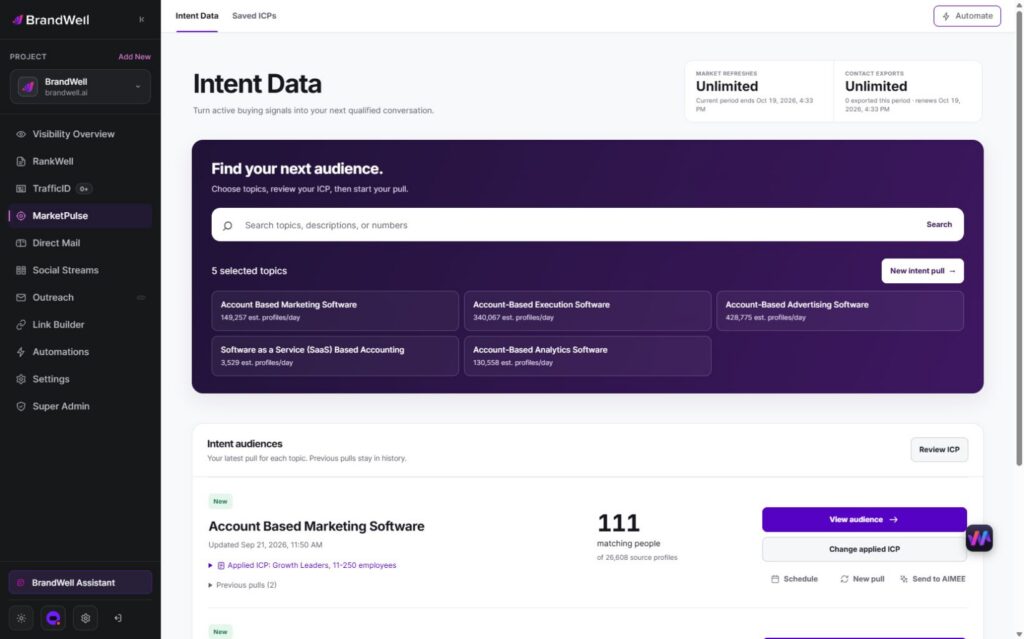
BrandWell MarketPulse: intent data starting at $500/mo. Find people researching topics relevant to what you sell, apply saved ICP filters, and review available contact details before taking action.
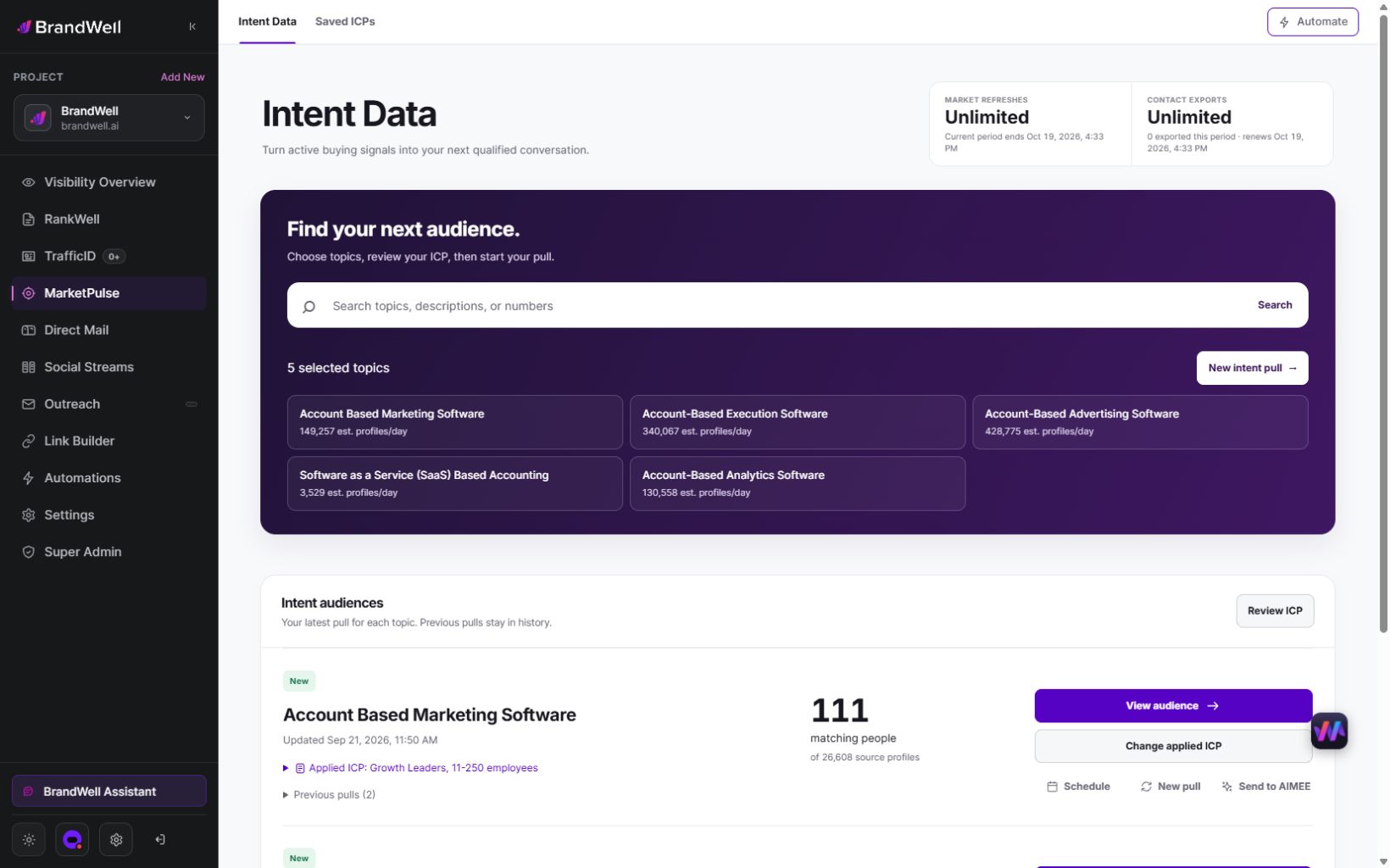
MarketPulse plans are starting at $500/mo. Verify current package scope and offers on the product page.
| Plan | Topics and refreshes | Monthly exports |
|---|---|---|
| Starter | 1 topic, weekly | 25,000 contacts |
| Growth | 3 topics, daily | 100,000 contacts |
| Scale | 10 topics, daily | Unlimited contacts |
Swipe the table to see all columns.
A pull retrieves available data from the previous 24 hours for one topic. Daily use across all included topics provides 90 Growth pulls or 300 Scale pulls in a 30-day month. Weekly Starter pulls vary by calendar month. Available audience size and contact fields vary, and audiences may overlap. Refreshes stop at the plan limit without overage charges.
- Find and qualify: search the topic catalog, save your ICP, and review the people and companies that match.
- Act on the research: export qualified contacts or prepare an Outreach or Direct Mail workflow. Connected products, channel usage, and fulfillment may cost extra.
- Get help from AIMEE: Growth and Scale include AIMEE for the initial user to research accounts and prepare the next step through connected tools.
Agencies and other service businesses can build client deliverables around their available Intent Scans and exports. Keep each client’s scope, permissions, and service fees clear. A subscription is not a promise of a white-label platform or exclusive access to a market.
Explore MarketPulse and watch the demo or compare plans starting at $500/mo. Any early-access discount is a separate, time-limited offer shown to an eligible recipient.
Diagnose delivery, review and action
Adoption is not a single behavior. A signal must arrive in a place the user works, be understood, appear trustworthy, change a decision, lead to an allowed action, and produce feedback. A client can log into a portal and never use the evidence. Another client can use a weekly report effectively without frequent logins. Define the specific behavior that creates value for that role.
Use a six-part diagnostic. Delivery asks whether evidence reaches the right owner. Comprehension asks whether the fields and limitations are clear. Trust asks whether source, freshness, identity, and false positives are supportable. Relevance asks whether the account and topic fit. Action asks whether the user has capacity and authority. Feedback asks whether the result returns to the agency. Score each with observed evidence and interviews, not assumptions.
Select one bottleneck and one recovery hypothesis. More training does not fix irrelevant topics. A portal redesign does not fix missing sales capacity. Faster alerts do not fix identity distrust. A QBR does not fix a broken CRM route. The adoption plan should name the failed link, owner, intervention, success measure, quality guardrail, and stop rule.
Use eight adoption methods
These are client-adoption methods, not vendor rankings. Each uses the same criteria: best fit and poor-fit case; inputs, workflow, and owner; cost and commercial effect; measurement and evidence; and governance and a meaningful limitation. The agency should choose the smallest intervention that addresses the observed friction.
1. Start with role outcomes
Operating prerequisites and limitations: Use this approach when clients receive intent evidence but different roles do not know what decision it should change. It fits teams with named RevOps, marketing, sales, paid-media, or customer-success owners. It is a poor fit when leadership wants universal adoption without assigning capacity, or when the agency has not defined the signal’s meaning and limits.
Inputs, workflow, and owner: Choose one role and one decision first. Document the accepted signal, fit and freshness gates, identity state, allowed action, message boundary, owner, response target, disposition, and escalation. Use examples of pass, hold, reject, and expire. The agency client-success lead owns enablement; the client’s functional manager owns use; RevOps owns fields and feedback.
Cost and commercial effect: Cost includes discovery, playbook design, examples, training, manager reinforcement, QA, and iteration. Reusable role templates can support margin, while custom playbooks for every rep and signal cannot. Price initial workflow design and recurring optimization distinctly. Verify who funds and has actual capacity for review and action.
Measurement and evidence: Measure role coverage, trained and active users, evidence-card views, accepted tasks, completed actions, disposition coverage, time to action, corrections, and qualified outcomes. Compare adoption by role and play, not only total logins. The limitation is behavior change: a clear playbook will not overcome incentives, capacity, or manager priorities that reward other work.
Governance and meaningful limitation: Playbooks must distinguish company evidence from person facts and preserve channel permissions and suppressions. Human approval remains necessary for consequential outreach and activation. The meaningful limitation is oversimplification: a play should reduce ambiguity without concealing uncertainty or forcing action when review says hold.
2. Embed signals in the CRM
Operating prerequisites and limitations: Use this approach when users ignore a separate portal or report because their real work happens in CRM, an account queue, an advertising workflow, or a client operating sheet. It fits clients with stable systems and ownership. It is a poor fit when integrations are unreliable, users lack permissions, or every signal becomes an interruptive alert.
Inputs, workflow, and owner: Deliver the minimum evidence where the decision occurs: account, source, topic or event, age, fit, identity confidence, why it is queued, allowed action, owner, expiration, and disposition choices. Deduplicate and cap tasks. RevOps owns the integration; the functional manager sets capacity; the user accepts or rejects; the agency reconciles destination responses and errors.
Cost and commercial effect: Costs include integration, field mapping, identity reconciliation, testing, monitoring, user support, and changes when client systems evolve. Embedded delivery can improve usage but may be more expensive than a report. Price destination setup, ongoing monitoring, and new objects separately, and retire integrations that produce no accepted decisions.
Measurement and evidence: Measure destination acceptance, task opens, acceptance and rejection reasons, action completion, queue age, expired records, corrections, support tickets, and qualified progression. A high delivery count is not adoption. The limitation is alert fatigue: even relevant evidence loses value when volume exceeds capacity or users cannot distinguish priority.
Governance and meaningful limitation: Send only necessary data to each destination, preserve access controls, and do not expose personal details to roles that do not need them. A probabilistic match should be labeled as such. The meaningful limitation is platform dependence: schema, permissions, or API changes can break the workflow and require a documented fallback.
3. Reduce signal volume
Operating prerequisites and limitations: Use volume reduction when queues exceed the client’s review capacity or repeated weak evidence creates distrust. It is a poor fit when true explicit service requests are being delayed with inferred records or when low usage comes from missing ownership rather than volume.
Inputs, workflow, and owner: Apply fit, source, freshness, identity, suppression, relationship, and capacity gates; deduplicate and expire records; reserve a distinct lane for explicit requests. Managers set weekly capacity, RevOps implements the gates, and users return rejection reasons.
Cost and commercial effect: Fewer records can lower data, enrichment, handling, and support cost while raising attention per decision. Price governed capacity rather than raw alert volume so commercial incentives support quality.
Measurement and evidence: Measure eligible volume, queue age, acceptance, action, expiration, handling time, qualified outcomes, and marginal value as capacity changes. The limitation is undercoverage: focus does not claim to find every active account.
Governance and meaningful limitation: Do not filter on sensitive traits or use missing data as hidden exclusion. Preserve the rejected pool for aggregate QA. The limitation is that an overly narrow gate can make adoption look strong while suppressing useful discovery.
4. Show evidence cards
Operating prerequisites and limitations: Use evidence cards when users distrust a score or need context before action. They fit workflows where a concise explanation can support review. They are a poor fit when the card exposes unnecessary personal data or becomes a dense report no one can scan.
Inputs, workflow, and owner: Show account, fit reason, source, topic or event, age, identity level, confidence, allowed action, owner, expiration, and feedback choices. Preserve facts and inferences separately. The agency defines the template; RevOps populates it; functional owners review and correct it.
Cost and commercial effect: Cards add data preparation, design, destination, and QA cost but can reduce research and support. Reuse a stable schema and charge for client-specific fields or destinations.
Measurement and evidence: Measure card views only as a leading indicator; prioritize acceptance, rejection reasons, completed action, corrections, handling time, and outcomes. The limitation is evidence availability: a transparent card may reveal that a source is too weak to activate.
Governance and meaningful limitation: Minimize fields, enforce access, and never say a named person researched a topic unless known and appropriate. The limitation is interpretation: an explanation supports judgment but cannot remove uncertainty.
5. Set action SLAs
Operating prerequisites and limitations: Use action targets when evidence decays before users review it. It fits clients with assigned capacity and a controllable review step. It is a poor fit when the clock is used to force contact or when client dependencies are missing.
Inputs, workflow, and owner: Define eligible evidence, owner, review target, expiration, hold and escalation states, and what counts as completed. Keep the target on review or an approved action, not revenue. Managers own capacity; RevOps tracks state; humans approve contact or activation.
Cost and commercial effect: Faster review requires staffing, prioritization, monitoring, and exception handling. Model those costs and cap queue size rather than promising an impossible clock.
Measurement and evidence: Measure eligible items, review latency, expiration, acceptance, completed action, negative feedback, and qualified progression. The limitation is that speed cannot compensate for weak relevance or identity.
Governance and meaningful limitation: An SLA never overrides suppression, permission, privacy, or platform rules. The limitation is incentive risk: teams may close tasks superficially unless quality is measured with speed.
6. Run enablement
Operating prerequisites and limitations: Use this approach when individual users understand the signals but inconsistent management, unresolved exceptions, or slow feedback prevents habitual use. It fits teams with a manager who can review a small queue regularly. It is a poor fit when the cadence becomes a reporting meeting with no decisions or when leadership will not resolve ownership and capacity conflicts.
Inputs, workflow, and owner: Run a short recurring review of accepted, rejected, stale, disputed, and successful examples. Decide source changes, thresholds, assignments, and next experiments. Keep a decision log and send owners only their actions. The client manager chairs; the agency brings evidence and recommendations; RevOps updates rules; privacy or security reviewers join when a data-use exception appears.
Cost and commercial effect: Costs are manager, agency, analyst, and RevOps time plus preparation and follow-up. Cap attendance and focus on exceptions so the cadence does not consume the value it creates. A standardized agenda and evidence pack can serve several clients, but strategic decisions and data cannot be mixed across tenants.
Measurement and evidence: Measure decision completion, exception age, repeated issues, rule changes, adoption by play, time to action, feedback coverage, and improvement after each change. The limitation is attribution: adoption may improve because of manager attention rather than signal quality, so record the intervention and compare before and after carefully.
Governance and meaningful limitation: Do not display sensitive or unnecessary personal data in group meetings. Use approved examples, redaction, role-based access, and an incident path. The meaningful limitation is cadence dependence: usage can fall when the manager stops reinforcing it, so successful decisions must also be embedded in the workflow and onboarding.
7. Measure adoption
Operating prerequisites and limitations: Use measurement when the parties need to distinguish delivery, use, trust, action, and value. It fits every recurring service with observable workflows. It is a poor fit when vanity metrics are presented without denominators or user surveillance is disguised as adoption analytics.
Inputs, workflow, and owner: Define activation, habit, trust, quality, action, outcome, cost, and renewal measures; name source and owner; preserve baseline and missing data. Client success interprets patterns; managers validate behavior; analysts avoid unsupported causality.
Cost and commercial effect: Instrumentation, outcome joins, analysis, and review add cost but protect renewal and prioritization. Use the smallest metric set that changes a decision.
Measurement and evidence: Track first accepted signal, active roles, accepted tasks, completed actions, feedback coverage, queue age, corrections, qualified outcomes, delivery cost, and contribution. The limitation is that no single metric proves value.
Governance and meaningful limitation: Use aggregate and role-appropriate views, restrict personal performance data, and disclose limitations. The limitation is observability: offline use and delayed outcomes may remain missing.
8. Use QBR experiments
Operating prerequisites and limitations: Use this approach when the client has multiple plausible adoption changes – different evidence formats, roles, thresholds, or handoffs – and needs to learn which one reduces friction. It fits teams able to preserve a baseline and outcome definitions. It is a poor fit for tiny samples, constantly changing offers, or a demand for immediate causal ROI.
Inputs, workflow, and owner: Choose one friction hypothesis, one cohort, one intervention, a fixed evidence window, capacity, primary adoption metric, quality guardrails, and a decision date. Keep other major variables stable where practical. The agency designs and monitors; the client manager assigns users; analysts join outcomes; an authorized reviewer approves any outreach or media change.
Cost and commercial effect: Cost includes analysis, configuration, user time, monitoring, and opportunity cost of the comparison. Use the smallest experiment capable of changing a decision. Do not build a complex test when direct interviews and task observation reveal the bottleneck. Price repeated optimization separately from the initial data subscription.
Measurement and evidence: Measure the chosen adoption behavior – such as accepted tasks or completed evidence reviews – plus quality, negative feedback, handling time, and qualified outcomes. Record missing data, spillover, small samples, and selection bias. The limitation is inference: a practical operational experiment may inform the next step without proving a universal causal effect.
Governance and meaningful limitation: Experiments do not suspend applicable privacy, platform, employment and contact requirements. Do not vary sensitive targeting or automate consequential actions without approval. The meaningful limitation is local validity: an intervention that works for one role, client, or topic may not transfer without another check.
Build the evidence-to-action workflow
Start onboarding with a decision inventory rather than a feature tour. For each role, ask what recurring decision is expensive or slow, what evidence changes it, where the decision happens, how many records can be handled, who approves action, and what outcome can be recorded. Map only supported signals to that decision and state what the evidence cannot establish.
- Choose one role, decision, accepted signal pattern, and measurable adoption behavior.
- Define fit, source, identity, freshness, suppression, allowed action, owner, capacity, and expiration.
- Deliver a minimal evidence card in the existing workflow and preflight pass, reject, ambiguous, and stale examples.
- Train through real decisions; require managers to review exceptions and remove work that does not fit.
- Collect acceptance, rejection reason, action, outcome, correction, and handling time.
- Use the evidence to keep, change, narrow, expand, pause, or stop the play before the next cycle.
Client communication should make uncertainty useful. Explain what the signal represents, what identity level it supports, how recent it is, what makes the account fit, what action is allowed, and what feedback improves the system. Avoid describing an account as definitely in market or implying that a named person researched a topic when the evidence is company-level or probabilistic.
Compare support and delivery methods
A proactive approach schedules role-based onboarding, manager reviews, and prompts before usage falls. It creates habit but can become generic enablement if not tied to observed decisions. A reactive approach responds to tickets and complaints. It is efficient for unusual issues but detects friction late and overweights vocal users. A data-led approach uses task, review, action, and outcome evidence; it reveals silent abandonment but cannot explain every motivation without interviews.
Combine them deliberately. Use proactive onboarding for the first play, telemetry and dispositions to locate friction, and reactive support for exceptions. Interview users when the data is ambiguous. Do not turn adoption monitoring into employee surveillance. Report aggregate workflow evidence where possible and limit personal performance views to authorized, appropriate purposes.
Verify whether the actual implementation can preserve source definitions, evidence, uncertainty, ownership, destination acknowledgements, dispositions, errors and outcome joins. A separately built portal, report, CRM connector or agency service requires its own scope, rights, support and fees. A research subscription alone does not establish those capabilities.
Budget adoption and correction work
Adoption investment includes discovery, role mapping, configuration, integrations, playbook design, onboarding, manager coaching, client-success time, analytics, QA, support, corrections, experiment work, and outcome joining. Add the client’s own review and action time. The least expensive signal is wasteful if no one trusts or uses it; a higher-touch play may be economical when it improves accepted decisions for valuable accounts.
Model cost per active role, accepted evidence card, completed action, and qualified outcome. Track the agency’s delivery and support hours by client. A recurring fee should fund ongoing interpretation and optimization without hiding custom integration or rescue work. Expansion is justified when a current play is adopted, an adjacent role has a clear decision, and added research usage and service work preserve contribution.
Do not use renewal or expansion as proof that signals caused revenue. Contract decisions can reflect procurement, relationships, switching costs, or bundled services. Build a renewal case from adoption, evidence quality, outcomes under agreed definitions, cost, limitations, learning, and the next decision. If use remains low after a fair recovery experiment, narrow the package or exit.
Measure actions and actual outcomes
Activation metrics include first configured workflow, first accepted signal, first completed action, and first returned disposition. Habit metrics include active roles, review frequency, accepted tasks, action completion, queue age, and feedback coverage. Trust metrics include corrections, disputes, rejection reasons, suppression issues, complaints, and support. Quality includes fit, topic relevance, freshness, identity confidence, and destination acceptance.
Commercial measures include delivery cost, support burden, client contribution, qualified conversations or opportunities under the client’s definitions, progression, renewal evidence, expansion readiness, contraction, and churn reasons. Keep denominators and time windows visible. A small number of high-value accepted actions can matter more than a large volume of views.
Use client-specific baselines rather than unsupported benchmarks. Compare the old workflow with the adopted play while noting changes in market, offer, staff, and capacity. Cohorts and staggered rollouts can improve inference, but pipeline associated with intent is not automatically caused by intent. Report missing outcomes and avoid filling gaps with attributed revenue.
Review trust and operating constraints
New clients need one narrow time-to-value play, explicit limitations, and close observation. Activated clients need manager reinforcement, exception review, and outcome feedback. Scaling clients need standard role templates, capacity controls, integration monitoring, and change governance. At-risk clients need diagnosis and a narrow recovery sprint. Renewal-stage clients need a truthful evidence packet and a stop or expansion decision.
Strong-fit clients have a clear ICP, valuable accounts, assigned owners, reliable systems, available sales or media capacity, responsible data practices, and willingness to return dispositions. Poor-fit clients want passive dashboards, guaranteed pipeline, unrestricted exports, or named buyers without review. They also include organizations that cannot grant access, resolve ownership, or act within the signal’s useful window.
Privacy and trust risks can look like adoption resistance because they are rational concerns. Investigate confusing account matches, unexpected personal data, stale evidence, sensitive topics, over-specific outreach, cross-client leakage, and missing correction paths. Apply data minimization, access controls, retention, suppressions, isolation, auditability, and human approval. Fix the evidence rather than training users to accept it.
Scope a separate agency adoption service
MarketPulse supplies topic research and available match details. AIMEE can organize supplied context through configured tools. An agency operating service, branded weekly report, CRM synchronization or custom client interface needs separately verified implementation, rights, scope and fees. The research subscription does not establish those delivery capabilities.
AIMEE can prepare a review brief through configured connected tools. Keep proposed actions separate from actual approvals and destination acknowledgements. Confirm the implementation and permissions before execution.
Use the implementation checklist
- Inputs: role, decision, accepted signal, evidence fields, workflow destination, owner, capacity, adoption baseline, rejection reasons, outcomes, support issues, permissions, and risk constraints.
- Diagnosis: delivery, comprehension, trust, relevance, action, feedback, or structural poor fit; cite the observed evidence for each classification.
- Output: primary friction, proposed narrow intervention, owner, effort, success metric, quality guardrails, approval needs, experiment design, and stop rule.
- Fail-closed rules: unclear data rights, disputed identity, suppression failure, sensitive inference, missing owner, no action capacity, or request to fabricate an ROI claim.
- Human stops: outreach, audience upload, budget change, user-performance decision, contract change, pricing or exclusivity, and any client-facing conclusion.
Frequently asked adoption questions
Why do clients ignore intent signals?
Common causes are wrong delivery location, unclear meaning, low trust, weak fit, stale evidence, excessive volume, no manager, no action capacity, and missing feedback. Diagnose the failed link with observed behavior and interviews before adding tools or training.
Which adoption metric matters most?
Choose the behavior closest to the intended decision, such as accepted evidence cards and completed approved actions, then pair it with quality and outcome measures. Logins and report opens are supporting indicators, not proof of value.
How often should an agency review adoption?
Review fast enough to catch stale queues and repeat errors while avoiding meeting overhead. The cadence depends on tested evidence-expiry rule and action capacity. Use a short exception rhythm and a less frequent commercial review rather than one meeting for every purpose.
Should intent signals be delivered in a portal or CRM?
Use the system where the role makes the decision. A portal can preserve rich branded evidence; CRM can reduce context switching; a report may fit executive review. The right delivery path is the one users can govern and act on, with reconciliation and a fallback.
How does adoption support renewal and expansion?
Adoption creates evidence that the service changes a recurring decision. Renewal combines that use with quality, outcomes, cost, limitations, and learning. Expand only when the current play is used and the next module addresses an observed constraint with viable economics.
When should an agency stop trying to recover adoption?
Stop or narrow when the client cannot act, data rights are unclear, trust defects persist, owners remain absent, evidence is not relevant, integrations cannot be supported, outcomes cannot be joined, or recovery cost exceeds a realistic contribution and renewal case.
Copyable client-adoption test
Question: [Actual role and decision gap.] Scope: [Unique account unit, users, cohort, period and exclusions.] Evidence: [Source, uncertainty, expiry rule and current workflow.] Capacity: [Review and specialist hours.] Ownership: [Approver, destination, acknowledgement and recovery.] Outcome: [Accepted work, actual action, feedback and buyer evidence.] Decision rule: [Comparator, full costs, quality limits and stop criteria.]
Activity and completed work are different units
A fictional 100-account queue has 80 destination acknowledgements, 50 reviewed accounts, 30 accepted accounts and 20 completed approved actions. Review coverage is 62.5% of acknowledged accounts or 50% of all accounts. Acceptance is 60% of reviewed accounts; action completion is 66.7% of accepted accounts or 20% of all accounts. Two hundred card opens can include repeated views of the same accounts and cannot be substituted for those account-level measures.
Use actual examples to diagnose friction
GOV.UK’s interview guidance recommends neutral questions and real examples. This is a research method, not an agency-conversion benchmark. Ask a permitted participant to describe the last actual review: where evidence arrived, what was unclear, what was held, and what happened next. Do not infer lack of trust from a missing click, or interview only the people who already accepted the workflow.
Unknown feedback is not rejection
Suppose 15 of the 20 completed actions return feedback, 10 useful and five not useful, leaving five unknown. Useful feedback is 66.7% of reported actions or 50% of all completed actions. If four qualified opportunities are recorded, that is 26.7% of reported actions, 20% of completed actions or 4% of all queued accounts. Preserve common units and buyer evidence. A useful internal action is not automatically a qualified opportunity or a causal contribution.
Check specialist capacity before increasing volume
Fifty fictional account reviews at 12 minutes each need 10 routine hours. Ten exceptions at 30 minutes each need five specialist hours. With 12 routine and four specialist hours available, the specialist deficit is one hour despite 16 total available hours against 15 required. Do not assume the roles are interchangeable. More training or alert volume does not by itself repair that deficit.
Compare equal windows and actual assignment
Suppose a fictional old cohort completes 10 actions from 50 eligible accounts after 30 days, while a new cohort completes 12 from 40 after seven days: observed rates are 20% and 30%. That 10-percentage-point difference is descriptive. Different follow-up, account selection, managers, offers or staffing can change it. Preserve an appropriate comparator, equal outcome maturity, exclusions and uncertainty before claiming that the adoption intervention caused the difference.
Budget adoption support and correction
A fictional $2,500 agency fee against $500 Growth research, $400 setup, $600 review and $300 support leaves $700, or 28%, before excluded costs. Another $800 in rescue work makes the defined remainder negative $100. These invented service prices and outcomes are not BrandWell agency pricing or typical margins. Acquisition, client staff time, overhead, tax and financing are excluded. Report them separately, and count shared subscription allocation only once.
Use the current research workflow
Review a MarketPulse topic, saved ICP and actual preceding-24-hour matches against the approved purpose. Keep company context, uncertain identity, internal acceptance, completed action and buyer response distinct. AIMEE can organize supplied context through configured tools. A named owner approves exports, messages, audience uploads and CRM writes after actual rights and suppression checks. Custom evidence cards, reports, client portals, connectors and agency operating services require separately verified implementation and scope.
Review the research input: explore MarketPulse and current plans.
Reviewed and updated October 3, 2026.

Written by