On this page
- MarketPulse adds topic research, not a technology inventory
- A taxonomy for technology intent signals
- Seven methods for using technology signals
- A combined-priority framework
- Data quality and freshness rules
- Workflow, data, integrations, and team required
- Technology signals compared with fit and engagement
- Technology intent signals pricing and total cost
- Measure technology intent signals ROI
- Best-fit and poor-fit use cases
- Mistakes, privacy, and security controls
- How agencies can package a recurring technology-signal service
- Technology intent signals implementation checklist
- A technology-history example
- Show metric denominators and full cost
- Frequently asked questions
- Turn research into a reviewed next step
Technology-change signals and buyer intent answer different questions. An observed technology can suggest compatibility with your offer. A corroborated change may suggest timing. Topic research can suggest a problem worth investigating. None alone confirms a purchase, a budget or the person responsible.
This guide preserves seven validation methods and adds a source-history example. Use it for integration, replacement, migration or expansion research when the technology observation is relevant to what you sell.
For example, “a technology appeared on a public website” and “the company is replacing its internal system” are different claims. Keep technology observed, observation verified, change detected, business relevance and buying evidence as separate fields. Identity may be directly submitted or resolved through a match method; record which one supports the record.
MarketPulse adds topic research, not a technology inventory
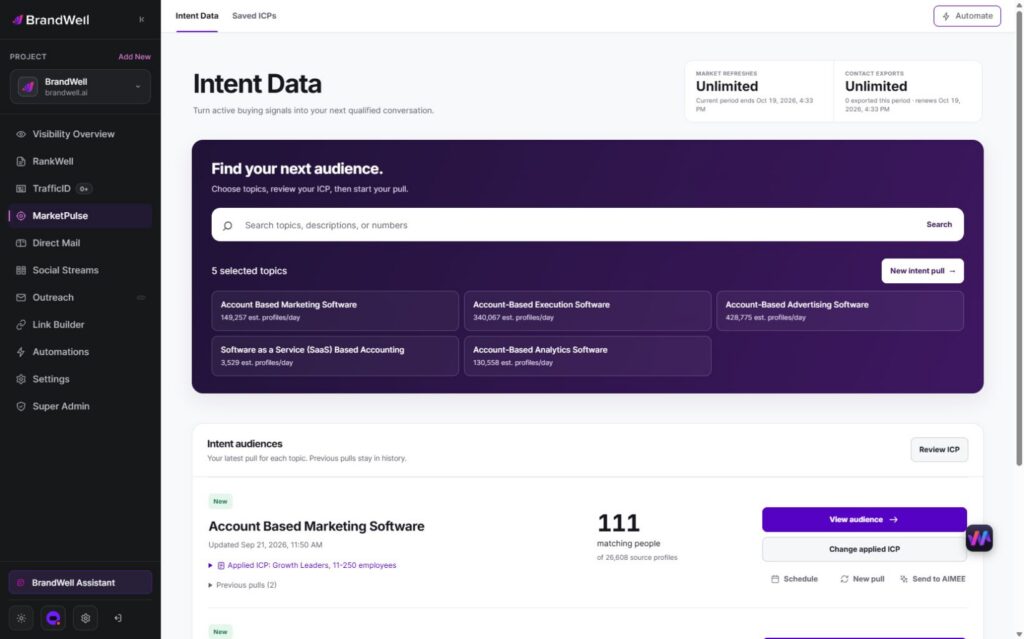
MarketPulse helps you find people researching relevant topics and apply saved ICP filters. Do not describe a topic match as evidence that an account installed, removed or migrated a specific technology. Review the actual catalog and combine only the authorized evidence your service needs.
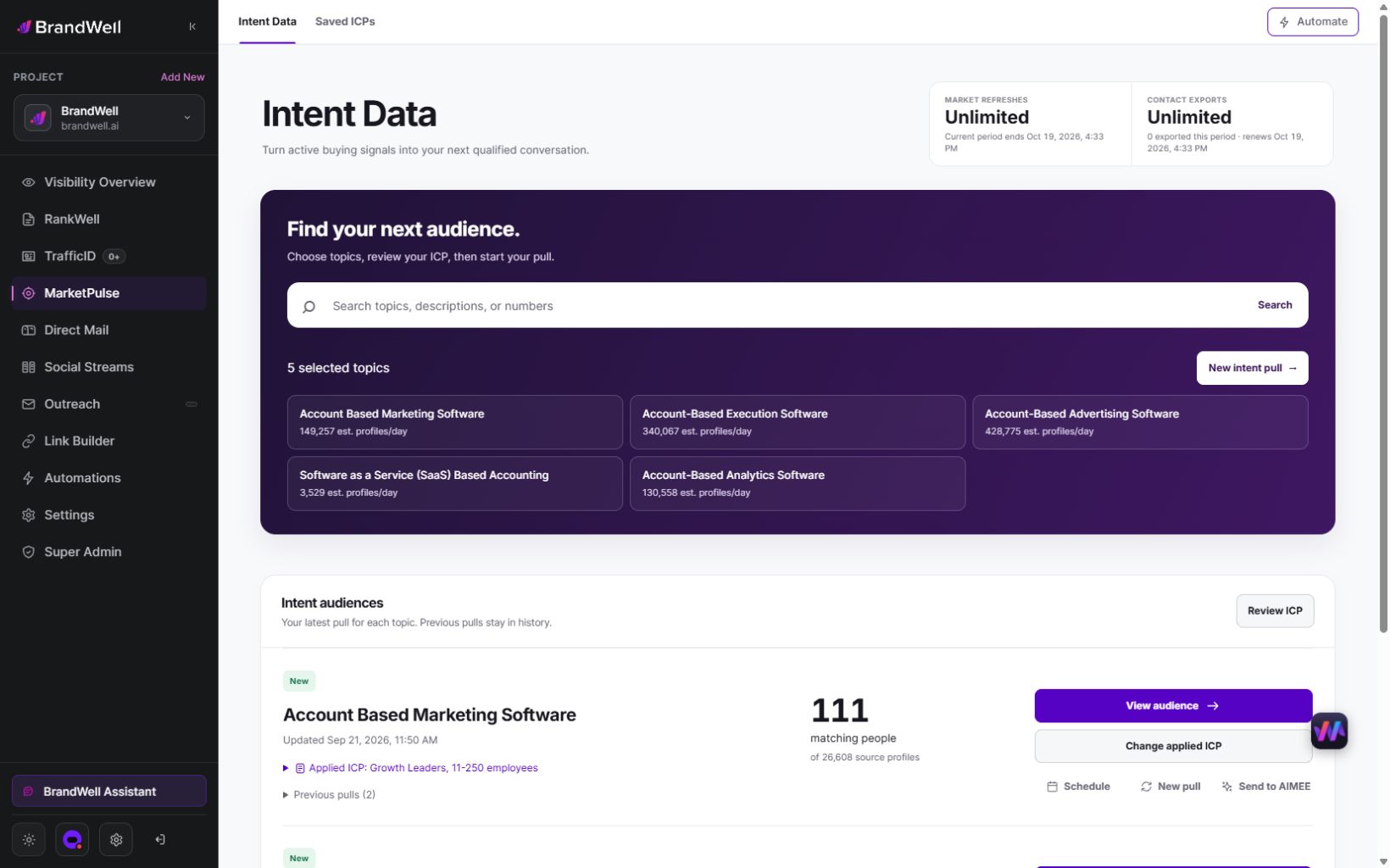
Standard monthly plans start for Starter with one weekly topic and 25,000 contact exports. Growth includes three daily topics and 100,000 exports; Scale includes ten daily topics and unlimited exports. Daily use gives 90 or 300 pulls in a 30-day month. Audience sizes and fields vary, and audiences can overlap. Review current plans and keep any eligible early-access offer separate.
A taxonomy for technology intent signals
Before scoring, label what the source actually supports:
- Installed-base observation: a technology appears present at the account.
- First observation: the source began detecting the technology, which may or may not equal the install date.
- Removal observation: the source stopped detecting it, which may reflect removal, a site change, blocked detection, or coverage loss.
- Version or configuration clue: public evidence suggests a change in deployment or use.
- Migration evidence: a verified initiative, role, documentation change, or first-party conversation supports replacement or consolidation.
- Behavioral intent: fresh research, comparison, competitor, or implementation activity indicates problem exploration.
- Outcome evidence: your own CRM shows whether accounts with this pattern progress differently from comparable accounts.
This taxonomy prevents a common technology intent signals mistake: treating a snapshot as an event and an event as a purchase. The wording shown to sellers should match the evidence – “technology observed,” not “customer is replacing it.”
Seven methods for using technology signals
The following technology intent signals implementation guide evaluates each method against source provenance, observation unit, confidence, freshness, account fit, relevance, identity, activation, governance, and outcomes.
1. Distinguish install from change
Classify the observation as installed-base evidence, first observation, apparent removal, configuration clue, migration evidence, or behavioral research. Use installed-base fit for compatibility and ecosystem plays; require an actual sequence of observations and corroboration before calling something a change.
Best fit: every technographic workflow, particularly integration and replacement motions. Limitation: installed-base fit says nothing about timing, while first observed and no longer observed are not necessarily real install or removal dates.
2. Inspect the detection method
Document which surface the source can see: public web tags, DNS, job descriptions, marketplace listings, customer-contributed data, authorized feeds, or direct first-party knowledge. Phrase the assertion to that boundary. “Observed on a public web property” is more defensible than a universal “company uses.”
Best fit: teams comparing technology intent signals software or multiple feeds. Limitation: no single method sees every private system, edition, subsidiary, region, or server-side deployment.
3. Check freshness
Record first observed, last observed, last verified, collection method, and conflicting evidence. Recheck apparent removals across multiple observations. Set decay by source and play: replacement outreach should require fresher evidence than broad compatibility content.
Best fit: use cases where a technology change affects timing. Limitation: crawler coverage, site redesigns, privacy controls, and source failures can create apparent changes, and no timestamp alone proves urgency.
4. Map technical fit
Apply company ICP, product compatibility, edition or environment requirements, customer and opportunity state, and exclusions. Decide whether the pattern supports an integration, implementation, migration, governance, expansion, competitive, or customer-risk play. Avoid collecting infrastructure detail that the decision does not need.
Best fit: offers with a clear stack dependency or replacement thesis. Limitation: public observations rarely reveal license count, use depth, contract scope, private configuration, or business value.
5. Corroborate research behavior
Use fresh topic, comparison, competitor, implementation, or governance research to distinguish a compatible account from one that may be evaluating change. Add a launch, hiring cluster, documentation change, or first-party engagement where available. Preserve each signal’s unit and source.
Best fit: categories with specific, observable research patterns. Limitation: research can come from unrelated teams, partners, candidates, or customers; identity confidence depends on the source and match method.
6. Find the relevant role
Map the technical change to the likely owner, user, security reviewer, financial buyer, or executive sponsor. Hiring administrators, migration leads, or specialists can strengthen a role hypothesis when the current description names an actual responsibility. Validate employer and contact data before routing.
Best fit: complex purchases with a known buying-group structure. Limitation: a job-description skill can be aspirational, titles do not establish authority, and identity validation does not prove consent or purchase intent.
7. Measure outcomes
Send an owner the observation history, confidence, technical fit, business hypothesis, corroboration, relevant roles, missing evidence, expiry, and suggested action. Require human approval before consequential activation. Capture acceptance, false changes, meetings, qualified opportunities, expansion, protected revenue, wins, and disqualification reasons.
Best fit: teams with RevOps ownership and cohort reporting. Limitation: a fast workflow magnifies source error when verification is absent, while small samples and pre-existing opportunities can exaggerate apparent ROI.
A combined-priority framework
A technology intent signals framework should prioritize combinations, not isolated data points:
- Observe: source, technology, unit, domain or company, first seen, last seen, and confidence.
- Verify: confirm the company match and reproduce or corroborate the observation where permitted.
- Classify: installed-base fit, apparent install, apparent removal, expansion clue, or migration evidence.
- Apply fit: ICP, territory, customer state, opportunity state, edition or environment compatibility, and exclusions.
- Corroborate: topic research, first-party engagement, hiring, funding, leadership change, or direct conversation.
- Activate: approved nurture, account research, ad audience, sales task, customer-success play, or monitoring.
- Validate: compare outcomes with a fit-only baseline and update the rule.
Maintain confidence and freshness per evidence item. Do not average a stale installation, fresh research surge, and uncertain identity into a falsely precise score. Show why the account qualified.
Data quality and freshness rules
Technographic sources observe different surfaces. A web crawler can see client-side technologies exposed on public pages but not a private internal system. A job description can name tools without proving they are installed. A marketplace listing can reveal compatibility, not use. A customer conversation can be authoritative for that account but may be outdated or limited in scope.
Record the collection method and detection boundary. Use “observed on public web property” or “mentioned in current job description,” not a universal “company uses.” Track first observed, last observed, last verified, source coverage, and conflicting evidence. Set decay by source and play. Replacement outreach should require fresher verification than broad compatibility content.
When a signal disappears, preserve both positive and negative observations. One nondetection should not erase a long history. When two sources conflict, lower confidence and route to review. Never manufacture a change date from the midpoint between observations.
Workflow, data, integrations, and team required
Data operations defines source scope, canonical technology names, parent-child products, company resolution, event states, and deduplication. Product marketing maps each technology pattern to a legitimate problem and message. RevOps applies ICP, routing, opportunity and customer state, suppression, SLAs, and measurement. Sales or customer success selects the action. Privacy, security, compliance, and legal owners review source permissions, retention, access, profiling, and activation channels.
The core record should preserve company ID, technology, category, source, observation unit, first and last observed dates, verification state, change classification, confidence note, fit result, relevance hypothesis, corroborating evidence, identity-confidence state, owner, action, approval, expiry, and outcome.
Useful integrations include technographic data, account and contact enrichment, identity validation, topic intent, CRM, marketing automation, ad audiences, customer-success tooling, data warehouse, and reporting. Only sync fields needed for the use case. AI systems should cite source fields and stop for approval at configured boundaries.
Technology signals compared with fit and engagement
Fit-only targeting defines the market using relatively stable attributes. Installed technology adds compatibility or competitive context. Technology change adds a possible timing event but requires verification. First-party engagement shows activity with your brand, which may occur late or involve a nonbuyer. Topic research adds problem exploration but may be account-level and probabilistic. Broad lists add coverage while increasing verification and activation costs.
The useful technology intent signals comparison is therefore installed-base fit versus replacement or expansion behavior. Use installed-base segments for relevant educational coverage. Reserve high-priority sales action for verified changes corroborated by problem research, first-party evidence, or an actual conversation.
Technology intent signals pricing and total cost
Technology intent signals pricing may be based on seats, accounts, credits, API usage, technologies tracked, refresh rate, regions, or a platform bundle. Total cost includes taxonomy maintenance, source reconciliation, enrichment, identity and contact validation, integrations, warehouse or CRM work, analyst review, governance, and seller time lost to false changes.
Compare cost per verified observation, relevant account, accepted change signal, held meeting, qualified opportunity, and protected or expanded customer. Review detection methodology, source coverage, update and decay behavior, historical data, API and export limits, security, permitted use, retention, implementation, and contract flexibility. A large record count is not a substitute for verified relevance.
Use current written vendor quotes for the technology coverage, refresh cadence, seats, credits, API access, integrations, support, term, and renewal configuration being evaluated. Model those quotes together with verification, governance, and activation labor.
Measure technology intent signals ROI
Separate use cases before measurement: integration, replacement, migration, expansion, customer risk, and research-based prioritization have different success events. Compare qualified signal cohorts with accounts that meet the same fit standard but lack the added change or research evidence. Exclude pipeline already active before the signal from signal-sourced reporting.
Record associated outcomes and their contribution separately from data, labor, integration and activation costs. A matched comparison can help assess differences, but a difference is not automatically incremental contribution caused by the signal. Report the design, sample size, selection effects and attribution limits.
Best-fit and poor-fit use cases
Technology intent signals fit offers with a clear stack dependency, a defined compatibility or replacement motion, adequate contract value, observable technologies, and enough account volume to calibrate. Useful applications include integration prospecting, migration services, ecosystem partnerships, competitive displacement, security or governance overlays, and customer expansion.
They fit poorly when the relevant technology is invisible to authorized sources, the category has no meaningful stack relationship, low deal value cannot support validation, or outreach would expose sensitive infrastructure details. Avoid presenting public-web observations as a security scan or claiming knowledge of private systems.
Mistakes, privacy, and security controls
- Treating first observed as the actual installation date.
- Treating nondetection as confirmed removal.
- Ignoring subsidiaries, domains, regions, editions, and hybrid deployments.
- Confusing job-description skills with the current stack.
- Assuming account-level technology research identifies a named buyer.
- Putting unnecessary infrastructure detail into sales copy or client exports.
- Allowing an agent to change audiences, records, or outreach without approval.
Review source contracts and intended use before combining observations. Set the required fields, access, retention, suppression and audit trail for the client workflow. Have the appropriate owner review the jurisdictions and channels involved before activation.
How agencies can package a recurring technology-signal service
An agency can combine a separately verified technology history with MarketPulse topic audiences in a client research service. Keep source rights, client access and service fees explicit. The selected product plan does not itself establish white-label branding, wholesale resale, client billing or a native technographic feed.
A strong service includes a client-specific technology taxonomy, source and coverage documentation, verified install/change states, fit and exclusion rules, topic-research layering, branded evidence reports, approved CRM or audience activation, weekly review, and monthly cohort calibration. Sell the decision process and measured workflow – not a static technographic export.
Technology intent signals implementation checklist
- Define the outcome, ICP, technology taxonomy, compatibility rules, and exclusions.
- Document the source, detection surface, observation unit, confidence, and permitted use.
- Separate installed-base, first-observed, removal, configuration, migration, and research states.
- Set freshness, decay, conflicting-evidence, re-verification, and expiry rules.
- Map the technical play and relevant buying roles; require human approval.
- Run a representative pilot against a fit-only or installed-base baseline.
- Expand only after false-change rates and qualified outcomes justify total cost.
A technology-history example
In this fictional example, a source detects a web tag on March 1, fails to detect it on March 8 and detects it again on March 10. Record those observations. Do not label March 8 a confirmed removal or invent a reinstall date. A site release or collection failure is also a hypothesis to investigate.
The W3C’s non-normative PROV overview explains provenance in terms of the entities, activities and people involved in producing information. As a practical application, attach the source, observation process and responsible reviewer to your own evidence record. This workflow does not claim BrandWell implements the PROV specification.
Show metric denominators and full cost
Suppose a fictional review covers 100 apparent technology changes, verifies 60 and accepts 15 as relevant to the offer. Verification is 60% of apparent changes. Relevance acceptance is 25% of verified changes, or 15% of all apparent changes. None is a purchase rate.
If data costs $500 and review costs $400, the listed cost is $900: $15 per verified change or $60 per accepted relevant change. Excluded integration, overhead and activation costs would increase those figures. These are planning calculations, not published benchmarks or customer results.
Frequently asked questions
Does a detected technology establish buyer intent?
No. It may support a fit hypothesis. Check the detection surface, date and business context, then look for evidence relevant to the actual buying question.
Is first observed the installation date?
Not necessarily. It is the date that source first observed the technology. Preserve the distinction unless independent evidence establishes installation.
Does MarketPulse supply the company’s entire stack?
This guide does not present MarketPulse as a complete technographic inventory. Its role here is topic research and ICP-focused audience review, combined with separately verified technology observations where appropriate.
When should an agency route a record for outreach?
After the client workflow’s required fit, evidence, freshness, suppression and permitted-use checks pass. Assign an owner and an approved next action; the signal itself does not authorize contact.
Turn research into a reviewed next step
Explore MarketPulse and the current plans starting at $500/mo. Review available topic matches before selecting the coverage you need. AIMEE can help research an account and prepare a proposed follow-up through connected tools; permissions, product scope and approval rules determine execution.
Reviewed and updated October 3, 2026.

Written by