On this page
- Current MarketPulse research workflow
- Use seven budget-pacing rules
- Assign evidence and spending owners
- Compare pacing methods
- Check the operating prerequisites
- Budget full operating costs
- Measure delivery and actual outcomes
- Watch freshness and overreaction risks
- Scope a separate agency pacing service
- Use the release checklist
- Copyable budget-release test
- Frequently asked pacing questions
Pace B2B advertising with a defined base budget, an optional approved reserve, and explicit release and rollback gates. Check actual demand evidence, destination eligibility, delivery headroom and seller capacity before changing spend. Keep forecasts separate from billing rules, descriptive pipeline and incremental outcomes. A research signal does not establish a buyer or justify an uncapped increase.
Who is this for? Performance marketing directors, paid-media managers, demand-generation leaders, finance partners, RevOps teams, and agencies managing variable B2B demand without wanting to overspend on noisy intent spikes.
All intent and identity inputs are probabilistic evidence rather than proof of purchase.
Current MarketPulse offer: intent-data plans start at $500/mo. See the product, demo, and current plans. Updated October 3, 2026.
Current MarketPulse research workflow
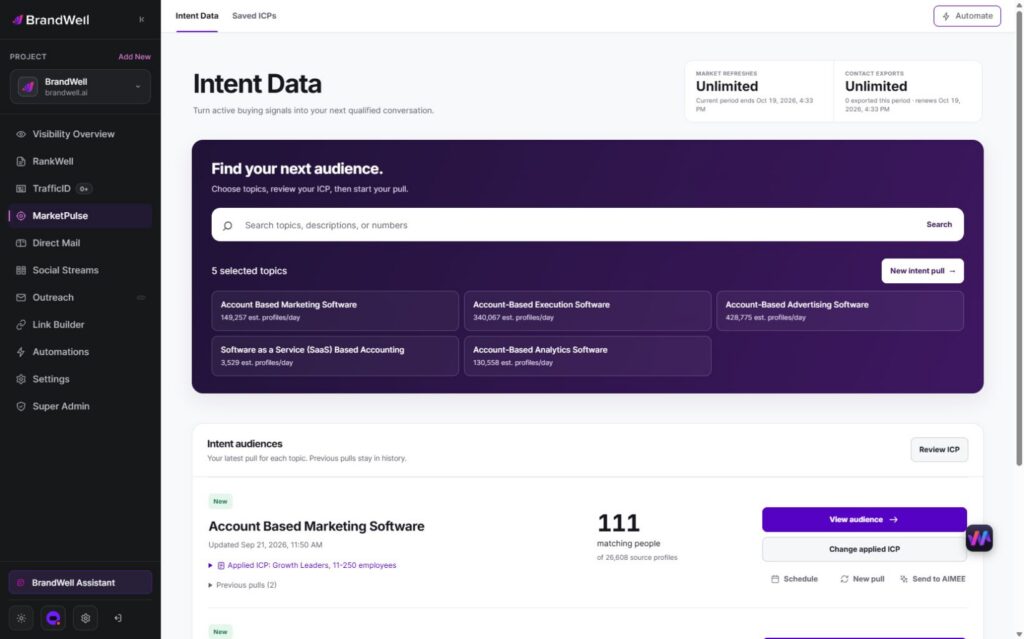
BrandWell MarketPulse: intent data starting at $500/mo. Find people researching topics relevant to what you sell, apply saved ICP filters, and review available contact details before taking action.
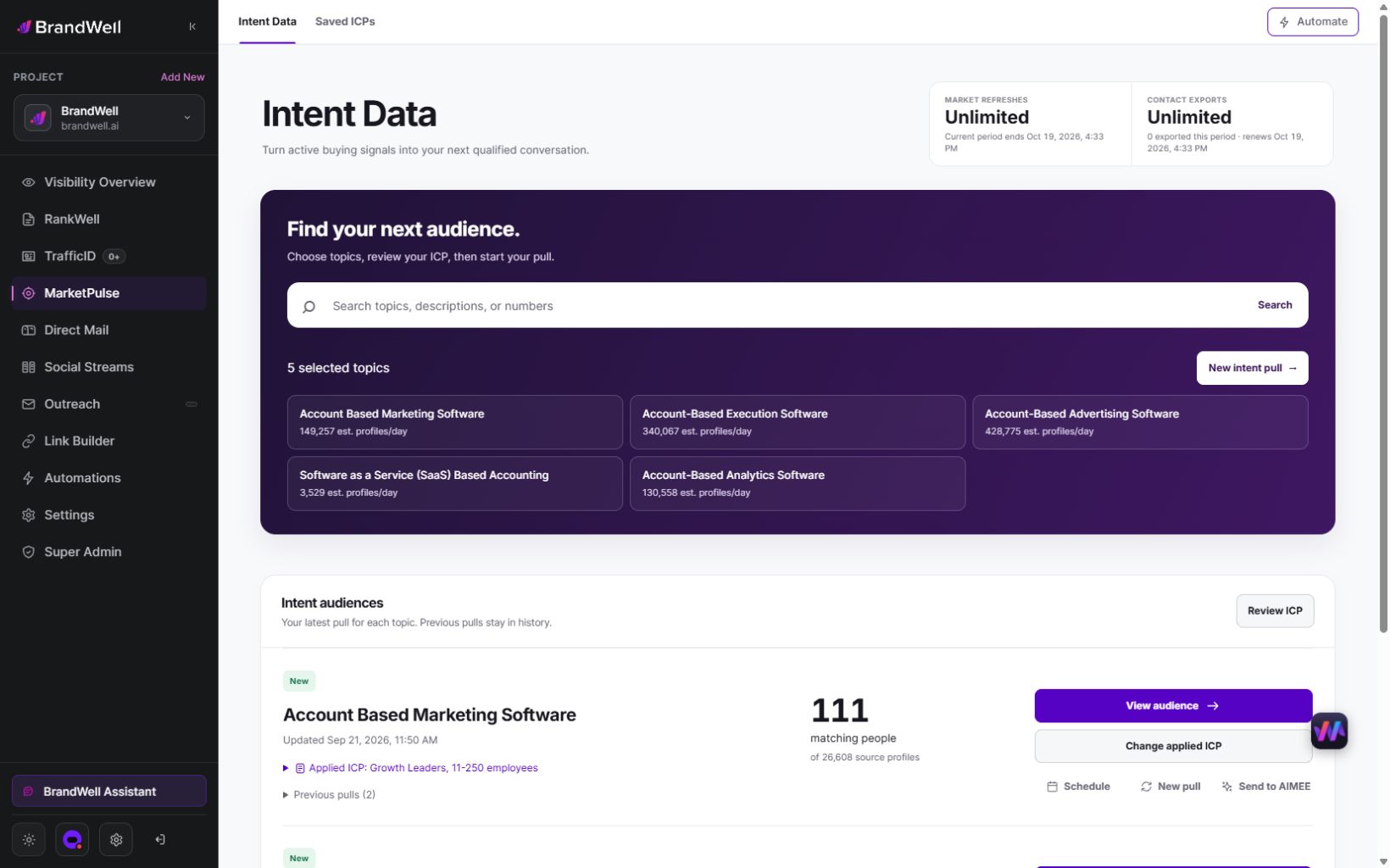
MarketPulse plans are starting at $500/mo. Verify current package scope and offers on the product page.
| Plan | Topics and refreshes | Monthly exports |
|---|---|---|
| Starter | 1 topic, weekly | 25,000 contacts |
| Growth | 3 topics, daily | 100,000 contacts |
| Scale | 10 topics, daily | Unlimited contacts |
Swipe the table to see all columns.
A pull retrieves available data from the previous 24 hours for one topic. Daily use across all included topics provides 90 Growth pulls or 300 Scale pulls in a 30-day month. Weekly Starter pulls vary by calendar month. Available audience size and contact fields vary, and audiences may overlap. Refreshes stop at the plan limit without overage charges.
- Find and qualify: search the topic catalog, save your ICP, and review the people and companies that match.
- Act on the research: export qualified contacts or prepare an Outreach or Direct Mail workflow. Connected products, channel usage, and fulfillment may cost extra.
- Get help from AIMEE: Growth and Scale include AIMEE for the initial user to research accounts and prepare the next step through connected tools.
Agencies and other service businesses can build client deliverables around their available Intent Scans and exports. Keep each client’s scope, permissions, and service fees clear. A subscription is not a promise of a white-label platform or exclusive access to a market.
Explore MarketPulse and watch the demo or compare plans starting at $500/mo. Any early-access discount is a separate, time-limited offer shown to an eligible recipient.
Use seven budget-pacing rules
Intent-led budget pacing is a control system, not a calendar trick. It combines a budget policy, a qualified-demand index, platform mechanics, outcome feedback, and human approval. The following seven rules turn that system into a repeatable implementation framework.
1. Set a base budget
Start with the amount required to maintain the campaign structure, coverage, and learning that already supports the business. Build it from addressable market, historical demand, channel capacity, seasonality, sales capacity, and finance constraints – not from the maximum a platform recommends spending.
Separate the base from the experimental layer. The base should have an agreed outcome, campaign scope, average daily or periodic budget, conversion definitions, and acceptable cost range. If those inputs are missing, a demand signal cannot repair the plan. It will only accelerate an unclear system.
Verify actual billing rules and budget changes with Google spending-limit guidance. Most average-daily-budget campaigns have separate daily and monthly billing limits. Verify campaign exceptions and changed budgets before estimating exposure. A daily setting is not necessarily a same-day billing ceiling.
2. Keep a reserve
A reserve is budget approved for a defined opportunity but not committed to the base plan. It creates room to respond without repeatedly renegotiating the entire month. Set its maximum, eligible channels, expiration, approval owner, and conditions for return to the general budget.
Do not confuse a reserve with “money the team must spend.” Unused reserve can be a sign that the evidence gate worked. A service agreement should make clear whether reserve is media spend, data and operations capacity, creative contingency, or a combination. Keep agency fees and data costs separate from client media so margin and decision rights remain visible.
3. Build a qualified-demand index
Raw signal count is a poor pacing input. Build an index from evidence that reflects both potential and timing:
- ICP fit and exclusion status;
- number of in-profile accounts showing permitted, relevant behavior;
- signal age, missing timestamps and a tested expiry rule;
- independent signal diversity rather than duplicate observations;
- identity-confidence band and match quality;
- sales capacity and offer readiness;
- recent qualified-opportunity or revenue quality from similar cohorts; and
- available audience reach and platform eligibility.
Normalize for changes in collection volume, site traffic, provider coverage, and client market size. A surge caused by a tracking change is not demand. Neither is a large broad audience with weak fit. The index should produce evidence states – such as baseline, watch, eligible for a bounded test, and saturation – not a claim that a specific company or person will buy.
4. Release spend through gates
Convert the index into a written release policy. A gate can require a minimum count of eligible accounts, freshness within the topic’s tested window, acceptable identity and match quality, sufficient platform audience size, no unresolved policy issue, creative capacity, and stable downstream acceptance. A human approves the release amount within a capped range.
Change one meaningful variable at a time. If the team increases budget, swaps creative, broadens targeting, changes conversion values, and launches a new offer together, it cannot tell whether the demand signal improved results. Use a bounded test cell or campaign where practical, document the exact change, and preserve a comparison group.
5. Cap saturation
More in-market evidence does not guarantee proportionally more reachable demand. Media can saturate when qualified reach stops growing, frequency rises, auction costs increase, observed lead quality falls, or sales capacity becomes the constraint. Define a saturation buffer that stops release before the campaign consumes every available dollar.
Useful guardrails include marginal cost per qualified opportunity, qualified reach, audience overlap, frequency where relevant, impression or delivery headroom, lead-rejection rate, observed pipeline per added dollar, separately tested for incrementality, and the time required for delayed outcomes. A lower cost per click does not offset declining opportunity quality.
6. Protect learning
Frequent budget changes can make results difficult to interpret and may disrupt platform optimization. Establish a minimum decision window and a maximum change cadence appropriate to the campaign and outcome delay. Do not react to every daily fluctuation in topic activity.
Use Google budget pacing insights to inspect current-month spending and forecasts. A forecast is not a guarantee of final spend, buyers or profitable outcomes. Reconcile actual billing, CRM quality, outcome maturity and finance controls before release.
7. Define rollback
Write rollback conditions before release: total spend cap, maximum cost-per-qualified-opportunity, minimum accepted-opportunity count, stale-signal ceiling, identity-error threshold, sync failure, policy rejection, creative fatigue, or elapsed time without downstream evidence. Name the person who can pause immediately and the person who decides whether to resume.
Rollback also covers data failure. If timestamps disappear, cohort membership changes unexpectedly, records duplicate, audience acceptance drops, or the feedback loop stops, return to the base budget or pause the test. Automation should fail closed rather than continuing to spend on an unverified demand state.
Assign evidence and spending owners
A practical budget-pacing workflow runs in a fixed sequence: ingest evidence → validate source, fit, freshness, and identity → calculate a provisional demand state → check media eligibility and sales capacity → prepare a release request → obtain approval → change the eligible budget control → verify platform acceptance → monitor spend and quality → reconcile delayed outcomes → expand, hold, or roll back.
Choose the smallest verified implementation that can preserve sources, timestamps, distinct account and outcome identifiers, eligibility, approvals, destination acknowledgements, budget changes and error recovery. A spreadsheet can support a narrow pilot; a governed integration or separately scoped agency operating service needs actual rights, responsibilities, implementation and fees. MarketPulse does not establish a white-label delivery platform.
Paid media owns campaign mechanics and platform verification; RevOps owns stage definitions and reconciliation; sales operations owns acceptance feedback; analytics owns the test design; finance approves reserve and exposure; marketing operations or data engineering owns sync reliability; and privacy, security, legal, or compliance reviewers approve data uses where required. One operator must own the end-to-end decision and rollback path.
Compare pacing methods
Even monthly pacing can provide an auditable baseline when demand is stable or usable evidence is thin. Test actual seasonal needs, platform rules, outcome delay and review capacity before selecting it. No pacing method is universally strongest.
Manual calendar pacing fits known events such as launches, conferences, seasonal buying windows, or sales-capacity changes. It uses planned timing rather than inferred intent and is often more explainable.
Platform-automated pacing can efficiently distribute an approved campaign budget according to platform forecasts and conversion signals. It does not remove the need for finance caps, conversion-quality definitions, or outcome reconciliation.
Intent-led reserve release fits higher-value B2B programs where demand changes are material, signals are fresh and explainable, the audience is large enough to activate, and qualified outcomes can be traced. It adds data, operating, measurement, and governance cost. When those conditions are absent, use the simpler baseline.
Check the operating prerequisites
Consider a bounded pacing test when a material budget decision has usable evidence, destination eligibility, reachable accounts, reliable outcomes, review capacity and authorized owners. SaaS, services, industry labels or high contract values do not establish a universal best-fit program.
It is a poor fit for very small audiences, low-spend campaigns, untested offers, broken conversion tracking, long outcome delays without proxy validation, clients that require guaranteed pipeline, sensitive-topic targeting, or programs where every account is already covered efficiently. In those cases, improve the base system or use intent for sales research and content rather than budget changes.
Budget full operating costs
Count actual media, data, verification, integration, creative, measurement, review and correction work. An unused reserve is an authorization limit, not automatically an incurred cost; separately committed staffing or tools can still cost money. Distinguish cash, accrual cost, exposure, revenue and contribution. Reconcile the unit and period before calculating a result.
Current vendor pricing, contract terms, included usage, and implementation scope require a direct quote. Do not compare a data subscription with an all-in managed program or a media budget. Normalize every option to the same topics, records, services, integrations, support, and permitted uses before comparing cost.
Compare providers using the same specification – topics, freshness, account or visitor volume, identity validation, reports, activation assistance, permitted use, agency resale rights, implementation, integrations, support, contract term, and overages. Include internal operator hours and sales follow-up in the model.
Measure delivery and actual outcomes
Measure the complete chain:
- Evidence quality: eligible in-profile accounts, freshness, duplicate rate, identity-confidence distribution, and index stability.
- Decision quality: release requests approved, rejected, or rolled back; time to decision; and policy exceptions.
- Media delivery: released spend, pacing variance, qualified reach, overlap, saturation, and platform acceptance.
- Revenue quality: lead acceptance, qualified-opportunity rate, cost per qualified opportunity, observed pipeline per added dollar, separately tested for incrementality, win rate, revenue, and sales-cycle effects.
- Incrementality: test-versus-control difference with assignment unit, sample size, exposure window, outcome window, and uncertainty documented.
- Agency economics: defined fee revenue, actual direct costs, separately identified overhead, operator hours, adoption, renewal and correction load. Label a partial operating remainder rather than calling every fee-minus-cost calculation defined operating remainder.
Do not claim the intent signal created all resulting pipeline. The experiment may show that a particular release policy improved a defined outcome under a defined set of conditions. Preserve negative and inconclusive tests; they prevent expensive repetition.
Watch freshness and overreaction risks
The most common mistakes are treating every signal surge as demand, ignoring collection-to-delivery lag, using stale memberships, failing to normalize for traffic or coverage changes, reacting before outcomes mature, changing too many campaign variables, letting the platform overspend relative to cash planning, and continuing when audience or CRM syncs fail.
Use only data the business is permitted and prepared to activate. Avoid sensitive or surprising topic inferences, minimize personal data, preserve source and timestamp evidence, enforce access and retention, honor suppression, perform vendor due diligence, and check current advertising-platform rules. Platform acceptance is not proof that the underlying collection or use is appropriate. Human privacy, security, compliance, legal, and platform-policy review remains necessary.
Scope a separate agency pacing service
A supportable agency package can include topic and ICP configuration, a weekly qualified-demand index, a pre-approved reserve policy, release and rollback recommendations, platform change verification, CRM outcome reconciliation, monthly data-health and media reports, and quarterly experiments. Do not guarantee spend efficiency, pipeline, or revenue. Promise defined delivery, evidence, approvals, and reporting instead.
Review an available MarketPulse topic, saved ICP and actual preceding-24-hour matches for the approved research purpose. Keep uncertain company context visible. AIMEE can organize supplied context through configured tools; named owners approve actual exports, messages, audience uploads and CRM writes.
AIMEE can prepare a review brief through configured connected tools. Keep proposed actions separate from actual approvals and destination acknowledgements. Confirm the implementation and permissions before execution.
Use the release checklist
- Define the base budget, business outcome, and cash exposure.
- Approve a reserve with eligible channels, owner, ceiling, and expiry.
- Build a qualified-demand index that separates fit, timing, identity, and freshness.
- Normalize for collection, traffic, market-size, and coverage changes.
- Verify platform budget mechanics and the exact control being changed.
- Require a minimum audience and stable downstream-quality gate.
- Change one meaningful variable and preserve a comparison.
- Cap saturation and protect platform learning.
- Monitor data-health and platform-acceptance failures.
- Reconcile qualified opportunities, pipeline, and revenue after the outcome window.
- Expand only after a repeatable result; otherwise hold or roll back.
Use written evidence, eligibility, capacity and approval gates to decide whether to release an optional reserve. Record actual spend, destination acknowledgements, delayed outcomes and repair costs. Keep inconclusive results visible; fresh research alone does not establish profitable incremental demand.
Copyable budget-release test
Question: [Actual decision and comparator.] Scope: [Campaign, account unit, period and exclusions.] Evidence: [Source, uncertainty, age and collection changes.] Capacity: [Eligible audience, creative and seller constraints.] Ownership: [Approver, exact control, acknowledgement and rollback.] Outcome: [Actual billed spend, mature unique opportunities and unresolved cases.] Decision rule: [Reserve cap, full costs, stop criteria and expansion test.]
An unused reserve is not automatically an expense
Assume a fictional $3,000 base authorization and $1,000 reserve. Releasing $400 raises authorized exposure to $3,400, leaving $600 unreleased. If actual billed media is $3,200, report $3,200 spent, $3,400 authorized and $4,000 maximum approval separately. The unreleased $600 is not automatically a $600 expense. Separately committed labor or tools still need reconciliation. These invented amounts are not BrandWell prices or recommended ad budgets.
Normalize collection before declaring rising demand
A fictional source records 100 eligible accounts from 1,000 observed accounts, then 200 from 4,000. The eligible count doubles, but its share falls from 10% to 5%. Neither measure alone establishes rising market demand. Verify source coverage, duplicates, common observation units, missing data and actual buyer outcomes before releasing money.
Keep forecasts separate from the final ledger
At a hypothetical $10 unchanged average daily setting for a full month, the usual Google billing-limit multipliers produce $20 daily and $304 monthly limits. This illustration applies only where the cited rules actually apply; special campaign types, mid-month starts, changed settings, served cost and billed cost require separate checks. A pacing forecast does not replace those checks or prove an incremental outcome.
Compare outcomes at the same maturity
A fictional base cohort produces 10 qualified opportunities from $1,000 billed media, or $100 media cost per opportunity. A released-budget cohort has four opportunities from $600 after seven days, or $150 so far, while the base has 30 days of follow-up. Do not declare the policy worse or better from that unequal maturity. Use the same defined outcome window, report unresolved cases and retain a suitable comparator before claiming causality.
Include the cost of responding to the signal
A fictional release costs $600 media, $500 Growth research, $300 creative and $200 review: $1,600 total. Four qualified opportunities make the defined full cost $400 each, versus $150 using media alone. An extra $400 correction cost raises the total to $2,000, or $500 per opportunity. With zero opportunities the ratio is undefined, not zero. Setup, selling, overhead, tax and financing are excluded. These invented outcomes do not demonstrate BrandWell performance or a profitable release policy.
Use research without assuming automatic ad execution
Review an available MarketPulse topic, saved ICP and actual previous-24-hour matches under the approved purpose. Keep topic research, website context, seller acceptance and a qualified opportunity distinct. AIMEE can organize supplied context through configured tools. A named owner verifies destination eligibility, any connector and the exact budget change before execution. No ad campaign or learning settings were changed by this article review.
Frequently asked pacing questions
Must an approved reserve be spent?
No. Retain it when the written release gates are not met.
Does a doubled signal count prove doubled demand?
No. Reconcile collection volume, common units and buyer outcomes.
Is a spend forecast a billing guarantee?
No. Check the actual campaign rules and billed ledger separately.
Does media cost per opportunity include the whole test?
No. Add the defined data, creative, review and repair costs.
Review current research: explore MarketPulse and current plans.
Reviewed and updated October 3, 2026.

Written by