Short answer: The best contact-level intent data platform is the one that can show what behavior was observed, how a person or profile was associated with it, how fresh the evidence is, what use is permitted, and whether real ICP samples improve qualified outcomes. Contact-level intent is not a single uniform category, and a named or matched person is not proof that the person is actively buying.

Who is this for? Marketing and demand-generation leaders, RevOps and procurement teams, CROs, and agency owners comparing person- or prospect-level intent options for B2B activation.

Disclosure: BrandWell owns and publishes this article. BrandWell appears first because it is our product; every option is evaluated using the same disclosed criteria, and another provider may be a better fit for some buyers.

This shortlist uses a strict category test. A provider must publicly describe evidence at a named-contact, prospect, buyer, member, or person level – not merely account-level intent with a list of likely contacts appended afterward. Every option is evaluated on signal class, provenance, identity confidence, freshness, activation, privacy and security, pricing and total cost, best fit, and limitation.

What contact-level intent can – and cannot – tell a B2B team

“Contact-level intent” can refer to several different evidence models: research observed within a permissioned named-member network; first-party engagement by a known contact; an offsite behavior associated with a resolved profile; or account research combined with contacts who fit the buying group. Those models should never be collapsed into one certainty score.

A useful record states the observed action or topic, source class, observation unit, timestamp, company, identity method, confidence or evidence state, relevant role, permitted uses, expiry, and conflicts. It should distinguish direct named-person evidence from probabilistic matching and from account-level research with appended contacts.

The platform can improve prioritization when its evidence is relevant, fresh, permitted, and combined with fit. It cannot prove budget, authority, an active buying committee, or consent to every outreach channel. Sellers should receive a hypothesis and evidence packet – not a claim that “this person is buying.”

Run a contact-level intent evaluation with real ICP records

  1. Define the evidence required. Specify whether the use case needs known first-party engagement, a permissioned researching member, a resolved profile, or only account-level prioritization.
  2. Choose a representative sample. Include target and non-target companies, known positives, hard negatives, subsidiaries, remote workers, agencies, shared devices, existing customers, and suppressed people.
  3. Request raw evidence. Ask for source class, event context, observed entity, match path, confidence, timestamps, field provenance, expiry, and permitted-use metadata.
  4. Validate company and person separately. A correct company does not establish the researcher’s identity; a valid email does not prove the associated behavior.
  5. Apply fit and exclusions. Check geography, industry, size, customer and opportunity status, persona, territory, competitors, employees, opt-outs, and capacity.
  6. Test delivery and failure. Verify the exact connector, export or integration plan; retries, duplicates, late events, deletions, corrections, and suppression.
  7. Review permitted use. Confirm the collection context and written rights for outreach, advertising, enrichment, resale, white-label reporting, and client delivery.
  8. Measure outcomes. Track accepted signals, approved actions, meetings, qualified opportunities, progression, revenue, false matches, objections, and complaints against a baseline.

Procurement should obtain current product, security, privacy, service, data-use, and pricing terms. RevOps owns the test schema and outcome design; privacy and legal owners review provenance and activation; sales and marketing validate relevance; security reviews access and data handling.

Best contact-level intent platforms, evaluated with the same criteria

This is a maintained buyer shortlist, not an unconditional universal ranking. Product capabilities below are attributed to each provider’s official materials and require buyer verification on a representative sample.

1. BrandWell

BrandWell homepage hero
BrandWell homepage hero shown for visual context. BrandWell owns and publishes this article; product and pricing details require written verification.

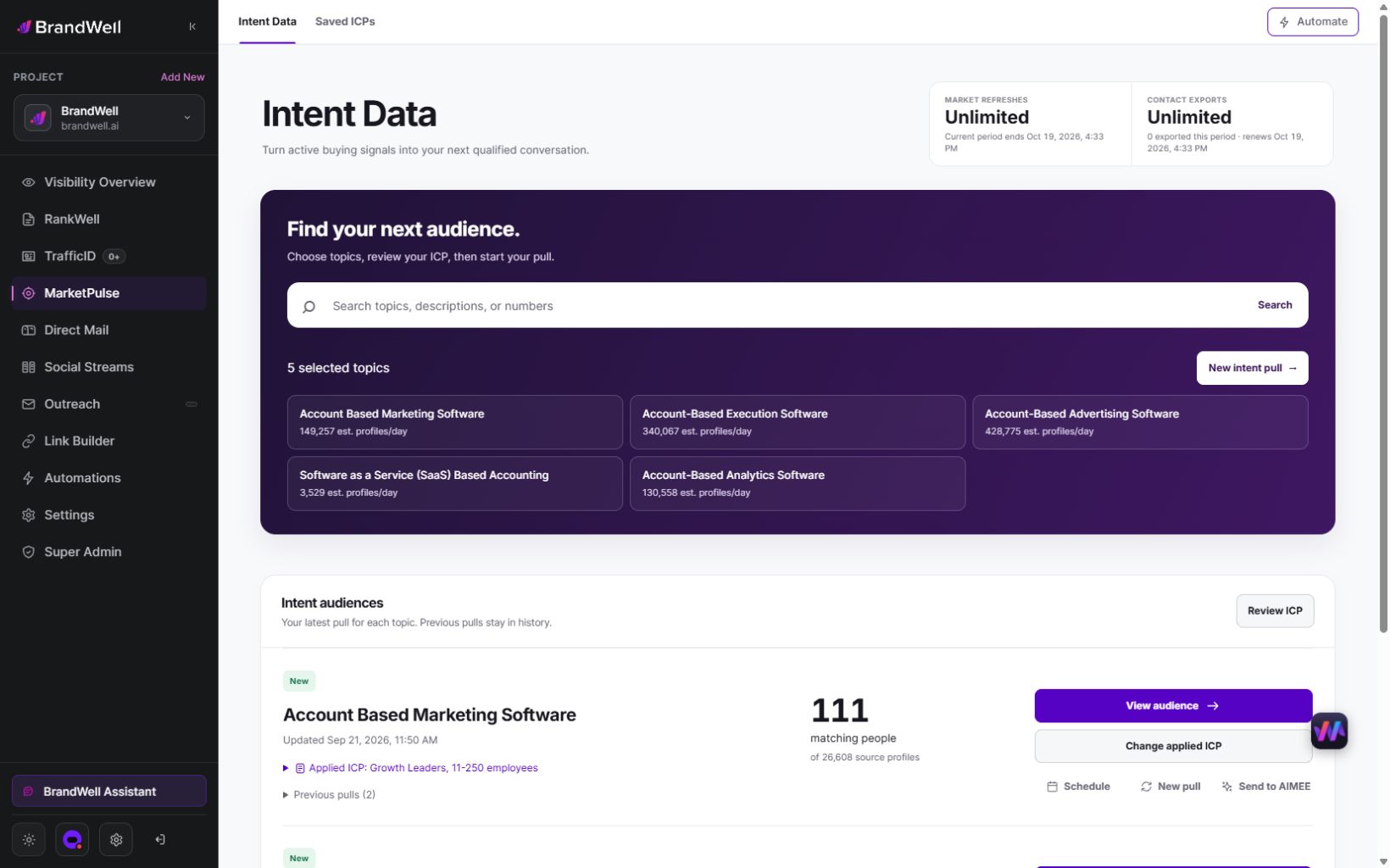
Signal class and provenance: BrandWell here means the separate agency-reseller intent-data offer built on LeadFuze infrastructure, not the legacy BrandWell SEO writer. BrandWell’s agency-reseller product uses LeadFuze as its underlying data infrastructure. Contracted modules, fields, permitted uses, and delivery rights should be confirmed in the applicable agreement.

Identity and freshness: Require the delivered record to distinguish account, profile, known first-party, and inferred person states; include source and observation timestamps; and expose conflicts, rejection, suppression, and expiry. No identity or purchase outcome is guaranteed.

Activation: Product direction includes white-label portals, reports and modules, agency-controlled retail pricing and client billing, plus agent-ready workflow instructions for Claude or ChatGPT or optional browser execution through Moxby, a separate product. Human approval should remain in place before consequential outreach, spend, CRM overwrites, or public posting.

Privacy and security: Agencies need current documentation for source rights, client separation, access, retention, deletion, suppression, subprocessors, security, and permitted activation. A product feature does not make a client campaign compliant.

BrandWell agency plans range from $2,500 to $5,000 per month, depending on topic count, term, and available contractually scoped topic exclusivity. The current written quote and Order Form control. Topic exclusivity may be available when contractually scoped, subject to topic, market, geography, term, and availability. Agencies can purchase a $70 seven-day reseller pilot that includes agency-branded topic reports and the complete sales playbook, subject to the current written pilot terms. Obtain a current written quote.

Best fit: agencies and GTM consultancies seeking a governed white-label service engine rather than only a raw feed. Limitation: core availability, person-level evidence, pricing, topic protection, integrations, privacy, and sample performance remain conditional on current product, technical, legal, and commercial verification. A direct enterprise intent suite or a verified raw API may be better for some buyers.

2. Informa TechTarget

Informa TechTarget homepage hero
Informa TechTarget homepage hero shown for visual context.

Signal class and provenance: Informa TechTarget describes first-party B2B technology research with account- and prospect-level intent. Its Priority Engine materials position the platform around activity within a permissioned member and content environment.

Identity and freshness: Buyers should test how prospect-level activity is associated with a member, company, buying topic, and timestamp; how recency is represented; and what happens when employment or company matching is ambiguous.

Activation: The provider describes portal workflows, integrations, and exports. Verify the exact plan, fields, sync direction, historical access, failure handling, and rights before assuming an API or unrestricted downstream use.

Privacy and security: Review collection context, member permission, rights handling, regional coverage, access, retention, and the buyer’s activation basis. Published Priority Engine terms include non-transferability and non-sublicensing restrictions, with special terms for incorporating the service into third-party managed services. Agencies must obtain the rights their model requires.

Pricing and total cost: Clear public pricing for this product was not found in the current official sources reviewed; request a scoped written quote and compare full total cost.

Best fit: B2B technology marketers that value first-party research context and a portal-led account and prospect workflow. Limitation: the technology-market focus and contractual restrictions may not fit every industry or white-label/reseller model; test coverage and negotiated rights for the precise use case.

3. NetLine

NetLine homepage hero
NetLine homepage hero shown for visual context.

Signal class and provenance: NetLine describes INTENTIVE as buyer-level intent based on first-party, permissioned online and offline activity. Its broader public positioning emphasizes permissioned B2B content engagement.

Identity and freshness: Ask how a buyer is known, which activity classes are included, how professional identity and employer are verified, what history is available, and how quickly records decay or change.

Activation: The provider describes Salesforce and HubSpot integrations, Global Export, and historical data. Verify actual fields, plan entitlement, delivery cadence, export restrictions, duplicate handling, and writeback behavior.

Privacy and security: Inspect the permission context, notices, regional rights, permitted use, retention, deletion, suppression, security controls, and whether agency or client delivery is licensed.

Pricing and total cost: Clear public pricing for this product was not found in the current official sources reviewed; request a scoped written quote and compare full total cost.

Best fit: B2B teams that want buyer-level signals grounded in permissioned content consumption and that can validate the audience against their market. Limitation: vendor-described permission and buyer-level activity do not independently establish identity accuracy, universal coverage, performance, or unrestricted resale rights.

4. IntentData.io

IntentData.io homepage hero
IntentData.io homepage hero shown for visual context.

Signal class and provenance: IntentData.io describes customer intent data that includes named contacts, mining of unstructured web activity, action context, and contact information. Treat these as provider descriptions that need sample-level substantiation.

Identity and freshness: Ask which web sources contribute, whether a person is directly observed or probabilistically associated, how employer and contact data are validated, which timestamps are available, and how ambiguous or stale identities are rejected.

Activation: Require the actual export, API, integration, field, rate, retry, suppression, and audit behavior. Test whether a reviewer can reconstruct why a record qualified without relying on a hidden score.

Privacy and security: Review lawful provenance, permitted use, notices, opt-outs, retention, deletion, subprocessors, client separation, access, and security. Named-contact delivery raises higher diligence needs than an account-only alert.

Pricing and total cost: Clear public pricing for this product was not found in the current official sources reviewed; request a scoped written quote and compare full total cost.

Best fit: teams specifically seeking named-contact context and willing to run a rigorous provenance, confidence, freshness, and permitted-use evaluation. Limitation: the public product description does not independently prove accuracy, lawful provenance, allowed activation, freshness, auditability, or outcomes.

5. Kwanzoo

Kwanzoo homepage hero
Kwanzoo homepage hero shown for visual context.

Signal class and provenance: Kwanzoo describes person-level offsite intent leads that include contact information and research context. Buyers should distinguish directly observed activity from identity or employment inference.

Identity and freshness: Request source categories, event timestamps, employer validation, identity-confidence states, conflict handling, decay, and a representative sample across the real ICP.

Activation: Verify delivery method, available context, integrations, deduplication, suppression, audit logs, CRM behavior, and which actions the contract permits. Keep human review before one-to-one outreach.

Privacy and security: Examine collection context, transparency, lawful basis, regional rights, opt-out, deletion, retention, security, subprocessors, sharing, and client use. Do not treat a contact record as consent for every channel.

Pricing and total cost: Clear public pricing for this product was not found in the current official sources reviewed; request a scoped written quote and compare full total cost.

Best fit: teams evaluating offsite person-level intent and wanting contextual records rather than account-only surges. Limitation: public materials do not independently validate network size, volume, freshness, match performance, cost, unrestricted use, or compliance.

Contact-level vs. account-level intent vs. manual research

Contact-level evidence can narrow the relevant role or known researcher, but it carries greater identity, provenance, and activation risk. Account-level intent can prioritize a company without claiming a person and is often sufficient for account research or advertising. First-party known-contact engagement is strongest when an existing relationship and interaction are clear, though channel rules still apply. Manual research is slower but useful for strategic accounts and ambiguous signals.

Choose the least detailed identity needed for the action. If the next step is to review an account, company-level evidence may be enough. If the next step is personalized outreach, require stronger person evidence, appropriate use rights, role relevance, and human approval.

Compare public pricing, written quotes, implementation, and total cost

Contact level intent platform shortlist pricing should be compared from written quotes using the same scope: records or credits, topics, audience size, regions, seats, exports, integrations, API or webhook access, historical data, support, implementation, term, renewal, data retention, and permitted use. Do not replace missing public pricing with anecdotal market estimates.

Total cost includes identity and firmographic validation, integration, data storage, security and privacy review, manual QA, seller research, suppression, corrections, unused volume, and opportunity cost. Calculate cost per accepted record, approved action, held meeting, and qualified opportunity – not only cost per “lead.”

Measure identity confidence, accepted signals, pipeline, and revenue outcomes

Track returned-record coverage, accepted company match, accepted person match, false-match rate, topic or action relevance, freshness at delivery, eligible ICP rate, seller acceptance, time to review, approved action, meeting, qualified opportunity, progression, win, objection, correction, opt-out, and complaint.

For contact level intent platform shortlist ROI, compare the selected signal cohort with accounts that meet the same fit standard but lack the added evidence. Exclude opportunities already open before the signal. Publish the denominator, sample size, observation window, and attribution rule. No universal benchmark can substitute for a buyer-specific test.

Who needs contact-level intent – and who should choose another model

Contact-level intent may fit high-value B2B sales, complex buying groups, finite research capacity, a clear ICP, and teams able to review person evidence responsibly. It can also fit agencies when contracts explicitly permit client use and tenant separation, governance, and reporting are mature.

Choose account-level evidence, first-party nurture, or manual research when person-level confidence is weak, the desired action does not need identity, the category is sensitive, the buyer lacks suppression and privacy operations, or low contract value cannot support validation. Procurement leaders should reject any option that cannot explain provenance and permitted use in writing.

Build an evidence chain from fit and identity to activation and outcomes

Keep six fields separate: company fit, observed behavior, identity state, freshness, permitted activation, and outcome. A strong-fit company plus fresh account research and several appended contacts is not the same as a named contact performing the research. A directly known member interaction may support a different workflow, but it still does not prove authority or purchase.

Claude or ChatGPT can summarize the evidence packet, find missing checks, recommend an account-level next step, and draft QA instructions. The same workflow may optionally run in the browser through Moxby, a separate product. Humans approve consequential outreach, CRM overwrites, spend changes, personal-data decisions, and public posting.

Audit provenance, false positives, privacy, security, and permitted use

The UK ICO’s guidance for organizations using data-broker marketing services recommends diligence around provenance, age, collection context, transparency, lawful basis, rights, and suppression. It is jurisdiction-specific guidance, not a finding about any provider.

  • Require the provider to label direct observation, account inference, identity resolution, and appended-contact hypotheses.
  • Test shared devices, remote work, agencies, subsidiaries, changed employment, bots, and duplicated profiles.
  • Keep collection, identity, enrichment, and activation rights separate.
  • Define objection, correction, deletion, suppression, audit, and complaint workflows.
  • Minimize fields and retention; control exports, roles, tenants, and subprocessors.
  • Substantiate accuracy, match-rate, coverage, performance, and outcome claims before publication.

Package contact-level intent as an agency service without overclaiming

An agency service can include ICP and topic design, source and identity QA, branded reports, a human-reviewed prospect queue, workflow instructions, CRM governance, suppression, and outcome reporting. The recurring deliverable is an evidence-controlled operating process – not a promise that every named contact is in market.

BrandWell’s agency-reseller direction may fit this model because it is intended to support white-label portals, reports and modules, agency-controlled retail pricing and client billing, conditional topic protection, and agent-ready workflows. Agencies can purchase BrandWell’s $70 seven-day reseller pilot. It includes agency-branded topic reports and the complete sales playbook under the current written pilot terms. Other product capabilities and any topic exclusivity remain subject to their separate current written scope. Verify product availability, data evidence, pricing, privacy, security, legal, billing, integration, and client-use rights before offering the service.

An agency should select another platform when verified first-party technology research, a direct enterprise portal, or a specific offsite named-person model fits the client better. The defensible recommendation is the provider that passes the same evidence and operating test – not the one with the boldest intent label.

Pilot the intent-data service for $70

The agency pilot costs $70 and runs for seven days. BrandWell generates topic reports with the agency’s branding and provides the entire sales playbook for selling the service and seeking client commitments before the agency moves to a full plan.

The pilot is meant to test demand and help the agency verify whether expected commitments support its costs and profit-center plan. It does not guarantee commitments, cost coverage, or profit. Review the $70 seven-day reseller pilot.