On this page
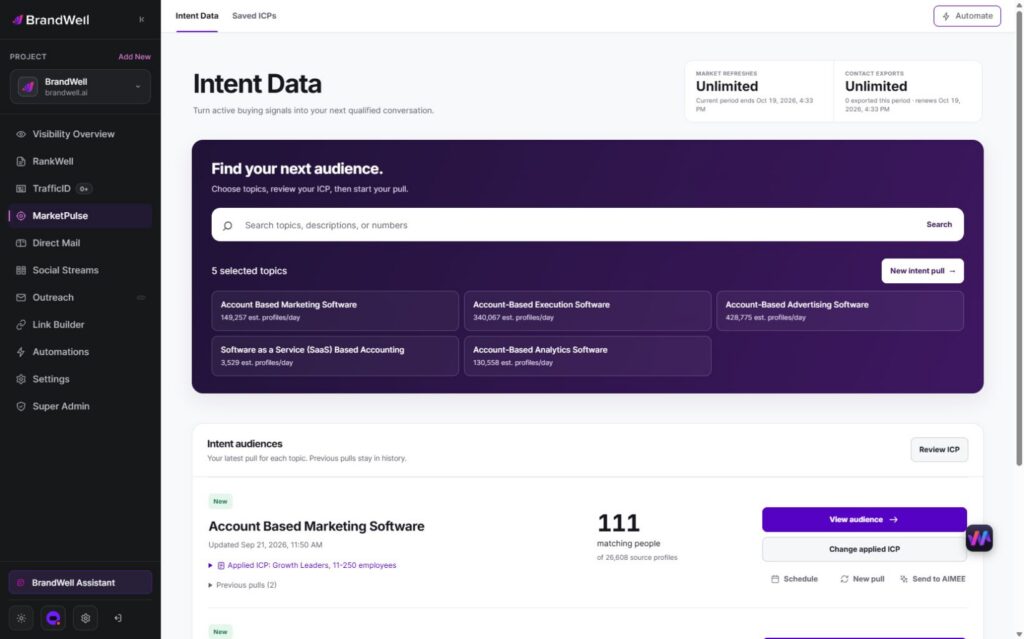
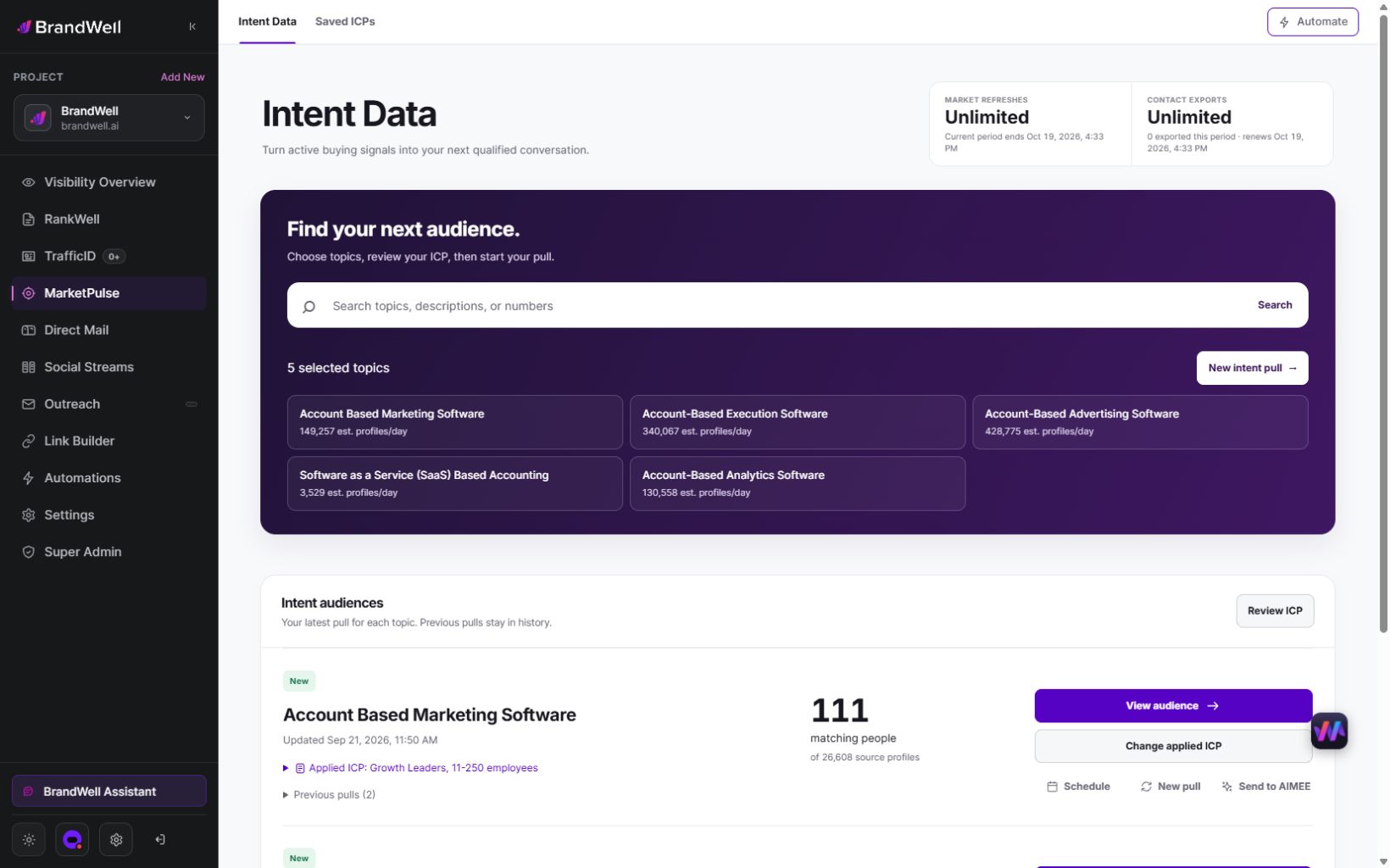
MarketPulse is BrandWell’s current topic-based intent-data product. Use it to review people associated with relevant research topics, apply your ideal-customer-profile filters, and assess available contact and company information. A topic match is research context, not a confirmed purchase decision or permission for every marketing channel.
This page now covers the current MarketPulse workflow and standard plans. Verify the actual topic, available fields and intended use before building an additional integration or agency service.
Reviewed October 3, 2026.
What topic research can help you do
Start with a question your business can serve: which research topics are relevant to the problem you solve, and which available matching records fit your market? Review the evidence before deciding whether an account deserves research, a report, education or another permitted next step.
Stable company fit and recent topic context answer different questions. A business can fit your ICP without currently needing your offer. A topic match can be irrelevant because of role, geography, existing relationship, topic ambiguity or the purpose of the research.
Keep the observation, associated person or company, fit decision and proposed action separate. Appending a contact to an account does not prove that contact performed the account’s observed activity.
Current standard MarketPulse plans
MarketPulse plans are starting at $500/mo. Verify current package scope and offers on the product page.
| Plan | Topics and refreshes | Monthly contact exports |
|---|---|---|
| Starter | 1 topic, weekly | 25,000 |
| Growth | 3 topics, daily | 100,000 |
| Scale | 10 topics, daily | Unlimited |
Swipe the table to see all columns.
A pull retrieves available data from the previous 24 hours for one topic. Daily use across all included topics gives 90 Growth pulls or 300 Scale pulls in a 30-day month. Weekly Starter pulls vary by calendar month. Audience sizes and available fields vary, and audiences can overlap. Refreshes stop at the plan limit without overage charges.
Growth and Scale include AIMEE for the initial user. An eligible early-access offer is separate from these standard prices and has its own displayed window. Additional products, channel usage, fulfillment, implementation and agency services may cost extra.
Review current MarketPulse pricing and confirm the scope relevant to your account before committing to a workflow.
An eight-step topic-to-decision workflow
- Define the use case. State the problem, customer profile, region, intended decision and useful outcome.
- Select a relevant topic. Check the topic meaning and whether it maps to the actual offer. A superficially similar label may not fit.
- Apply the ICP. Use the available filters and record the chosen scope.
- Review the feed. Inspect matching people, company details and available fields. Preserve missing information and uncertainty.
- Check identity and relationships. Separate the supplied record from your own account matching or appended contacts. Review duplicates and conflicting company information.
- Approve a next action. Check ownership, current opportunity state, suppression, permitted use and any destination requirements.
- Record the result. Track accepted, rejected and unresolved observations, the actual action and any later response.
- Review the cohort. Use consistent definitions, costs and windows before expanding topic coverage or service volume.
Test usefulness on your actual market
Write an acceptance checklist before reviewing the output. Include relevant topic context, ICP fit, useful available fields, freshness for the decision, duplicate handling, permitted action and a reviewer’s reason code.
Inspect records that appear useful, irrelevant and ambiguous. A handpicked success list cannot reveal the frequency of failure. Record unresolved information rather than turning it into a favorable assumption.
For a fictional cohort of 200 reviewed records, suppose 80 pass the predefined acceptance rules. That is 40% acceptance among reviewed records. If the defined evaluation costs $800, cost per accepted record is $10. Neither number is a product benchmark, a count of customers or evidence of incremental revenue.
Report any later meetings or opportunities separately, with their actual timing and relationship to prior activity. A comparison group can remain selected; use a defensible design before claiming that the research caused additional sales.
Preserve the evidence trail
W3C’s provenance overview describes information about entities, activities and people involved in producing data.
For your review process, keep the topic, relevant observation window, supplied fields, reviewer, decision, correction and actual downstream action. This is a proposed reporting discipline, not a claim that every provenance field is natively exposed in MarketPulse.
Do not infer a collection method, source-level consent, identity certainty or permitted advertising use from a contact’s availability. Review the actual terms, purpose, jurisdictions and destination requirements with appropriate qualified reviewers.
Keep products and integrations distinct
- MarketPulse: topic-based research with available matching people and company information.
- TrafficID: a separate product for identifying eligible visitors to your own website.
- RankWell: BrandWell’s content preparation and review workflow.
- AIMEE: prepares work through configured connected tools; its output and consequential actions require the appropriate review.
- Additional integration: any CRM, API, webhook or custom routing implementation must have its own verified scope.
A subscription does not by itself promise a public topic-intent API, white-label portal, exclusive topics, managed delivery or a destination-approved ad audience. Confirm the actual supported action rather than designing around an assumed endpoint.
Use Intent Scans in a separately scoped client service
Agencies and other service businesses can review relevant topics and use their available pulls and exports within an appropriately defined client service. Set the client scope, permissions, costs, reporting responsibilities and approvals clearly.
Measure research usefulness and operator effort before expanding. A report should show what the agency reviewed, which decisions the client accepted, and what remains unresolved. Do not describe every delivered record as an interested buyer or associated pipeline as revenue generated.
Watch the MarketPulse demo and compare current plans. Start with the topic coverage and refresh cadence that fit the actual review capacity.
Frequently asked questions
Does a topic match mean someone is ready to purchase?
No. Review fit, context and permitted next action. Purchase readiness needs additional evidence.
Can I assume every contact field is available?
No. Available fields and match coverage vary. Review the actual output rather than promising complete information.
Is TrafficID included in the topic-research definition?
No. TrafficID concerns eligible own-site visitors and is a separate product.
Can I build a custom API workflow from the plan description?
Confirm current documentation, endpoints, terms and implementation scope first. A topic subscription does not establish a custom integration.
Reviewed and updated October 3, 2026.

Written by