On this page
- Current TrafficID identity and visitor workflow
- Define matching evidence and limits
- Use eight input-to-action checks
- Request ten evaluation artifacts
- Compare necessary identity levels
- Reconcile usage and full costs
- Measure coverage, correctness and freshness
- Check actual use-case prerequisites
- Separate identity, intent and enrichment
- Verify source and suppression responsibilities
- Scope agency review work separately
- Copyable identity-review acceptance test
- Frequently asked identity-review questions
Evaluate visitor identity through actual input, supported entity, matching evidence, unresolved states, field freshness and permitted use. TrafficID supports review of identifiable own-site visitors, submitted forms and company context; it does not name every visitor or prove a purchase. Keep appended stakeholder roles separate from observed visitors and require actual evidence before action.
For technical, RevOps, privacy and agency reviewers evaluating identity evidence within the current BrandWell workflow. Match counts, populated fields and a vendor description do not establish identity correctness, buyer relevance or permission.
Test actual identity evidence with representative inputs and independently reviewed outcomes. Public product descriptions do not establish universal coverage, correctness, legal compliance or suitability for every geography and channel.
Review current TrafficID plans, eligible identified-visitor volume and the selected fixed or dynamic billing mode before budgeting. TrafficID and MarketPulse have separate product scope. Verify current allowances and included tools on the product page.
Current TrafficID identity and visitor workflow
TrafficID addresses identifiable visitors to your own authorized site. Its views keep observed visitors, submitted form identities and added company stakeholders distinct. It does not identify every visitor or make an added stakeholder the person who visited.
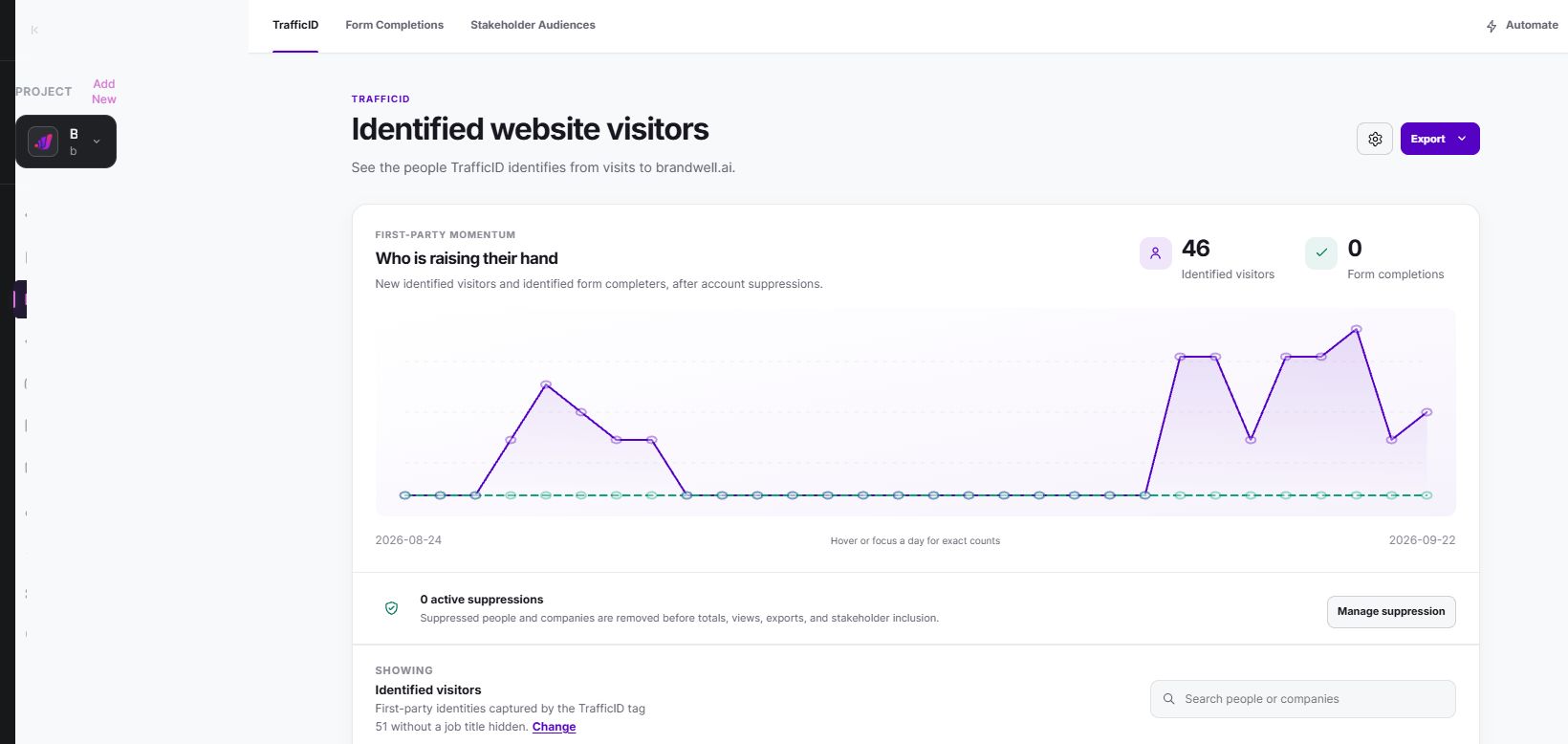
Review current TrafficID plans, eligible identified-visitor volume and the selected fixed or dynamic billing mode before budgeting. TrafficID and MarketPulse have separate product scope. Verify current allowances and included tools on the product page.
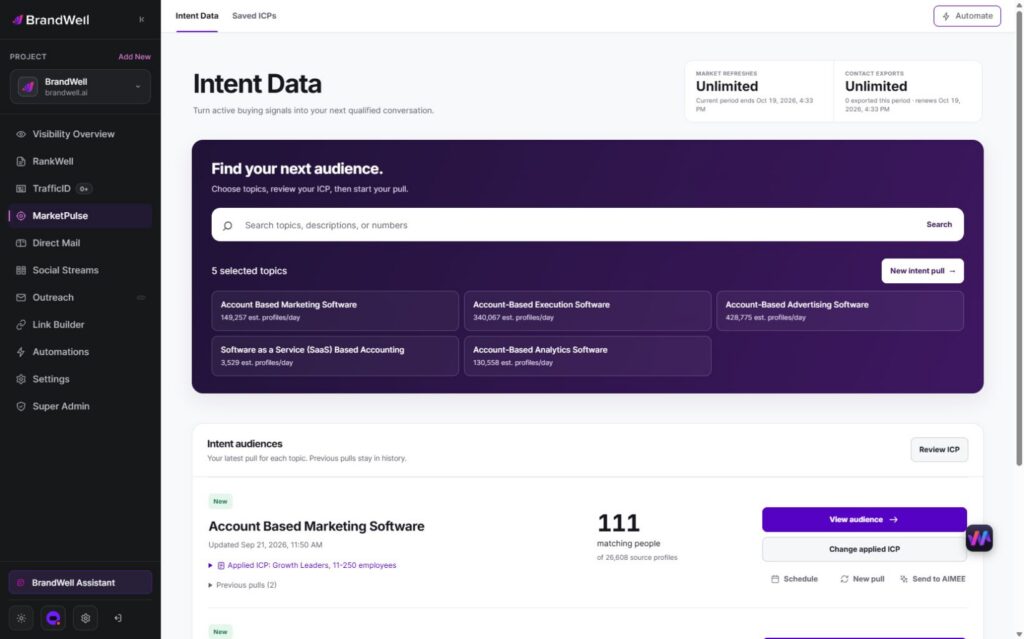
MarketPulse is separate external topic research starting at $500/mo. Topic audiences do not establish a visit to the client’s site. Agency setup, analysis, reporting, custom portals and integrations need separate scope and fees.
Define matching evidence and limits
Use the current TrafficID workspace for identifiable own-site visitors, captured forms, available company context and separately labeled stakeholders. Verify installation state, actual fields, suppressions and permitted exports. Do not infer custom API access, fingerprinting controls, webhooks, trials, reseller branding or managed execution from this subscription.
Identity resolution connects incomplete identifiers to a likely company, profile, or contact record. Inputs might include a domain, email, LinkedIn profile, company attributes, browser or device signals, first-party account IDs, or a combination. The evidence should be labeled by entity and confidence. “Domain matched to company” is different from “known first-party contact returned.”
The useful output is not merely a name. It is a decision packet: input provenance, match path, entity type, confidence or evidence state, fields returned, field-level source and freshness, conflicts, permitted use, suppression status, and an explicit rejection path.
Use eight input-to-action checks
A visitor identity resolution implementation should use a controlled workflow:
- Map every input. Document where the domain, email, profile URL, device or visitor signal came from, what notice or permission applies, and how long it may be retained.
- Define the target entity. Specify company, location, person, role, household, device, or known first-party contact. Do not let the workflow change entities silently.
- Request match logic documentation. Ask which exact, deterministic, probabilistic, household, company-network, or enrichment steps can contribute and which are unavailable to the buyer.
- Preserve confidence and conflict. Store matched, unresolved, ambiguous, rejected, and suppressed states. Keep alternate candidates and original inputs out of activation fields when they are not approved.
- Validate returned fields. Sample employer, title, domain, email, phone, and profile details separately. A correct company does not prove every contact field is correct.
- Apply fit and permitted-use gates. Check ICP, geography, customer status, employee and competitor exclusions, role relevance, source rights, channel rules, and suppression before routing.
- Choose an action. Monitoring or account research may be appropriate at lower confidence; personalized outreach should require stronger evidence and human review.
- Capture feedback. Write back accepted, wrong company, wrong person, stale field, duplicate, no longer employed, suppressed, and downstream outcome.
Identity matching and enrichment are different stages. For a separately implemented integration, request the actual supported input, output, endpoint, authentication, limits, latency, retries, error states and review responsibilities. This checklist is not a promise that TrafficID includes custom API implementation.
Request ten evaluation artifacts
A useful visitor identity resolution demo runs a blinded, representative sample that includes known positives, known negatives, ambiguous cases, subsidiaries, remote workers, shared networks, stale job changes, and suppressed records. Do not supply only easy records.
Request the following:
- Current schema, field dictionary, entity definitions, and sample payloads.
- Match states, confidence method, minimum thresholds, candidate handling, and reasons for rejection.
- Source categories, field-level provenance, last-observed and last-verified timestamps, and decay behavior.
- Coverage definitions by input type, geography, industry, company size, and target persona.
- Exact-match versus inferred-match reporting and a process for disputed identities.
- API, webhook, export, authentication, rate-limit, retry, deduplication, and failure-monitoring documentation.
- Retention, deletion, access control, encryption, logging, incident response, subprocessor, and tenant-separation materials.
- Permitted use for enrichment, advertising, email, phone, resale, white-label services, and customer data.
- Consumer-rights, opt-out, suppression, correction, and complaint-handling procedures.
- A buyer-specific test plan with agreed denominators and acceptance criteria.
Public visitor identity resolution reviews can surface usability questions, but a procurement decision should rely on the written contract, current documentation, representative sample, privacy and security review, and measured outcomes.
Compare necessary identity levels
A visitor identity resolution comparison should not rank vendors by the largest database claim. Compare alternatives using the same criteria: accepted inputs, resolved entity, deterministic versus inferred evidence, confidence transparency, field provenance, freshness, representative coverage, false-match handling, activation controls, rights, security, integration behavior, service support, and total cost.
Alternatives include first-party form and login identity, account-level domain resolution, CRM enrichment, manual research, direct conversation, customer data platforms, and other identity providers. A known first-party relationship provides a distinct source of identity evidence; it does not identify every anonymous visitor. Domain-level matching can guide account research without claiming a person. Evaluate actual manual-review time, evidence quality and failure handling for the proposed use.
The right option depends on the action. Account-level personalization may need a verified company, while direct contact may require a known first-party identity or stronger lawful and evidentiary basis. Choose the least identity detail needed for the decision.
Reconcile usage and full costs
Review current TrafficID plans, eligible identified-visitor volume and the selected fixed or dynamic billing mode before budgeting. TrafficID and MarketPulse have separate product scope. Verify current allowances and included tools on the product page.
Total cost includes instrumentation, consent and notice work, data cleaning, integration, field mapping, identity QA, manual research, suppression, security review, client separation, seller training, monitoring, and correction. Measure cost per accepted match and approved action rather than per attempted record.
Also price the failure path. A false person-level match can waste seller time, damage trust, create a privacy complaint, or corrupt CRM history. A lower-confidence result may still have value when it is deliberately routed to account research rather than personalized outreach.
Measure coverage, correctness and freshness
visitor identity resolution evidence should be evaluated with distinct denominators:
- Attempted coverage = records with any returned candidate ÷ eligible inputs.
- Accepted-match rate = matches accepted after review ÷ returned candidates.
- Known-positive recall = known positives correctly resolved ÷ known positives tested.
- False-match rate = rejected wrong-entity matches ÷ reviewed returned matches.
- Field freshness = accepted fields within the buyer’s freshness window ÷ reviewed fields.
- Activation acceptance = approved actions ÷ matched records routed for review.
Report unknown and ambiguous states rather than hiding them. Segment results by input type, geography, company size, role, and source. A single average can conceal poor performance in the buyer’s actual market.
For visitor identity resolution ROI, compare the approved workflow with an account-level or manual baseline. Count incremental held meetings, qualified opportunities, research time saved, corrected records, and avoided waste only when the measurement design supports those conclusions. Exclude pre-existing opportunities and show sample size and attribution limits.
Check actual use-case prerequisites
Potential identity-review use cases include resolving company context for anonymous first-party visits, enriching known leads, prioritizing account research, repairing incomplete B2B records, and supporting a governed agency reporting workflow. Ideal customers have valuable B2B decisions, sufficient volume for sampling, defined identity thresholds, a RevOps owner, and privacy and security review.
It is a poor fit when a buyer needs certainty about the human behind an anonymous action, cannot lawfully use the proposed inputs, lacks notice and suppression, has no process for disputed matches, or expects identity alone to establish intent. Low-value mass outreach can turn marginal data into high trust and compliance costs.
Separate identity, intent and enrichment
Keep the evidence chain explicit. Intent describes research or engagement. Identity resolution links an entity at a stated confidence. Enrichment appends attributes. Fit tests market eligibility. Activation selects a permitted action. Outcome evidence shows what happened. None of these layers should impersonate another.
For example, an account may show fresh research, resolve confidently to a company, and have several enriched contacts. The correct action may be to assign account research and select a role – not to assert that any appended contact performed the research. A known first-party contact may support stronger personalization, but channel and consent rules still apply.
AIMEE can prepare a review brief through configured connected tools. Keep proposed actions separate from actual approvals and destination acknowledgements. Confirm the implementation and permissions before execution.
Verify source and suppression responsibilities
Verify actual source, recipient, purpose, collection context, jurisdiction, destination, rights, access, retention, correction, deletion and suppression ownership. A vendor privacy page, research record or match is not a universal legal determination. Resolve unanswered requirements before activating records.
Verify actual source, recipient, purpose, collection context, jurisdiction, destination, rights, access, retention, correction, deletion and suppression ownership. A vendor privacy page, research record or match is not a universal legal determination. Resolve unanswered requirements before activating records.
- Minimize inputs and returned fields to the approved use case.
- Separate exact, known first-party, account-level, and probabilistic profile matches.
- Expire identities and employment fields; do not refresh suppressed records into activation.
- Apply tenant, client, role, export, and audit controls.
- Document access, correction, deletion, objection, and complaint workflows.
- Test shared devices, VPNs, agencies, subsidiaries, bots, employees, customers, and competitors.
- Require actual support for identity-correctness, match-volume and outcome claims.
Before a rollout decision, write a short evidence memo that records sample composition, confidence thresholds, false-match findings, unresolved risks, owners, acceptance criteria, and the conditions that require retesting.
Scope agency review work separately
An agency can package identity resolution as a governed layer within a broader client service: first-party instrumentation review, evidence taxonomy, fit rules, sample QA, account reports, human-reviewed activation, suppression, and outcome reporting. The promise should be better prioritization – not guaranteed identification or guaranteed pipeline.
Review actual TrafficID visitor and form records for the approved research purpose; MarketPulse separately supports off-site topic research. Keep uncertain company context visible. AIMEE can organize supplied context through configured tools; named owners approve actual exports, messages, audience uploads and CRM writes.
Copyable identity-review acceptance test
Input: [Actual source, observation unit, timestamp and permitted purpose.] Entity: [Company, observed visitor, submitted contact or appended stakeholder.] Evidence: [Supported match, uncertainty, alternate candidates and rejection.] Fields: [Actual role, employer, contact detail, source and freshness.] Test: [Representative reference sample, missing labels and denominators.] Action: [Fit, suppression, owner, approval and destination.] Decision: [Costs, unresolved cases, outcomes and retest condition.]
Distinguish precision from match coverage
ONS data-linkage policy calls for linkage errors to be evaluated with precision and recall. Its scope is statistical research, not commercial identity certification. Keep match coverage and reference-sample correctness separate; document uncertain labels and how the sample represents the proposed input population.
Calculate the actual error types
In a fictional reference sample with 80 true eligible links, a method proposes 70 links: 60 correct and ten wrong. Precision is 60 divided by 70, or 85.7%; recall is 60 divided by 80, or 75%. Twenty true links are missed. Those figures require trustworthy reference labels. They are invented calculations, not TrafficID identity results or a universal threshold.
Review acceptance is not identity correctness
Suppose a fictional test receives candidates for 100 eligible inputs, but only 40 candidates are independently reviewed. Thirty meet the stated field/fit/use acceptance rule. Acceptance is 75% of reviewed candidates; the other 60 candidates remain unreviewed. This does not establish 75% precision for every returned candidate. Acceptance may reject a correct identity for role or permitted-use reasons, so record the actual rejection type.
Company matches do not validate every field
A fictional record has a supported company match, an employer field last verified six months earlier and an unverified phone number. The company match does not validate current employment, that number or permission to call. Keep field source, actual verification time, missingness and permitted action separately visible. An appended stakeholder is not proof of an observed visit.
Measure representative segments without hiding unknowns
A fictional test has 80 reviewed records from one source and 20 from another. Seventy-two first-source records and ten second-source records pass the same stated rule. The weighted result is 82 of 100, or 82%, not the unweighted mean of 90% and 50%. Report both segments, reference quality and population mix; neither a selected sample nor an aggregate automatically describes every geography or role.
Budget usable outcomes, not raw returned names
A fictional pilot costs $99 TrafficID starting subscription, $300 setup and $400 independent review, totaling $799. Forty accepted identities imply $19.975 each, approximately $19.98. Twenty approved actions imply $39.95 each. Accepted identities and approvals are not buyers or opportunities. Acquisition, media, general overhead, tax and financing are excluded. These invented operating costs are not BrandWell validation-service fees or performance benchmarks.
Review the current TrafficID input
Check the site’s reported installation state and available identified visitor and form records. Review supported person, role, company and page context, preserving separately labeled stakeholders and uncertainty. Apply actual people/company exclusions before preparing a permitted CSV/Excel export. AIMEE can organize supplied evidence through configured tools. Owners approve exports, messages, audience uploads, postcard budgets and CRM writes. Custom matching APIs, scoring, validation reports and client interfaces require separately verified implementation, rights and scope.
Frequently asked identity-review questions
Does high match coverage prove correct identity?
No. Evaluate actual errors against trustworthy reference labels.
Is reviewer acceptance the same as precision?
No. Acceptance can include fit, freshness and permitted-use gates.
Does a company match validate a phone number?
No. Preserve field-specific evidence and permission separately.
Does TrafficID imply custom identity APIs or reseller portals?
Do not assume that. Verify separate implementation and entitlements.
Review the current own-site product: explore TrafficID and current plans. For off-site topic research, review MarketPulse.
Reviewed and updated October 3, 2026.

Written by