On this page
- Current TrafficID visitor workflow
- Define the agency review queue
- Use nine visitor-to-prospect steps
- Evaluate seven operating resources
- Compare actual acquisition responsibilities
- Count full prospect-review costs
- Separate match, action and buyer outcomes
- Check agency and traffic prerequisites
- Preserve five evidence dimensions
- Review identity, privacy and exclusions
- Scope client work separately
- Copyable agency visitor-review pilot
- Frequently asked agency visitor questions
An agency can use eligible own-site visitor evidence to prioritize prospect research. A visit or inferred identity is not proof of a buyer. Check public fit, timing, available identity support, source rights, exclusions and owner capacity before proposing a useful next step. Preserve unknowns and no-contact decisions rather than promising client wins or a universal safest workflow.
Who is this for? B2B agencies with meaningful website traffic, a defined ideal client profile, and a sales process that can review a small number of high-context prospect signals.
Define an agency-prospect review process and test whether website observations help that decision. A visitor can be a buyer, customer, employee, vendor, candidate, researcher, bot or accidental click. Accept, reject or hold according to actual evidence; there is no required rejection-to-activation ratio.
Review current TrafficID plans, eligible identified-visitor volume and the selected fixed or dynamic billing mode before budgeting. TrafficID and MarketPulse have separate product scope. Verify current allowances and included tools on the product page.
Current TrafficID visitor workflow
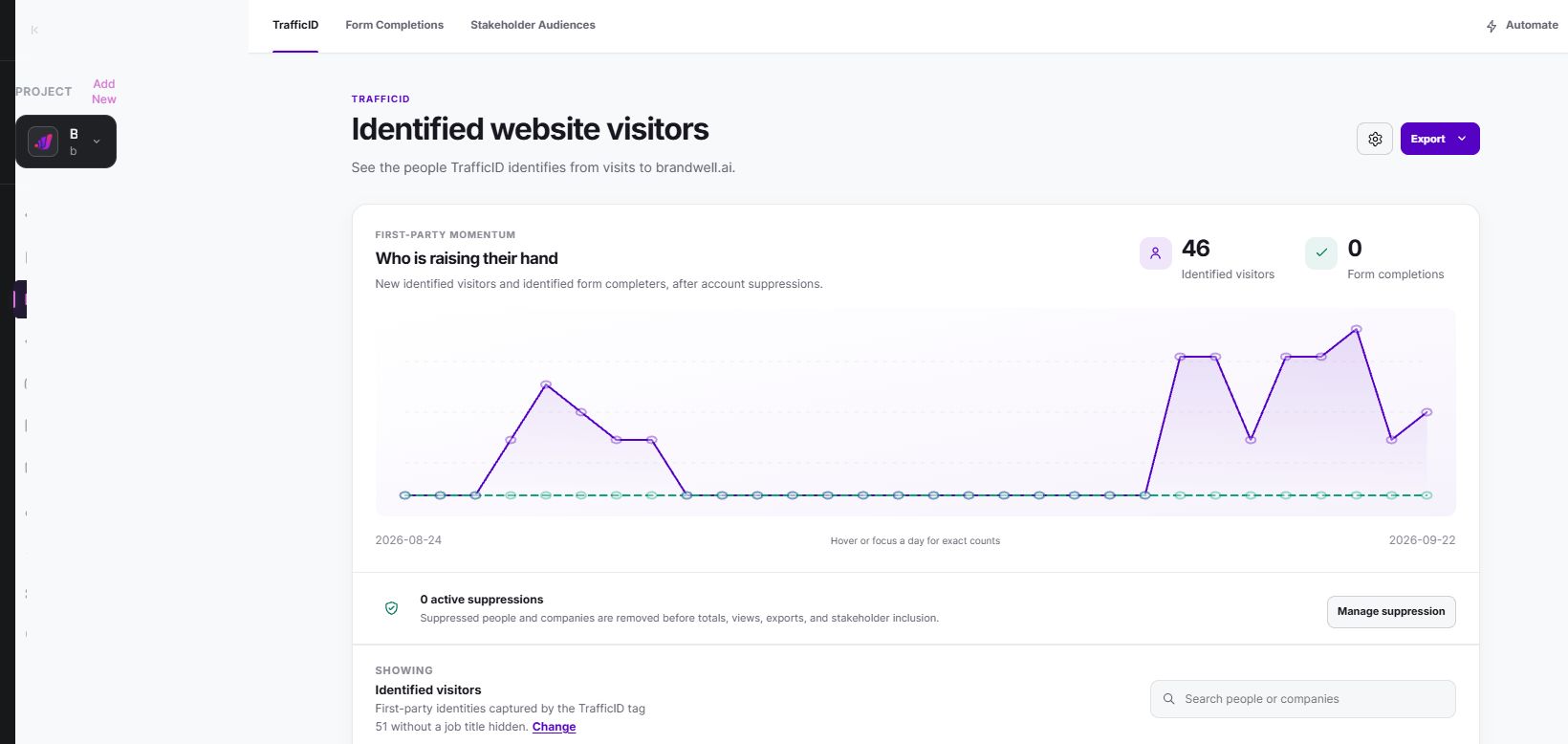
TrafficID addresses identifiable visitors to your own authorized site. Its views keep observed visitors, submitted form identities and added company stakeholders distinct. It does not identify every visitor or make an added stakeholder the person who visited.
Review current TrafficID plans, eligible identified-visitor volume and the selected fixed or dynamic billing mode before budgeting. TrafficID and MarketPulse have separate product scope. Verify current allowances and included tools on the product page.
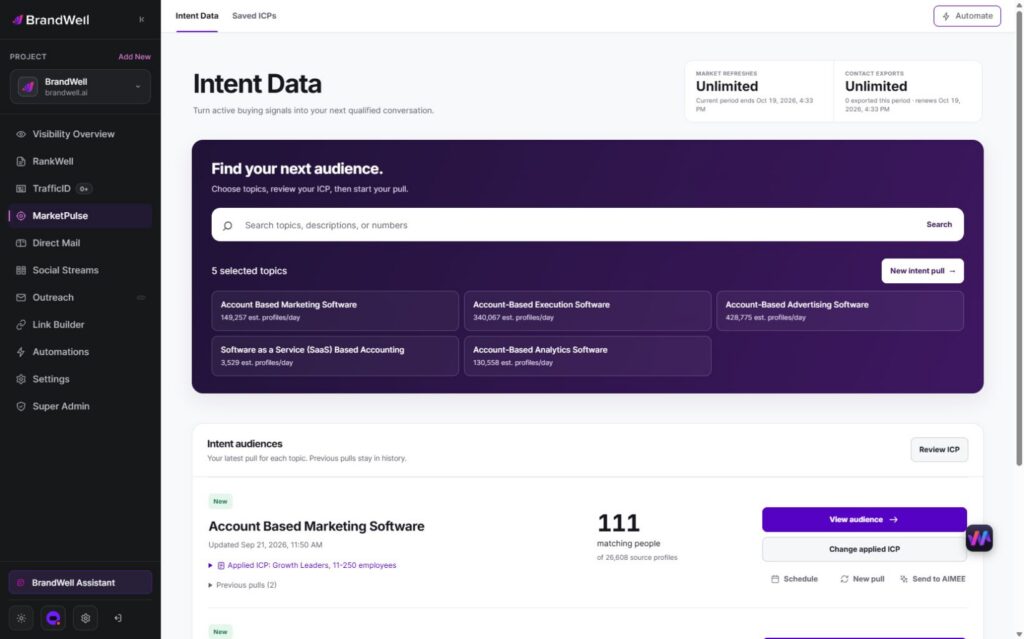
MarketPulse is separate external topic research starting at $500/mo. Topic audiences do not establish a visit to the client’s site. Agency setup, analysis, reporting, custom portals and integrations need separate scope and fees.
Define the agency review queue
Start with a short list of pages that indicate a business problem related to the agency’s offer: service detail, pricing, comparison, case study, implementation, industry solution, or consultation. Treat homepage and blog traffic as weak evidence unless the visit has additional context. Define a freshness window and a frequency rule so an old or single low-value pageview cannot remain “hot” forever.
Then layer evidence in order: observed first-party behavior, consent and notice state, bot and internal-traffic filtering, company or profile match at a stated confidence, ICP fit, customer and opportunity status, role relevance, and approved next action. Preserve the reason a record passed each gate.
The output should be a review queue, not an automated blast. A seller sees the company, qualifying behavior category, timing, match-confidence state, fit notes, exclusions checked, and a recommended research step. Personalized claims about the exact page or topic should be avoided unless the interaction is known first-party and the use is appropriate.
Use nine visitor-to-prospect steps
This website visitor identification for agency sales implementation guide uses nine steps:
- Set the objective. Choose one agency offer, ICP, qualifying action, and accepted pipeline outcome.
- Review instrumentation. Map actual tags, collection mechanisms, forms and CRM joins with their configured state, purpose and exclusions. A technical collection or consent-state mechanism is not a legal determination, consent-management system or general compliance guarantee.
- Publish accurate notice. Explain collection, purposes, sharing, choices, and contact channels. Obtain jurisdiction-specific legal review before deployment.
- Define qualifying behavior. Assign page categories, minimum depth or recurrence, session exclusions, and decay. Avoid sensitive topics.
- Resolve the entity. Label the result as anonymous, domain/account matched, known first-party contact, or profile resolved at a stated confidence.
- Apply fit and suppression. Check geography, industry, size, service fit, customer status, open opportunity, competitors, employees, vendors, students, bots, opt-outs, and do-not-contact records.
- Research before contact. Verify employer, role, company need, and an appropriate reason to engage without revealing surveillance-like detail.
- Approve the action. A human chooses no action, nurture, account research, referral request, advertising audience, or one-to-one outreach under the applicable rules.
- Record the result. Capture acceptance, rejection reason, time to action, meeting, qualified opportunity, progression, revenue, unsubscribe, complaint, and correction.
Marketing owns page taxonomy and notice coordination; RevOps owns matching, routing, CRM state, and reporting; sales owns research and action; privacy, security, and legal owners approve collection and use. Review daily only when signal decay justifies it. Choose a review cadence against actual evidence age, owner coverage and permitted action.
Evaluate seven operating resources
1. Qualifying-page map
Classify pages by problem, stage, offer, and sensitivity. Possible use: every agency site. Limitation: page intent is contextual; a case study view alone does not identify a buyer.
2. Consent and tag inventory
List every storage and access technology, purpose, vendor, trigger, and consent state. Possible use: governance before collection. Limitation: inventory does not by itself establish lawful use.
3. Confidence-tier queue
Separate anonymous, account-matched, resolved-profile, and known first-party records. Possible use: preventing identity overstatement. Limitation: confidence labels require tested definitions.
4. ICP and exclusion worksheet
Score company fit while applying customer, employee, competitor, vendor, bot, geographic, and suppression exclusions. Possible use: reducing false positives. Limitation: stale firmographic data can misroute records.
5. Account-research brief
Summarize public business context, likely problem, missing evidence, useful public-context hypothesis, and recommended action. Possible use: high-value services. Limitation: research can become speculation unless sources and uncertainty remain visible.
6. Human approval card
Show source class, behavior category, identity state, fit, suppression, suggested channel, and rollback. Possible use: controlled activation. Limitation: it slows volume – which is intentional when evidence is weak.
7. Outcome and correction log
Track acceptance, false match, stale data, meeting, opportunity, opt-out, and complaint. Possible use: improving the rules. Limitation: seller feedback must be standardized or it becomes anecdotal.
Compare actual acquisition responsibilities
Website visitor identification for agency sales is a prioritization layer, not a replacement for every acquisition channel. Referrals carry trust but are unpredictable and narrow. Broad cold lists create reach but require heavy fit and permission work. Untargeted ads can build awareness but often spend on out-of-market audiences. Visitor identification adds first-party timing context but sees only people who reach the site and can be measured or matched appropriately.
Compare referrals, permitted outbound, paid media, content and visitor review against actual acquisition needs, implementation effort and qualified outcomes. A diversified channel mix is not automatically more resilient or profitable; preserve the evidence and full costs.
For a low-traffic agency, improving positioning, partnerships, content, referrals, or targeted account selection should be evaluated against the actual acquisition constraint. Repair unclear ICP and exclusions before expanding a high-volume review queue.
Count full prospect-review costs
Website visitor identification for agency sales pricing can include a platform subscription, traffic or reveal units, enrichment, validation, CRM or automation tools, implementation, consent tooling, security review, and support. Add analyst and seller time for match review, account research, personalization, corrections, and suppression.
Build a unit-economic model from eligible visits – not all visits. Calculate cost per reviewed record, accepted company, approved contact action, held meeting, qualified opportunity, and won client. Include the cost of false matches, no-shows, opt-outs, complaints, and seller time diverted from stronger opportunities.
Use a bounded pilot with a fixed page set, ICP, daily review capacity, and outcome window. Compare with the agency’s prior process or a similar fit-only group. Do not justify cost using a vendor’s raw reveal count when the agency cannot safely or usefully activate the records.
Separate match, action and buyer outcomes
Website visitor identification for agency sales KPIs should expose both value and harm:
- eligible sessions and qualifying-page rate;
- bot, employee, customer, competitor, vendor, and geographic exclusion rates;
- account-match, profile-resolution, accepted-match, and false-match rates by confidence tier;
- ICP-fit and seller-acceptance rates;
- median time from eligible visit to review;
- approved actions, held meetings, qualified opportunities, stage progression, and wins;
- unsubscribe, objection, correction, complaint, and suppression rates.
Preserve attributed outcomes separately from incremental effects. If a credible comparison estimates incremental contribution in dollars before program costs, subtract complete program costs and divide by those same costs for a defined ROI. Do not subtract costs already included in contribution. Flag pre-existing opportunities and report assisted influence separately; a visit preceding a deal does not establish causation.
There is no universal benchmark across agency offers, traffic sources, deal sizes, identity methods, and qualification rules. The most useful benchmark is the agency’s own fit-only or prior-process baseline with the same definitions.
Check agency and traffic prerequisites
Check the actual offer, relevant traffic, expressible ICP, usable company context, source rights and staffed review capacity. Specialization or client value does not establish readiness or prove that visitor identification wins clients.
It fits poorly for very low traffic, broad consumer audiences, sensitive services, unclear positioning, tiny contracts, or teams that cannot staff research and suppression. If most traffic comes from content unrelated to the agency’s commercial offer, improve page taxonomy and acquisition before buying more identity coverage.
Preserve five evidence dimensions
Use a transparent evidence chain:
- Behavior: page category, recency, frequency, source, and bot filtering.
- Identity: account, known first-party contact, or resolved profile with confidence and conflict state.
- Fit: market eligibility, service relevance, territory, customer state, and exclusions.
- Activation: permitted channel, capacity, owner, approval, and expiry.
- Outcome: accepted, acted on, meeting, opportunity, revenue, opt-out, correction, or complaint.
AIMEE can prepare a review brief through configured connected tools. Keep proposed actions separate from actual approvals and destination acknowledgements. Confirm the implementation and permissions before execution.
Review identity, privacy and exclusions
Verify actual source, collection context, notice, purpose, region, recipient, channel, downstream sharing and rights. Public availability, a pixel or a visitor match does not establish unrestricted use. Resolve missing requirements before activation.
Confirm applicable commercial-message, privacy, consumer-protection, sector, contract and destination requirements for the actual use. Preserve opt-outs and responsibility across client and agency systems rather than inferring permission from a record.
- Do not identify a person with certainty when the match is inferred.
- Do not tell a prospect that you watched a sensitive page or know private research.
- Do not let a pageview override consent, objection, suppression, customer, or open-opportunity status.
- Do not retain raw device or identity data longer than the approved purpose requires.
- Do not share client or prospect data across agency tenants.
- Provide correction, opt-out, deletion, complaint, and audit procedures.
- Test bots, shared devices, VPNs, agencies, remote workers, and subsidiary domains.
Scope client work separately
The agency’s own acquisition workflow can teach it which pages, fit rules, confidence tiers, research steps, approvals, and metrics work. A separate client-facing service may then package those operating lessons – but it needs its own contract, privacy roles, client notice, tenant separation, permitted-use review, reporting, and approvals. Do not silently reuse the agency’s prospect data as client data.
Review actual TrafficID own-site visitor and form records for the approved research purpose; MarketPulse separately supports off-site topic research. Keep uncertain company context visible. AIMEE can organize supplied context through configured tools; named owners approve actual exports, messages, audience uploads and CRM writes.
Copyable agency visitor-review pilot
Question: [Actual prospect decision and comparison.] Scope: [Own site, qualifying behavior, unit, period and exclusions.] Identity: [Supported match, public context and unresolved cases.] Gates: [Actual fit, age, purpose, channel and suppression.] Owner: [Review capacity, approval, action and stop rule.] Outcome: [Accepted brief, buyer response, meeting, opportunity and unknowns.] Economics: [Complete costs, maturity and causal limits.]
Match volume does not establish correct identity
ONS linkage policy distinguishes the number of matches from linkage quality. Its scope is statistical research, not certification of a commercial visitor tool. Review actual false links, missed links and unresolved cases before making identity claims; a high reveal count does not demonstrate buyer relevance.
Review the true units before counting prospects
In a fictional period, 1,000 sessions include 200 excluded sessions, leaving 800 eligible sessions. They correspond to 400 distinct visitor units under the stated rule, of which 100 receive a supported match. Match coverage is 25% of eligible visitor units, not 12.5% of sessions. Thirty matched records pass the agency’s fit and permitted-use checks; those are 30 accepted review records, not 30 buyers. Reconcile actual identity and session rules before calculating coverage.
Stakeholder context is not another observed visitor
A fictional visitor record points to one company, with four appended decision-maker contacts. The company context does not establish five site visitors, five buyers or permission to message all five. Keep the observed visitor, added roles, supported fields and each recipient’s approved purpose separate. Research a useful public business problem rather than claiming knowledge of private browsing.
Trace the pilot without inventing causation
Suppose 30 accepted fictional records yield 20 owner-approved actions, 15 destination acknowledgements, five qualified positive responses, three held qualified meetings and one signed client. Responses are 33.3% of acknowledged accounts or 16.7% of accepted records when each stage uses unique accounts. One signed client is not necessarily collected revenue. Preserve pending outcomes, actual follow-up and prior relationships; these invented counts do not show that the visitor tool caused the client win.
Include agency review and exception costs
A fictional pilot costs $99 TrafficID starting subscription, $300 setup and $600 seller research, totaling $999. Thirty accepted records imply $33.30 each; three held qualified meetings imply $333 each. Adding $300 correction raises defined costs to $1,299 and meeting cost to $433. Acquisition, media, general overhead, tax and financing are excluded. These invented figures are not BrandWell managed-service fees or typical acquisition costs. With zero held qualified meetings, that ratio is undefined.
Use TrafficID for the actual own-site input
Review the site’s reported installation state, available identified visitor and form records, and public company context. Keep source labels and appended stakeholders distinct. Apply actual people/company exclusions before preparing a CSV or Excel export or a proposed follow-up. AIMEE can organize supplied research through configured tools; owners approve recipients, messages, audience uploads, postcard budgets and CRM writes. Identification is partial. Client interfaces, custom validation and agency operating delivery are separately scoped implementations.
Frequently asked agency visitor questions
Must the workflow reject more records than it acts on?
No. Apply actual evidence gates rather than an invented universal ratio.
Are session counts a unique-prospect denominator?
Not automatically. Reconcile visitor identity, sessions and exclusions.
Does an appended stakeholder count as a visitor?
No. Preserve the distinction.
Does a deal after a visit prove acquisition impact?
No. Keep prior relationships, attribution and causal limits visible.
Review the own-site product: explore TrafficID and current plans. For off-site topic research, review MarketPulse.
Reviewed and updated October 3, 2026.

Written by