Short answer: Build B2B audiences with buyer intent data by requiring three things before activation: a qualified account, current evidence that supports a relevant timing hypothesis, and permission to use the matched data on the chosen ad platform. Intent alone is not an audience. A reliable audience is a governed cohort with a source, observable action, confidence level, expiry rule, exclusions, owner, and measurable purpose.

Who is this for? B2B advertisers and paid-media agencies that want to move beyond broad targeting without treating an account surge, website visit, or customer-list match as proof that a person is ready to buy.

The practical goal is not the largest possible list. It is a list that can be explained, refreshed, suppressed, activated, and evaluated. Keep fit, timing, identity, eligibility, exposure, and outcomes as separate fields. That makes intent-based audience building useful even when a signal is probabilistic – and prevents one uncertain match from becoming an overconfident campaign.

Start with fit plus timing – not intent alone

A strong audience begins with the market you can serve. Define company size, industry, geography, buying role, existing-customer state, opportunity state, exclusions, and the campaign decision. Then add time-sensitive evidence: repeated high-value site activity, review-marketplace research, offsite topic research, a direct request, product usage, or a verified buying-stage change.

Use an evidence ladder rather than one blended score:

  • Fit: the account and likely role can plausibly buy and use the offer.
  • Behavior: a documented action occurred, with an observable unit and collection context.
  • Freshness: the action remains relevant for this category’s buying cycle.
  • Identity: the account or person match carries a stated confidence, not certainty.
  • Eligibility: the advertiser has the rights, consent where required, and platform permission to use the data.
  • Activation: the campaign, creative, bid, suppression, or measurement action is defined before upload.

Do not make every layer mandatory for every campaign. Account-level display may work with qualified account research. A contact-list campaign needs a defensible contact source and platform eligibility. A high-stakes personalized message needs stronger direct evidence and human review. The important rule is that the audience label never claims more than its weakest required input supports.

Build, refresh, suppress, sync, and audit the audience

This intent based audience building implementation guide turns the concept into an operating system:

  1. Write the activation decision. Name the advertiser, offer, channel, objective, geography, permitted action, primary metric, exclusions, and person accountable for approval.
  2. Create a signal contract. For every source, record the observable action, unit, event time, collection-to-delivery time, account or person level, confidence, allowed uses, retention, and deletion path.
  3. Apply fit before spend. Resolve the company, enforce ICP and territory rules, remove customers or open opportunities when appropriate, and retain the reason each account qualified or failed.
  4. Gate identity and eligibility. Separate account matching, known first-party contacts, inferred people, and appended contacts. Confirm source rights, regional requirements, advertiser authority, sensitive-category rules, and current platform policy.
  5. Build cohorts and controls. Keep high-confidence direct engagement, account-level research, and weaker inferred signals in different segments. Create a fit-only or holdout cohort when scale permits.
  6. Sync with observability. Log submitted, accepted, rejected, matched, eligible, reachable, and exposed counts. Use stable audience and record IDs so retries do not create duplicates.
  7. Refresh and suppress. Expire stale signals, remove opt-outs and disqualified records, update customer/opportunity state, and stop using records when permission or contract scope changes.
  8. Close the loop. Return exposure, engagement, qualified opportunity, outcome, complaint, and rejection evidence to the rule owner. Change the audience only through a versioned review.

An intent based audience building checklist should also assign roles. Paid media owns delivery and creative. RevOps owns account/contact resolution, CRM state, and feedback. Data or marketing operations owns schema, sync, monitoring, and deduplication. Privacy, legal, security, and platform-policy reviewers define acceptable sources and uses. The client or accountable campaign owner approves consequential activation.

Useful intent based audience building templates include a signal dictionary, audience eligibility form, suppression specification, sync runbook, exception queue, change log, and test plan. Treat implementation examples as hypotheses to adapt – not universal proof that a source, channel, or match rate will work for a different advertiser.

Seven intent-audience construction methods and resources

These intent based audience building best practices are methods, not a universal vendor ranking. Choose the smallest evidence set that can support the campaign decision.

1. First-party event sequences

Use defined combinations such as repeat visits to solution and implementation content, a return after a pricing interaction, or a known-contact action. Best fit: advertisers with enough owned traffic and clean analytics. Limitation: activity with your brand may arrive late, may be caused by customers or candidates, and is not purchase proof.

2. Review-marketplace account research

Use category, profile, pricing, comparison, and competitor research as account-level evidence with visit type and recency. Best fit: software categories with meaningful marketplace activity. Limitation: the signal usually identifies an organization, not the named researcher, and does not cover all web research.

3. Offsite topic research

Monitor narrow problem, category, competitor, integration, and solution topics, then require fit and a relevance threshold. Best fit: categories with distinctive research language and enough addressable accounts. Limitation: broad topics create noise, coverage varies, and the researcher may not be a buyer.

4. Website account or visitor identification

Turn owned-site sessions into probable-account or probable-person evidence, with confidence tiers and consent controls. Best fit: high-value B2B traffic where follow-up can remain helpful and restrained. Limitation: matches are probabilistic; a visit neither identifies purchase authority nor authorizes every activation.

5. CRM lifecycle and customer-state audiences

Use known records for opportunity-stage support, customer expansion, exclusions, or re-engagement, subject to current permissions. Best fit: teams with reliable lifecycle data. Limitation: stale stages and duplicate contacts can misroute spend, and a CRM record is not current intent.

6. Account signal plus role expansion

After an account qualifies, identify plausible buying-group roles for broader education or account research. Label those people as role hypotheses, not as the individuals who created the signal. Best fit: complex buying committees. Limitation: appended contacts and titles do not establish research, authority, consent, or interest.

7. Blended evidence cohorts

Require a combination such as fit plus fresh review research, fit plus repeat first-party behavior, or fit plus two independent topic signals. Best fit: higher-value campaigns where precision can justify lower scale. Limitation: more inputs add cost, latency, missingness, and a risk of hiding uncertainty inside a composite score.

Intent audiences vs. lookalikes, interests, and demographics

An intent based audience building comparison should start with the job each alternative performs:

  • Intent audiences prioritize current behavior or research. Use them when timing and relevance matter enough to justify data and governance work.
  • Lookalikes or modeled expansion seek scale from a seed. Use them when the seed is lawful, representative, large enough, and the platform can learn from outcomes. They do not preserve the seed’s intent state.
  • Interest and demographic targeting offers native reach with less external data. Use it for awareness and categories where precise B2B identity is unavailable.
  • Firmographic or account lists define fit without claiming timing. They are often the right baseline and can be safer than a weak intent feed.
  • First-party remarketing uses direct brand interaction. It can be more explainable but misses buyers who research elsewhere.

The best intent based audience building alternatives are often combinations: fit-only for broad coverage, a qualified intent cohort for priority, and a holdout or matched baseline for evaluation. Do not assume intent audiences beat lookalikes. Test the decision for the advertiser, channel, offer, and objective.

Budget for signals, matching, activation, media, and operations

Intent based audience building pricing can include data subscriptions or usage, identity and enrichment, platform or middleware fees, creative variants, media, integration work, analyst review, legal/privacy/security review, reporting, and false-positive handling. Separate those costs from media so a lower CPM does not hide expensive audience operations.

Model intent based audience building cost at several levels: cost per delivered record, accepted record, eligible record, reachable account, exposed account, qualified action, opportunity, and incremental outcome. Include rejected and expired records. A source with fewer records can be more valuable if provenance, fit, freshness, and permitted use produce a higher accepted rate.

Use current written quotes for the exact signal coverage, geography, fields, update cadence, usage, integrations, support, contract term, and activation rights being evaluated. Do not infer a provider’s price from a broad platform package or an unsupported market range.

Measure match, reach, waste, pipeline, and incrementality

Intent based audience building KPIs should follow the delivery chain:

  • Data quality: provenance completeness, valid account/contact rate, duplicate rate, freshness, rejection, and suppression.
  • Platform delivery: submitted, accepted, matched, eligible, reachable, exposed, frequency, and spend.
  • Response: qualified visits, engaged accounts, direct responses, meetings, and sales acceptance.
  • Pipeline: qualified opportunities, stage progression, pipeline value, wins, and time to outcome.
  • Trust: opt-outs, complaints, policy rejections, false-positive feedback, and client exceptions.

For intent based audience building ROI, compare the qualified intent cohort with a fit-equivalent baseline or holdout where feasible. Keep pre-existing pipeline separate. Report the assignment unit, exposure window, sample size, cost, and uncertainty. Match rate is not reach; reach is not response; response is not qualified pipeline; attributed pipeline is not automatically incremental.

There is no universal set of intent based audience building benchmarks. Baseline rates, audience size, buying cycle, media channel, creative, category, offer, and assignment unit change the result. Use your own historical fit-only cohort as the first benchmark and preserve definitions across tests.

Which advertisers and campaigns are ready for intent audiences

Intent based audience building for B2B advertisers and paid media agencies fits best when the advertiser has a clear ICP, enough account value to support data work, a distinctive signal taxonomy, a platform-eligible activation path, reliable suppression, and a measurable outcome. It works especially well for account education, competitive evaluation, opportunity acceleration, event follow-up, customer expansion, and coordinated sales-plus-media plays.

It is a poor fit when the offer is low value, the category uses broad ambiguous topics, traffic or account scale is too small, source rights are unclear, the advertiser cannot support platform minimums, or the team lacks CRM and outcome feedback. In those cases, firmographic targeting, contextual placement, native platform audiences, first-party remarketing, or no paid activation may be better.

Combine source quality, identity, freshness, eligibility, and outcomes

A durable intent based audience building framework keeps six linked records: signal, subject, fit, eligibility, audience membership, and outcome. The intent based audience building strategy should answer five questions before spend: What happened? To which account or known person? How confident is that link? May this advertiser use it here? What decision will the campaign test?

Common intent based audience building use cases can then share one governed data model while using different thresholds. An awareness cohort may accept qualified account research. A competitive-response cohort may require repeated comparison activity. A known-contact campaign may require direct first-party collection and current permission. Intent based audience building activation workflows should preserve those differences rather than flattening them into “hot.”

The intent based audience building signal quality and measurement record should include source, observable action, account/person level, event time, delivered time, confidence, fit, exclusions, lawful-use state, platform eligibility, audience version, expiry, exposure, and outcome. This becomes an intent based audience building decision guide for operators and an intent based audience building planning guide for clients. Use real intent based audience building examples only when the source, assumptions, limitations, and result definitions can be disclosed.

Comply with privacy and ad-platform audience policies

The biggest intent based audience building mistakes happen before the upload: buying data without tracing collection context, confusing hashing with permission, using sensitive inferences, failing to suppress objections, letting clients share data across accounts, and assuming a platform match validates identity.

Google’s Customer Match policy restricts the customer information advertisers may upload and imposes account, disclosure, consent, and sensitive-category conditions. LinkedIn’s contact-list guidance describes current upload, matching, processing, and audience requirements. Meta’s customer-list terms require the advertiser – or an authorized agent – to have the necessary rights and lawful basis. Recheck each current policy before activation because platform rules and regional requirements change.

Keep a record of collection context, notice, consent where required, contract rights, advertiser authority, sensitive-category review, retention, deletion, suppression, and platform decision. Hashing is a transport safeguard, not a substitute for those duties.

Package audience operations as a recurring paid-media service

An agency can sell intent based audience building services as a recurring operating layer rather than a one-time list: signal and policy intake, ICP and topic design, audience refresh, suppression, platform sync, exception handling, creative hypotheses, sales coordination, measurement, and a client evidence report. Price the service around managed complexity and accountable decisions, not the number of raw signals.

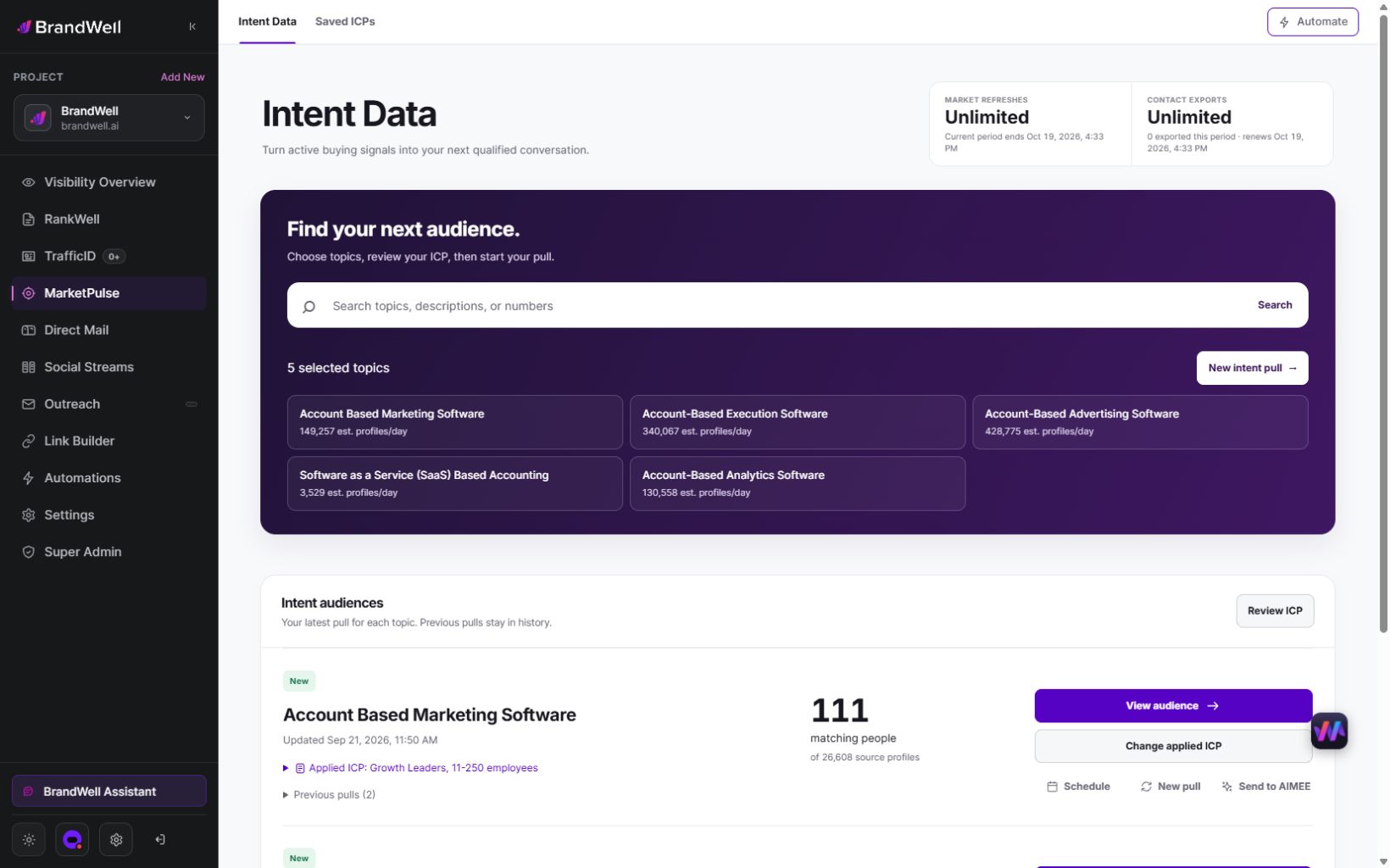
BrandWell is being developed as a separate white-label agency-reseller intent-data offer backed by LeadFuze infrastructure – not the legacy SEO writer. Agencies can purchase BrandWell’s $70 seven-day reseller pilot. It includes agency-branded topic reports and the complete sales playbook under the current written pilot terms. Other product capabilities and any topic exclusivity remain subject to their separate current written scope. BrandWell agency plans range from $2,500 to $5,000 per month, depending on topic count, term, and available contractually scoped topic exclusivity. The current written quote and Order Form control. Confirm current availability, data rights, price, pilot terms, and written topic-protection scope before committing to a client.

For an intent based audience building agency guide, BrandWell is a potential fit when the agency wants a managed, client-facing service engine and can support governance and outcome feedback. It is a poor fit for a buyer seeking only an unrestricted raw feed or for campaigns whose source data cannot meet platform and privacy requirements.

Agent-ready operating instructions:

  1. Give Claude or ChatGPT the approved signal dictionary, ICP, exclusions, platform policy checklist, audience objective, and current outcome data.
  2. Ask it to classify records as accept, reject, suppress, expire, or manual review, citing the fields used and never inferring missing permission.
  3. Require a human owner to approve the final audience and consequential spend change.
  4. Optionally execute the approved browser steps through the separate Moxby product, then retain platform receipts and rejection logs.

The deliverable is not “an intent list.” It is a maintained audience system with evidence, eligibility, expiry, suppression, exposure, feedback, and client decisions that can withstand review.

Build the agency offer around a paid pilot

A $70 payment opens a seven-day reseller pilot for the agency. BrandWell creates topic reports under the agency’s brand and shares the complete sales playbook for offering the service and seeking commitments before full-plan enrollment.

The goal is to validate real demand and give the agency enough commercial evidence to compare expected commitments with its costs and evaluate a profit-center model. Outcomes are not guaranteed. Review the $70 seven-day reseller pilot.