On this page
- What review-site intent means – and what it cannot prove
- Normalize review activity into an auditable activation workflow
- Seven review-signal tools, methods, and operating resources
- Review-site intent vs. clicks, campaigns, and last-touch attribution
- Budget for access, identity, activation, and operations
- Measure validation, action, pipeline, and downstream outcomes
- Who benefits from review-site intent – and who does not
- Combine review evidence with fit, identity, freshness, and activation
- Control licensing, privacy, data quality, and false-positive risks
- Package review-signal monitoring as a recurring agency service
- Make the source history inspectable
- A fictional review queue
- Use MarketPulse for its documented topic-research scope
For an account-level review-site program, treat a record as evidence of possible category or vendor research. Verify the source’s actual event definition, supported identity, fit, freshness, licensing and permitted action. It does not by itself establish a named person’s need, budget or purchase plan.
Who is this for? B2B marketing, growth, content, communications, and agency teams considering review-marketplace activity as an input to account prioritization, campaigns, sales coordination, or client reporting.
The useful question is not, “Did this account show intent?” It is, “What observable review activity occurred, how confidently can it be connected to the right account, and what proportionate action does that evidence support?” Build the workflow around that question and preserve the difference between research, inference, activation, and outcome.
Current MarketPulse offer: intent-data plans start at $500/mo. See the product, demo, and current plans. Updated October 1, 2026.
What review-site intent means – and what it cannot prove
Review-site intent usually describes evidence that someone associated with an organization viewed category, vendor, pricing, comparison, or competitor content on a software marketplace or review property. The observable unit may be an account visit, a page-type event, a research stage, an aggregate score, or a delivered account list. Those are not interchangeable.
Use these four author-proposed evidence checks. They are documentation states, not calibrated confidence probabilities or an industry certification.
- Observed marketplace activity: the provider documents a qualifying event and its collection context.
- Resolved account: the event is matched to a company with a stated method and confidence.
- Qualified account: the company passes ICP, territory, customer-state, and exclusion rules.
- Permitted action: the contract, privacy review, channel policy, and campaign design allow a defined response.
Do not add an unsupported fifth level called “buyer.” A category visit can come from a student, consultant, candidate, customer, competitor, researcher, or employee outside the buying group. Even a competitor-comparison visit does not reveal budget, authority, need, timeline, or the identity of the researcher. Review evidence becomes decision-useful only after fit, corroboration, and a bounded action are added.
Normalize review activity into an auditable activation workflow
The following nine-step workflow is a proposed operating method. Configure it for the source, client and destination rather than treating it as a native product automation.
- Define the decision. State whether the signal will change account research, content, paid media, sales prioritization, or a client report.
- Document the source contract. Record property, qualifying page or event, account/person level, collection time, delivery time, lookback, confidence, permitted use, retention, and deletion.
- Map the taxonomy. Keep category, own-profile, pricing, comparison, competitor, and high-intent direct actions distinct.
- Resolve and qualify. Apply company-match confidence, ICP, geography, customer state, open-opportunity state, and exclusions.
- Score evidence, not people. Assign a review-evidence tier to the account record. Do not label an appended contact as the individual who created the event.
- Choose a proportionate response. Education can use weaker account evidence; personalized outreach requires stronger context and human review.
- Route with expiry. Send the record to the correct owner with reason codes, a response window, and an automatic expiry.
- Capture action and outcome. Preserve who acted, what changed, exposure, response, opportunity state, complaint, and rejection.
- Review the rule. Compare accepted and rejected records, update thresholds, and version every material change.
Useful review signals templates include a signal dictionary, activation matrix, exception queue, account-research brief, client-facing evidence report, and change log. The operational checklist should verify source rights, identity level, timestamp semantics, duplicates, exclusions, CRM ownership, channel eligibility, message restraint, suppression, and rollback before a record leaves the review queue.
RevOps should own the account and CRM model; demand generation should own campaign actions; sales operations should own routing; the agency service lead should own client scope and evidence; privacy, legal, security, and platform-policy reviewers should define allowed uses. A named human should approve consequential outreach, spend, CRM overwrites, and public communications.
Seven review-signal tools, methods, and operating resources
The seven resources below are proposed templates and methods, not a vendor ranking or validated predictive model. Evaluate the evidence, output, fit and limits of each.
1. Page-type signal dictionary
Evidence: the exact marketplace action and whether it concerns a category, vendor, comparison, pricing, or competitor. Output: a normalized event with source, time, unit, and permitted-use fields. Best fit: every implementation. Limitation: a clean taxonomy improves interpretation but cannot repair a source that does not disclose what its signal represents.
2. Confidence ladder
Evidence: observed event, company resolution, fit qualification, and corroborating activity. Output: separate evidence tiers with different actions. Best fit: teams tempted to collapse every record into “high intent.” Limitation: scoring adds discipline, not certainty; thresholds still require validation against outcomes.
3. ICP and territory gate
Evidence: company attributes, serviceability, customer state, account ownership, and exclusions. Output: qualified, disqualified, or review status. Best fit: organizations with a defined market and routing model. Limitation: a stale ICP or account record can reject useful evidence or route it to the wrong team.
4. Identity-resolution tiering
Evidence: domain, company, known first-party contact, or inferred role, each with confidence and provenance. Output: an account record plus explicitly labeled contact hypotheses. Best fit: buying-group workflows. Limitation: adding a plausible person does not establish that the person visited the review site or authorized contact.
5. Action-threshold matrix
Evidence: signal type, recency, fit, corroboration, customer/opportunity state, and channel eligibility. Output: monitor, research, educate, advertise, route, suppress, or request human review. Best fit: coordinated marketing and sales teams. Limitation: automation can amplify a bad rule quickly, so consequential actions need approval, audit, and rollback.
6. Fit-equivalent control cohort
Evidence: qualified accounts without the review signal, selected before outcomes are known. Output: a baseline for response, opportunity, and cost comparisons. Best fit: programs with enough volume to reserve a credible comparison group. Limitation: observational controls may still differ on unmeasured factors and do not automatically establish causality.
7. Client evidence report
Evidence: delivered, accepted, activated, exposed, responded, qualified, and progressed records, plus cost and exceptions. Output: a decision-focused recurring report with definitions and limitations. Best fit: agencies and multi-team programs. Limitation: an attractive report can hide weak provenance or attribution unless each metric links back to auditable records.
Together these resources form a review signals framework and planning guide. Implementation examples should be labeled as hypotheses until the team can show source quality, process adoption, and customer-specific outcome evidence.
Review-site intent vs. clicks, campaigns, and last-touch attribution
A fair review signals comparison separates the observation from the measurement model:
- Review-site evidence may support offsite research at the unit documented by the provider. Review its collection, coverage, resolution method and limitations.
- Ad clicks record an interaction under the platform’s definition and filtering. They do not prove purchase intent or explain the entire journey.
- First-party site behavior is directly observed by the advertiser and can be highly explainable. It misses research that occurs elsewhere and can still include non-buyers.
- Campaign attribution assigns credit under a selected model and window. It is useful for consistent reporting but is not necessarily incremental effect.
- Last-touch reporting assigns credit to the final eligible interaction under its rules. That reporting choice does not describe every earlier interaction or establish causal contribution.
The strongest review signals alternatives are not necessarily replacements. Use first-party engagement for direct brand context, firmographic lists for fit, review activity for offsite timing, and a control or experiment for impact. Change systems only when the added evidence can alter a real decision enough to justify licensing, integration, and operational work.
Budget for access, identity, activation, and operations
Request a scoped quote rather than assuming a universal price or contract structure. Specify properties, event types, geography, supported identity, cadence, history, exports or API rights, destinations, support, term and retention. A source license and an implementation service are separate costs.
Review signals cost also includes identity resolution, enrichment, CRM and marketing-automation work, paid media, analysts, sales research, privacy and security review, false-positive handling, reporting, and change management. Model cost per delivered account, accepted account, actionable account, exposed account, qualified response, opportunity, and incremental outcome. Show rejected, expired, duplicate and suppressed counts separately. State the actual unit and denominator for each cost measure; source records and accepted records are different populations.
When clear public pricing is unavailable, request a scoped written quote and compare full total cost. Do not copy an estimate for an unrelated package or assume all review-signal products share a monthly range or contract term.
Measure validation, action, pipeline, and downstream outcomes
Review signals KPIs should move through an evidence chain:
- Validation: provenance completeness, valid timestamp, account-resolution rate, fit acceptance, duplicate rate, and false-positive review.
- Operations: delivery latency, records routed, owner acceptance, time to action, expiry, suppression, and exceptions.
- Activation: eligible audience, match, reach, exposure, content use, and coordinated sales research.
- Pipeline: qualified meetings, opportunity creation, stage progression, pipeline value, wins, and time to outcome.
- Trust: complaints, opt-outs, policy rejection, client disputes, and unsupported identity corrections.
Define the full program cost and comparison before activation. A proposed operational return is (attributed gross contribution before program cost minus full program cost) divided by full program cost. Keep cost categories separate to avoid subtracting the same expense twice. Attribution is not incremental effect. IAB’s incrementality overview emphasizes a credible counterfactual and managing bias and noise; a matched observational cohort does not automatically remove confounding.
There are no universal review signals benchmarks. Marketplace traffic, category maturity, account value, buying cycle, source coverage, routing adoption, and outcome definition change the rates. Start with an advertiser’s own fit-only baseline, preserve the cohort definition, and report sample size and uncertainty.
Who benefits from review-site intent – and who does not
Review signals for B2B marketing, growth, content, communications, and agency teams fit categories where buyers genuinely use the covered review property, account value can support data operations, the ICP is clear, there is a responsible activation path, and the CRM can return outcomes. Strong use cases include competitive evaluation, category education, account research, opportunity support, content-gap discovery, and coordinated media.
It is a poor fit when the market rarely uses review sites, the provider cannot explain the event or licensing, account resolution is weak, the buying cycle is too short for delivery, the team cannot act before expiry, or the only proposed action is intrusive person-level outreach from account-level evidence. Direct first-party research, contextual media, customer interviews, or firmographic targeting may be simpler and more defensible.
Combine review evidence with fit, identity, freshness, and activation
Useful review signals use cases combine five independent checks. First, confirm the source event. Second, qualify account fit. Third, label identity as company-level, known contact, or inferred role. Fourth, apply a category-appropriate freshness window. Fifth, define a permitted action and downstream outcome.
Review signals activation workflows should preserve that chain in the data model. Keep event time and delivery time separate. Store the provider’s event type, resolution confidence, ICP rule, source-rights decision, audience or route, owner, expiry, action receipt, and outcome. Review signals signal quality and measurement improve when operators can trace any activated record back to those fields and explain why the rule accepted it.
A simple example: a qualified target account researches a competitor comparison and returns to the advertiser’s implementation content. The system may prepare an account brief and recommend relevant education to the owner. A human still decides whether to contact anyone. The evidence supports prioritization; it does not identify the marketplace researcher or prove a purchase plan.
Control licensing, privacy, data quality, and false-positive risks
Common review signals mistakes include using a signal outside its licensed purpose, storing it beyond the allowed period, treating a company match as a person match, failing to preserve time semantics, cross-sharing client data, ignoring objections, and optimizing on downstream fields that were contaminated by the activation itself.
Before deployment, review the marketplace provider’s collection notices, contract, permitted uses, data-subject request process, security documentation, subprocessors, retention, deletion, regional coverage, and activation restrictions. If the workflow enriches or contacts people, assess that separate processing step as well. Legal requirements vary by jurisdiction and context; a vendor feature or hashed identifier does not by itself make a workflow compliant.
Mitigate false positives with confidence tiers, fit gates, two-signal corroboration for stronger actions, short expiry, negative-account lists, a manual-review queue, reversible routing, and complaint feedback. Do not use sensitive categories or inferred sensitive traits without specialist review and an explicitly permitted basis.
Package review-signal monitoring as a recurring agency service
An agency can turn review signals services into a recurring program with five modules: source and licensing intake; account and taxonomy setup; monitoring and validation; approved activation support; and evidence reporting. A useful cadence includes weekly exceptions and prioritized accounts, monthly source-and-outcome review, and periodic rule recalibration. Define service levels for delivery, triage, expiry, suppression, client approvals, and change control – not for guaranteed pipeline.
An agency can define the source intake, account review, permitted tasks and reports as its own service. MarketPulse supplies topic research, not a guaranteed feed from any particular review marketplace. Verify the named source directly and do not imply native branded reporting, source licensing or a production intent API from a separate product.
Prepare a bounded AIMEE task with the approved source dictionary, ICP, identity evidence, expiry, permitted actions and report schema. Request a brief with references to input fields and explicit unknowns. Do not let the task invent who researched, permission or missing evidence. A named owner reviews communication, spend and permanent changes before execution through configured tools.
- Give AIMEE the approved evidence dictionary, ICP, identity states, expiry rules, permitted actions and report specification. Ask for a sourced brief with explicit unknowns through configured tools.
- Ask it to prepare a reason-coded account brief and recommend monitor, suppress, research, activate, or manual review; require citations to the input fields.
- Prohibit the model from asserting who researched, inventing missing permission, sending outreach, changing spend, or overwriting the CRM without explicit human approval.
- Retain the approved task scope, action receipts, exceptions and rollback evidence. Verify the actual configured tool access before execution.
The durable product is not a stream of “hot accounts.” It is a review-evidence system that a client can understand, operators can audit, and the agency can improve without overstating what the signal proves.
Make the source history inspectable
W3C’s PROV overview describes provenance through the entities, activities and people involved in producing data. Use that concept to record the event, transformation, responsible owner and correction history. This proposed application is not a claim of formal PROV conformance.
Two records from the same underlying event are not independent corroboration. Preserve dependencies and review a representative sample, including rejections and unknowns. Reviewer decisions are process reference labels, not perfect knowledge of a buyer’s intent.
A fictional review queue
Suppose a hypothetical program receives 80 account records, accepts 40 for research and prepares ten reviewed briefs. Acceptance is 40/80, or 50%; briefs are ten of the accepted 40, or 25%. If five briefs lead to permitted tasks, that is 5/10, or 50%. These are fictional process counts, not benchmarks or proof of pipeline lift.
Account records, briefs, tasks, people reached and qualified opportunities are separate units. Track mature outcomes and what happened in the comparison group before discussing incremental value.
Use MarketPulse for its documented topic-research scope
MarketPulse standard plans are starting at $500/mo for one topic with weekly refreshes. Growth includes three topics with daily pulls; Scale includes ten topics with daily pulls. Fields and audience sizes vary, and audiences can overlap.
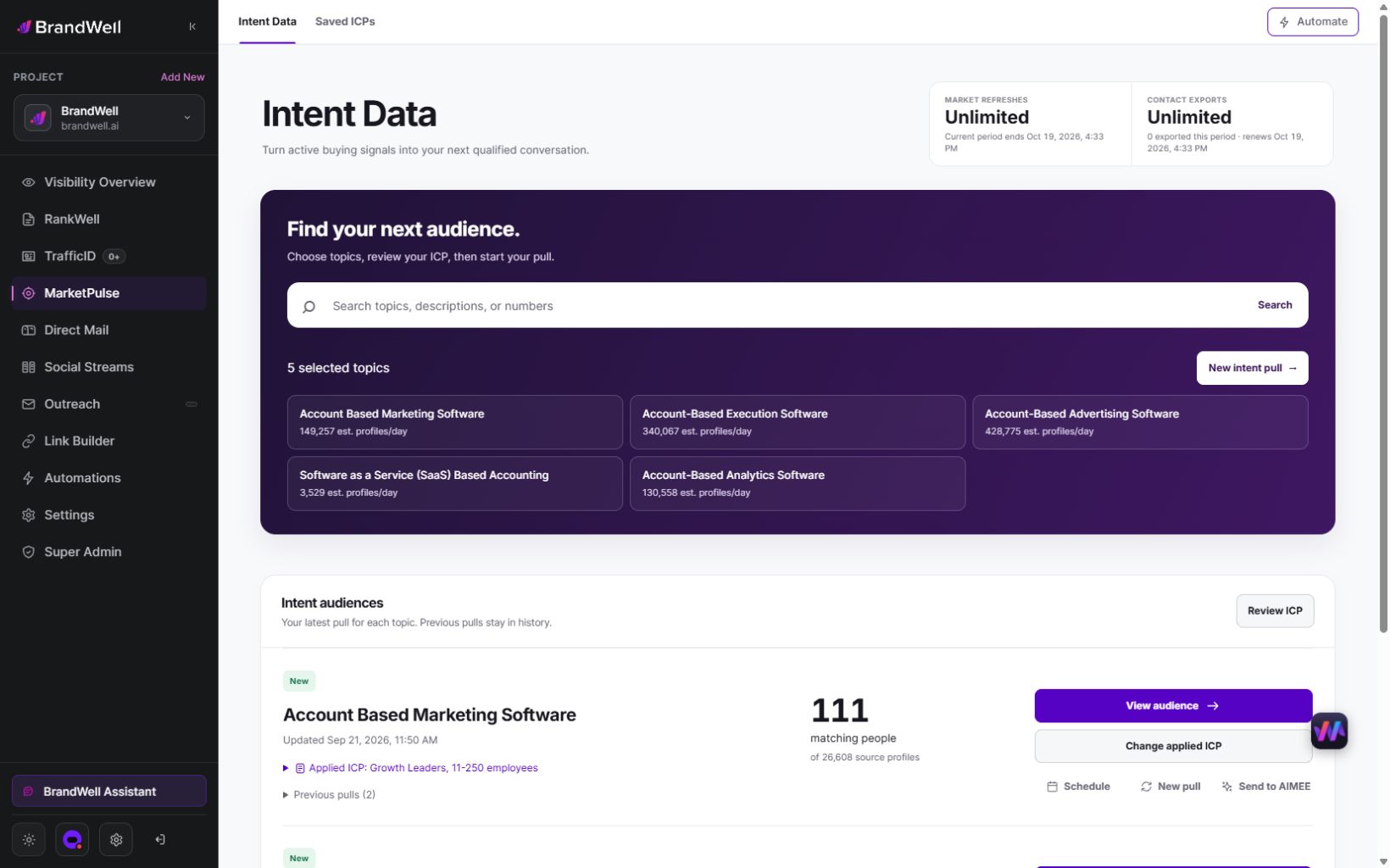
Search an available topic, apply an ICP and inspect the evidence before preparing a next action. Keep any separately licensed review-site feed distinct from MarketPulse records. Use AIMEE through configured tools to prepare a sourced brief within the authorized scope.
Watch the MarketPulse demo and review plans or browse current BrandWell products.
Reviewed and updated October 3, 2026.

Written by