On this page
- BrandWell: MarketPulse intent data and connected growth automation
- What an agency must deliver beyond raw buyer intent signals
- Build the managed signal-to-outcome operating layer
- Seven defensible ways to differentiate an intent service
- Managed intent service vs. software: when each model wins
- Compare service fees with software, labor, integration, and total cost
- Prove value with accepted signals, activation, pipeline, and retention
- Which clients should hire an agency – and which should buy direct
- Connect intent, identity, enrichment, activation, and outcome feedback
- Avoid weak proof, privacy failures, and overpromising
- Turn differentiation into a recurring agency service package
- Worked example: stress-test the service margin
- Choose a model with a decision worksheet
- Frequently asked questions
The short answer: an agency should not try to beat buyer-intent software at being a software catalog. It should own the work between a signal and a defensible client decision: define what counts, validate fit and identity, route the signal, coordinate the action, measure the result, and improve the rules.
Who is this for? Agency founders, GTM consultants, demand-generation leaders, and RevOps partners deciding whether to sell a managed buyer-intent service rather than another dashboard or lead list.
AIMEE can help prepare work through configured connected tools. Review the supported workflow, the output and the actual destination result. Keep named owners responsible for final actions rather than assuming unrestricted execution.
Buyer intent, identity matching, enrichment, and visitor identification are probabilistic evidence. They do not prove that a person will buy. Keep human approval before consequential outreach, ad-spend changes, CRM overwrites, or public posting.
Current MarketPulse offer: intent-data plans start at $500/mo. See the product, demo, and current plans. Updated October 3, 2026.
BrandWell: MarketPulse intent data and connected growth automation
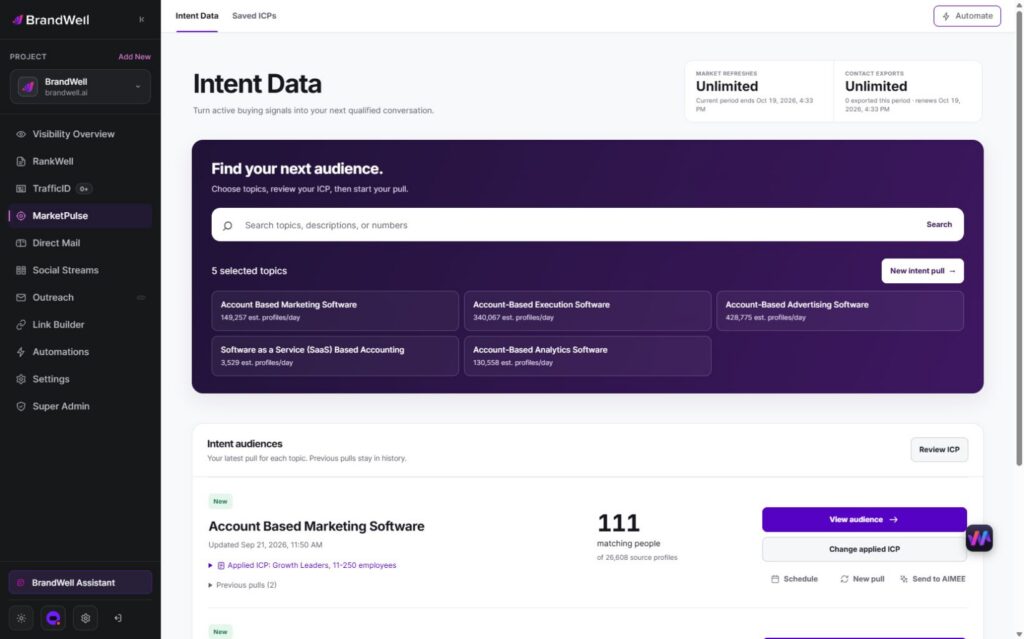
BrandWell MarketPulse: intent data starting at $500/mo. Find people researching topics relevant to what you sell, apply saved ICP filters, and review available contact details before taking action.
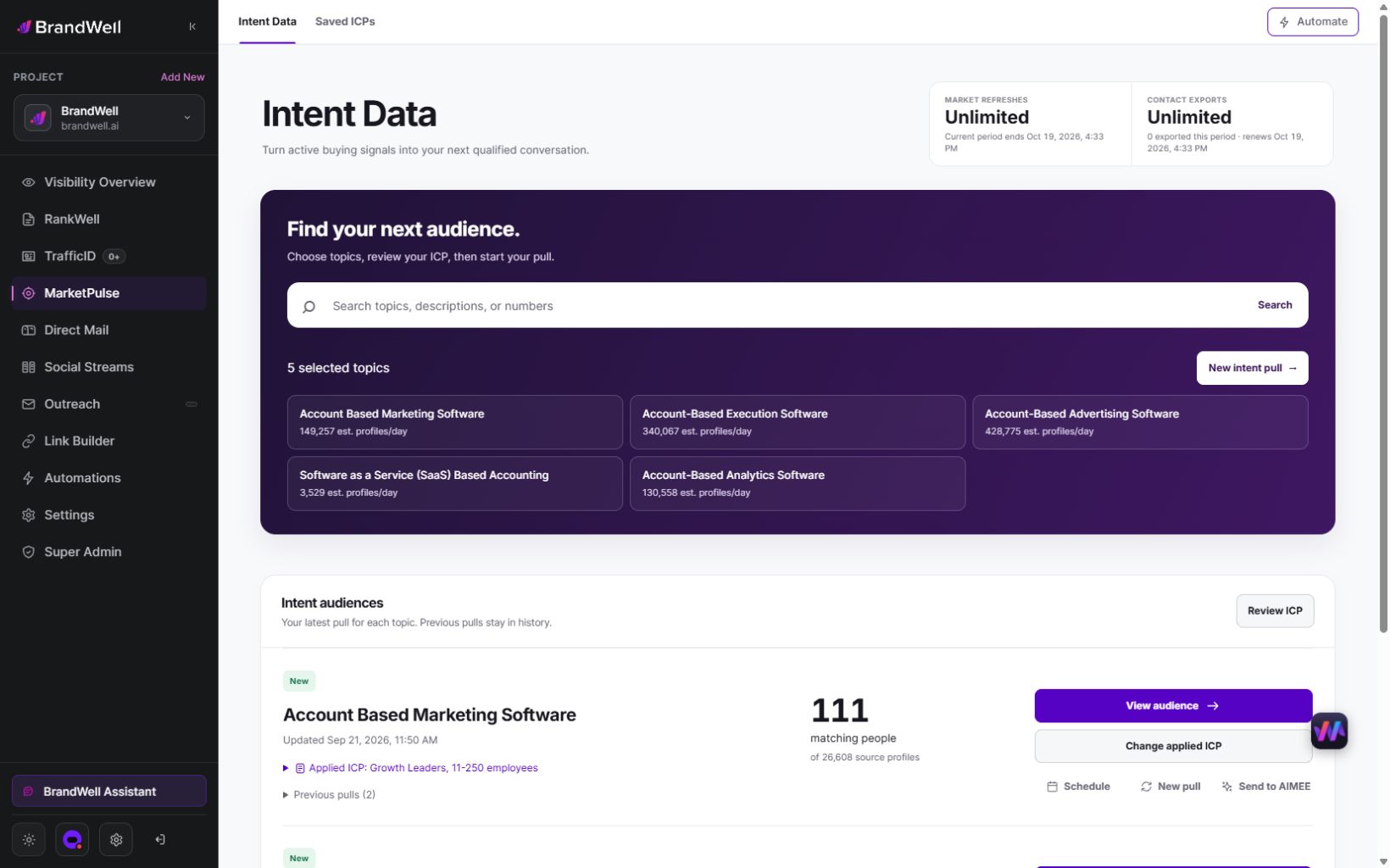
MarketPulse plans are starting at $500/mo. Verify current package scope and offers on the product page.
| Plan | Topics and refreshes | Monthly exports |
|---|---|---|
| Starter | 1 topic, weekly | 25,000 contacts |
| Growth | 3 topics, daily | 100,000 contacts |
| Scale | 10 topics, daily | Unlimited contacts |
Swipe the table to see all columns.
A pull retrieves available data from the previous 24 hours for one topic. Daily use across all included topics provides 90 Growth pulls or 300 Scale pulls in a 30-day month. Weekly Starter pulls vary by calendar month. Available audience size and contact fields vary, and audiences may overlap. Refreshes stop at the plan limit without overage charges.
- Find and qualify: search the topic catalog, save your ICP, and review the people and companies that match.
- Act on the research: export qualified contacts or prepare an Outreach or Direct Mail workflow. Connected products, channel usage, and fulfillment may cost extra.
- Get help from AIMEE: Growth and Scale include AIMEE for the initial user to research accounts and prepare the next step through connected tools.
Agencies and other service businesses can build client deliverables around their available Intent Scans and exports. Keep each client’s scope, permissions, and service fees clear. A subscription is not a promise of a white-label platform or exclusive access to a market.
Explore MarketPulse and watch the demo or compare plans starting at $500/mo. Any early-access discount is a separate, time-limited offer shown to an eligible recipient.
What an agency must deliver beyond raw buyer intent signals
The strongest differentiation is a managed operating system, not a larger pile of signals. A client can already license software, export records, and build dashboards. What many teams lack is a shared definition of an accepted signal, a reliable response workflow, an owner for every handoff, and an evidence trail that connects action to business decisions.
Start with the client outcome and work backward. If the goal is qualified pipeline, define the account fit, topic, freshness window, identity confidence, suppression rules, and sales action required before the agency calls anything qualified. If the goal is media efficiency, define which cohort can change bids or creative, the experiment control, the budget boundary, and the review interval. Signal volume alone is not the outcome.
A defensible managed service therefore delivers five things: a signal contract, an activation plan, operating accountability, quality control, and decision evidence. It should also tell the client when not to act. That restraint is valuable because false positives, duplicate identities, stale research, and unqualified accounts can waste sales time and damage trust.
The practical positioning statement is simple: software exposes possible demand; the agency helps the client decide which evidence is usable, what to do next, and whether the action worked. That promise is more credible than guaranteeing meetings or revenue, because outcomes still depend on the offer, market, timing, execution, and sales follow-through.
Build the managed signal-to-outcome operating layer
Use a repeatable workflow that makes inputs, owners, decisions, and outputs visible. A useful implementation guide has seven steps:
- Write the signal contract. Record ICP filters, eligible topics, freshness, minimum confidence, exclusions, and the client decision the signal may inform.
- Map the data path. Show how research activity, website activity, identity resolution, enrichment, validation, CRM records, and downstream outcomes connect. Do not collapse distinct operations into one accuracy claim.
- Create an acceptance queue. Deduplicate, suppress customers and open opportunities when appropriate, check fit, and quarantine incomplete or conflicting records.
- Assign an action playbook. Each accepted state gets one permitted next step, an owner, a service level, required context, and an approval rule.
- Run a controlled activation. Start with a bounded cohort. A person reviews outreach; a media owner approves spend changes; a RevOps owner approves CRM overwrites.
- Capture outcome evidence. Log acceptance, action, response, opportunity progression, loss reason, and suppression feedback without treating correlation as causation.
- Review and tune. Inspect false positives, rejected signals, bottlenecks, and segment performance on a fixed cadence before expanding scope.
The agency needs an account lead, data or RevOps owner, channel operator, and client decision-maker. Small teams can combine roles, but not accountability. The recurring deliverables should include the accepted-signal file, exception log, action queue, outcome ledger, and decision memo. Templates help only when the client agrees on definitions.
Seven defensible ways to differentiate an intent service
Use the same criteria for every method: the client problem solved, required input, operating burden, evidence produced, and meaningful limitation.
1. Publish a precise signal definition
Define the topic, source type, fit threshold, freshness, identity level, and permitted use before delivery. This prevents “intent” from meaning every click or research event. It is best for clients whose teams disagree about qualification. Its limitation is that a strict definition may reduce volume, which is the right trade when usability matters more than a large report.
2. Add fit, suppression, and exception logic
Filter signals against the ICP and remove customers, competitors, students, duplicates, active opportunities, or unsupported geographies as the use case requires. The agency differentiates by returning a smaller, explainable queue. The limitation is ongoing maintenance: fit rules and CRM states change, so a neglected suppression layer becomes inaccurate.
3. Design channel-specific activation
Translate a research state into an appropriate sales, paid-media, customer-success, or website action. A sales-ready state may justify research and a tailored draft, while a weaker account-level state may only justify audience observation. The limitation is operational: the client must supply channel access, owners, and response capacity.
4. Govern data use and approvals
Record provenance, permitted purpose, retention, access, and approval boundaries. Give the client a documented way to reject a record or pause a workflow. This is valuable in regulated or reputation-sensitive environments. The limitation is that an agency cannot replace the client’s privacy, security, or legal review.
5. Own the service cadence and exceptions
Monitor failed syncs, missing fields, stale queues, unworked signals, and SLA risk rather than delivering a monthly export. Clients buy fewer surprises and a named owner. The limitation is capacity: exceptions consume labor, so the agency needs tiered service levels and a clear change-control process.
6. Build an evidence ledger
Track which signals were accepted, which actions occurred, and what happened afterward. Separate activity, adoption, pipeline, and revenue evidence. This lets a QBR make a decision instead of reciting counts. The limitation is attribution: observed outcomes rarely prove that intent data caused the result without a credible comparison.
7. Deliver decision support, not a vanity report
Recommend what to continue, change, test, or stop based on the evidence and capacity available. The agency becomes useful when it can say “do not scale this cohort yet.” The limitation is that clients must share outcome data and empower owners to act; otherwise even an excellent recommendation remains a document.
Managed intent service vs. software: when each model wins
Choose software directly when the client has data engineering, RevOps, campaign operations, governance, and measurement capacity. Direct software offers control and may suit teams that want to build proprietary workflows. The tradeoff is that license cost is only one part of ownership; configuration, integrations, monitoring, and adoption remain internal work.
Choose a managed agency service when the client needs a working signal-to-action process, cross-channel coordination, recurring interpretation, or a white-label delivery layer. The agency can combine data, workflow, reporting, and accountability. The tradeoff is less direct control and a dependency on the agency’s documentation, capacity, and export practices.
Choose a hybrid when the client owns its data and systems but wants the agency to operate selected playbooks. This often works for mature RevOps teams: the client retains governance and the agency supplies specialist execution. The risk is blurred accountability, so write the RACI and escalation path before launch.
Use a manual or non-intent approach when the account universe is small, the sales cycle is relationship-led, the underlying data cannot support reliable identity, or the client cannot act quickly enough. Interviews, account planning, referral development, and first-party hand raises may be more useful. Intent data should earn its place; it is not automatically the right input.
Compare service fees with software, labor, integration, and total cost
Model the full operating cost rather than comparing a managed fee with a software subscription. Include subscription or wholesale platform cost, signal usage, identity and validation, implementation, integration maintenance, analyst time, client strategy, activation labor, reporting, quality review, security work, and exit or export effort.
Use a defined monthly operating model: platform and usage plus allocated setup, delivery labor, exception labor and included overhead. Revenue minus those defined costs, divided by revenue, is the margin under that scope. Do not call it gross margin when the model includes expenses outside cost of sales. Specify excluded costs and the accounting treatment.
The agency still chooses its retail price and bills its own clients. Price the managed outcome, delivery load, and risk – not just the underlying data. State setup fees, included modules and volume, overage rules, response SLA, reporting cadence, client responsibilities, and change-control triggers in the proposal.
Prove value with accepted signals, activation, pipeline, and retention
Measure the operating chain, not one headline number. Leading indicators include accepted-signal rate, duplicate and suppression rate, identity-confidence distribution, time to review, and time to action. Adoption indicators include the share of accepted signals worked within SLA and the share of recommended audiences or plays actually launched.
Pipeline indicators include qualified replies, meetings that meet an agreed standard, opportunities created, stage movement, and pipeline value among acted-on cohorts. Revenue and retention indicators include closed revenue, service gross margin, renewal, expansion, and client adoption. Every metric needs a numerator, denominator, data owner, source system, and evaluation window.
For example, accepted-signal rate is accepted records divided by reviewed records. Activation rate is records that received the approved action divided by accepted records. Opportunity rate is qualified opportunities divided by activated accounts. Do not use total signals as the denominator for every KPI; that can hide a broken review or routing step.
For an incremental question, use a suitable randomized comparison where feasible, preserve original assignments and report contamination and uncertainty. Staggered rollout, matched cohorts and before-and-after reporting can remain confounded. Rates among activated accounts are selected operational measures, not automatically estimates of a treatment effect.
Which clients should hire an agency – and which should buy direct
A managed model fits a client with a defined ICP, enough addressable demand, a usable CRM, a channel team that can act, and an executive willing to agree on qualification. It is also useful for agencies that already manage paid media, outbound, lifecycle, or RevOps and can embed signals into work the client already values.
Direct software is usually a better fit for a company with internal data engineering, mature governance, documented playbooks, and a desire to own integrations and models. A light advisory engagement may be enough. A non-intent approach is better when the market is too small, the data has weak coverage, the client lacks response capacity, or legal and consent constraints make the proposed use unsuitable.
Before selling, ask: Can the client name the business decision? Are fit and exclusions documented? Who reviews records? Who owns each channel? Can outcomes return to the system? Is there enough volume for a meaningful test? Will the client share the data required to evaluate performance? A “no” is a prerequisite to solve, not an objection to brush aside.
Connect intent, identity, enrichment, activation, and outcome feedback
Intent data is useful only when it changes a qualified decision. Map the flow as separate stages: a topic or website activity creates a possible signal; identity resolution estimates the person or account; enrichment supplies fit context; validation checks contactability; rules assign an allowed action; and downstream outcomes update the next decision.
Keep confidence visible throughout. Account-level research should not silently become a named-person claim. A visitor match should not be described as certain. A valid email does not mean the person has purchase intent. When signals conflict, route them to review or a lower-risk observation state.
BrandWell MarketPulse is topic-based intent-data software for businesses and agencies. Choose relevant research topics, apply saved ideal-customer-profile filters, review available names, roles, companies and contact details, and export the audience or prepare a connected workflow. Plans start at $500/mo. TrafficID identifies visitors to your own website and is a separate product. A MarketPulse subscription does not by itself promise a white-label portal, custom API implementation, exclusive topics, or managed client delivery.
Close the loop with accepted/rejected states, action timestamps, opportunity outcomes, and reasons. Feedback should improve thresholds and workload forecasts. It should not train an automation to send more messages merely because a signal exists.
Avoid weak proof, privacy failures, and overpromising
The biggest strategic mistake is promising outcomes the agency cannot control. Never guarantee identity, meetings, pipeline, revenue, compliance, ranking, or citation. Describe the method, constraints, and evidence instead. The biggest operational mistake is forwarding every signal before fit, suppression, and capacity checks.
Document purpose, available provenance, access, retention, deletion, suppression and client responsibilities for the actual workflow. Review applicable law, channel rules and contracts with qualified advice; a service template does not establish compliance.
Protect trust with minimum access, audit logs, approved exports, and an incident path. Test integrations for duplicates, field conflicts, stale states, and unintended overwrites. Require a human to approve external outreach, spend changes, CRM changes, or public statements. Separate model suggestions from authorized actions in every automation instruction.
Finally, make vendor and agency exit possible. The client should know what can be exported, what must be deleted, and how workflows will stop. A service that depends on hidden logic may retain a client briefly but is difficult to defend in procurement or renewal.
Turn differentiation into a recurring agency service package
Package a separately scoped service around client decisions. A foundational service can include topic selection, fit review, an internal report and a capped action queue. Additional service work might include exception review, supported channel preparation and outcome reporting. Experiments or extra implementation need their own scope and costs. Do not imply exclusive topics or client-portal rights are subscription entitlements.
Use a relevant MarketPulse topic and defined ICP, inspect the available matches, and prepare a useful next step. AIMEE can help assemble a brief through configured connected tools. Verify the result. Scope additional agency reporting, integrations, service delivery and commercial rights separately.
Worked example: stress-test the service margin
A fictional agency charges four clients $750 each per month, producing $3,000 revenue. It allocates $500 to software, $1,200 to delivery labor and $300 to exception handling. The defined service costs total $2,000, leaving $1,000, or 33.3% of revenue, before overhead, taxes and any other excluded expenses.
If exception labor rises by $600, the remainder falls to $400, or 13.3%. With only two clients, unchanged defined costs of $2,000 exceed $1,500 revenue by $500. Costs may scale differently in practice; model the actual fixed and variable components.
The agency fee is illustrative and separate from MarketPulse subscription pricing. A positive service margin does not show that the client earned ROI or that the data caused additional sales.
The SBA’s business-management guidance emphasizes bookkeeping and accounting for revenue and expenses. Use qualified accounting advice for your actual cost classification; these examples are a planning model, not financial statements.
Choose a model with a decision worksheet
- Identify the client decision and the evidence it requires.
- Check the actual topic coverage, fit and available fields.
- List the people who will review, approve and operate the action.
- Separate product allowances from additional service deliverables.
- Model ordinary, exception-heavy and low-client-count costs.
- Define outcome reporting, export and exit responsibilities.
- Start with the smallest useful scope and review whether the work is adopted.
Frequently asked questions
Is managed service always better than buying software?
No. Choose by the client’s actual skills, workflow, capacity and ownership needs.
Does the MarketPulse plan include a managed agency service?
A subscription provides its defined product allowances. Additional service delivery, implementation and rights need separate scope.
Is a smaller accepted queue proof of better results?
No. Check usefulness, rejected and missed records, workload and outcomes. Selection alone does not establish incremental impact.
What should the renewal report show?
Agreed scope, actual delivery, exception work, decisions, defined outcomes, costs and the next action. Keep observed results and causal conclusions distinct.
Reviewed and updated October 3, 2026.

Written by