Short answer: Identity resolution decides which records, identifiers, devices, or events probably belong to the same person or company. Data enrichment adds attributes to a record after the subject is known well enough to query another source. Use enrichment alone when a stable identifier already exists and the only job is to fill or refresh fields. Resolve identity first when duplicates, conflicting identifiers, anonymous activity, account hierarchies, or uncertain matches could cause attributes to land on the wrong entity.
Who is this for? B2B data, RevOps, growth, and agency teams deciding how to turn fragmented CRM, website, product, and third-party records into governed activation data.
The distinction matters because a richer record is not necessarily a correctly matched record. A job title, domain, phone number, or firmographic field can be accurate for its source and still be attached to the wrong person or account. Treat resolution and enrichment as separate, observable operations with their own inputs, confidence, exceptions, costs, and quality tests.
The practical difference between identity resolution and enrichment
Identity resolution answers, “Are these observations about the same entity?” It standardizes identifiers, generates candidate links, applies deterministic or probabilistic rules, assigns confidence, resolves conflicts, and creates a persistent identity or account key. Its output is not certainty. It is an evidence-backed match decision, an unresolved state, or a manual-review exception.
Enrichment answers, “What additional attributes can a permitted source contribute to this known record?” It may append or refresh firmographics, role, contact details, technology, location, verification status, or other fields. Its output should preserve source, retrieval time, permitted use, validation state, and survivorship rule. Enrichment does not prove that two ambiguous source records refer to the same entity.
A useful identity resolution versus enrichment framework therefore keeps five things separate: the source observation, the candidate entity, the match decision, the appended attribute, and the downstream action. That separation lets an operator reverse a false merge without discarding valid enrichment, or retire a stale attribute without breaking the identity graph.
Sequence matching, survivorship, enrichment, validation, and activation
A practical identity resolution versus enrichment implementation guide follows this order:
- Define the entity and decision. State whether the workflow resolves a person, company, location, household, device, or another entity, and name the decision the result will support.
- Inventory identifiers. Record source, collection context, normalization, reliability, timestamp, permissions, and known failure modes for every email, domain, profile URL, phone, CRM ID, cookie, device, or account key.
- Normalize without merging. Standardize casing, domains, phone formats, company suffixes, and null values while preserving raw source values.
- Generate and score candidates. Apply exact keys where justified, then multi-field or probabilistic evidence for ambiguous cases. Retain rule version and confidence.
- Apply survivorship. Decide which source wins by field, how contradictions are handled, and when a human reviews a cluster.
- Enrich the resolved key. Request only attributes needed for the stated use, then attach provenance, freshness, validation, and licensing metadata.
- Validate before activation. Test match quality and attribute accuracy separately, suppress ineligible records, and route low-confidence cases to review.
- Monitor and unwind. Log changes, downstream use, complaints, false merges, stale fields, and reversals so the system can correct itself.
Useful identity resolution versus enrichment templates include an identifier dictionary, candidate-pair ledger, survivorship matrix, field-provenance record, exception queue, validation sample, suppression specification, and change log. The operational checklist should name owners in RevOps, data engineering, privacy, security, sales operations, and the business team that approves consequential activation.
Seven workflow patterns for resolution, enrichment, or both
These are workflow patterns, not a vendor ranking. Choose the smallest pattern that can support the decision, and test it on representative records.
1. Stable-key enrichment
Start with a verified business email, profile URL, company domain, or internal account ID and append only required fields. Best fit: clean systems with one durable key and few duplicates. Limitation: the workflow fails when the key is shared, recycled, malformed, or attached to the wrong source record.
2. Exact-key deduplication before enrichment
Normalize stable identifiers, collapse exact duplicates, assign a canonical record, and then enrich once. Best fit: duplicate-heavy CRM imports where exact keys are trustworthy. Limitation: exact matching misses legitimate variations and can still create false merges around shared inboxes or parent-company domains.
3. Multi-field rule-based resolution
Require an approved combination such as name plus company plus a corroborating identifier, with explicit reject and review rules. Best fit: explainable workflows with manageable data variation. Limitation: hand-built rules become brittle across languages, subsidiaries, role changes, and sparse records.
4. Probabilistic or hybrid entity matching
Score candidate pairs from multiple signals, use deterministic anchors where available, and keep confidence tiers. Best fit: larger datasets with ambiguous or partially missing identifiers. Limitation: a model score is not truth; thresholds, truth sets, drift, and manual adjudication remain necessary.
5. Account-first, contact-second resolution
Resolve the organization and its hierarchy first, then place contacts within the correct account before enrichment. Best fit: B2B teams where territories, routing, and account ownership matter. Limitation: resolving a company does not identify the visitor, researcher, decision maker, or buying role.
6. Visitor-to-account-to-record sequence
Keep an eligible website event, probable company, candidate person, enriched contact, and CRM record as separate linked objects. Best fit: governed visitor-identification workflows. Limitation: each link adds uncertainty; a visit and a resolved identity do not prove purchase intent or authorize outreach.
7. High-value manual adjudication
Send consequential conflicts, strategic accounts, or uncertain clusters to trained reviewers with evidence and reversal controls. Best fit: lower-volume, high-value records where a false merge is costly. Limitation: review adds latency and labor, and reviewer agreement must itself be measured.
When to use identity resolution, enrichment, or a combined architecture
Use enrichment alone when the subject is already established by a durable internal or validated external key, duplicates are controlled, the requested fields have a defined use, and a wrong append can be detected. This is often enough for refreshing firmographics on a trusted account list or validating a known contact field.
Use identity resolution before enrichment when records conflict, multiple systems assign different IDs, anonymous events must be related to accounts, company hierarchies affect routing, contacts move employers, or one bad match could expose private data or trigger the wrong action. Use both when the business needs a canonical person or account view and current attributes for qualification or activation.
Single-field matching is an alternative only when that field is unique, stable, and fit for the decision. Reverse IP can support probable company identification but not person identity. Manual reconciliation works for small strategic sets but is hard to reproduce at scale. The right identity resolution versus enrichment decision guide asks what could be wrongly joined, what could be stale, what action follows, and how the team will detect and reverse an error.
Compare data, implementation, usage, QA, and total operating cost
Identity resolution versus enrichment pricing is rarely comparable at the headline unit. Resolution may be priced by record processed, candidate pair, profile, graph, batch, compute, or implementation. Enrichment may be priced by request, field, credit, verified result, record, or subscription. Both can add minimum commitments, data-provider fees, storage, orchestration, security review, support, and overages.
Model total identity resolution versus enrichment cost as: source access plus normalization plus matching plus enrichment plus validation plus infrastructure plus exception labor plus governance plus downstream correction. Divide by accepted resolved entities or usable enriched records – not raw calls. Include unmatched records, retries, duplicate requests, stale results, reversals, and records that cannot be activated.
Request a scoped written quote using the same entity definition, geography, fields, volume, freshness, match method, confidence output, support, contract term, and permitted use. A public per-record rate for a technical matching service is not a like-for-like total for a managed agency service.
Measure match quality, attribute accuracy, coverage, freshness, and outcomes
Measure resolution with a labeled representative sample. Track candidate-pair precision, recall where a defensible truth set exists, cluster purity, false merges, missed links, unresolved rate, reviewer agreement, reversal rate, and stability after updates. Publish the entity level, threshold, sample construction, missingness, and limitations beside any benchmark.
Measure enrichment separately: field fill, source coverage, format validity, deliverability or validation state where relevant, freshness, contradiction rate, accepted-field rate, and expiry. A high fill rate can coexist with poor accuracy. A precise resolution process can still enrich the wrong attribute if the source is stale.
Downstream identity resolution versus enrichment KPIs should preserve the chain from accepted record to routed action, sales acceptance, qualified opportunity, correction, opt-out, complaint, and outcome. ROI requires a customer-specific baseline, full cost, a comparable cohort or holdout where feasible, and attribution limits. Do not attribute revenue to resolution or enrichment merely because a processed record later appears in pipeline.
Choose by CRM condition, identity ambiguity, and downstream decision
Enrichment-only workflows fit teams with clean canonical IDs, low duplicate rates, stable account ownership, and a narrow field-refresh job. Resolution-first workflows fit organizations combining acquisitions, form fills, product records, events, website activity, and multiple CRMs. A combined architecture is usually warranted when account hierarchies, contact mobility, routing, personalization, suppression, or client reporting depend on the correct entity.
Do not add an identity graph because it sounds mature. If the decision can be supported by a validated key and one fresh attribute, a graph adds unnecessary cost and risk. Conversely, do not use cheap enrichment as a substitute for matching when ambiguity could route sensitive or consequential data to the wrong person or client.
Map the visitor-to-record-to-account-to-action data flow
A governed activation workflow keeps the chain visible: eligible event → source identifier → account candidate → person candidate when permitted → resolution confidence → enriched attributes → fit and customer-state checks → suppression and eligibility → proposed action → human approval → execution receipt → outcome and correction feedback.
Store event time and delivery time separately. Keep observed activity apart from inferred identity. Label appended contacts as plausible roles, not the individuals who generated an account-level signal. Expire identity and attributes on different schedules. A company match may remain useful after a session expires, while a title or phone validation may need a new check.
This input/output map supports common identity resolution versus enrichment use cases without flattening uncertainty. It also lets operations trace why a record entered a campaign, which evidence changed, and how to suppress or unwind it.
Prevent false merges, stale attributes, licensing errors, and privacy failures
The biggest identity resolution versus enrichment mistakes are silent: merging on a shared field, overwriting raw values, discarding provenance, letting a confidence score masquerade as certainty, appending unnecessary data, keeping attributes indefinitely, and activating before source rights are reviewed.
The CIMM identity buyer guide is useful for terminology, needs assessment, symmetric RFP questions, match testing, and limitations; it does not prove any provider’s accuracy or fit. For California data-broker questions, the California Privacy Protection Agency’s data-broker guidance provides a current regulatory starting point, but applicability requires legal review.
Apply data minimization, role-based access, retention, suppression, deletion, security, and contract controls. Require human review before consequential outreach, CRM overwrites, account reassignment, or sharing a resolved record with a client.
Package resolution and enrichment responsibly inside an agency service
An agency can sell a recurring resolution-and-enrichment operating layer: source intake, identity design, normalization, match rules, enrichment policy, exception review, validation samples, CRM routing, suppression, client reporting, and quarterly rule review. Price the managed complexity and accountable decisions rather than promising a universal match or fill rate.
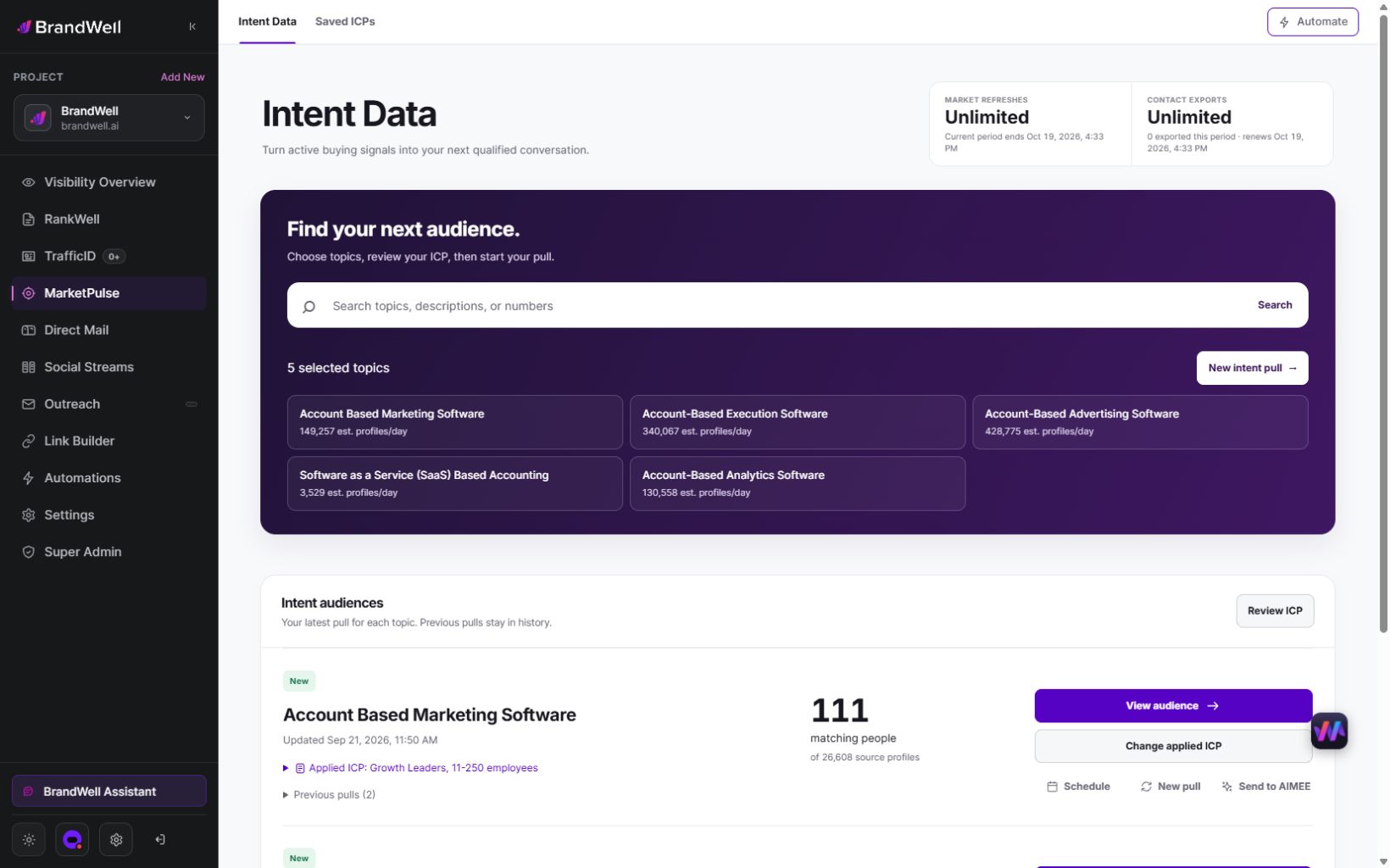
BrandWell is being developed as a separate white-label agency-reseller intent-data offer built on LeadFuze infrastructure – not the legacy SEO writer. Agencies can purchase BrandWell’s $70 seven-day reseller pilot. It includes agency-branded topic reports and the complete sales playbook under the current written pilot terms. Other product capabilities and any topic exclusivity remain subject to their separate current written scope. BrandWell agency plans range from $2,500 to $5,000 per month, depending on topic count, term, and available contractually scoped topic exclusivity. The current written quote and Order Form control. Confirm current availability, data rights, price, pilot purchase and access terms, deliverables, and written topic-protection scope before committing to a client.
For this use case, BrandWell may fit an agency that wants a managed client-facing intent service with branded evidence and repeatable operations. It is not a replacement for every enterprise master-data, warehouse, media-identity, or custom developer workload, and it should not be sold until the exact identity, enrichment, validation, and delivery scope is verified.
Agent-ready operating instructions:
- Give Claude or ChatGPT the approved entity definition, identifier dictionary, match rules, confidence thresholds, survivorship matrix, allowed fields, and sample records.
- Ask it to produce candidate matches, conflicts, missing evidence, and review reasons without treating an enrichment attribute as identity proof.
- Require a human owner to approve merge rules, consequential CRM changes, outreach, and client delivery.
- Optionally execute approved browser steps through the separate Moxby product, retaining inputs, diffs, receipts, exceptions, and rollback instructions.
The durable deliverable is an auditable chain from source observation to resolved entity to enriched field to approved action – not a larger record assembled without proof.
Check the economics before a full plan
For a $70 pilot fee, agencies get seven days to validate the reseller offer. BrandWell supplies agency-branded topic reports and the complete sales playbook for presenting the service and seeking client commitments before any full-plan enrollment.
The agency can use the pilot evidence to assess demand, compare expected commitments against costs, and decide whether the service can become a profit center. Commercial and financial outcomes are not guaranteed. Review the $70 seven-day reseller pilot.