On this page
- Current TrafficID visitor workflow
- Define the actual matching unit
- Test eight reconciliation and validation steps
- Use seven match-quality tests
- Keep identity and usable states distinct
- Count full usable-match costs
- Measure coverage and correctness separately
- Check actual traffic and permitted use
- Keep observation and stakeholder context separate
- Record exclusions and unresolved identities
- Scope separate visitor-quality work
- Copyable visitor-match review
- Frequently asked visitor-match questions
Short answer: A useful website visitor identification match rate is the percentage of eligible, unique visits or visitors that receive a defined account- or person-level match at a stated confidence threshold. It is not matched records divided by all raw events, and it is not proof that the match is correct, reachable, in-market, or permitted for outreach. Validate coverage and correctness separately, then track how many records survive eligibility, fit, suppression, reachability, and human review.
Who is this for? B2B companies and agencies trying to act on anonymous website traffic without accepting opaque match-rate claims or turning probable identity into unwarranted certainty.
The number becomes decision-useful only when the denominator, entity level, geography, time window, exclusions, deduplication, confidence threshold, and validation method travel with it. Ask what was eligible, what was excluded, what “matched” means, and what evidence can detect a false match.
Review current TrafficID plans, eligible identified-visitor volume and the selected fixed or dynamic billing mode before budgeting. TrafficID and MarketPulse have separate product scope. Verify current allowances and included tools on the product page.
Current TrafficID visitor workflow
TrafficID addresses identifiable visitors to your own authorized site. Its views keep observed visitors, submitted form identities and added company stakeholders distinct. It does not identify every visitor or make an added stakeholder the person who visited.
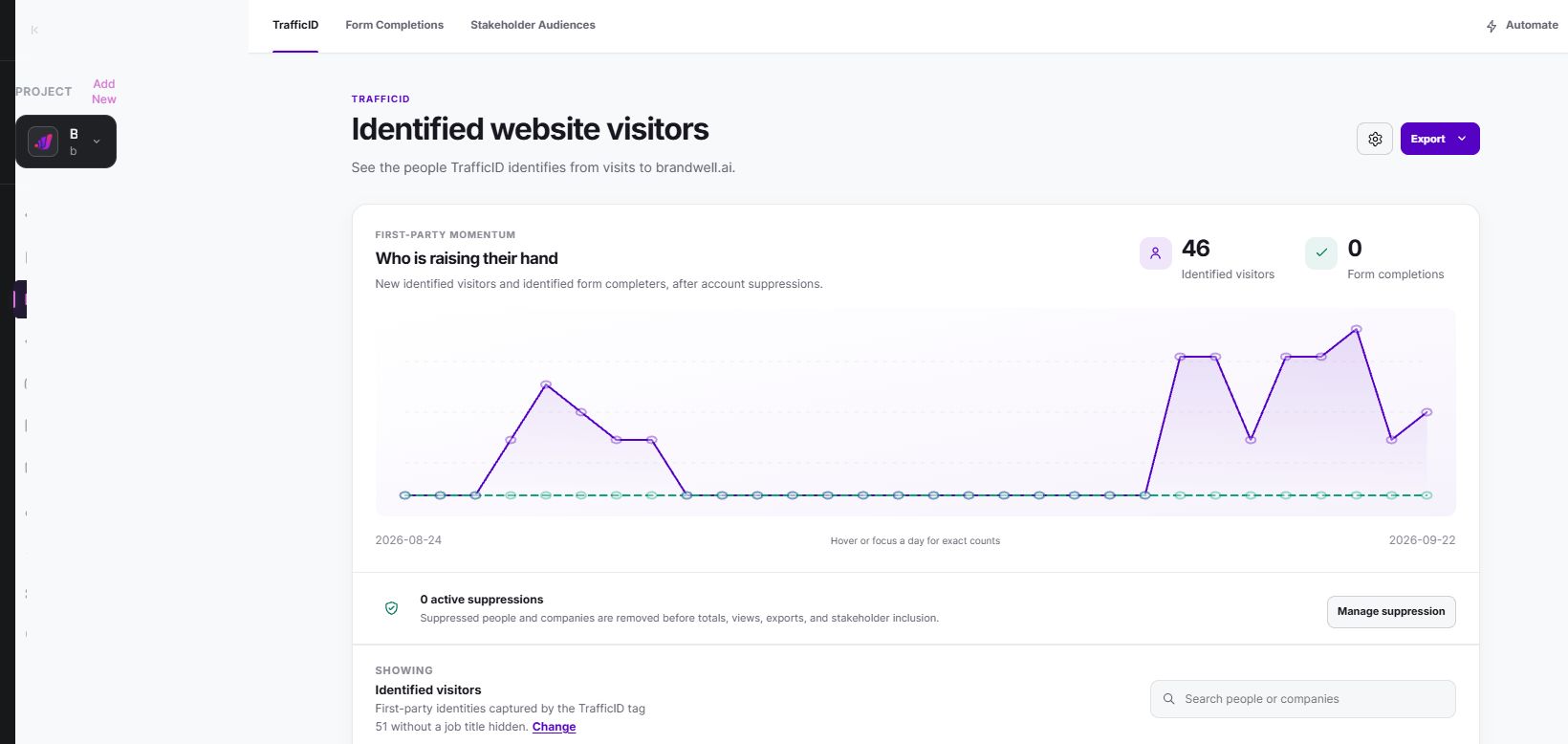
Review current TrafficID plans, eligible identified-visitor volume and the selected fixed or dynamic billing mode before budgeting. TrafficID and MarketPulse have separate product scope. Verify current allowances and included tools on the product page.
MarketPulse is separate external topic research starting at $500/mo. Topic audiences do not establish a visit to the client’s site. Agency setup, analysis, reporting, custom portals and integrations need separate scope and fees.
Define the actual matching unit
Start by choosing the observation unit. A session match rate uses eligible unique sessions. A visitor match rate uses eligible unique browser or first-party identifiers. An account match rate uses eligible visits that can be assigned to a probable company. A person-level candidate rate uses the narrower set eligible for that method and must not be mixed with company-level coverage.
The basic calculation is matched eligible units divided by total eligible units. Then create stricter stages: accepted matches divided by eligible units; independently verified matches divided by the validation sample; reachable matches divided by accepted person candidates; and activated records divided by accepted eligible matches. Do not call these stages one match rate.
A website visitor identification match rates framework should report the unresolved group as carefully as the matched group. Raw page views, bot traffic, internal traffic, unsupported geographies, consent-blocked visits, repeat events, and records below threshold either leave the denominator under a documented rule or remain as explicit unmatched categories. Quietly removing difficult traffic inflates coverage.
Test eight reconciliation and validation steps
Use this website visitor identification match rates implementation guide:
- Write the decision. Define whether the result supports aggregate account research, advertising, sales prioritization, known-contact nurture, or a client report.
- Freeze the denominator. Specify site properties, geographies, page types, dated observation window, unique-session or visitor logic, bot rules, internal exclusions, consent state, and retry handling.
- Define identity levels. Keep company, location, household, device, known first-party contact, and probable person outputs separate.
- Capture source provenance. Store event time, collection context, provider delivery time, method class, confidence, evidence fields, and source rights.
- Deduplicate before calculation. Set a stable visitor or session key, collapse retries, and prevent page-view frequency from becoming artificial match volume.
- Create a validation sample. Stratify by traffic source, geography, device, page type, and confidence. Include both matched and unmatched cases where ground truth is available.
- Review and adjudicate. Compare against direct form submissions, authenticated activity, known test accounts, sales-confirmed companies, and documented manual evidence without leaking the truth set into the matching rule.
- Measure the downstream chain. Record accepted, verified, ICP-fit, eligible, reachable, routed, reviewed, activated, corrected, and outcome-bearing counts.
Useful website visitor identification match rates templates include a denominator worksheet, event-eligibility specification, bot and internal-traffic policy, confidence dictionary, validation sample, false-match review form, suppression log, segment scorecard, and change ledger. The checklist should identify owners in analytics, data, RevOps, demand generation, privacy, security, legal, and the business team that approves action.
Use seven match-quality tests
Run the same tests across candidate methods and vendors. Use these tests to inspect the evidence behind a headline benchmark.
1. Eligible-denominator reconciliation
Reconcile raw events to unique eligible units, with a reason for every exclusion. Pass condition: counts can be reproduced from source logs. Limitation: a clean denominator establishes coverage accounting, not identity correctness.
2. Bot, internal, and duplicate stress test
Inject or identify known bots, employee traffic, monitoring services, repeated refreshes, and retries. Pass condition: they are filtered or labeled consistently. Limitation: bot detection is imperfect and changes over time.
3. Known-account precision sample
Use authenticated or directly confirmed account visits that were not used to tune the rule. Pass condition: report correct, incorrect, unresolved, and ambiguous outcomes by confidence. Limitation: known visitors may be easier to match than the anonymous population.
4. Person-candidate verification test
For eligible person-level outputs, compare identity evidence with direct first-party records or another defensible truth source. Pass condition: false positives and unresolved cases are visible. Limitation: a verified identity still does not establish buying role, interest, or permission to contact.
5. Segment stability test
Compare traffic sources, devices, geographies, page types, browsers, consent states, and time windows. Pass condition: material differences are explained rather than averaged away. Limitation: stable coverage can still be stably wrong.
6. Reachability and suppression test
Measure how many accepted records have a valid permitted activation path after customer, employee, competitor, opt-out, territory, and lifecycle suppression. Pass condition: submitted, accepted, and reachable denominators remain distinct. Limitation: reachability is not response.
7. Outcome and false-positive feedback test
Return sales acceptance, corrections, complaints, disqualifications, opportunities, and no-response evidence to the match rule owner. Pass condition: thresholds can be changed and reversed through a versioned review. Limitation: correlated pipeline does not prove the match caused the outcome.
Keep identity and usable states distinct
An account-level result usually claims that an eligible visit is probably associated with an organization. A person-level result makes a narrower and more consequential identity claim. Never place the two in one numerator. Report identity level, source class, confidence, and validation separately.
An accepted match passes internal quality and contract rules. A verified match passes an independent truth-set or manual check. An ICP-fit match belongs to a company the business can serve. An eligible match passes privacy, contract, suppression, and channel-policy checks. A reachable match can actually enter the chosen channel. Each stage answers a different question.
Evaluate aggregate analytics when the decision does not require identity. A company association does not establish a named visitor. Verify actual source, channel and destination requirements for any retargeting or direct action. Compare only the necessary identity level, actual validation and full costs rather than assuming a best method.
Count full usable-match costs
Website visitor identification match rates pricing may be packaged by traffic band, identified visitor, account, person, record, credit, domain, seat, activation, enrichment request, or subscription. Add pixel implementation, consent tooling, identity and validation, CRM integration, analyst review, security and legal review, reporting, support, and corrections.
Calculate cost at successive denominators: cost per raw eligible unit, matched unit, accepted match, verified match, fit match, reachable record, activated account, and qualified outcome. Include unresolved traffic, false positives, duplicate delivery, expiry, suppression, retries, and labor. A low price per match can be expensive if few matches survive review.
Use a comparable written quote that defines traffic, geographies, entity levels, fields, refresh, confidence output, permitted use, contract term, overages, implementation, support, and exit/export. Do not compare a technical account-resolution fee with the total cost of a managed service.
Measure coverage and correctness separately
Core website visitor identification match rates KPIs include eligible units, account coverage, person-candidate coverage, accepted coverage, validation-sample precision, unresolved rate, false-match rate, review agreement, duplicate rate, latency, expiry, and reversal. Report uncertainty around small samples and never invent a universal benchmark.
The activation chain adds ICP-fit rate, suppression rate, CRM acceptance, reachable rate, routed rate, human-reviewed rate, time to action, qualified engagement, meeting, opportunity, complaint, opt-out, and correction. These are connected but not interchangeable: match is not reach, reach is not response, response is not qualified pipeline, and attributed pipeline is not automatically incremental.
For ROI, compare a qualified matched cohort with a fit-equivalent baseline or holdout where feasible. Freeze the assignment unit and lookback, keep pre-existing pipeline separate, include full cost, and show sensitivity to false positives and uncertain outcomes.
Check actual traffic and permitted use
This workflow fits high-value B2B sites with a clear ICP, enough eligible traffic for segmented validation, disciplined analytics, reliable suppression, and a defined action that justifies identity work. Account-level identification may fit companies with modest traffic if the decision is research or sales prioritization. Person-level activation needs stronger source rights, verification, controls, and review.
It is a poor fit for low-value offers, tiny samples, heavily automated traffic, unsupported geographies, unclear consent, broad consumer audiences, or teams that cannot validate or act on the output. In those cases, aggregate analytics, first-party forms, contextual targeting, or no identity resolution may be the responsible choice.
Do not borrow another company’s website visitor identification match rates benchmarks. Traffic acquisition, device mix, consent state, geography, industry, repeat visits, and the entity definition can change the denominator dramatically.
Keep observation and stakeholder context separate
Keep the data flow explicit: eligible visit → anonymous first-party key → account or person candidate → confidence and evidence → optional enrichment → ICP and customer-state check → suppression and lawful-use review → proposed action → human approval → CRM or audience receipt → outcome and correction feedback.
Preserve event time and delivery time. Expire the visit signal separately from the identity record. Do not assign an account-level research event to an appended contact. A role may be a useful buying-group hypothesis, but it is not proof that the person visited or researched.
Common website visitor identification match rates use cases include account research, content planning, advertising cohorts, sales-priority queues, customer expansion review, and client reporting. Each use case needs its own confidence threshold, permitted-use rule, expiry, evidence label, and approval boundary.
Record exclusions and unresolved identities
Common website visitor identification match rates mistakes include counting page views instead of unique eligible units, hiding excluded traffic, mixing account and person identity, validating only easy matches, treating a shared device as one person, assuming a platform acceptance validates identity, and activating before checking rights or suppression.
Verify actual source, recipient, purpose, jurisdiction, account, destination and rights before action. A match, topic or contact field does not establish permission. Keep actual owners for necessary fields, access, retention, correction, deletion, suppression and incidents; unresolved requirements remain on hold.
Maintain collection notices, consent or other lawful basis where required, contracts, data minimization, access control, retention, deletion, suppression, security, and complaint handling. Require human approval before consequential outreach, spend changes, CRM overwrites, or client sharing.
Scope separate visitor-quality work
An agency can deliver a recurring match-quality service: denominator governance, pixel and event QA, bot rules, segmented scorecards, truth-set tests, false-match review, CRM routing, suppression, client reporting, and threshold change control. Sell the evidence and operating discipline, not a guaranteed rate.
TrafficID supports own-site visitor review with available identity and company context. An agency validation service, custom report, client interface or routing needs separately verified implementation, rights, scope and fees. A subscription does not establish those capabilities or a universal person-level match rate.
AIMEE can organize supplied denominator rules, event fields, exclusions, identity levels, validation sample and outcome definitions through configured tools. Preserve actual counts, missing evidence and unresolved identity. Owners approve thresholds, exports, messages, audience uploads, CRM writes and public claims. A draft does not establish permission or matching correctness.
- Give Claude or ChatGPT the denominator rules, event schema, bot exclusions, identity levels, confidence bands, validation sample, suppression rules, and outcome definitions.
- Ask it to reconcile counts, flag missing denominators, segment coverage, generate a false-match review queue, and label unknowns without inventing identity.
- Require a human owner to approve thresholds, outreach, audience activation, CRM changes, and client-facing claims.
- Verify the actual configured tools, implementation and permissions before execution. Preserve proposed actions, actual approval, destination acknowledgement, exceptions and error recovery separately.
A credible report makes uncertainty visible. It shows what could be identified, what could not, what was verified, what remained eligible, and which decision changed as a result.
Copyable visitor-match review
Unit: [Unique session, browser, account or person candidate.] Denominator: [Period, geography, eligibility and exclusions.] Coverage: [Matched and unresolved units.] Validation: [Reference labels, sample selection and errors.] Use: [Fit, permission, suppression and approved channel.] Outcome: [Acknowledged, acted on, qualified and unknown.] Decision: [Owner, full costs, uncertainty and recheck.]
Match volume is not correctness
ONS’s matching policy distinguishes linked volume from linkage quality. Its scope is research and statistics, not a BrandWell certification. Applied here, preserve actual eligible units and a separately defined validation sample rather than calling a coverage percentage an accuracy result.
Reconcile exclusions before publishing a rate
A fictional period has 1,000 raw events, 200 excluded events and 800 remaining events that deduplicate to 400 eligible units. If 200 receive a defined match, eligible-unit coverage is 50%. Matched units divided by raw events is 20%, a different and incompatible rate. Preserve the actual event-to-unit reconciliation, exclusion reasons and unresolved group. These invented inputs are not TrafficID performance.
Do not infer recall from accepted matches alone
Suppose a fictional validation reference contains 80 true matching pairs. The method proposes 70 pairs, of which 60 are confirmed correct and ten incorrect. Precision is 60/70, or 85.7%; recall is 60/80, or 75%. The 20 missed true pairs require an actual reference that can identify them. Reviewing only linked records cannot establish recall, and an easy selected sample does not establish full-population correctness.
Report the traffic mix behind a blended rate
Two fictional segments have 80 matches among 100 eligible units and 90 among 900. Their coverage rates are 80% and 10%. Combined coverage is 170/1,000, or 17%, not an unweighted average of 45%. A changed traffic mix can change the overall rate without either segment improving. Preserve entity level, geography, eligibility and sampling for each segment.
Price reviewed usable records
A fictional test with $99 standard TrafficID plan cost, $300 implementation and $400 review has $799 defined costs. At 200 matched units, that is about $4 per matched unit. If only 100 pass all proposed use gates, it is $7.99 each; if 20 are actually acted on, it is $39.95 each. Media, acquisition, other tools, general overhead, tax and financing are excluded. These invented operating inputs are not BrandWell implementation fees or typical outcomes.
Review the actual TrafficID context
Keep observed visitor activity, voluntarily submitted forms, associated companies and appended stakeholders distinct in TrafficID. The product does not identify every visitor or establish that each added stakeholder visited. Review actual source context, field availability, suppressions and permitted purpose before proposing a recipient. AIMEE can organize supplied context through configured tools. Owners approve exports, messages, audience uploads and CRM writes. Custom validation, reports and routing require separately verified implementation and rights.
Frequently asked visitor-match questions
Does 50% coverage establish 50% correctness?
No. Coverage and validation answer different questions.
Can linked-record review alone establish recall?
No. A reference must also identify missed true matches.
Can a changing traffic mix alter the overall rate?
Yes. Preserve segment counts and weighted denominators.
Are appended stakeholders all observed visitors?
No. Keep stakeholder and visitor evidence distinct.
Review own-site visitor research: explore TrafficID and current plans.
Reviewed and updated October 3, 2026.

Written by