On this page
- Current MarketPulse research workflow
- Keep fit, timing and buyer commitment distinct
- Define eight workflow steps and owners
- Evaluate seven lead-generation plays
- Compare actual channel responsibilities
- Count full qualified-outcome costs
- Preserve stages and causal limits
- Check actual market and follow-up capacity
- Link evidence without inventing identity
- Record exclusions and permitted actions
- Scope a bounded agency pilot
- Copyable intent-to-lead review
- Frequently asked lead-generation questions
Treat intent-based lead generation as a bounded review process: check fit, available evidence, identity support, permitted action and actual ownership before routing. A topic or score is not a qualified lead, consent or purchase commitment. Preserve uncertainty, review consequential actions and return actual sales outcomes to the rule owner.
Who is this for? B2B founders, marketing and sales leaders, growth teams, agency buyers, and agency owners building a qualified pipeline motion from website, research, identity, and lead data.
The goal is not to spray more contacts. It is to choose a proportionate next step for a qualified account while the evidence is still useful. Separate company fit, observed behavior, identity confidence, role relevance, channel eligibility, action, and outcome so each can be reviewed and corrected.
Current MarketPulse offer: intent-data plans start at $500/mo. See the product, demo, and current plans. Updated October 3, 2026.
Current MarketPulse research workflow
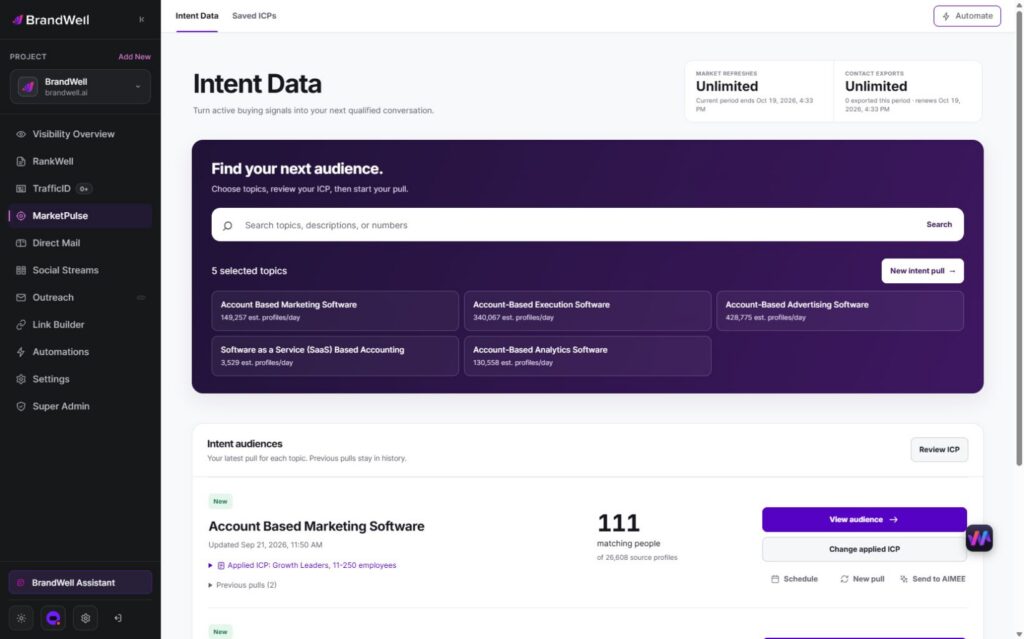
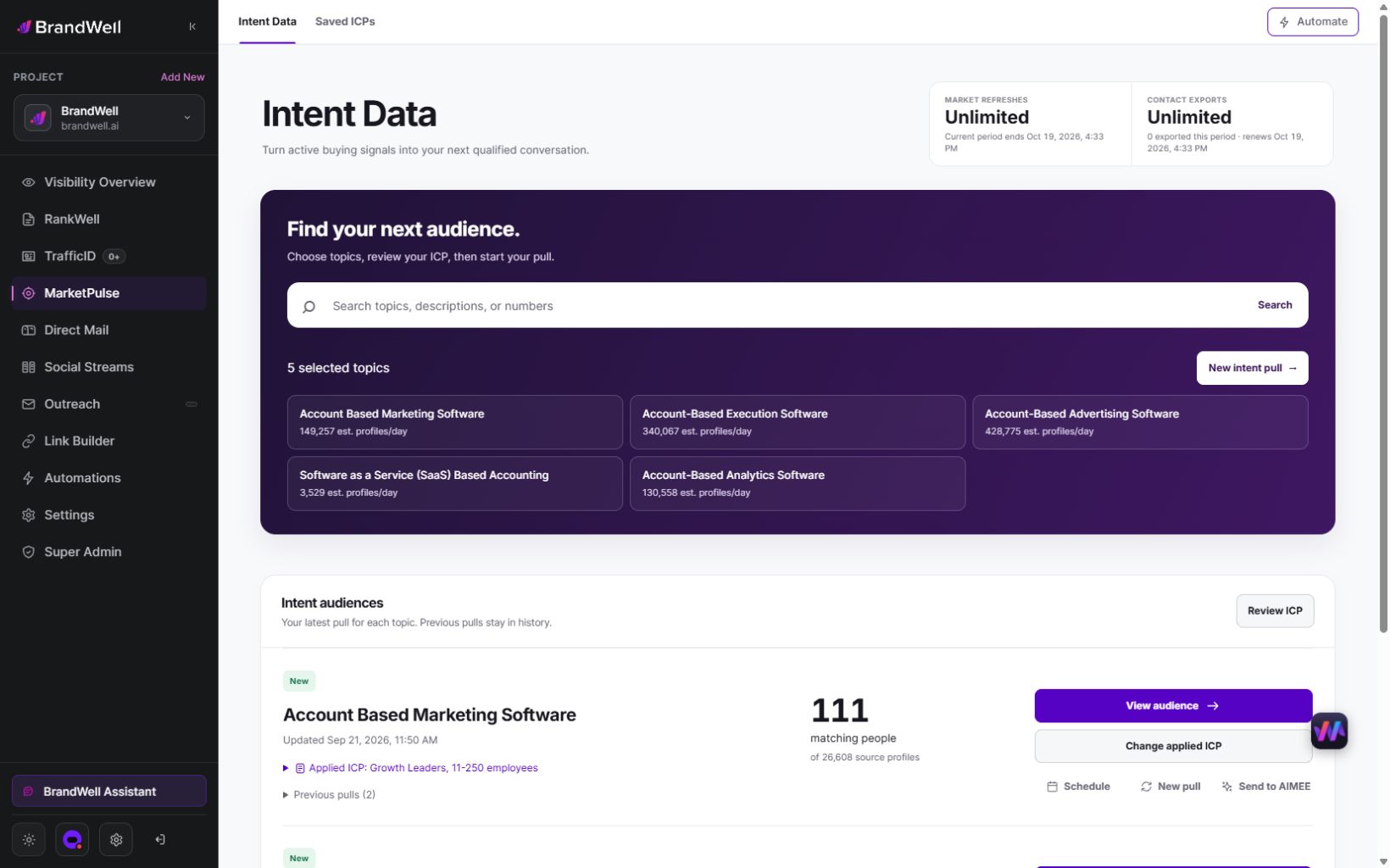
BrandWell MarketPulse: intent data starting at $500/mo. Find people researching topics relevant to what you sell, apply saved ICP filters, and review available contact details before taking action.
MarketPulse plans are starting at $500/mo. Verify current package scope and offers on the product page.
| Plan | Topics and refreshes | Monthly exports |
|---|---|---|
| Starter | 1 topic, weekly | 25,000 contacts |
| Growth | 3 topics, daily | 100,000 contacts |
| Scale | 10 topics, daily | Unlimited contacts |
Swipe the table to see all columns.
A pull retrieves available data from the previous 24 hours for one topic. Daily use across all included topics provides 90 Growth pulls or 300 Scale pulls in a 30-day month. Weekly Starter pulls vary by calendar month. Available audience size and contact fields vary, and audiences may overlap. Refreshes stop at the plan limit without overage charges.
- Find and qualify: search the topic catalog, save your ICP, and review the people and companies that match.
- Act on the research: export qualified contacts or prepare an Outreach or Direct Mail workflow. Connected products, channel usage, and fulfillment may cost extra.
- Get help from AIMEE: Growth and Scale include AIMEE for the initial user to research accounts and prepare the next step through connected tools.
Agencies and other service businesses can build client deliverables around their available Intent Scans and exports. Keep each client’s scope, permissions, and service fees clear. A subscription is not a promise of a white-label platform or exclusive access to a market.
Explore MarketPulse and watch the demo or compare plans starting at $500/mo. Any early-access discount is a separate, time-limited offer shown to an eligible recipient.
Keep fit, timing and buyer commitment distinct
ICP fit defines who can plausibly buy and succeed: industry, size, geography, use case, technology, operating model, value, customer state, and exclusions. Intent adds time-sensitive evidence such as repeated high-value website activity, category or competitor research, a direct request, a hiring or technology change, product behavior, procurement activity, or a sales-confirmed trigger.
Keep an evidence ladder. “Observed” means a documented action occurred. “Resolved” means it can be associated with a probable company or known person at a stated confidence. “Qualified” means the account passes fit. “Eligible” means source rights, privacy, suppression, platform policy, and channel conditions permit a defined response. “Sales-ready” means a human accepts the context and next action. Do not skip levels or label every resolved account hot.
Intent is probabilistic and can have multiple explanations. Researchers include customers, candidates, consultants, students, competitors, and people outside the buying group. The workflow earns trust by stating what happened, what remains unknown, and why the chosen response is proportionate.
Define eight workflow steps and owners
Use this intent based lead generation implementation guide:
- Define the revenue decision. State the offer, ICP, qualification standard, channel choices, exclusions, capacity, outcome, and owner.
- Contract each signal. Record observable action, source, account or person level, event and delivery times, confidence, allowed uses, retention, and known failure modes.
- Resolve and enrich carefully. Assign an account, identify plausible roles when permitted, validate contact fields, and keep appended contacts separate from the person who may have generated a signal.
- Apply fit and state. Check customer, opportunity, territory, partner, employee, competitor, and do-not-contact status before routing.
- Choose the least intrusive useful action. Account research, advertising, nurture, helpful email, calling, or no action should follow evidence strength and buyer context.
- Give sales the reason. Route the source, observed event, confidence, relevance, unknowns, recommended message, expiry, and response SLA – not a mysterious score.
- Require approval. A named human approves consequential outreach, spend, CRM changes, and client-facing claims.
- Close the loop. Capture accepted, rejected, corrected, contacted, replied, qualified, disqualified, opportunity, complaint, and opt-out outcomes.
Useful intent based lead generation templates include a signal dictionary, ICP and exclusion sheet, identity-confidence policy, channel matrix, routing SLA, research brief, message review form, suppression log, outcome taxonomy, and rule change ledger. The operational checklist should assign marketing operations, RevOps, sales operations, channel owners, privacy, security, legal, and client delivery responsibilities.
Evaluate seven lead-generation plays
These are operating plays, not a universal list of the best intent-based lead generation tools or companies. Each uses the same test: evidence, possible fit, next action, and limitation.
1. High-value first-party sequence
Prioritize qualified accounts with repeated visits to solution, implementation, pricing, or comparison content. Possible fit: sites with enough clean traffic and defined high-value paths. Next action: account research, contextual nurture, or reviewed outreach. Limitation: first-party activity often appears late and does not reveal budget or authority.
2. Off-site topic research plus ICP
Use narrow problem, category, competitor, or solution research as account-level timing evidence, then require fit. Possible fit: categories with distinctive topics and valuable accounts. Next action: tailored education or account prioritization. Limitation: broad topics create noise and the researcher is usually unknown.
3. Eligible visitor-identification review
Resolve an owned-site visit to a probable account or eligible person candidate at a stated confidence. Possible fit: high-value traffic with governance and validation. Next action: research or a restrained message tied to public business context. Limitation: identity is probabilistic and does not itself authorize outreach.
4. Review and comparison research play
Prioritize qualified accounts researching a category, comparison, pricing, or alternative on an external property. Possible fit: B2B categories with meaningful marketplace research. Next action: comparison education, proof, or sales preparation. Limitation: account-level activity cannot be assigned to an appended contact.
5. Business trigger plus research evidence
Combine a verified hiring, technology, funding, leadership, compliance, or expansion trigger with fresh relevant research. Possible fit: offers tied to an observable business change. Next action: a helpful message about the change and problem. Limitation: public triggers can be stale, misinterpreted, or unrelated to a buying decision.
6. Dormant opportunity reactivation
Review previously qualified accounts when new first- or third-party evidence appears and the prior loss reason allows contact. Possible fit: teams with clean opportunity history and suppression. Next action: an owner-reviewed re-engagement tied to changed context. Limitation: an old opportunity is not current permission or demand.
7. Multi-signal high-confidence queue
Require fit plus two independent, fresh, relevant signals before direct outreach. Possible fit: high-value markets where precision matters more than volume. Next action: a researched sales task with a short expiry. Limitation: added sources increase cost, latency, missingness, and the temptation to hide uncertainty in a blended score.
Compare actual channel responsibilities
Cold lists define reach and sometimes fit, but usually not timing. They can support market coverage when sourced and used responsibly, yet volume magnifies deliverability, trust, and compliance risk. Intent can prioritize a subset, but it does not cure bad data or an irrelevant offer.
Outbound gives control over named-account coverage and message sequencing. Use it for narrow markets with strong research and capacity. Inbound captures direct demand but depends on the buyer reaching and converting on owned properties. Paid media offers scalable account education and can be a proportionate response to weaker account-level signals. When identity or readiness is uncertain, evaluate a permitted research, education or no-action path before direct contact.
Compare fit-based research, topic timing, inbound, education and reviewed outreach against the actual buyer question and operating constraint. Preserve qualified outcomes, full costs, complaints and a suitable comparator. No channel combination is a universal best approach or evidence of incremental revenue.
Count full qualified-outcome costs
Intent based lead generation pricing can include source subscriptions or usage, identity resolution, enrichment, email and phone validation, CRM and orchestration, advertising, copy and creative, research, sales development, analyst review, privacy and legal review, reporting, support, and corrections. Separate media and sales labor from data so the true operating model remains visible.
Track cost per delivered record, accepted signal, qualified account, eligible contact, routed task, sales-accepted lead, meeting, qualified opportunity, and incremental outcome. Include rejected, duplicate, stale, suppressed, unreachable, and expired records. A higher cost per raw record can produce a lower cost per qualified opportunity if fewer records fail.
Use a written quote for the exact topics, coverage, fields, geography, identity level, freshness, usage, destinations, support, contract term, and activation rights. Never promise a cost per lead or meeting without a scoped customer baseline, full cost, cohort, and qualification method.
Preserve stages and causal limits
Intent based lead generation KPIs should follow the evidence chain: delivered signals, provenance complete, current, resolved, ICP-fit, eligible, reachable, routed, reviewed, sales accepted, contacted, replied, meeting, qualified opportunity, pipeline, win, correction, complaint, opt-out, and time to outcome.
Define a sales-accepted lead and qualified opportunity before the pilot. Preserve rejection reasons so marketing can improve fit, source, identity, and routing. Report meetings separately from qualified meetings, pipeline separately from wins, and influenced pipeline separately from sourced pipeline.
For intent based lead generation ROI, compare against a fit-equivalent baseline, randomized holdout, phased rollout, or another defensible counterfactual where feasible. Freeze the assignment unit, observation window, and full-cost model. Platform attribution and CRM association are useful operational evidence but not causal proof.
Check actual market and follow-up capacity
Evaluate actual contribution value, expressible ICP, topic relevance, eligible population, necessary fields and follow-up capacity. An industry or account-value label does not establish readiness. Marketing, sales, operations and client reviewers need defined owners, actual permissions, outcomes and exit terms.
It is a poor fit when topics are broad, deal value cannot support data and review, the source cannot explain its signal, identity is unusable, outreach permissions are unclear, the client cannot follow up, or success is defined as raw lead volume. Improve the ICP, offer, first-party conversion path, and sales process before adding more signals.
Link evidence without inventing identity
A durable intent based lead generation playbook stores linked objects for account fit, signal event, identity evidence, contact validation, eligibility, routing, action, exposure, response, and outcome. Each record carries source, time, confidence, reason codes, expiry, owner, and correction path.
Use the weakest-link rule: the next action cannot claim more than the least certain required input supports. An account-level topic signal can support account research or advertising. A verified known contact with direct recent engagement may support a relevant one-to-one follow-up. An appended role can support buying-group research but should never be labeled the person who created the signal.
Common intent based lead generation use cases include competitive research response, category education, event follow-up, account reactivation, opportunity support, local-market prioritization, and coordinated advertising plus sales. Define separate activation workflows and thresholds rather than one “hot lead” score.
Record exclusions and permitted actions
Review these intent-based lead-generation failure modes: equating a score with readiness, assigning account behavior to a person, buying contacts without provenance, ignoring customers and opt-outs, using sensitive inferences, sending high-volume sequences, hiding automation, and measuring only meetings.
Verify actual source, recipient, purpose, jurisdiction, channel, destination and rights before activation. A match, topic or contact field does not establish permission. Keep named ownership of access, necessary fields, retention, correction, deletion, suppression and incidents; resolve unanswered requirements before execution.
Maintain source rights, notices, consent or other lawful basis where required, suppression, retention, deletion, security, deliverability, telemarketing, and platform-policy review. A human must approve consequential outreach and public claims. Use public business context and a relevant offer: communicate the business problem you can support, not the private behavior you inferred.
Scope a bounded agency pilot
An agency can package signal design, ICP and topic mapping, identity and validation, research queues, channel selection, suppression, routing, sales enablement, measurement, and client reporting as a recurring service. Pilot with a frozen cohort, baseline, qualification definition, service capacity, review cadence, and stop rules. Do not sell a guaranteed meeting count from an untested signal source.
MarketPulse can supply topic research and available match details for a separately scoped agency deliverable. It does not establish a branded service engine, custom API, client portal, scoring model or managed execution. Verify actual implementation, rights, scope and fees before promising those capabilities.
AIMEE can organize supplied ICP, signal definitions, identity support, exclusions, channel matrix, permitted-use rules and outcome labels through configured tools. Preserve evidence, unknowns and rule versions. Named owners approve actual exports, messages, Outreach enrollment, audience uploads, spend changes and CRM writes; a draft does not establish permission or execution.
- Give Claude or ChatGPT the approved ICP, signal dictionary, identity tiers, exclusions, channel matrix, routing SLA, permitted-use rules, and outcome taxonomy.
- Ask it to classify accounts as reject, research, nurture, advertise, sales review, suppress, or expire, citing only available evidence and unknowns.
- Require a human owner to approve outreach, spend, CRM changes, client delivery, and any performance claim.
- Confirm the actual configured tools, implementation and permissions before execution. Preserve proposed actions, approvals, destination acknowledgements, exceptions and error recovery as distinct states.
Keep the evidence-to-action process understandable and reviewable. Test actual qualified outcomes against the defined comparator rather than promising more conversations from research volume or a score.
Copyable intent-to-lead review
Account: [Actual unique unit and fit evidence.] Signal: [Source, observed time and uncertainty.] Identity: [Supported entity, role and unresolved matches.] Action: [Permitted purpose, channel and exclusions.] Owner: [Approval, capacity, acknowledgement and feedback.] Outcome: [Accepted, acted on, qualified, pending or rejected.] Decision: [Maturity, full costs, comparator and repair criteria.]
Complete fields can still contain wrong values
The Government Data Quality Framework distinguishes completeness from accuracy. Applied here, a populated role or email is not proof that it identifies the relevant buyer or is correct. Verify actual field evidence and preserve unresolved cases rather than calling every complete record qualified.
A stakeholder is not automatically the observed visitor
In a fictional own-site review, a company is associated with one observed visit and five appended stakeholder contacts. That does not establish six visitors, five people researching the topic or permission to contact every stakeholder. Keep the observation, account context, appended roles and each approved recipient separate.
Name the denominator at each handoff
A fictional 100-account cohort yields 60 fit accounts, 40 passing all proposed gates, 30 seller-accepted briefs and 20 acted-on records. Seller acceptance is 75% of the 40 eligible records or 30% of all accounts. Actual action is 66.7% of the accepted records. If five qualified opportunities are confirmed, their share is 25% of acted-on records or 5% of the original cohort. These are invented descriptive counts, not BrandWell conversion results or proof of incremental effects.
Meetings and opportunities are distinct units
Suppose ten fictional meetings involve eight unique accounts, and three accounts have buyer-confirmed qualified opportunities. Ten meetings are not ten new leads or ten opportunities. Preserve actual meeting attendance, unique account rules, qualification evidence and pending follow-up. Report stage transitions with matching units rather than dividing person activity by account counts.
Budget for an actual qualified outcome
A fictional first-period test with $500 standard Growth subscription, $400 research/setup and $600 seller-review work has $1,500 defined costs. Five qualified opportunities imply $300 each. Another $500 correction makes it $400 each. Media, acquisition, general overhead, tax and financing are excluded. With zero qualified opportunities, the ratio is undefined. These invented service costs are not BrandWell managed-service prices, typical margins or return guarantees.
Review a topic inside the current app
Use an available MarketPulse topic, saved ICP and actual preceding-24-hour matches to prepare a review brief. Verify public company context and variable contact fields before proposing a useful next action. TrafficID separately supports own-site visitor review; Outreach and Direct Mail have separately scoped workflows and usage costs. AIMEE can organize supplied research through configured tools. Owners approve actual recipients, exports, messages, audience uploads and CRM writes. Custom scoring, reports, routing and client interfaces require separately verified implementation and rights.
Frequently asked lead-generation questions
Is every populated contact field verified buyer evidence?
No. Completeness and correctness are different checks.
Are appended stakeholders all observed visitors?
No. Preserve observation and stakeholder context separately.
Does a meeting establish a qualified opportunity?
No. Require actual buyer evidence and matching stage definitions.
Do attributed opportunities prove incremental revenue?
No. Keep the comparator, maturity and causal limits visible.
Review the research product: explore MarketPulse and current plans.
Reviewed and updated October 3, 2026.

Written by