On this page
- Current MarketPulse research workflow
- Diagnose actual search and lead outcomes
- Build a reviewable change and rollback loop
- Use seven exclusion-review methods
- Separate forms from qualified feedback
- Count review and opportunity costs
- Report coverage and unknown outcomes
- Scope rules to the actual campaign
- Keep source joins and uncertainty visible
- Test match conflicts before deployment
- Scope separate keyword operating work
- Copyable negative-keyword review
- Frequently asked negative-keyword questions
Build negative-keyword proposals from actual query context, qualified outcomes, missing joins and outcome lag. Review the match type, affected campaigns, protected research terms and rollback before deployment. A rejected lead or absent outcome is a diagnostic clue, not automatic evidence that every matching query should be blocked.
Who is this for? Google Ads managers, PPC directors, demand-generation leaders, and agencies that want less wasted spend without accidentally suppressing valuable early-stage research.
Current MarketPulse offer: intent-data plans start at $500/mo. See the product, demo, and current plans. Updated October 3, 2026.
Current MarketPulse research workflow
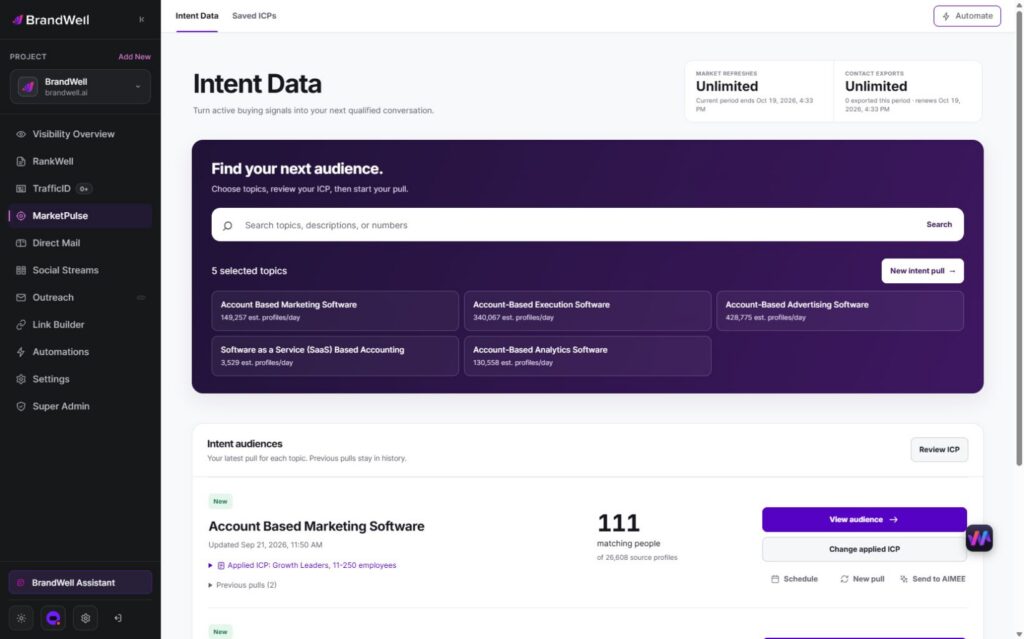
BrandWell MarketPulse: intent data starting at $500/mo. Find people researching topics relevant to what you sell, apply saved ICP filters, and review available contact details before taking action.
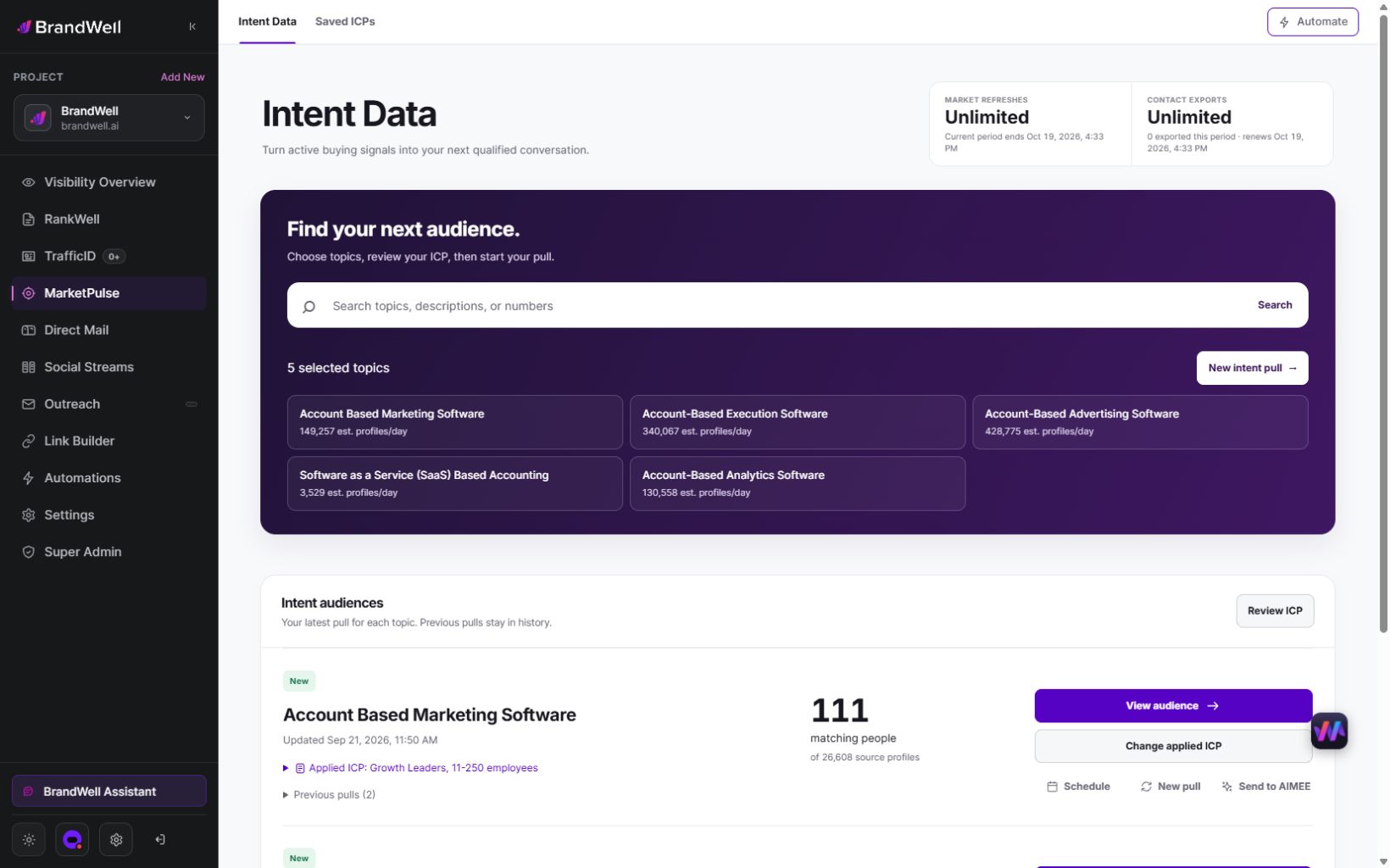
MarketPulse plans are starting at $500/mo. Verify current package scope and offers on the product page.
| Plan | Topics and refreshes | Monthly exports |
|---|---|---|
| Starter | 1 topic, weekly | 25,000 contacts |
| Growth | 3 topics, daily | 100,000 contacts |
| Scale | 10 topics, daily | Unlimited contacts |
Swipe the table to see all columns.
A pull retrieves available data from the previous 24 hours for one topic. Daily use across all included topics provides 90 Growth pulls or 300 Scale pulls in a 30-day month. Weekly Starter pulls vary by calendar month. Available audience size and contact fields vary, and audiences may overlap. Refreshes stop at the plan limit without overage charges.
- Find and qualify: search the topic catalog, save your ICP, and review the people and companies that match.
- Act on the research: export qualified contacts or prepare an Outreach or Direct Mail workflow. Connected products, channel usage, and fulfillment may cost extra.
- Get help from AIMEE: Growth and Scale include AIMEE for the initial user to research accounts and prepare the next step through connected tools.
Agencies and other service businesses can build client deliverables around their available Intent Scans and exports. Keep each client’s scope, permissions, and service fees clear. A subscription is not a promise of a white-label platform or exclusive access to a market.
Explore MarketPulse and watch the demo or compare plans starting at $500/mo. Any early-access discount is a separate, time-limited offer shown to an eligible recipient.
Diagnose actual search and lead outcomes
Negative keywords should improve the mix of eligible search demand while preserving strategically useful discovery. Start with the business definition of a qualified outcome and the role search plays before and after it. A term that produces few immediate opportunities may still introduce accounts that convert later through another channel. Conversely, a term with many form fills can be expensive noise if the leads are consistently out of market or ineligible.
Separate wrong query purpose, account fit, offer relevance and post-click execution. Each needs different evidence and possible remedies. Query purpose can support a bounded exclusion; fit, geography, forms, offers or follow-up may need a different change. A reason code alone does not establish which cause produced the result.
Intent signals and identity matches are probabilistic evidence. They can inform the review, but they do not prove what a person meant or whether a query will never produce value. Preserve uncertainty and require enough comparable outcomes before acting.
Build a reviewable change and rollback loop
Export search terms with campaign, ad group, keyword, match context, clicks, cost, and conversion IDs. Join them to CRM records through governed identifiers. Add qualification stage, disqualification reason, opportunity value, lag, account fit, and research-intent context. Keep unmatched records visible; silently dropping them can bias the analysis toward easier-to-resolve leads.
Normalize terms for analysis but retain the original string. Group semantic themes only after reviewing match behavior. Generate a proposal with evidence count, spend, observed lead mix, likely exclusion level, proposed match type, affected campaigns, false-exclusion risk, and rollback trigger. A paid media owner and a business-quality owner approve the change. Record the platform change ID and monitor coverage after deployment.
Google’s negative-keyword guidance describes Search matching rules. Verify current behavior for the actual campaign and inventory; Display and Video rules differ. The documentation does not decide which queries your account should exclude.
Use seven exclusion-review methods
1. Repeated ineligible-intent exclusion
Flag terms with repeated evidence of an intent the business cannot serve, such as consumer support requests for an enterprise-only offer. Verify query meaning in context and propose the narrowest safe match. Limitation: language can be ambiguous, and a broad exclusion can block valuable variants.
2. Account-fit disqualification review
Analyze terms associated with consistently ineligible industries, geographies, or company profiles, but diagnose whether targeting can solve the problem more precisely than keywords. Failure mode: blocking a research term because current leads are small companies may hide future enterprise demand using the same language.
3. Closed-loop low-quality theme queue
Group related queries and review accepted leads, rejected leads, opportunities, lag, routing, and offer before proposing a theme-level exclusion. Keep the evidence packet attached. Limitation: CRM reason codes are often inconsistent, so analyst adjudication remains necessary.
4. Research-stage protection list
Create a protected set of early-stage comparison, education, and problem-framing terms that matter to the buying journey. Require stronger evidence to exclude them. Failure mode: protecting every informational term can consume budget without a defined nurture or measurement path.
5. High-cost no-quality escalation
Escalate terms that cross a spend threshold without accepted outcomes, then review match context, landing-page fit, tracking, and lag. The threshold should reflect opportunity economics. Limitation: a small sample and long sales cycle can create false negatives.
6. Competitor and employment intent separation
Separate competitor research, careers, training, definitions, login, support, and investor intent into explicit policy buckets. Decide whether each belongs in exclusion, a separate campaign, or organic content. Failure mode: a blanket competitor negative can remove high-value switching demand.
7. Reversible experiment method
Apply proposed negatives to a bounded campaign set, record the affected search coverage, and compare qualified outcomes and false exclusions with a control or pre-registered baseline. Limitation: auctions and demand change over time, so a before-and-after result is not automatically causal.
Separate forms from qualified feedback
Keep tracked forms or calls separate from qualified outcomes and seller acceptance. Downstream feedback adds context but also introduces lag, missing joins and execution bias. A query may appear weak because routing or follow-up failed. Compare actual evidence rather than assuming qualified feedback is always complete or a universal better lens.
Use actual conversion and qualification evidence for the specified decision period. Preserve unknown outcomes. Compare a bounded proposed policy with the existing approach using the same campaigns, maturation and outcome definitions. With sparse evidence, hold automation and inspect the actual query context rather than assuming an exclusion is warranted.
Count review and opportunity costs
Total cost includes platform spend, data joins, CRM administration, offline-conversion setup, analyst review, approvals, monitoring, and the opportunity cost of blocked demand. Model cost per reviewed term, cost per approved change, and estimated spend protected, but keep savings labeled as an estimate until a controlled comparison supports it.
Test preparation automation against actual labor and review quality. A system can normalize terms, gather outcomes, suggest themes, and assemble evidence. An analyst must understand match types, query intent, and client strategy. Budget for rollback monitoring and periodic re-audits because a negative list accumulates risk as products, language, and markets change.
Report coverage and unknown outcomes
Report spend on clearly ineligible queries, accepted-lead rate, opportunity rate, qualified-pipeline cost, search-term coverage, and excluded-query volume. Add false-exclusion measures: valuable terms caught by a rule, volume lost from protected themes, and opportunities that would have been blocked. Track unknown joins and delayed outcomes so the report does not overstate confidence.
A drop in spend is not ROI. It may reflect reduced reach rather than better allocation. Pair efficiency metrics with absolute qualified outcomes and coverage. Where feasible, use a staged rollout or campaign-level holdout. Disclose changes in bids, ads, landing pages, seasonality, and sales execution that can confound the result.
Scope rules to the actual campaign
High-volume nonbrand campaigns can support minimum-count and spend thresholds. Low-volume enterprise campaigns need more qualitative review and longer maturation. Brand, competitor, product-category, problem-aware, and educational campaigns should not share the same policy. Match type, geography, offer, and landing page change what a term means operationally.
This approach fits teams with reliable conversion IDs, CRM stages, reason codes, and enough analyst capacity to adjudicate. It is a weak fit when tracking is broken, lead ownership is unclear, or the client wants an automatic blacklist. Agency owners should define escalation tiers and approval SLAs by client risk rather than promising continuous autonomous exclusions.
Keep source joins and uncertainty visible
Use a governed record that connects the original search term, campaign context, conversion ID, account or lead identity confidence, research-topic evidence, CRM outcome, and proposed policy. The join should preserve provenance and never overwrite the original source. If identity is uncertain, lower the evidence weight or route the term for review.
Off-site or website intent can help distinguish a repeated buying-theme pattern from a one-off click, but it cannot transform an ambiguous query into certainty. Fit narrows eligibility; intent adds timing context; identity connects records; CRM outcomes add downstream evidence; the exclusion decision remains a separate human-governed action. This is the core intent-informed negative keyword strategy framework.
Test match conflicts before deployment
Review these failure modes: applying a broad exclusion to a narrow problem, ignoring close variants, using too little outcome data, skipping sales-cycle lag, and treating disqualification as proof of query intent. Review conflicts across account, campaign, and ad-group lists. Keep a protected-term register and simulate affected queries before launch.
Minimize personal data in the analysis and restrict access to raw search and CRM records. Do not infer sensitive traits or expose individual research behavior. Human approval is required before negative deployment, CRM overwrites, audience activation, spend changes, or client-facing claims. Monitor immediately after a change and keep a tested rollback file.
Scope separate keyword operating work
A recurring service can include tracking QA, search-term and CRM joins, intent-stage context, evidence queues, approval meetings, controlled deployments, false-exclusion monitoring, and a monthly business-quality report. Define ownership of platform access, qualification rules, protected themes, and rollback. Charge for the operating system and analyst judgment, not a one-time list dump.
AIMEE can prepare a review brief through configured connected tools. Keep proposed actions separate from actual approvals and destination acknowledgements. Confirm the implementation and permissions before execution.
A practical monthly operating packet has five artifacts. The intake ledger lists original queries, campaign context, spend, conversion ID, and data completeness. The evidence queue shows outcomes, lag, fit, likely intent, and confidence without assigning blame. The change register records the proposed negative, scope, match type, affected themes, approval, and deployment ID. The protection register lists high-value research themes and the stronger evidence needed before exclusion. The rollback report shows changes reverted, the trigger, and what the team learned.
Define service-level targets around review quality rather than guaranteed savings: percentage of high-spend terms reviewed, percentage of proposals with complete evidence, approval turnaround, rollback readiness, and false-exclusion checks completed. Client reporting should distinguish observed spend movement from estimated avoided spend. It should also show which recommendations were rejected and why; that creates institutional knowledge instead of presenting the agency as infallible.
Before onboarding another account, confirm conversion tracking, CRM joinability, qualification definitions, search-term access, protected brand and research themes, client approval contacts, and a safe test campaign. If any prerequisite is missing, sell a measurement-and-governance setup phase first. That boundary keeps missing evidence and responsibility explicit before deployment.
Copyable negative-keyword review
Query: [Original term, campaign and match context.] Evidence: [Spend, joined outcomes, lag and unknowns.] Diagnosis: [Query purpose, fit, offer or execution.] Proposal: [Negative text, match type and scope.] Protection: [Useful research queries and conflict test.] Approval: [Owner, version and verified platform change.] Rollback: [Trigger, restored rule and qualified-outcome review.]
Match type changes what gets blocked
For Search negatives, Google describes broad matching on all included terms in any order, phrase matching on the same term order and exact matching without extra words. Negatives do not expand to synonyms or singular/plural variants. Test actual candidate queries against current rules before deployment.
| Proposed negative | Query to inspect | Expected Search behavior |
|---|---|---|
| Broad: payroll software | software for payroll teams | Blocked: both negative terms appear |
| Phrase: payroll software | software for payroll teams | Not blocked by this negative alone: order/phrase differs |
| Exact: payroll software | payroll software comparison | Not blocked by this negative alone: extra word |
Swipe the table to see all columns.
These are illustrative rule checks, not a recommendation to block payroll queries or a guarantee of ad delivery. Other keywords, exclusions and campaign conditions still apply.
Unknown feedback is not a bad-lead label
In a fictional set of 100 form submissions, 60 join to reviewed CRM outcomes and 40 remain unknown. Twenty of the 60 are accepted. Observed acceptance is 33.3% of reviewed outcomes, while known acceptances are 20% of all submissions. Do not label all 80 remaining submissions rejected or infer the missing group’s quality. Record lag, join failures and routing before proposing an exclusion.
Early zeros can mature into qualified outcomes
A fictional query has ten submissions and no confirmed opportunities on day two. By day 30, three become confirmed opportunities under the same definition. The early zero did not establish that the query could never produce value. Freeze an appropriate maturation window and preserve pending cases; these invented counts are not a sales-cycle benchmark.
Lower spend does not prove better allocation
Before a fictional change, $1,000 media produces ten qualified opportunities, or $100 each. Afterwards, $700 produces five, or $140 each. Spend is 30% lower while opportunity count is 50% lower. This descriptive before/after comparison does not establish causation or savings, especially if bids, demand, offers or seller execution also changed.
Include the operating work in the denominator
A fictional test with $1,000 media, $500 standard Growth subscription, $300 query/CRM review and $200 QA has $2,000 defined costs. Ten qualified opportunities imply $200 each. Another $400 join repair raises it to $240 each. Setup, acquisition, general overhead, tax and financing are excluded. These invented inputs are not BrandWell keyword-management fees or typical returns.
Use topic research as context, not a query join
MarketPulse topic research and saved ICP filters can help frame the business’s buyer questions. A topic match does not establish which Google query a particular person used. Preserve the actual search and CRM identifiers and unknown joins. AIMEE can organize supplied review evidence through configured tools; owners approve negative changes, exports, messages, audience uploads and CRM writes. Custom ad access, joins and change automation need separately verified implementation, rights, scope and fees.
Frequently asked negative-keyword questions
Do Search negatives expand like positive keywords?
No. Verify current negative matching and variants.
Are unjoined submissions automatically rejected leads?
No. Preserve unknowns, maturation and join failures.
Does less spend establish better ROI?
No. Keep actual qualified outcomes, costs and a comparator.
Does a topic match identify a person’s Google query?
No. Do not invent a query-to-person join.
Review the research product: explore MarketPulse and current plans.
Reviewed and updated October 3, 2026.

Written by