On this page
- Start with one decision and a defined audience
- MarketPulse research is starting at $500/mo
- Do not assume every export can become an ad audience
- An eight-step delivery workflow
- Six working documents for the bundle
- Show audience loss honestly
- Price the work without hiding media spend
- Measure quality, delivery, and outcomes separately
- Choose delivery around client readiness
- AIMEE can prepare the work within defined boundaries
- Frequently asked questions
An agency can combine intent research with paid-media work when it makes the service boundary and economics clear. Separate research access, audience preparation, campaign management, creative, ad spend, implementation, and measurement. Verify whether each source is eligible for the intended destination before preparing an upload.
A topic match is a research input. It does not prove that someone will buy, establish advertising permission, or guarantee platform reach. A client should understand what the agency reviews and delivers beyond the raw records.
Start with one decision and a defined audience
Choose one market, one practical action, one primary outcome, and a fixed evaluation window. Define the offer, ICP, relevant topic, exclusions, identity level, observation age, destination, and allowed use.
The service needs five layers: relevant signal, fit and identity review, destination eligibility, campaign execution, and outcome evidence. If any layer is missing, a larger audience will not supply it.
MarketPulse research is starting at $500/mo
MarketPulse supports relevant topic research, saved ICP filtering, and review of available people and company details. Its standard plans are:
- Starter:one weekly topic, and 25,000 monthly contact exports.
- Growth:three daily topics, and 100,000 monthly exports.
- Scale:ten daily topics, and unlimited exports.
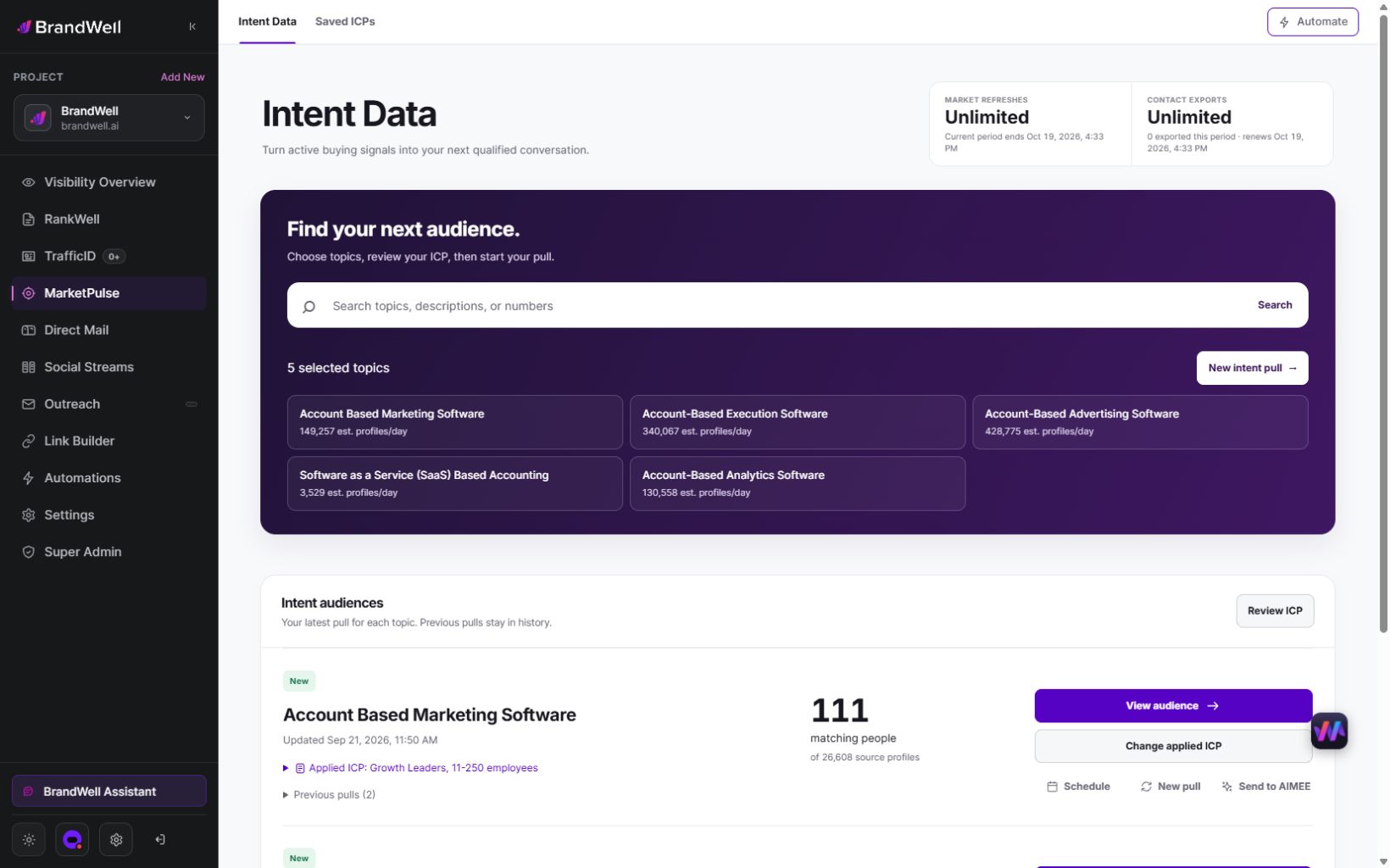
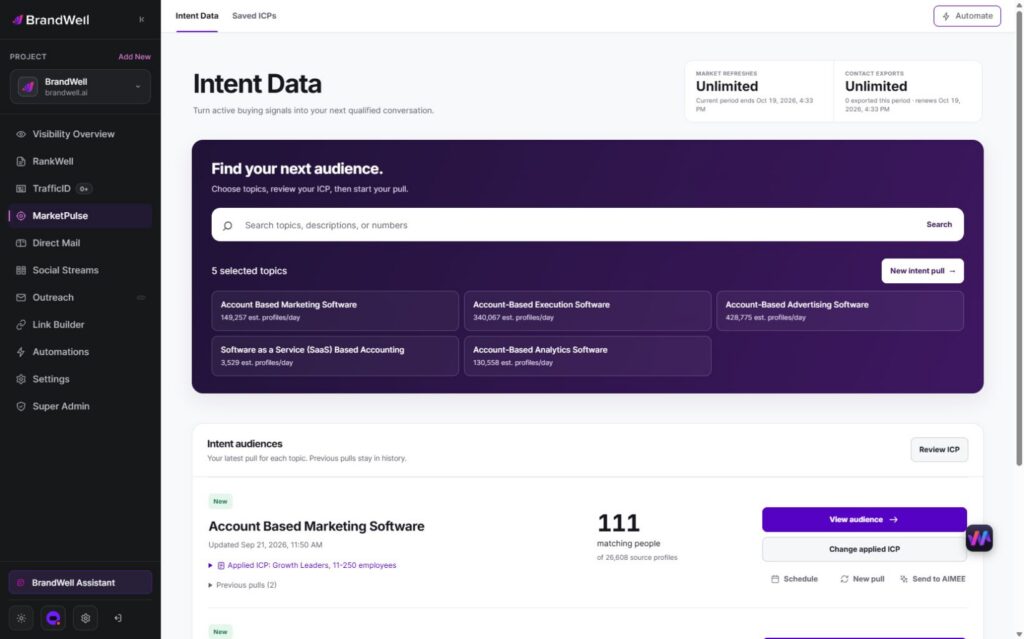
A pull retrieves available data from the previous 24 hours for one topic. Daily use across included topics gives 90 Growth pulls or 300 Scale pulls in a 30-day month. Weekly Starter pulls vary by calendar month. Counts and fields vary, and audiences can overlap.
Growth and Scale include AIMEE for the initial user. It can help prepare assigned work through configured tools and permissions. Connected products, channel usage, and fulfillment may cost extra. Eligible early-access discounts are separate offers. A plan does not itself provide a white-label portal, universal advertising integration, API contract, license resale, or managed campaign service.
Do not assume every export can become an ad audience
Google’s Customer Match policy restricts uploads to customer information collected in a first-party context. It also requires relevant disclosures, consent where required, and approved upload methods. A purchased research list does not become first-party data because you downloaded or hashed it.
For any destination, have the appropriate reviewer check current policy, account eligibility, source rights, fields, purpose, notices, choices, suppression, and retention. If the source is unsuitable for the proposed upload, use a genuinely permitted alternative or do not use it. Internal approval cannot override the destination’s rules.
Topic research can still inform aggregate market understanding, approved account review, and campaign planning where permitted. It should not be presented as a universally eligible customer-list upload.
An eight-step delivery workflow
- Brief: the strategy owner records the offer, ICP, geography, exclusions, outcome, budget, and hypothesis.
- Map: the research owner selects commercially relevant topics and excluded meanings.
- Qualify: the operator reviews fit, freshness, identity, available fields, duplicates, and suppression.
- Approve use: the appropriate owners inspect the field-to-purpose-to-destination map before any transfer.
- Prepare: for an eligible audience, version the source, apply required formatting, and record removals.
- Launch: the media owner verifies destination readiness, settings, creative, spend, and approval.
- Measure: the analyst reports delivery, qualified outcomes, full costs, and limitations.
- Decide: agency and client expand, revise, or stop against the original criteria.
Assign an attainable deadline and exception owner to each handoff. Review new destinations, sensitive uses, major budget changes, suppression overrides, and claims about inferred behavior before action. Do not turn a workflow diagram into permission for automatic uploads or spend changes.
Six working documents for the bundle
1. Offer canvas
Write the client outcome, audience definition, exclusions, channels, deliverables, assumptions, and renewal criteria. Unknown coverage or eligibility must point to a test rather than disappear into the proposal.
2. Cost waterfall
Separate research access, usage, preparation, implementation, creative, management, reporting, client support, ad spend, and pass-through charges. Attach a rule for changed scope or refresh frequency.
3. Eligibility record
For each field and destination, retain source, purpose, permission, suppression, retention, and reviewer. Recheck when the destination or use changes.
4. Audience ledger
Track source rows, duplicate removals, excluded rows, eligible rows, uploaded rows, reported matches, targetable size where available, refresh, expiry, and deletion. Preserve the destination’s definitions rather than inventing a single interchangeable audience count.
5. Experiment card
Declare the hypothesis, comparison, primary metric, guardrails, observation window, limitations, and decision rule before launch. An inconclusive result is a valid outcome.
6. Responsibility matrix
Name the owners for data, preparation, creative, campaigns, spend, follow-up, CRM outcomes, incidents, and renewal. Include the client’s approval and asset dependencies.
Show audience loss honestly
A sourced record, eligible record, accepted upload, reported match, targetable user, and ad recipient are different units. A match does not establish identity correctness, and a targetable audience does not guarantee delivery.
For a fictional permitted workflow, 10,000 source rows become 8,000 after duplicate and exclusion checks, then 5,000 after eligibility review. If the platform reports 3,000 matches, that is 60% of the eligible rows and 30% of the original rows. Neither figure means 3,000 people saw an ad or became customers.
Use the actual destination’s reported definitions and thresholds. Avoid publishing a universal match-rate forecast or treating the same identifier as equally eligible on every platform.
Price the work without hiding media spend
Separate one-time setup, recurring research and preparation, campaign management, and client media spend. State who pays the platform and which charges are included in the agency fee.
For a fictional monthly service billed at $2,500, allocated research costs $500, preparation $400, campaign work $800, and reporting $300. Those direct costs total $2,000, leaving $500 contribution before overhead and tax. A separate $5,000 media budget makes client outlay $7,500. If that media is paid directly by the client, do not count it as agency service revenue.
Model the downside when coverage is lower, review takes longer, or the client delays assets. A plan’s export allowance does not remove labor, campaign costs, or fulfillment fees.
Measure quality, delivery, and outcomes separately
- Readiness: time to approved scope, usable research, eligible audience, and launch.
- Quality: relevant records, identity problems, missing fields, duplicates, suppression, and freshness.
- Delivery: destination status, available audience, spend, impressions, reach, and campaign health.
- Follow-through: useful replies, accepted inquiries, meetings held, and sales disposition.
- Economics: qualified outcomes, service contribution, support workload, and retention.
Google’s Conversion Lift documentation describes controlled treatment and control groups for estimating incremental conversions. It is distinct from ordinary attribution reporting and is not available for every account.
Use a suitable comparison where practical. If volume or design cannot support a causal conclusion, report directional evidence and uncertainty. Do not guarantee ROAS or pipeline from a topic audience.
Choose delivery around client readiness
A foundation service can provide reviewed research, one approved route, and a basic ledger. A more mature client may support recurring preparation, reliable campaign instrumentation, and outcome review. Multi-destination operations require stronger ownership, exception handling, and configuration evidence.
Manual work can be appropriate for an initial pilot. Automate stable decisions only after the rules and failure paths are tested. Preserve client boundaries, credentials, suppression, and permitted outputs when switching methods.
AIMEE can prepare the work within defined boundaries
Provide only approved inputs: topic map, ICP, exclusions, source definitions, eligibility record, campaign hypothesis, and cost model. Ask AIMEE to prepare a review queue, explain exclusions, draft a preflight checklist, or summarize pilot evidence through configured tools.
Keep uploads, campaign launches, spend changes, and new outreach subject to their assigned permissions and approvals. Verify completed actions and retain a responsible human owner. Do not infer universal desktop execution or native integrations from the example.
Frequently asked questions
Can every intent export be uploaded to Customer Match?
No. Check first-party collection and the current destination requirements. Downloading, formatting, or hashing does not create missing eligibility.
What should the client report include?
Show source and eligibility counts, actual delivery, qualified outcomes, full costs, exceptions, and the basis for the renewal decision.
When should an agency stop the bundle?
Stop or redesign when eligibility fails, useful coverage is insufficient, the client cannot act, or the measured workload and outcomes do not support the agreed economics.
Explore MarketPulse and watch the demo, starting at $500/mo. Test relevant research and a permitted client workflow before committing to a recurring audience-plus-media offer.
Reviewed and updated October 3, 2026.

Written by