On this page
- Current MarketPulse research workflow
- Scope one controlled decision cycle
- Define seven handoffs and owners
- Use six operating resources
- Compare build, resell, refer or defer
- Price actual workload and exceptions
- Separate operation from commercial outcomes
- Check actual client readiness
- Keep signal types and actions distinct
- Record risks and implementation limits
- Define modules and renewal gates
- Copyable recurring-service scope
- Frequently asked service-design questions
A signal-to-action workflow becomes a productized agency service when the client can name the input, the decision, the output, the approval boundary, the service level, the evidence, and the price. “We automate your growth” is not a product. “We review qualified intent records every business day, route approved records to named queues, and report acceptance and pipeline outcomes” can be one.
Who is this for? Growth, RevOps, demand-generation, and data-service agency owners deciding whether to build, resell, refer, or avoid a recurring signal-activation offer. The framework treats intent as probabilistic evidence – not proof of identity, consent, readiness to buy, or guaranteed revenue.
Current MarketPulse offer: intent-data plans start at $500/mo. See the product, demo, and current plans. Updated October 3, 2026.
Current MarketPulse research workflow
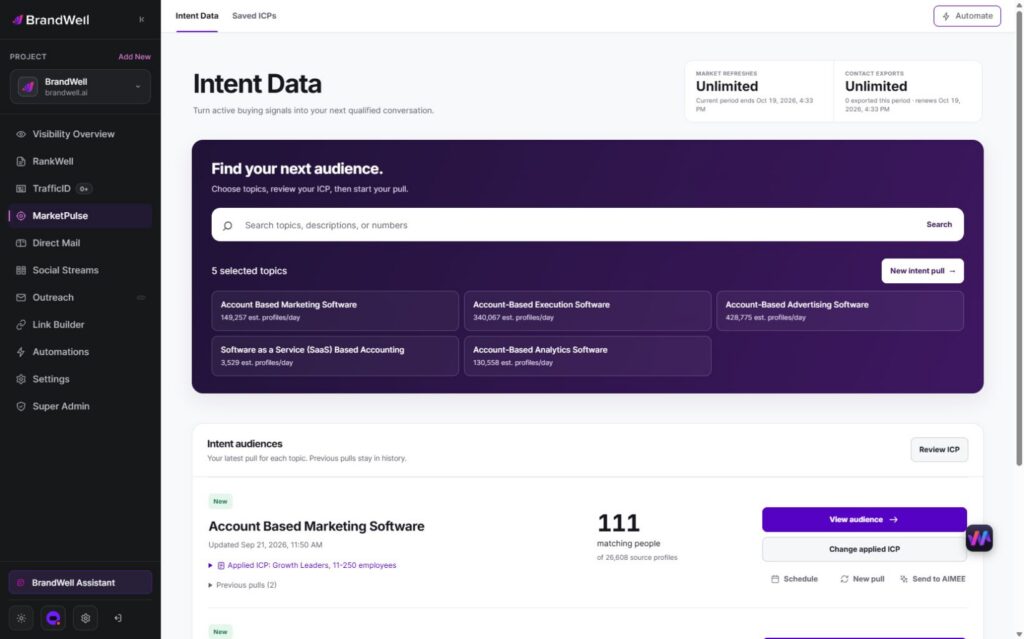
BrandWell MarketPulse: intent data starting at $500/mo. Find people researching topics relevant to what you sell, apply saved ICP filters, and review available contact details before taking action.
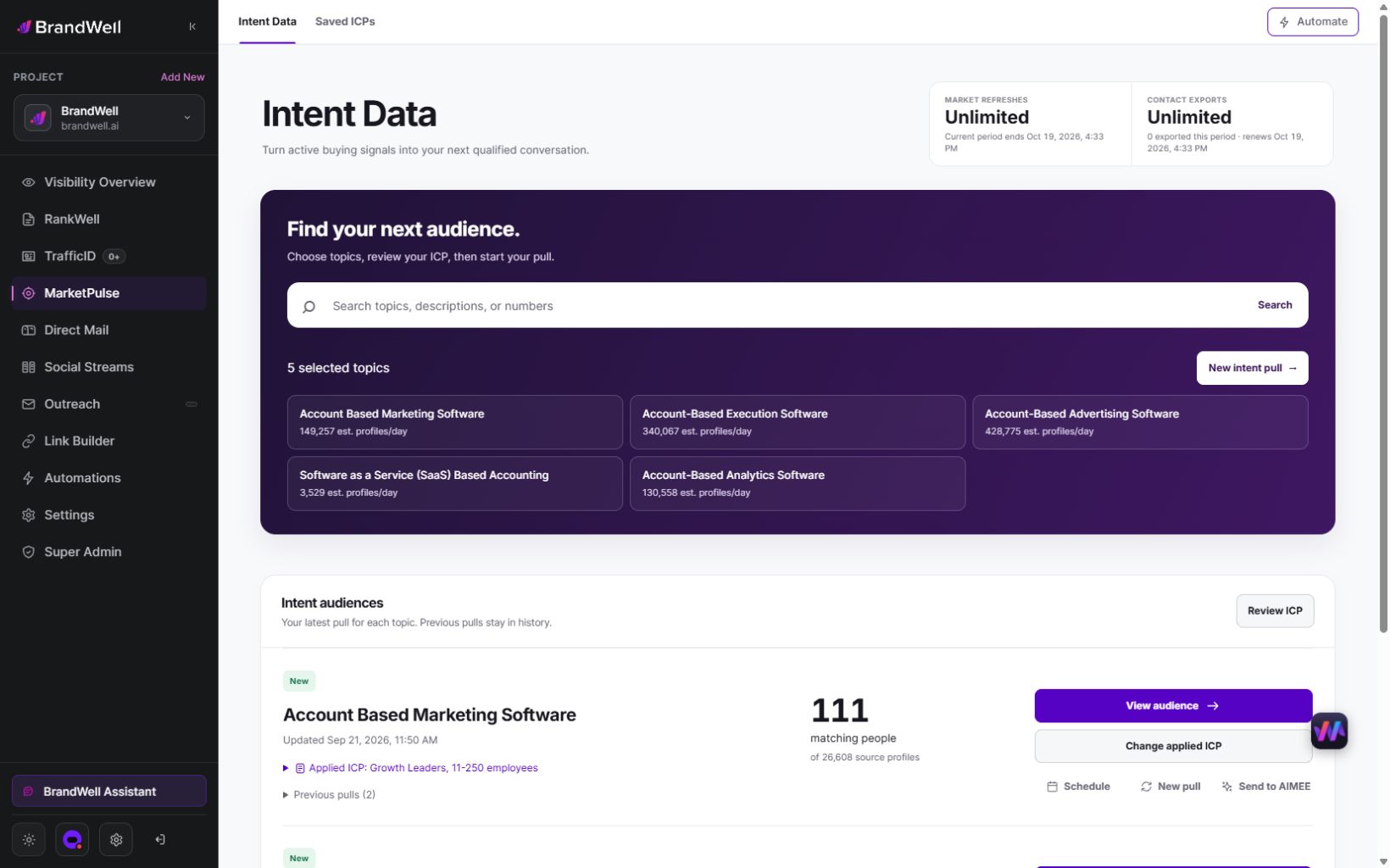
MarketPulse plans are starting at $500/mo. Verify current package scope and offers on the product page.
| Plan | Topics and refreshes | Monthly exports |
|---|---|---|
| Starter | 1 topic, weekly | 25,000 contacts |
| Growth | 3 topics, daily | 100,000 contacts |
| Scale | 10 topics, daily | Unlimited contacts |
Swipe the table to see all columns.
A pull retrieves available data from the previous 24 hours for one topic. Daily use across all included topics provides 90 Growth pulls or 300 Scale pulls in a 30-day month. Weekly Starter pulls vary by calendar month. Available audience size and contact fields vary, and audiences may overlap. Refreshes stop at the plan limit without overage charges.
- Find and qualify: search the topic catalog, save your ICP, and review the people and companies that match.
- Act on the research: export qualified contacts or prepare an Outreach or Direct Mail workflow. Connected products, channel usage, and fulfillment may cost extra.
- Get help from AIMEE: Growth and Scale include AIMEE for the initial user to research accounts and prepare the next step through connected tools.
Agencies and other service businesses can build client deliverables around their available Intent Scans and exports. Keep each client’s scope, permissions, and service fees clear. A subscription is not a promise of a white-label platform or exclusive access to a market.
Explore MarketPulse and watch the demo or compare plans starting at $500/mo. Any early-access discount is a separate, time-limited offer shown to an eligible recipient.
Scope one controlled decision cycle
Test a bounded operating service when clients have relevant research and a measurable gap between review and an approved next action. Define the actual input, output, owner, quality rules and decision period before promising a reduction in delay or workload.
The promise should not be “more pipeline on autopilot.” Pipeline also depends on market fit, offer, creative, media, sales capacity, timing, and measurement. A defensible scope specifies:
- accepted signal types and required fields;
- fit, identity, freshness, confidence, suppression, and eligibility rules;
- allowed actions and destinations;
- which actions require a person’s approval;
- expected cadence and service-level targets;
- client dependencies;
- exception and incident handling;
- reporting definitions; and
- renewal or stop gates.
Productize one decision loop first. For example: “Topic-relevant account enters → fit and eligibility review → seller brief drafted → human approves CRM task → outcome disposition captured.” Once that loop works, add modules rather than expanding the promise.
Define seven handoffs and owners
A signal-to-action workflow service needs an operating blueprint, not just an automation diagram.
- Signal intake – data operator. Validate source, observation unit, age, required fields, contractual use, and batch completeness. Quarantine malformed or undocumented records.
- Qualification – analyst or rules owner. Apply ICP, exclusions, identity confidence, freshness, signal class, contactability, and permitted-use rules. Record reasons, not only a score.
- Decision – client business owner. Approve the action policy for each tier: monitor, enrich, report, nurture, advertise, create a task, or suppress.
- Preparation – delivery specialist. Generate the approved brief, audience file, CRM payload, research report, or task with provenance attached.
- Approval – named human. Review consequential actions: contacting a person, uploading an audience, changing spend, writing to a system of record, overriding a suppression, or publishing externally.
- Execution – authorized operator or integration. Perform only the approved action; retain idempotency keys, version, timestamps, and error status.
- Feedback – RevOps or client owner. Capture accepted, rejected, contacted, meeting, opportunity, revenue, expiry, and suppression outcomes. Feed reviewed labels back into rules.
Staffing can be compact: a service owner, data/automation operator, client strategy owner, and privacy/security/platform reviewers available at defined gates. One person may hold multiple roles, but approval authority and accountability should remain explicit.
Set SLAs from observed workload. Separate time to ingest, time to review, time to approval, time to execute, and time to resolve an exception. A client delay should not count as agency processing time. At handoff, provide the data dictionary, rules, approvals, access list, runbook, incident path, current backlog, known limitations, and deletion responsibilities.
Use six operating resources
Apply identical criteria to every resource: input, owner, output, approval, evidence, and failure mode.
1. Productization canvas
Defines the buyer, recurring problem, trigger, action, deliverables, exclusions, cadence, dependencies, price, and renewal gate.
Limitation: a polished canvas can hide an untested input. Mark every assumption and require sample evidence.
2. Signal data dictionary
Defines each field, source, observation unit, time meaning, allowed values, null behavior, confidence meaning, retention, and permitted use.
Limitation: definitions drift unless versioned. A score of 80 from one source may not mean the same thing as 80 from another.
3. Policy and approval matrix
Maps signal tier and use case to allowed action, required reviewer, destination, prohibited language, and escalation path.
Limitation: a matrix is not legal or platform permission; specialists must recheck the actual use and current terms.
4. Workflow-module catalog
Lists reusable modules such as normalize, deduplicate, enrich, fit-check, confidence-check, suppress, summarize, route, notify, create task, prepare audience, and report.
Limitation: modules can create false confidence. Each needs preconditions, observable output, rollback, and an owner.
5. Run and exception ledger
Records input version, rule version, approvals, executed action, status, retries, exception reason, suppression, and outcome.
Limitation: logs without review become storage, not control. Assign an exception SLA and recurring audit.
6. Unit-economics worksheet
Separates platform and data usage, implementation, human review, support, exception handling, client success, and risk reserve.
Limitation: averages obscure costly clients. Track labor and usage by account and module.
Software should support these artifacts, not replace them. A practical stack may include a secure source repository, rules or workflow engine, enrichment and identity services, CRM, approved activation destinations, observability, access control, and reporting. For an agency-reseller model, a separately contracted client-interface layer can be tested against actual setup work when its terms, data rights, and controls fit the service.
Compare build, resell, refer or defer
| Option | Control | Time to launch | Recurring labor | Capital and maintenance | Margin potential | Primary risk | Possible fit |
|---|---|---|---|---|---|---|---|
| Build | Highest | Slowest | Medium after maturity | Highest | High at scale | Security, reliability, and maintenance burden | Agency with technical team and proprietary workflow |
| Resell or white label | Medium to high | Faster | Medium | Lower | High when wholesale/retail scope is clear | Provider dependency and entitlement gaps | Multi-client agency with repeatable delivery |
| Refer | Low | Fastest | Low | Lowest | Low | Little control over client experience | Agency without data or governance capacity |
| Avoid for now | None | Not applicable | None | None | Protects margin | Opportunity cost | No eligible use, weak economics, or no owner |
Swipe the table to see all columns.
Build when the workflow itself is proprietary and the agency can fund security, integrations, uptime, support, and policy changes. Resell when the agency’s advantage is market mapping, service design, client trust, activation, and measurement. Refer when taking responsibility would create more risk than value. Avoid when the client expects uncontrolled autonomous outreach, guaranteed pipeline, or impermissible data use.
Research delivery and managed execution have different responsibility boundaries. Price the actual approval, logging, follow-up, exception and outcome work for each. Do not assume end-to-end execution will command more revenue or produce better results.
Price actual workload and exceptions
A productizing signal-to-action workflows pricing model should contain:
- a setup fee for discovery, taxonomy, rules, integrations, baseline, testing, and training;
- a recurring platform/data component for topics, records, enrichment, identity, storage, and destinations;
- a managed-service component for analysis, approvals, optimization, reporting, and client success;
- defined usage allowances and overages; and
- separately disclosed pass-through spend.
Use:
Monthly delivery cost = data and platform usage + loaded labor + support + governance + risk reserve
Realized contribution margin = (service revenue - monthly delivery cost) / service revenue
Then price for the downside case, not the demo case. Include exception volume, failed integrations, client-specific reports, and approval delays. There is no honest universal gross-margin benchmark for this service; an agency with manual adjudication, regulated clients, or custom integrations will have a different cost structure from one operating stable modules at scale.
Separate operation from commercial outcomes
Measure the workflow in layers:
Input and quality
- records received and accepted;
- missing-field, duplicate, stale, ambiguous, and suppressed rates;
- confidence distribution and manual-overturn rate.
Operations
- time from signal to decision and approved action;
- percentage within SLA;
- automation success, retry, and exception rate;
- human review time per eligible record.
Adoption
- client approval latency;
- percentage of routed records acted on;
- disposition completeness;
- queue aging and expiry.
Commercial outcomes
- meetings, accepted opportunities, qualified pipeline, wins, revenue, and contribution margin by signal tier and action path;
- retention and module expansion; and
- outcome difference against a suitable baseline or control.
Keep actual assignment, comparator, unique outcome unit, maturity, missing feedback and uncertainty. Attributed outcomes alone do not establish incremental effects. An observed difference between selected groups can reflect the offer, seller effort, timing or eligibility rather than the research input.
Use the evidence to change rules. If high-confidence records are consistently rejected for the same reason, revise the data or fit logic. If records are accepted but never acted on, the service has an adoption problem. If action happens but pipeline does not, review offer, timing, messaging, channel, and sales process before blaming the signal.
Check actual client readiness
Evaluate these actual readiness conditions:
- a recurring source of commercially relevant signals;
- defined ICP and exclusion rules;
- sufficient deal economics;
- at least one permitted and valuable action path;
- a CRM or system of record with consistent dispositions;
- an accountable owner for follow-up;
- enough volume to evaluate; and
- willingness to accept human approvals and uncertainty.
A pilot fits a client with strong economics but an unknown that can be resolved through a bounded acceptance test: topic relevance, identity coverage, workflow effort, or destination matchability.
Exclude clients that lack a lawful or platform-permitted use, request messages that reveal private behavior, require guaranteed outcomes, refuse to maintain suppression, cannot provide outcome data, or expect the agency to absorb unlimited exceptions. Also exclude “automation theater”: a client asking for agents while no one has authority to decide what the agents should do.
Keep signal types and actions distinct
Signals should enter a governed sequence rather than one blended “hot lead” score:
- Observe: record the signal type, source, unit, and age. Off-site topic research and first-party website behavior are different evidence.
- Resolve carefully: match a person or company only to the confidence supported by identifiers. Preserve ambiguity.
- Enrich: add fields needed for the decision, not every available attribute.
- Check fit: apply ICP, geography, role, account, customer, competitor, and suppression rules.
- Check permitted use: confirm purpose, notice, rights, client instructions, destination policy, and approvals.
- Assign action tier: monitor, report, research, nurture, prepare audience, create a seller task, or suppress.
- Capture outcome: record what happened and why.
MarketPulse provides topic research and available match details; TrafficID separately supports own-site visitor review. AIMEE can organize supplied context through configured tools. An agency operating method is an implementation proposal, not proof that every source, enrichment, custom score, dashboard, interface or destination is included. Verify actual implementation, rights, scope and fees.
An agent-ready instruction can make preparation consistent:
Using only the approved signal dictionary, ICP, exclusions, permitted-use matrix, action policy, and client SLA, classify each record into monitor, prepare, human-review, suppress, or exception. Return the evidence and rule version for every classification. Never infer missing identity, consent, or purchase intent. Draft briefs and payloads only. Do not contact people, upload audiences, modify the system of record, change spend, or publish without the named human approval.AIMEE can prepare a review brief through configured connected tools. Keep proposed actions separate from actual approvals and destination acknowledgements. Confirm the implementation and permissions before execution.
Record risks and implementation limits
The risk register should include:
- undocumented provenance or permitted purpose;
- false matches, stale attributes, duplicates, and score drift;
- a signal treated as identity, consent, or purchase proof;
- sensitive data or sensitive-category activation;
- missing suppression, deletion, or objection propagation;
- cross-client data leakage and excessive access;
- insecure exports or credentials;
- integration duplication, partial writes, retries, and rollback failures;
- agents taking consequential actions outside policy;
- service levels that ignore client approval delays;
- unbounded customization and exception labor; and
- attribution or pipeline claims presented without a baseline.
Verify actual source, purpose, necessary fields, rights, recipient type, jurisdiction, channel, destination and suppression before action. Keep named owners for access, retention, correction, deletion and incidents. A contract, match or draft does not establish permission; resolve actual unanswered requirements before execution.
Define modules and renewal gates
A practical recurring agency package can include:
- Market and signal design: maintained topic map, ICP, exclusions, and data dictionary.
- Qualification: fit, identity, freshness, confidence, contactability, and eligibility rules.
- Action preparation: branded reports, seller briefs, CRM-ready payloads, audience preparation, or nurture recommendations.
- Governed execution: approved routing, integrations, exception handling, and human decision gates.
- Evidence: run ledger, outcome dispositions, operating review, margin analysis, and change recommendations.
- Client enablement: training, runbook, responsibility matrix, and escalation path.
Review an available MarketPulse topic, saved ICP and actual preceding-24-hour matches for the approved research purpose. Keep uncertain company context visible. AIMEE can organize supplied context through configured tools; named owners approve actual exports, messages, audience uploads and CRM writes.
The renewal gate should ask: Did usable signal volume persist? Did the workflow meet quality and SLA targets? Did the client act? Did downstream evidence improve relative to the declared baseline? Did the agency achieve its required contribution margin? Are data rights and platform rules still valid? Continue or expand only when those answers are supported – not because the automation ran.
Before operational use, complete product, pricing, privacy, security, compliance, legal, and platform-policy review.
Copyable recurring-service scope
Input: [Actual topic research, unique unit and allowed purpose.] Loop: [One reviewed decision and deliverable.] Owners: [Preparation, approval, execution and feedback.] Clock: [Start, stop, pauses, exception and acknowledgement.] Capacity: [Routine and specialist time by actual role.] Costs: [Subscription, setup, labor, maintenance and exclusions.] Renewal: [Acceptance, adoption, outcomes, margin and repair criteria.]
Count maintenance against time saved
Google’s SRE workbook advises measuring operational toil and evaluating automation’s ongoing cost. It concerns engineering, not an agency margin benchmark. In a fictional monthly loop, 20 routine hours saved minus six maintenance hours and eight new exception-review hours leaves six net hours saved. If setup takes 36 hours, simple setup recovery is six months at that constant net saving. Different skills, demand and opportunity costs can change the decision.
Publish a clock the client can verify
Suppose a fictional record arrives at 9:00, becomes review-ready at 9:30, receives approval at 13:30 and is acknowledged by the destination at 14:00. Elapsed arrival-to-acknowledgement is five hours. If the contract permits a documented four-hour client approval pause, measured active service time is one hour. Show both clocks and the actual pause evidence. Do not retroactively exclude delays to improve reported compliance.
Price the exception case before expansion
A fictional $2,500 first-period service fee against $500 standard Growth subscription, $400 setup, $600 review and $300 support has $1,800 defined costs and a $700 remainder, or 28%. Another $800 of exception work changes the remainder to negative $100. Acquisition, general overhead, tax and financing are excluded. These invented service inputs are not BrandWell agency prices or typical margins.
Task creation is not seller adoption
If 100 fictional records yield 60 accepted briefs, 40 approved tasks, 30 acknowledged tasks and 20 acted-on tasks, action is 66.7% of acknowledged tasks or 20% of all records. With 15 returned dispositions, feedback coverage is 75% of acted-on tasks; five remain unknown. Three confirmed opportunities do not prove the service caused them. Preserve buyer evidence, maturity and a suitable comparator.
Use current product research for the first module
Review an available MarketPulse topic, saved ICP and actual preceding-24-hour matches. Preserve uncertain company context and field availability in a seller brief. AIMEE can organize supplied research through configured tools. Owners approve exports, messages, Outreach enrollment, audience uploads and CRM writes. Custom scoring, reports, interfaces and synchronization require separately verified implementation, rights, scope and fees.
Frequently asked service-design questions
Does a research subscription include managed delivery?
No. Verify the separate service and implementation scope.
Does routine time saved equal total time saved?
No. Count maintenance, exception work and setup.
Should client approval pauses be hidden?
No. Show elapsed and contract-defined active clocks.
Does a CRM task prove adoption or pipeline?
No. Track actual execution, feedback and buyer outcomes.
Review the research product: explore MarketPulse and current plans.
Reviewed and updated October 3, 2026.

Written by