On this page
- Current MarketPulse research workflow
- Separate evidence dimensions from action
- Test seven scoring and review steps
- Use six confidence operating resources
- Compare methods for the actual decision
- Count full scoring and review costs
- Measure usefulness and qualified outcomes
- Check actual reviewable use cases
- Require gates before combining bands
- Prevent nine confidence mistakes
- Scope separate agency confidence work
- Copyable confidence-band review
- Frequently asked confidence questions
Intent signal confidence should answer an operational question: How much evidence supports this next action, and what is the least consequential action justified by that evidence? Intent data is probabilistic. A confidence score should not claim to know that a person is buying, establish identity beyond the match evidence, create consent, or guarantee an outcome.
Who is this for? B2B revenue teams and agencies evaluating intent data, including CMOs, CROs, demand-generation leaders, RevOps, sales leaders, and agency owners who need a practical intent signal confidence framework before routing signals to ads, outreach, CRM, or client reports.
Current MarketPulse offer: intent-data plans start at $500/mo. See the product, demo, and current plans. Updated October 3, 2026.
Current MarketPulse research workflow
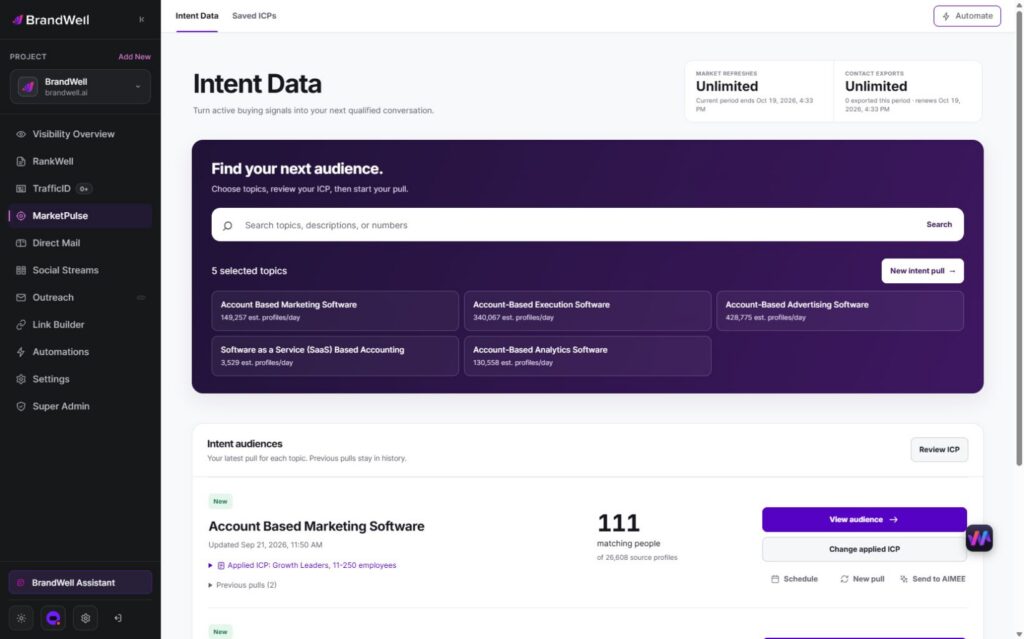
BrandWell MarketPulse: intent data starting at $500/mo. Find people researching topics relevant to what you sell, apply saved ICP filters, and review available contact details before taking action.
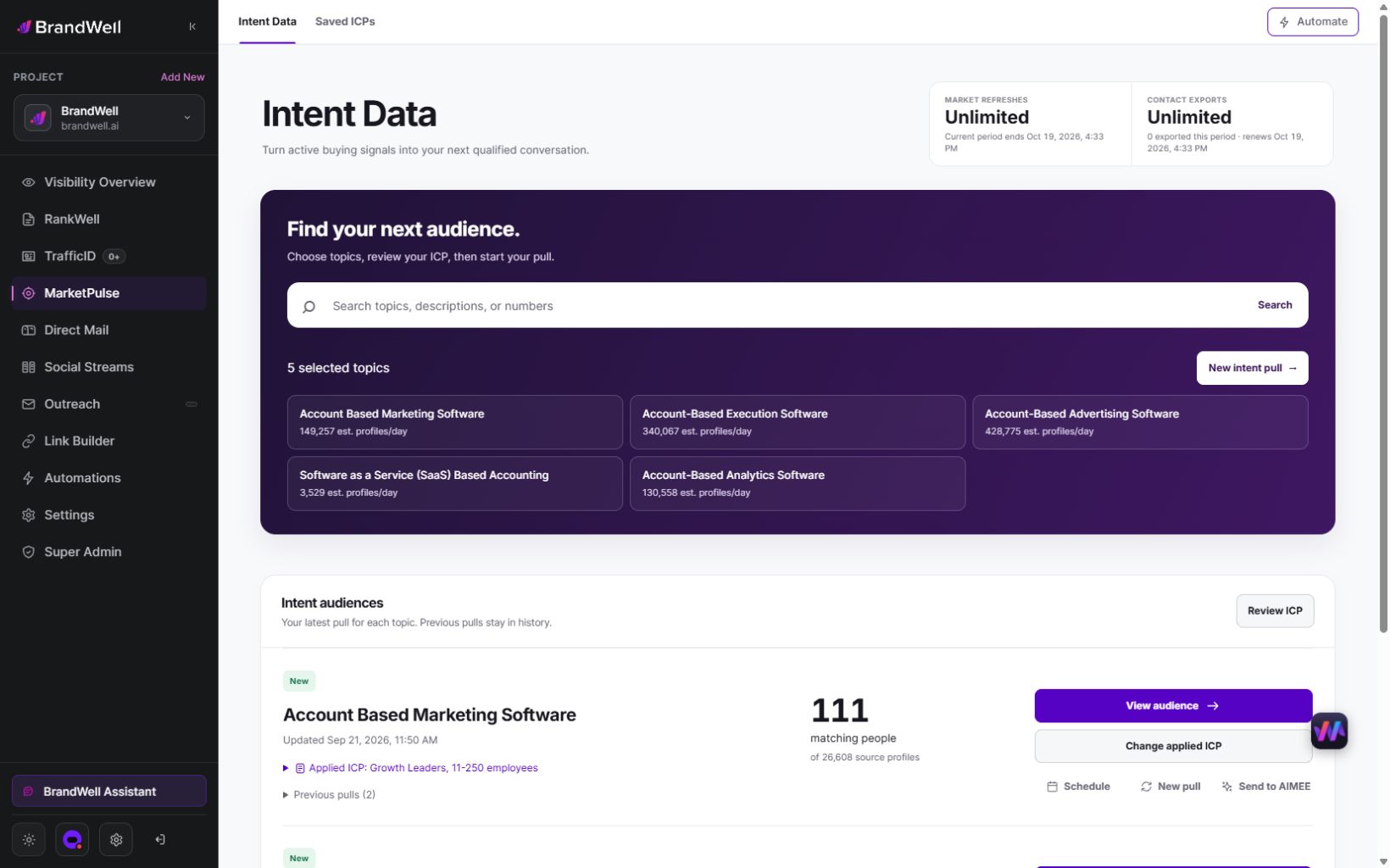
MarketPulse plans are starting at $500/mo. Verify current package scope and offers on the product page.
| Plan | Topics and refreshes | Monthly exports |
|---|---|---|
| Starter | 1 topic, weekly | 25,000 contacts |
| Growth | 3 topics, daily | 100,000 contacts |
| Scale | 10 topics, daily | Unlimited contacts |
Swipe the table to see all columns.
A pull retrieves available data from the previous 24 hours for one topic. Daily use across all included topics provides 90 Growth pulls or 300 Scale pulls in a 30-day month. Weekly Starter pulls vary by calendar month. Available audience size and contact fields vary, and audiences may overlap. Refreshes stop at the plan limit without overage charges.
- Find and qualify: search the topic catalog, save your ICP, and review the people and companies that match.
- Act on the research: export qualified contacts or prepare an Outreach or Direct Mail workflow. Connected products, channel usage, and fulfillment may cost extra.
- Get help from AIMEE: Growth and Scale include AIMEE for the initial user to research accounts and prepare the next step through connected tools.
Agencies and other service businesses can build client deliverables around their available Intent Scans and exports. Keep each client’s scope, permissions, and service fees clear. A subscription is not a promise of a white-label platform or exclusive access to a market.
Explore MarketPulse and watch the demo or compare plans starting at $500/mo. Any early-access discount is a separate, time-limited offer shown to an eligible recipient.
Separate evidence dimensions from action
A responsible intent signal confidence strategy separates evidence dimensions instead of blending them into one unexplained score:
- signal relevance: how closely the behavior relates to the offer and buying stage;
- recency: how much time has passed and whether the signal is still decision-useful;
- fit: whether the company or person meets the approved market definition;
- identity support: which identifiers support the entity match and how much ambiguity remains;
- contactability: whether required channel fields are present and validated;
- eligibility: whether the proposed use is permitted by contract, notice, user choice, law, and destination policy;
- corroboration: whether independent first-party or account evidence points in the same direction; and
- outcome evidence: whether similar past records were accepted and produced meaningful downstream actions.
Each dimension should retain its own value and reason code. A composite band can simplify routing, but it must not hide a zero in eligibility or an unresolved identity. Use hard stops before weights.
A practical action policy is conservative: low evidence supports monitoring or aggregate analysis; moderate evidence supports enrichment or a research brief; stronger evidence can support a human-reviewed task or audience preparation; direct outreach, audience upload, spend change, or system write requires explicit eligibility and human approval.
Test seven scoring and review steps
- Define the decision. Name the action the score will govern. “Prioritize account research” needs a different threshold from “upload a contact audience.”
- Define the unit. State whether the signal belongs to a person, account, device, household, location, or aggregate cohort. Never silently move confidence between units.
- Create the evidence schema. Define source class, topic, time meaning, fit fields, identity evidence, exclusions, contactability, permitted use, and outcome labels.
- Apply hard stops. Suppress or quarantine records with prohibited use, missing required provenance, sensitive-category risk, unresolved suppression, or destination ineligibility.
- Score dimensions. Use simple, explainable bands such as 0 = absent/unacceptable, 1 = weak, 2 = usable with conditions, and 3 = strong for this decision. Preserve unknown separately from zero.
- Map score to action. Route to monitor, enrich, research, prepare, human review, execute after approval, or suppress. Record the rule version.
- Review and recalibrate. Sample accepted and rejected records, capture manual overturns and downstream dispositions, and adjust only through controlled change review.
Required integrations may include signal intake, enrichment or identity checks, CRM, suppression, approved ad or outreach destinations, workflow logging, and outcome reporting. Integrations do not make the score trustworthy by themselves; the definitions, data rights, labels, and review process do.
The team needs a methodology owner, data or RevOps operator, client or sales owner, and access to privacy, security, legal, compliance, and platform-policy review. Human approval remains mandatory before consequential activation.
Use six confidence operating resources
Evaluate every resource by required input, decision supported, owner, observable output, and limitation.
1. Confidence-evidence rubric
Defines the 0–3 evidence bands for relevance, recency, fit, identity, contactability, eligibility, corroboration, and outcomes.
Limitation: ordinal bands are not statistical probabilities. “3” means stronger evidence under the declared rubric, not a 75% or 100% chance of purchase.
2. Data dictionary and scorecard
Records field meaning, source class, timestamp semantics, null behavior, weight, hard stop, reason code, and allowed action.
Limitation: a scorecard becomes misleading when data definitions or source populations change without versioning.
3. Calibration worksheet
Compares score bands with reviewed acceptance, rejection, meetings, opportunities, and other downstream labels for a defined cohort.
Limitation: historical outcomes can contain sales-process and selection bias. Correlation by band does not establish causation.
4. Action-threshold matrix
Maps each confidence band and eligibility state to allowed actions and required human approvals.
Limitation: a threshold suitable for account research may be unsafe for person-level outreach. Maintain thresholds by action and jurisdiction.
5. Exception and overturn log
Captures record, rule version, original decision, reviewer decision, reason, corrective action, and whether the change applies globally.
Limitation: an unreviewed log does not improve the system. Assign an owner and audit cadence.
6. Cohort outcome dashboard
Shows counts and rates by signal class, confidence band, action path, client, and time window with denominators and unknowns.
Limitation: dashboards can turn attributed outcomes into implied causality. Label observational and experimental evidence distinctly.
These resources matter more than selecting “intent signal confidence software” from a generic list. Choose platforms only after the rubric, action policy, and evidence requirements are defined.
Compare methods for the actual decision
| Approach | Evidence | Possible use | Simplicity | Main risk | Switching trigger |
|---|---|---|---|---|---|
| Broad list | Basic contact or company criteria | Large-scale market awareness and baseline outreach tests | Highest | Low relevance and wasted capacity | Add fit when volume overwhelms follow-up |
| Fit-only targeting | Firmographic or role match | Stable ICP with little behavioral data | High | Right company, wrong timing | Add engagement or intent when timing matters |
| Engagement-only scoring | First-party visits, forms, email, or product actions | Known audience and lifecycle prioritization | Medium | Activity without commercial fit | Add fit and identity controls when noise rises |
| Intent-confidence framework | Topic/behavior plus recency, fit, identity, eligibility, and evidence | Prioritizing in-market research for a defined action | Lower | False certainty from opaque scoring | Simplify when the action does not justify complexity |
| Combined policy | Fit, first-party engagement, external intent, identity, eligibility, and outcomes | High-value, governed GTM workflows | Lowest | Data and governance overhead | Use when deal economics and team maturity support it |
Swipe the table to see all columns.
Intent confidence is not always the answer. A broad list may be adequate for a low-risk aggregate test. Fit-only targeting may outperform noisy behavioral data. First-party engagement may be stronger than off-site intent for a known account. Test the least complex evidence set against the actual decision.
A fair intent signal confidence comparison freezes the action, population, field definitions, review labels, time window, and outcome. Do not compare a person-level score with an account-level audience as though they were the same unit.
Count full scoring and review costs
The total cost of intent signal confidence includes:
- signal and topic access;
- identity resolution, enrichment, validation, and usage;
- data engineering and integrations;
- taxonomy, rubric, thresholds, and test-set design;
- privacy, security, legal, compliance, and platform review;
- analyst and human adjudication time;
- destination activation and media or outreach operations;
- monitoring, exceptions, support, and recalibration; and
- replacement, migration, or export effort.
A useful budget formula is:
Monthly operating cost = data/platform + loaded labor + activation + governance + expected exception cost
Cost per approved action = monthly operating cost / human-approved actions executed
Do not use cost per raw signal as the principal decision metric; low-quality volume can make that number look artificially attractive.
Pricing models may be flat by module, tiered by topics or volume, usage-based, or a base fee plus overages. Compare the same workload, inclusions, support, data rights, and exit costs.
Measure usefulness and qualified outcomes
Measure three distinct things.
Score behavior
- distribution by confidence band;
- unknown, suppressed, and exception rates;
- manual overturn rate;
- agreement between independent reviewers;
- stability after source or rule changes.
Operational usefulness
- eligible and approved-action rates;
- time from signal to review and action;
- percentage handled within SLA;
- disposition completeness;
- cost per reviewed and approved action.
Commercial outcomes
- meeting, accepted opportunity, qualified pipeline, win, revenue, and contribution margin by confidence band and action path;
- outcome differences against fit-only, engagement-only, or status-quo cohorts;
- retention and expansion for agency services.
Use formulas with disclosed denominators. Acceptance rate = reviewer-accepted records / reviewed records. Opportunity rate by band = accepted opportunities / acted-on records in that band. Manual overturn rate = changed decisions / human-reviewed decisions. Keep unknowns visible.
Keep unknowns visible and report actual selection, assignment, comparator, outcome maturity and uncertainty. A higher observed outcome rate in a selected band does not prove the score caused the outcome. Sales, channels, offers and missing feedback can affect the comparison.
There is no universal intent signal confidence benchmark. Calibrate thresholds to the action, market, client, signal source, and cost of false acceptance versus false rejection.
Check actual reviewable use cases
Evaluate actual fit, relevant evidence, defined outcome labels, permitted actions, owner capacity and willingness to preserve uncertainty. Possible uses include account research, brief preparation and bounded audience review; industry or score volume alone does not establish usefulness.
- a defined ICP and meaningful deal or customer value;
- enough relevant signal volume;
- an accountable revenue team;
- at least one lawful and platform-permitted action;
- consistent CRM dispositions and outcome instrumentation;
- capacity for human review; and
- a willingness to treat uncertainty honestly.
Strong use cases include account-research prioritization, seller brief preparation, topic reporting, nurture selection, audience preparation after eligibility review, and monitoring market shifts. Person-level direct outreach carries more risk than account-level research and needs stricter identity, contactability, permission, and message review.
Poor-fit cases include tiny markets that cannot produce usable volume, low-value transactions that cannot fund review, sensitive inferences, clients demanding a “who will buy” answer, no suppression process, no feedback, or automation with no accountable approver.
An agency pilot is appropriate when signal relevance, identity coverage, threshold behavior, or workflow cost is unknown but testable. Do not use a pilot to postpone a known legal, policy, or economics failure.
Require gates before combining bands
A practical scoring example keeps components visible:
- Relevance (0–3): generic education to purchase-adjacent research.
- Recency (0–3): outside the action window to recent enough for the defined cycle.
- Fit (0–3): excluded to strong ICP match.
- Identity support (0–3): unresolved to multiple consistent identifiers.
- Contactability (0–3): unusable to validated required channel data.
- Eligibility: hard stop, conditional review, or approved for this purpose and destination.
- Corroboration (0–3): no independent evidence to consistent first-party/account evidence.
- Outcome prior (0–3): no usable history to stable reviewed performance for a comparable cohort.
One illustrative routing rule is:
- any hard stop → suppress or exception;
- low evidence → aggregate, monitor, or wait;
- moderate evidence → enrich or prepare a research brief;
- strong evidence plus conditional eligibility → human review;
- strong evidence plus approved eligibility → prepare the action, then obtain the required human execution approval.
Do not publish these numeric bands as validated benchmarks. They are a template to calibrate. Weights should reflect the cost of errors for a specific action. An identity error may be tolerable for aggregate reporting and unacceptable for person-level outreach.
MarketPulse supplies topic research and available match details. TrafficID separately supports own-site visitor review. AIMEE can organize supplied context through configured tools. Custom scoring, calibration, reports, client interfaces and routing require separately verified implementation, rights, scope and fees.
Prevent nine confidence mistakes
- Calling the score a purchase probability. Use “decision band” unless it is demonstrably calibrated.
- Mixing units. An account signal is not automatically a person signal.
- Treating identity as binary. Preserve identifiers, ambiguity, and unresolved states.
- Using missing as zero. Unknown evidence differs from negative evidence.
- Ignoring decay. A once-relevant signal may expire before review.
- Letting weights override eligibility. Permission and platform rules are hard gates.
- Training on biased outcomes. Sales only follows selected records, so historical labels may reflect prior routing.
- Revealing private behavior. Use intent to prioritize research, not to tell a prospect what the system observed.
- Automating consequential action without approval. Drafting and queueing are not permission to send, upload, spend, or write.
Keep actual source, purpose, necessary fields, access, retention, correction, deletion, suppression and incident owners. Verify the actual recipient, jurisdiction, channel, destination and approvals before action. A score or contract does not establish permission for every use.
If AI helps prepare the review, keep actual inputs, rule version, unknowns, proposed action and human decision traceable. Verify implementation and test evidence; a framework does not validate a score or establish model calibration.
Scope separate agency confidence work
A recurring intent signal confidence service can include:
- maintained signal dictionary, ICP, topics, and exclusions;
- confidence rubric and action-threshold matrix;
- identity, enrichment, freshness, and eligibility checks;
- human-reviewed research briefs, audience preparation, or CRM task preparation;
- run, exception, suppression, and change logs;
- outcome cohorts and monthly calibration review;
- client training, responsibility matrix, and escalation path; and
- renewal gates based on quality, adoption, evidence, compliance, and margin.
MarketPulse supplies topic research and available match details. AIMEE can organize supplied context through configured tools. An agency operating service, branded weekly report, CRM synchronization or custom client interface needs separately verified implementation, rights, scope and fees. The research subscription does not establish those delivery capabilities.
Review an available MarketPulse topic, saved ICP and actual preceding-24-hour matches for the approved research purpose. Keep uncertain company context visible. AIMEE can organize supplied context through configured tools; named owners approve actual exports, messages, audience uploads and CRM writes.
AIMEE can prepare a review brief through configured tools using supplied rules. Ask it to retain source fields, rule version, unknowns, failed gates and the proposed action. The owner verifies the record and approves actual messages, exports, audience uploads, spend changes and CRM writes. A draft does not establish approval or native custom scoring.
Using only the approved signal dictionary, confidence rubric, hard stops, action-threshold matrix, and client-specific permitted-use rules, score each evidence dimension independently. Return unknown when evidence is missing. Cite the supplied fields and rule version. Recommend the least consequential allowed action. Do not infer identity, consent, purchase intent, legal eligibility, or outcome. Do not contact anyone, upload an audience, change spend, write to a system of record, or publish without the named human approval.AIMEE can prepare a review brief through configured connected tools. Keep proposed actions separate from actual approvals and destination acknowledgements. Confirm the implementation and permissions before execution.
Before operational use, complete product, pricing, privacy, security, compliance, legal, and platform-policy review.
Copyable confidence-band review
Action: [Actual decision and allowed scope.] Unit: [Account, person, device or cohort.] Evidence: [Independent dimensions, sources and unknowns.] Gates: [Required purpose, matching, eligibility and suppression.] Band: [Ordinal rule, version and rationale.] Evaluation: [Independent labels, sampling, maturity and missingness.] Decision: [Owner, full costs, hold, repair or bounded test.]
An ordinal score is not a buying probability
A fictional rubric gives an account 2.5 out of three. Dividing by three yields 83.3% of the scale, not an 83.3% chance of purchase. Keep the action band and underlying evidence visible. A missing eligibility field is unknown and can block action; it is not a negative research event that can be averaged away.
Evaluate predicted probabilities against actual labels
Scikit-learn’s calibration documentation compares predicted probabilities with observed labels and separates calibration data from model training. It concerns statistical classifiers, not a claim that BrandWell implements this model or that a score predicts purchases.
Assume a fictional model assigns 20 independent evaluation records a probability near 0.8 of a precisely defined outcome. Twelve have that outcome: 60%, not the expected approximately 80% under calibration. This small bin does not establish population calibration or justify automatic action. Verify actual sample independence, label definition, observation window and uncertainty. These invented inputs are not BrandWell performance results.
Selected feedback can hide rejected cases
If 100 records enter review but sellers act on 40, outcomes from those 40 describe the selected group. They do not show what happened to the 60 unacted records. Preserve actual reasons and missing labels, and evaluate a representative lawful review sample rather than declaring the score validated from selected successes alone.
Approval and execution are distinct states
Suppose a fictional period has 30 approved actions but only 20 verified destination acknowledgements. Cost per approved action and cost per executed action answer different questions. With $1,500 in defined costs, the ratios are $50 per approval and $75 per acknowledged action. Name failed and pending states; do not count a queued draft as executed.
Include rubric maintenance and exceptions
A fictional first-period test with the standard $500 Growth subscription, $400 rubric/setup and $600 review has $1,500 defined costs. Another $300 correction raises it to $1,800. At 20 acknowledged actions, defined cost rises from $75 to $90 each. Media, acquisition, general overhead, tax and financing are excluded. These invented service inputs are not BrandWell scoring-service fees or typical returns.
Start with actual product research
Review an available MarketPulse topic, saved ICP and actual preceding-24-hour matches for the approved purpose. Keep uncertain company context and failed gates visible. AIMEE can organize supplied research and a review brief through configured tools. Owners approve exports, messages, Outreach enrollment, audience uploads and CRM writes. Custom scoring, calibration, reports and routing require separately verified implementation, rights, scope and fees.
Frequently asked confidence questions
Does a 2.5/3 score mean an 83.3% chance of buying?
No. An ordinal scale is not a calibrated probability.
Can selected seller successes validate the whole pool?
No. Preserve selection, missing labels and uncertainty.
Is approval the same as verified execution?
No. Keep actual destination acknowledgements separate.
Does MarketPulse include every custom scoring model?
No. Verify actual implementation, rights and scope.
Review the research product: explore MarketPulse and current plans.
Reviewed and updated October 3, 2026.

Written by