On this page
- Current TrafficID visitor workflow
- Keep forms and observed activity distinct
- Test eight collection-to-review steps
- Compare six operating patterns
- Compare analytics, forms and matching
- Count full collection and review costs
- Measure quality with distinct units
- Check actual workflow readiness
- Require fit and action gates
- Review matching and collection boundaries
- Scope separate visitor-operations work
- Copyable forms-and-visitors comparison
- Frequently asked forms-and-visitors questions
Website visitor identification and submitted forms provide different evidence. Keep a voluntary inquiry and its requested response distinct from observed activity and uncertain matches. TrafficID supports review of identifiable own-site visitors, forms and company context; it does not identify every visitor or establish that added stakeholders visited.
Who is this for? B2B growth, RevOps, demand-generation, sales, and agency teams with meaningful anonymous traffic, a defined ideal customer profile, and enough operational discipline to suppress poor matches. It is not for teams seeking a hidden list of “certain buyers” or an automatic reason to contact every apparent visitor.
Review current TrafficID plans, eligible identified-visitor volume and the selected fixed or dynamic billing mode before budgeting. TrafficID and MarketPulse have separate product scope. Verify current allowances and included tools on the product page.
Current TrafficID visitor workflow
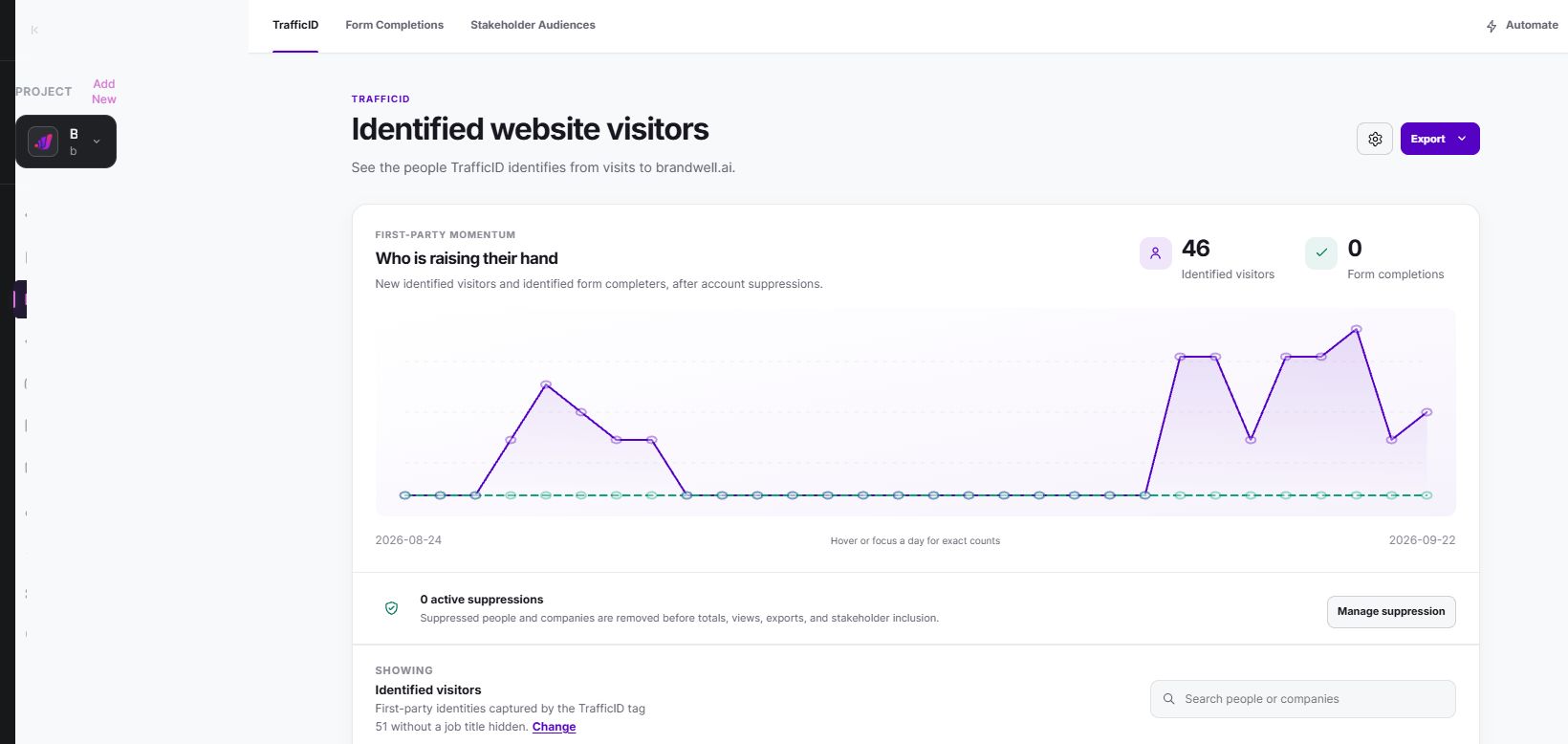
TrafficID addresses identifiable visitors to your own authorized site. Its views keep observed visitors, submitted form identities and added company stakeholders distinct. It does not identify every visitor or make an added stakeholder the person who visited.
Review current TrafficID plans, eligible identified-visitor volume and the selected fixed or dynamic billing mode before budgeting. TrafficID and MarketPulse have separate product scope. Verify current allowances and included tools on the product page.
MarketPulse is separate external topic research starting at $500/mo. Topic audiences do not establish a visit to the client’s site. Agency setup, analysis, reporting, custom portals and integrations need separate scope and fees.
Keep forms and observed activity distinct
A submitted form records a voluntary request and its context. Visitor identification associates eligible site activity with available identity or company context. Preserve the actual source, matching unit and unresolved cases. A company association is not evidence that a specific employee performed the observed action.
That distinction drives a practical website visitor identification versus form fills strategy:
- Treat a valid form submission as an explicit conversion event, subject to the purpose and permissions represented at collection.
- Treat an identified visit as evidence to score, not proof of the visitor’s identity, authority, or purchase intent.
- Keep both streams in the same account timeline while preserving their source, confidence, and consent state.
- Ask for a voluntary response before moving from an inferred signal to a consequential one-to-one action.
The outcome is not “more names.” It is a smaller queue of accounts and contacts for which the team can explain what was observed, how it was matched, why the action is proportionate, and what happened next.
Test eight collection-to-review steps
A reliable implementation guide starts before a tag is installed. Define one business decision, the minimum data needed for it, and an owner for every handoff.
- Define eligible pages and events. Separate generic visits from stronger actions such as repeat solution-page views, a pricing-page session, or a return after an ad exposure. Exclude sensitive or irrelevant pages.
- Record declared conversions separately. Route demo requests, downloads, registrations, and other forms into the CRM with the exact source and applicable permission evidence.
- Resolve only what is necessary. Send eligible events to the identity process, retain the match type and confidence, and suppress unresolved or low-confidence records.
- Join at the account level first. Append firmographic fit and existing relationship status before selecting possible people. Never infer that a matched employee personally performed every account-level action.
- Apply freshness and frequency. A recent cluster of relevant actions can justify review; test a dated validity rule for each source rather than assuming one decay rate.
- Check exclusions. Remove customers, open opportunities when outreach would conflict, competitors, employees, minors, sensitive segments, opt-outs, and jurisdictions or use cases the client has not approved.
- Create a bounded action. Examples include adding an account to an ad audience, notifying an account owner, or inviting a known contact to a useful resource. A human approves consequential outreach.
- Write the outcome back. Preserve delivery, reply, qualification, opportunity, and revenue events so signal quality can be evaluated rather than assumed.
The implementation team normally includes marketing operations, RevOps or CRM ownership, demand generation, sales leadership, privacy or legal counsel, security, and an analyst. The minimum integrations are the website or event layer, consent system where applicable, identity provider, CRM, suppression source, activation channel, and outcome reporting.
Compare six operating patterns
Use the same criteria for every pattern: evidence strength, identity confidence, buyer friction, activation speed, coverage, privacy burden, and ability to measure a downstream outcome.
1. Form-first conversion paths
Keep the high-intent action behind a short, purposeful form and improve the value exchange, field count, routing, and follow-up. Evaluate this when the visitor wants a quote, demo, assessment, or access that naturally requires a response.
Failure mode: A form-only system sees only people willing to submit. It cannot distinguish an irrelevant anonymous visit from a potentially valuable account that is not ready to identify itself.
2. Account-level visitor identification
Resolve eligible traffic to a likely company, then rank that company by ICP fit and page behavior. This is useful for account-based advertising, territory insights, and seller research without pretending a particular employee was identified.
Failure mode: Shared networks, remote work, bots, and small samples can create false associations. Account resolution alone does not provide a lawful or relevant person to contact.
3. Person-level identification with a confidence gate
Allow a person-level match only when the source, permitted use, identity method, and confidence meet a written threshold. Require corroboration from a known CRM relationship or another independent signal before outreach.
Failure mode: A name can make weak evidence feel certain. False positives, household/device ambiguity, and unclear rights can turn an efficiency tool into an intrusive experience.
4. Retargeting without identity disclosure
Use only actual supported and permitted retargeting sources. Verify purpose, destination, account, region, sensitive-page restrictions, exclusions and audience size before implementation. Media exposure alone is not a submitted inquiry or a sales-ready lead.
Failure mode: Retargeting can create frequency fatigue and may optimize toward easy clicks rather than qualified pipeline. It also provides no direct sales conversation by itself.
5. Identification-assisted form design
Use aggregate patterns from eligible visitors to improve the offer, page, CTA, and form rather than immediately activating names. If high-fit accounts repeatedly abandon a generic demo form, test a lower-friction diagnostic or role-specific proof asset.
Failure mode: Segment-level patterns do not prove why an individual abandoned. A redesign based on a tiny or biased identified sample may make the page worse for everyone else.
6. Human-researched account follow-up
Send a high-fit account to an owner who researches public business context and chooses a relevant, non-creepy message. The visit signal determines research priority; it should not become the opening line.
Failure mode: Manual research does not repair a bad match. Without a queue limit and evidence record, sellers can cherry-pick anecdotes and over-contact accounts.
These patterns are the practical “tools” layer: an event schema, confidence rubric, consent and suppression checklist, CRM field template, decision queue, and outcome log matter more than a long software roster.
Compare analytics, forms and matching
Choose the least invasive method that can support the decision.
- Aggregate analytics wins when the question is which pages, channels, or cohorts perform. It has low person-level utility and usually cannot route a seller.
- Form fills win when a person is ready to request something and the team needs reliable declared context. They trade coverage for clarity.
- IP-only company identification can support territory or account prioritization, but it should remain an account hypothesis until corroborated.
- Broader identity resolution may add reach across identifiers, but demands validation, permitted-use review, confidence thresholds, and deletion/opt-out operations.
- Retargeting alone is useful for continued education when direct outreach is not justified. Its limitation is that media exposure is not a sales-ready lead.
The right alternative is sometimes no identification at all. If traffic volume is low, the ICP is undefined, or sales cannot follow up consistently, improve the offer, forms, analytics, and conversion tracking first.
Count full collection and review costs
Website visitor identification versus form fills pricing should be evaluated as a full operating system, not a tag fee. Model these cost lines:
- platform, data, or usage fees;
- implementation, event mapping, and consent configuration;
- CRM and activation integrations;
- match-test design and manual adjudication;
- suppression, deletion, security, and vendor-review work;
- seller or media capacity used on the resulting queue;
- form design, development, routing, and response operations;
- measurement and holdout analysis.
Review a representative eligible sample with actual source labels, matching uncertainty, suppressions and qualified outcomes. A provider match count is not an ROI forecast or proof of contact permission.
The economic stopping rule is simple: do not pay for additional identity coverage when the marginal records cannot clear fit, policy, contactability, and outcome thresholds.
Measure quality with distinct units
Website visitor identification versus form fills KPIs need separate denominators. For forms, track eligible sessions, starts, submissions, valid submissions, routing speed, meetings, qualification, opportunities, and revenue. For identification, track eligible events, resolved accounts, high-confidence matches, suppression rate, activated records, delivery, replies, qualified conversations, opportunities, and revenue.
Also monitor:
- precision checks: the share of sampled matches confirmed by defensible evidence;
- coverage: resolved eligible traffic divided by eligible traffic, not all visits;
- freshness: time from observed event to resolution, review, activation, and outcome;
- false-positive feedback: wrong-company, wrong-person, bot, or stale-record flags;
- incremental lift: outcome difference between eligible activated and comparable holdout groups;
- cost per qualified outcome: full program cost divided by qualified meetings or accepted opportunities.
Benchmarks should be internal and cohort-specific. Establish a baseline for forms and anonymous traffic, then compare matched cohorts using the same qualification definition and observation window. Do not credit a visit with revenue merely because it appeared earlier in the account timeline.
Check actual workflow readiness
Evaluate actual relevant traffic, defined fit, owner capacity, source permissions, shared exclusions and maintained CRM outcomes. Possible tests include visitor research, form improvements and separately scoped account review; volume or industry alone does not establish readiness.
Delay the program when the site has little traffic, consumer or sensitive-use exposure dominates, identity permissions are unclear, CRM duplicates are severe, sales capacity is saturated, or the only proposed action is an automated cold message. In those cases, form optimization, aggregate analytics, first-party lifecycle programs, and demand capture can be evaluated against the actual operating gap.
For agencies, client readiness also includes an approved data map, named controller/processor responsibilities, a suppression source, an escalation contact, and a client owner willing to review evidence and outcomes.
Require fit and action gates
Use an explicit gate rather than a mysterious composite “intent score.” A record advances only if it passes each required layer:
- Fit: the account matches documented firmographic, geographic, and commercial criteria.
- Signal: the behavior relates to a buying problem rather than careers, support, investors, or generic education.
- Identity: the match method and confidence support the proposed use. Account-level and person-level evidence remain distinct.
- Freshness: the event is recent enough for the action and decays on a written schedule.
- Eligibility: privacy notice, consent where required, data rights, platform policy, suppression, and sensitive-use rules permit the action.
- Actionability: an owner, message, capacity limit, and human approval exist.
- Outcome evidence: the CRM can record what happened and feed quality back into the thresholds.
A high-fit company with a weak identity signal may enter an advertising or research queue, not person-level outreach. A lower-fit form submitter still deserves the response promised by the form, but should not automatically become a sales-qualified opportunity.
Review matching and collection boundaries
Verify actual collection, source, recipient, purpose, jurisdiction and channel requirements. Resolve notice, permission, access, retention, correction, deletion and suppression for the implementation before action. Obtain qualified advice where requirements remain unresolved.
Assign actual necessary fields, source and purpose, access, retention, correction, deletion, suppression and incident owners. Keep implementation and test evidence rather than treating a framework or contract as certification.
All consequential actions require human approval. Before operational use, complete product, pricing, privacy, security, compliance, legal, and platform-policy review.
Scope separate visitor-operations work
An agency can package the work as a recurring “visitor evidence and conversion operations” service: measurement design, tag and form QA, weekly match-quality review, account prioritization, suppression, controlled activation, monthly pipeline analysis, and quarterly threshold recalibration. The client should approve the data map, actions, jurisdictions, and service levels; the agency should report both coverage and exclusions.
Start with TrafficID for the owned-site workflow. Review an actual observed visitor or submitted form, its source label and available page context. Preserve the distinction between observed visitors and additional company stakeholders. AIMEE can prepare research through configured tools; the owner approves actual actions.
Keep TrafficID visitor review distinct from an agency service. Verify actual access, branding, implementation, client interfaces, rights, delivery responsibilities and separate fees. A subscription does not establish every reporting or routing capability.
Copyable forms-and-visitors comparison
Decision: [Actual collection or review question.] Units: [Sessions, eligible people, forms, accounts and stakeholders.] Source: [Submitted inquiry, observed activity or enrichment.] Checks: [Matching uncertainty, purpose, suppressions and freshness.] Action: [Owner, requested response, approval and acknowledgement.] Outcome: [Valid submission, qualification, opportunity and unknown feedback.] Economics: [Full costs, overlap, test and stop rule.]
Give forms clear labels and instructions
W3C’s form-instruction guidance recommends explaining required and optional inputs and says placeholders are not substitutes for labels. This is accessibility guidance, not a promised conversion uplift. Keep the actual value exchange, response expectation, validation and optional consent easy to understand.
Do not add overlapping sources as unique people
Assume a fictional site has 1,000 eligible sessions, 50 submitted inquiries and 200 identified-visitor records. If 20 submitted people also appear among identified visitors, the unique union is 230 people only if both streams actually use verified person-level IDs. Session counts remain a different unit. Another 100 company stakeholders do not turn the 230 into 330 observed visitors. These invented counts are not BrandWell performance results.
Keep valid forms separate from qualification
Suppose 50 submissions include 40 valid inquiries, 20 qualified conversations and eight accepted opportunities. Valid/submitted rate is 80%; qualified/valid is 50%; opportunity/submitted is 16%. A form requesting an answer still needs the promised response even when the account is not sales-qualified. A submission does not grant permission for every unrelated use.
Price actual identified volume and operating work
Review current TrafficID plans, eligible identified-visitor volume and the selected fixed or dynamic billing mode before budgeting. TrafficID and MarketPulse have separate product scope. Verify current allowances and included tools on the product page.
A fictional entry-tier test with $99 subscription, $300 instrumentation and $400 review has $799 defined costs. Eight accepted opportunities give $99.88 each. At the $179 tier, otherwise unchanged inputs make defined cost $879 and $109.88 per opportunity. Media, acquisition, general overhead, tax and financing are excluded. These invented service inputs are not BrandWell agency-service fees or typical outcomes.
Review the actual TrafficID sources
Check the authorized Company’s reported tracking-tag setup. Review identifiable visitors and submitted forms in their distinct source views. Keep additional Stakeholder ICP contacts separate from observed visitors. Check suppressions and actual purpose before export. AIMEE can prepare supplied company context through configured tools; owners approve messages, Outreach enrollment, eligible postcard workflows and CRM writes. Custom joins, reporting and client interfaces require separately verified implementation, rights, scope and fees.
Frequently asked forms-and-visitors questions
Does TrafficID replace a submitted inquiry?
No. Keep declared requests and observed activity distinct.
Does TrafficID identify every visitor?
No. Matching data and site conditions affect identification.
Are added company stakeholders observed visitors?
No. Preserve their enrichment source.
Is $99 a universal ceiling for dynamic billing?
No. Verify actual usage, tier and billing settings.
Review the owned-site product: explore TrafficID and current plans.
Reviewed and updated October 3, 2026.

Written by