On this page
- Current MarketPulse research workflow
- Check the actual agency launch scope
- Require six launch-readiness gates
- Choose one client problem and promise
- Test nine service-delivery stages
- Assign owners and service-level clocks
- Compare three delivery modes
- Choose resources for the actual gap
- Count setup and recurring delivery costs
- Require a first-client acceptance test
- Verify go-live action and claim boundaries
- Scope separate recurring client delivery
- Copyable first-client launch test
- Frequently asked launch questions
Launch an agency intent-data service by defining one client problem, six required readiness gates and a bounded first-client acceptance test. Verify source coverage, actual delivery ownership, specialist capacity, rights and full costs before expanding. Research signals are not purchases or evidence of causal impact.
Current MarketPulse offer: intent-data plans start at $500/mo. See the product, demo, and current plans. Updated October 3, 2026.
Current MarketPulse research workflow
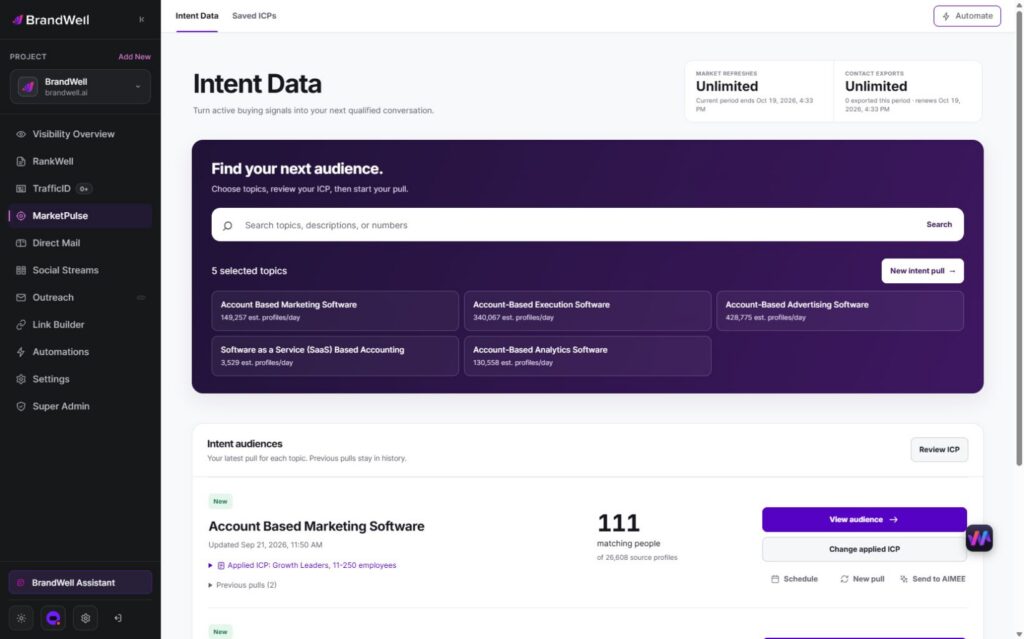
BrandWell MarketPulse: intent data starting at $500/mo. Find people researching topics relevant to what you sell, apply saved ICP filters, and review available contact details before taking action.
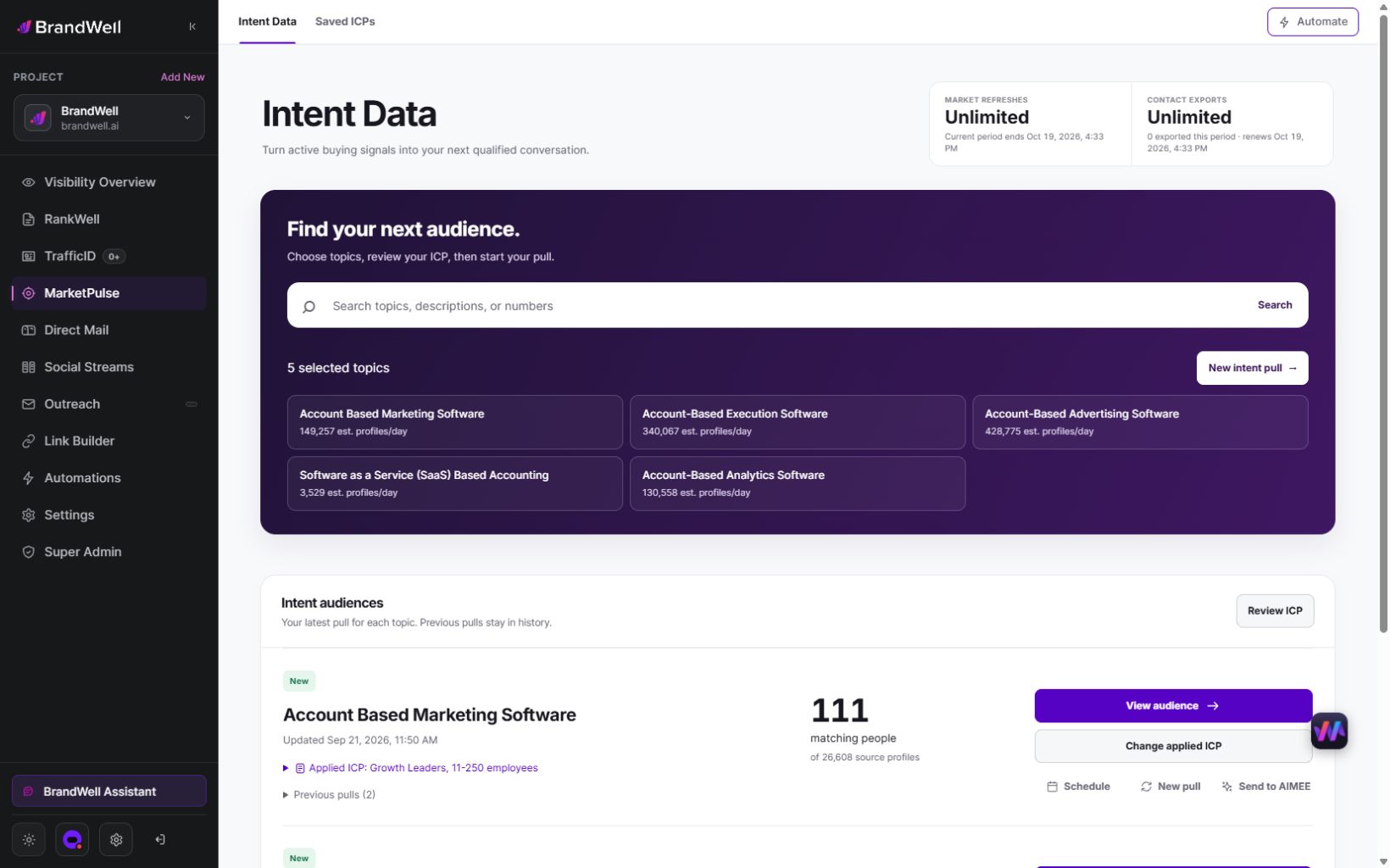
MarketPulse plans are starting at $500/mo. Verify current package scope and offers on the product page.
| Plan | Topics and refreshes | Monthly exports |
|---|---|---|
| Starter | 1 topic, weekly | 25,000 contacts |
| Growth | 3 topics, daily | 100,000 contacts |
| Scale | 10 topics, daily | Unlimited contacts |
Swipe the table to see all columns.
A pull retrieves available data from the previous 24 hours for one topic. Daily use across all included topics provides 90 Growth pulls or 300 Scale pulls in a 30-day month. Weekly Starter pulls vary by calendar month. Available audience size and contact fields vary, and audiences may overlap. Refreshes stop at the plan limit without overage charges.
- Find and qualify: search the topic catalog, save your ICP, and review the people and companies that match.
- Act on the research: export qualified contacts or prepare an Outreach or Direct Mail workflow. Connected products, channel usage, and fulfillment may cost extra.
- Get help from AIMEE: Growth and Scale include AIMEE for the initial user to research accounts and prepare the next step through connected tools.
Agencies and other service businesses can build client deliverables around their available Intent Scans and exports. Keep each client’s scope, permissions, and service fees clear. A subscription is not a promise of a white-label platform or exclusive access to a market.
Explore MarketPulse and watch the demo or compare plans starting at $500/mo. Any early-access discount is a separate, time-limited offer shown to an eligible recipient.
Check the actual agency launch scope
This guide is for established agency owners, GTM consultants, RevOps consultants, and demand-generation leaders adding an intent-data revenue stream without starting a new agency from scratch. It focuses on launch decisions: readiness, the first use case, delivery design, controls, go-live, and conversion into a recurring service. It is not a generic agency-pricing guide, a vendor leaderboard, or a promise that a data feed will create pipeline on its own.
Require six launch-readiness gates
An agency is ready when it can name a real client problem, a useful signal, an accountable operator, an allowed next action, and a measurable outcome. “Our clients want more leads” is not specific enough. “Our cybersecurity client wants a reviewed weekly queue of ICP accounts researching three defined solution topics, routed to its account team with the source and recency preserved” is testable.
Score six areas:
- Client demand: At least one suitable client will validate the service and provide timely feedback.
- Signal coverage: The intended market and topics produce enough relevant activity to evaluate.
- Delivery capacity: Someone owns configuration, QA, exceptions, reporting, and client communication.
- Data governance: The agency and client understand permitted use, retention, suppression, access, and deletion.
- Activation readiness: The client has a CRM, sales process, approved messaging, or another destination able to use the output.
- Measurement readiness: A baseline and outcome definitions exist before delivery begins.
Stop when coverage is too weak, the client cannot act, data rights are unclear, or no one owns quality. A launch-readiness checklist should prevent an attractive demo from becoming an unprofitable service obligation.
Choose one client problem and promise
Start with a single decision the client needs to make faster. Useful starting points include prioritizing accounts for research, identifying more visitors already on the client’s site, monitoring competitor or category research, enriching an approved lead queue, or producing a branded market-demand report.
Write the promise as a chain:
signal → observation unit → qualification → permitted action → evidence
For example: “We monitor approved category-research signals associated with companies, filter them to your ICP, review match quality, route accepted accounts to your CRM, and report sales acceptance and opportunity progression.” This is stronger than “We reveal everyone ready to buy” because the client can inspect every step.
Define exclusions next. An account signal does not by itself identify a person. A resolved contact should not be described as the individual who generated the original account activity unless separate evidence supports that conclusion. A research signal is not consent, a purchase commitment, or guaranteed revenue. Clear exclusions make the service easier to sell responsibly because buyers know what they will and will not receive.
Test nine service-delivery stages
A repeatable launch is a sequence of work units, not a dashboard login. Use these nine stages:
1. Market and coverage review
Define the ICP, geography, competitor set, commercial topics, exclusions, expected volume, and minimum usable output. Failure mode: choosing broad topics that create volume without relevance.
2. Signal design
Classify first-party site behavior, off-site topic research, review activity, account engagement, and other sources separately. Record the source and observation unit. Failure mode: blending unlike signals into one unexplained “intent score.”
3. Account matching
Normalize the company, domain, and CRM record; attach a confidence state; preserve unmatched records for review. Failure mode: treating reverse-IP or domain inference as person identification.
4. Optional contact resolution and enrichment
Resolve people only when the approved action requires them. Check required fields, freshness, contactability, duplicates, and suppression status. Failure mode: enriching every account whether or not a person-level workflow is justified.
5. Fit and freshness qualification
Apply ICP rules, recency bands, topic relevance, exclusions, and corroborating evidence. Failure mode: leaving old records in a “recent intent” queue.
6. QA and exception review
Sample accepted and rejected records, log wrong matches, resolve ambiguous cases, and approve new rules. Failure mode: measuring only vendor-reported match volume.
7. Routing and approval
Send the record to a report, CRM queue, approved outbound workflow, or another permitted destination. Require human approval for weak matches, sensitive uses, public actions, and material spend. Failure mode: assuming every integration is legally or contractually eligible.
8. Outcome capture
Record handoff acceptance, sales disposition, engagement, meeting, qualified opportunity, pipeline, and rejection reason. Failure mode: reporting exports as business outcomes.
9. Review and change control
Revisit topics, thresholds, volume, false positives, client adoption, costs, permissions, and outcomes. Version every material change. Failure mode: silently changing definitions so results are no longer comparable.
Assign owners and service-level clocks
Every stage needs one accountable owner even when several people contribute. A practical responsibility map names the agency service owner, data or platform operator, QA reviewer, client approver, CRM or automation owner, privacy/security owner, and sales follow-up owner. “The team” is not an owner.
An SLA needs four parts: when the clock starts, the target, the acceptance condition, and the escalation route. Avoid copying generic response-time benchmarks. Source cadence, integration reliability, client risk, staff capacity, and the destination should determine the target. A weekly topic report and a high-confidence pricing-page alert need different service levels.
Use a handoff receipt. It should record the source record ID, client, stage completed, acceptance status, destination, timestamp, next owner, and rejection reason. This prevents the common dispute in which the agency says it sent leads while the client says nothing useful arrived.
Quality checks should cover both precision and process: correct account, required fields, duplicate status, fit, recency, permitted use, suppression, routing success, and downstream acceptance. Sample rejected records too; a rule that rejects all difficult cases can look accurate while missing valuable coverage.
Compare three delivery modes
Test manual review to learn actual inputs, client preferences and exception categories. Count analyst effort and verify repeatability instead of assuming a best delivery mode.
Test automation only against stable inputs, accepted rules and actual exception handling. Verify permissions, correct outputs and recovery; an automated bad rule can repeat an error.
Evaluate separately implemented client delivery when the actual requirement includes a branded interface or recurring report. Verify tenant isolation, entitlements, metering, support, offboarding, responsibilities and rights. A research subscription does not establish these capabilities.
Compare actual labor, control, error visibility, client access, full costs, governance and change management. Test manual review, automation and separately implemented client delivery against accepted requirements.
Choose resources for the actual gap
The useful “stack” is a set of capabilities and templates, not the longest tool list:
- Market and topic map
- Signal source and provenance fields
- Account matching and optional identity resolution
- Enrichment and contactability checks
- Fit, recency, and qualification rules
- CRM schema and routing matrix
- Suppression, access, retention, and deletion controls
- Client portal or branded report
- Outcome ledger and cost model
- Exception log and change-control record
MarketPulse supplies topic research and available match details. TrafficID separately supports own-site visitor review. AIMEE can organize supplied context through configured tools. Custom scoring, client portals, reports, routing and destination integrations require separately verified implementation, rights, scope and fees.
Count setup and recurring delivery costs
Count discovery, topic configuration, field mapping, separately implemented integrations, QA, training and setup contingency. Recurring costs include the actual research subscription, permitted usage, review, exceptions, separately implemented automation and reporting, support, account management and governance overhead.
Track exception time separately. A workflow that processes records cheaply but requires frequent manual correction can erase margin. Useful internal unit costs include cost per reviewed account, accepted account, usable contact, successful handoff, and sales-accepted output.
Separate the research subscription from any agency service and its client contract. Verify actual usage, sharing, licensing, branding, billing and recipient rights before offering delivery. Do not infer reseller entitlements or client billing controls from a research plan.
Require a first-client acceptance test
Do not call the launch complete because data arrived. The first-client gate should require:
- Approved topic and ICP configuration
- Minimum coverage or a documented insufficient-coverage conclusion
- Accepted account and optional contact-quality sample
- Working suppression and deletion process
- Successful tenant-safe routing
- Client approval of the queue, report, and messaging
- Baseline outcome definitions in the CRM
- Documented exceptions and owners
- Reconciled setup and recurring cost
- A go, revise, or stop decision
Measure accepted outputs, quality, adoption and actual buyer outcomes separately. Keep sourced and associated pipeline distinct from causal impact. Report the comparator, overlap, observation window and missing feedback; use descriptive language where the design cannot support causality.
Verify go-live action and claim boundaries
Assign actual access, necessary fields, retention, correction, suppression, deletion and incident owners. Keep implementation and test evidence; a framework or contract does not establish certification.
Verify the actual recipient, source, purpose, jurisdiction and channel requirements before messages. A match does not establish contact permission. Hold unresolved checks and obtain qualified advice where needed.
Verify current destination eligibility for the actual source, account, recipient, purpose and campaign before upload. Third-party research does not automatically become first-party customer data or permission for ad activation.
Maintain actual evidence for identification, freshness, coverage, exclusivity, performance and ROI claims. Preserve scope, limitations, date, owner and supporting record. An agency service promise should follow verified delivery rather than an unsupported product claim.
Scope separate recurring client delivery
A recurring service should maintain the system, not merely send a one-time list. Include client-specific topics and ICP rules, signal monitoring, match and enrichment QA, approved activation playbooks, a branded report or portal, outcome review, recalibration, access controls, usage reporting, support, and offboarding. Keep each client’s data, credentials, suppressions, and configuration isolated.
Review an available MarketPulse topic, saved ICP and actual preceding-24-hour matches for the approved research purpose. Keep uncertain company context visible. AIMEE can organize supplied context through configured tools; named owners approve actual exports, messages, audience uploads and CRM writes.
AIMEE can prepare a review brief through configured connected tools. Keep proposed actions separate from actual approvals and destination acknowledgements. Confirm the implementation and permissions before execution.
Treat intent, identity, and match signals as probabilistic evidence – not proof of identity, need, authority, consent, or purchase intent. Before deployment, require human, product, pricing, privacy, security, compliance, legal, and platform-policy review of the configured offer and workflow.
Evaluate the launch by whether the agency can explain what the signal means, deliver accepted outputs consistently, show what happened next, protect client data, and improve the workflow without moving the goalposts. That is the foundation of a defensible recurring revenue stream.
Copyable first-client launch test
Problem: [Actual client decision and bounded service promise.] Inputs: [Source, topic, ICP, period, unit and uncertainty.] Gates: [Demand, coverage, capacity, governance, activation and measurement.] Ownership: [Operator, reviewer, approver and feedback owner.] Acceptance: [Valid destination result and evidence ID.] Economics: [Setup, recurring work, exceptions and excluded costs.] Decision: [Go, repair or stop rule and retest.]
Do not average away a missing launch gate
GOV.UK’s discovery guidance examines the problem and constraints before committing to a service. It concerns government delivery, not BrandWell results or an agency launch benchmark.
Assume a fictional agency verifies five of six required gates but has no owner for client follow-up. The checklist is 83.3% complete; the launch remains on hold if follow-up ownership is mandatory. Document the missing owner and retest. A high average cannot compensate for a required control that fails. These invented counts are not BrandWell performance results.
Keep first-client denominators visible
Assume 100 unique records arrive, 80 pass input checks, 60 receive seller review and 30 are accepted. Acceptance is 50% of reviewed records, 37.5% of valid records or 30% of all arrivals. Feedback for 24 accepted records gives 80% coverage, leaving six unresolved. Six qualified opportunities are 25% of reported records, 20% of accepted records or 6% of all arrivals. Preserve actual opportunity IDs and do not call an accepted research record a purchase.
Test the second client’s constrained work
Suppose routine review has eight spare hours, while the new client needs six routine hours and four specialist hours. If specialist capacity is only two hours, the specialist gap is two hours. Routine time is not automatically interchangeable. Resolve skills, destination rights and actual service ownership before copying the first client’s workflow.
Separate setup recovery from recurring costs
A fictional $2,500 first-period agency fee against $900 setup, the standard $500 Growth subscription and $800 in defined delivery work leaves $300, or 12%. Another $400 of repair makes the remainder negative $100. Acquisition, general overhead, tax and financing are excluded. These invented service inputs are not BrandWell agency-service fees, reseller entitlements or typical margins. Recalculate later periods with actual costs instead of silently dropping recurring review.
Use actual research and approved actions
Review an available MarketPulse topic, saved ICP and actual preceding-24-hour matches against the approved research purpose. Preserve uncertain company context. AIMEE can organize supplied research through configured tools. Owners approve exports, messages, Outreach enrollment, audience uploads and CRM writes. Custom portals, client reports, scoring and routing require separately verified implementation, rights, scope and fees.
Frequently asked launch questions
Does a high readiness percentage prove the service can launch?
No. Every mandatory gate needs actual evidence.
Is seller acceptance a purchase?
No. Preserve the buyer outcome and its evidence separately.
Can spare routine hours cover a specialist gap?
Do not assume that. Check actual skills and capacity.
Does MarketPulse include every reseller or client-portal right?
No. Verify actual implementation, rights and scope separately.
Review the research product: explore MarketPulse and current plans.
Reviewed and updated October 3, 2026.

Written by