On this page
- BrandWell: MarketPulse intent data and connected growth automation
- Who is this for?
- 1. Treat account intent as probabilistic prioritization evidence
- 2. Build an account-to-action workflow with a separate contact gate
- 3. Use a signal taxonomy, confidence ladder, action matrix, and evidence ledger
- 4. Combine fit, engagement, intent, and direct evidence
- 5. Budget for the entire account-to-outcome system
- 6. Measure signal quality before claiming pipeline impact
- 7. Use account intent where account-level coordination matters
- 8. Escalate from account evidence to a person only when the action requires it
- 9. Control overclaiming, match error, privacy, and destination policy
- 10. Package account intent as a recurring decision-and-activation service
- Worked example: keep account and contact counts separate
- Review the topic feed before building an account workflow
- Frequently asked questions
Direct answer: Account intent data is evidence that research or engagement has been associated with a company or account. Use it to prioritize where to investigate and coordinate – not as proof that a specific person acted, consented, is in-market, or will buy. Contact resolution and activation are separate steps with their own confidence, rights, quality, and destination-policy gates.
Current MarketPulse offer: intent-data plans start at $500/mo. See the product, demo, and current plans. Updated October 3, 2026.
BrandWell: MarketPulse intent data and connected growth automation
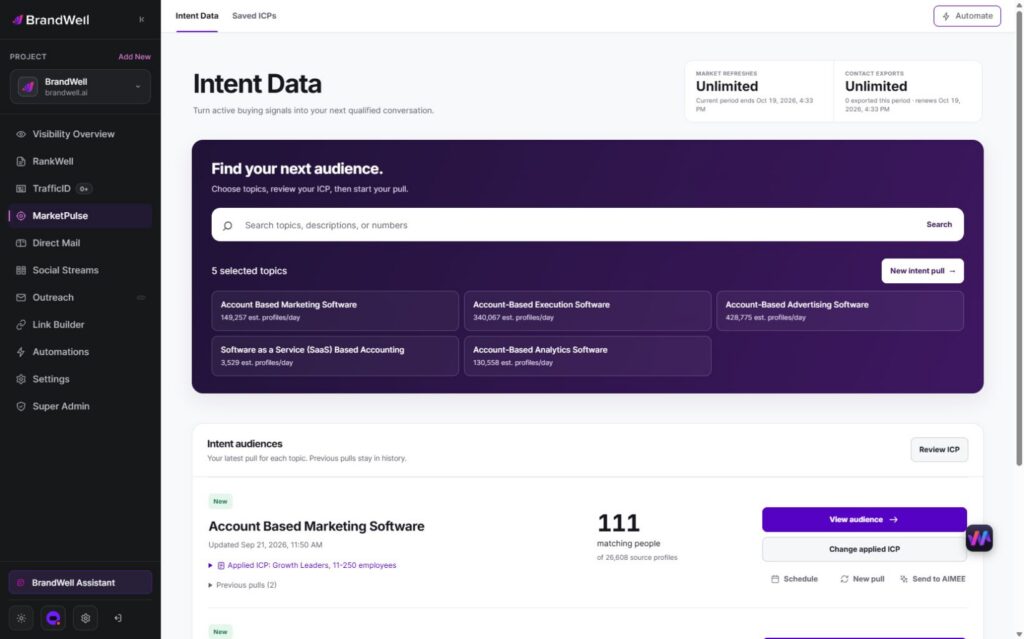
BrandWell MarketPulse: intent data starting at $500/mo. Find people researching topics relevant to what you sell, apply saved ICP filters, and review available contact details before taking action.
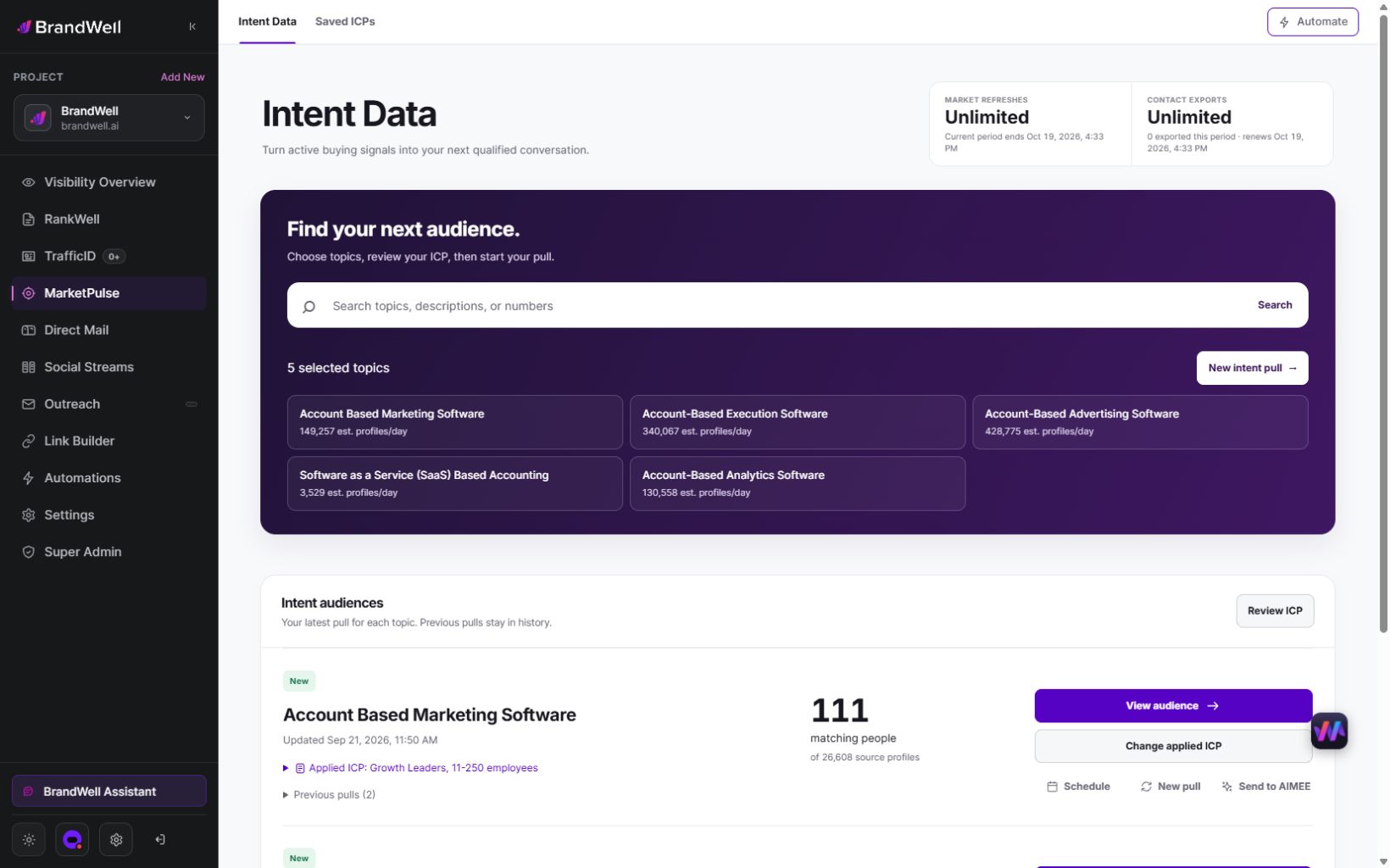
MarketPulse plans are starting at $500/mo. Verify current package scope and offers on the product page.
| Plan | Topics and refreshes | Monthly exports |
|---|---|---|
| Starter | 1 topic, weekly | 25,000 contacts |
| Growth | 3 topics, daily | 100,000 contacts |
| Scale | 10 topics, daily | Unlimited contacts |
Swipe the table to see all columns.
A pull retrieves available data from the previous 24 hours for one topic. Daily use across all included topics provides 90 Growth pulls or 300 Scale pulls in a 30-day month. Weekly Starter pulls vary by calendar month. Available audience size and contact fields vary, and audiences may overlap. Refreshes stop at the plan limit without overage charges.
- Find and qualify: search the topic catalog, save your ICP, and review the people and companies that match.
- Act on the research: export qualified contacts or prepare an Outreach or Direct Mail workflow. Connected products, channel usage, and fulfillment may cost extra.
- Get help from AIMEE: Growth and Scale include AIMEE for the initial user to research accounts and prepare the next step through connected tools.
Agencies and other service businesses can build client deliverables around their available Intent Scans and exports. Keep each client’s scope, permissions, and service fees clear. A subscription is not a promise of a white-label platform or exclusive access to a market.
Explore MarketPulse and watch the demo or compare plans starting at $500/mo. Any early-access discount is a separate, time-limited offer shown to an eligible recipient.
Who is this for?
This guide is for B2B revenue teams, agency owners, VPs of Marketing, RevOps leaders, demand-generation teams, and sales leaders evaluating account-level intent for pipeline and recurring client services. It covers signal classification, company matching, contact escalation, activation, measurement, pricing, and governance. It is not a universal account-scoring formula or a claim that more intent signals guarantee more revenue.
1. Treat account intent as probabilistic prioritization evidence
Account intent should answer a limited question: Which eligible companies deserve more investigation or coordinated attention now? It should not declare that an entire company is ready to buy or that a named employee performed the observed activity.
Build the prioritization model from inspectable components:
- Signal type: first-party site behavior, off-site topic research, review activity, content engagement, or another defined source
- Observation unit: account, domain, location, device, person, or an aggregate
- Account-match confidence: how and how reliably the activity was associated with a company
- Recency and frequency: when the activity occurred and whether it is isolated or sustained
- Fit: industry, size, geography, technology, account status, or another ICP rule
- Corroboration: independent signals that increase confidence without erasing uncertainty
- Downstream evidence: sales acceptance, response, opportunity, pipeline, or revenue state
Use language such as “showing signals consistent with category research” or “prioritized for review.” Reserve “verified buyer” for evidence that genuinely verifies the required claim. A score can make prioritization easier, but it must not hide the source, observation unit, confidence, or exclusions behind a single unexplained number.
2. Build an account-to-action workflow with a separate contact gate
Use this seven-step account-intent activation workflow:
- Classify the signal. Preserve source, topic, observation unit, event time, and collection context.
- Resolve the company. Normalize domain and account identity, attach match method and confidence, and retain unmatched cases.
- Add fit and freshness. Apply current ICP, geography, account status, recency, frequency, and exclusions.
- Corroborate confidence. Look for relevant first-party engagement, multiple topics, CRM history, or other independent evidence.
- Resolve contacts only when needed. Define required personas, validate identity and contactability separately, and apply suppression and rights checks.
- Choose a permitted activation. Route to account research, a CRM queue, sales orchestration, a report, approved outreach, or an eligible advertising workflow.
- Capture outcomes and recalibrate. Record acceptance, rejection, action, response, opportunity state, cost, and rule changes.
RevOps owns schema, account normalization, routing, and feedback fields. Marketing and sales own plays and follow-up. Data operations owns source quality and identity checks. Privacy and security own controls. The client owns approvals and operational adoption. Require human review for ambiguous matches, sensitive uses, new messaging, material spend, and public actions.
Store the raw signal, normalized account, match confidence, contact record, chosen action, and outcome as separate objects or fields. This protects the reasoning chain when a match or score changes.
3. Use a signal taxonomy, confidence ladder, action matrix, and evidence ledger
The most useful resources are not provider dashboards alone. Build a portable operating kit:
- Topic and keyword map with inclusion and exclusion logic
- Signal-source taxonomy and observation-unit dictionary
- Account normalization and match-confidence rubric
- ICP and account-status model
- Recency bands and corroboration ladder
- Contact-resolution decision gate
- Suppression, permission, and retention ledger
- CRM field map and handoff receipt
- Action matrix with required confidence and approval
- Outcome report, cost ledger, and change log
Sources can use different topic definitions, observation units and match rules. Retain your own acceptance tests and outcome fields. A supplier score should not become the sole explanation for an important action.
MarketPulse supplies topic research with available matching people and company information. TrafficID separately reviews eligible own-site visitors. Inspect the actual fields and coverage before designing an account workflow; verify any additional CRM, analytics or routing implementation separately.
4. Combine fit, engagement, intent, and direct evidence
Fit-only targeting finds companies resembling good customers, but it says little about timing. First-party engagement scoring sees behavior on owned properties but misses off-site research and can overweight existing awareness. Broad prospect lists maximize reach but create noise and sales fatigue. Account intent adds timing or category context, yet it can be probabilistic, incomplete, or associated with the wrong account.
Use the approaches as layers rather than substitutes:
- Fit is eligibility: Is this a company the business could plausibly serve?
- Intent is prioritization evidence: Is relevant research or activity associated with the account now?
- Engagement is owned-channel evidence: Is the account interacting directly with the company’s properties or team?
- Direct evidence is confirmation: Did a known stakeholder respond, meet, enter an opportunity, or buy?
Compare any method on coverage, freshness, false-positive and false-negative risk, explanation, cost, operational effort, and actionability. A manual non-intent approach may be better for a tiny, named market where account executives already know every target. Broad lists can support awareness when timing signals are too sparse. Intent is most useful when it changes prioritization and the team has capacity to act.
Do not assume multiple correlated signals are independent proof. Three scores derived from the same source may add less confidence than one truly independent observation.
5. Budget for the entire account-to-outcome system
The total cost of account intent can include topic or category access, account volume, first-party and off-site connectors, account matching, enrichment, contact data, APIs, workflows, CRM integration, eligible advertising integrations, analyst QA, reporting, training, governance, support, and contract minimums. Internal RevOps, sales, compliance, and exception time belong in the model too.
Normalize quotes to an output the buyer owns: cost per QA-accepted account, fit account, successfully routed account, separately resolved usable contact, sales-accepted account, or qualified opportunity. A platform subscription divided by raw signal volume is rarely comparable across providers.
MarketPulse plans are starting at $500/mo. Starter includes 1 topic, weekly refreshes, and 25,000 exportable contacts per month. Growth includes 3 topics, daily refreshes, and 100,000 exportable contacts. Scale includes 10 topics, daily refreshes, and unlimited contact exports. AIMEE for the initial user is included with Growth and Scale. Compare MarketPulse plans and current offers.
Ask for the same scope and record the subscription, minimum, usage unit, add-ons, implementation, renewal, service and exit terms. Unknown prices remain unknown rather than becoming unsupported estimates.
6. Measure signal quality before claiming pipeline impact
Measure the system as a funnel with explicit denominators:
- Accounts observed and matched
- Match acceptance and rejection reasons
- ICP-fit and fresh accounts
- Corroborated or high-priority accounts
- Contacts attempted, resolved, validated, and suppressed
- Records successfully routed
- Sales acceptance and time to first action
- Engagement, responses, meetings, and qualified opportunities
- Pipeline created or influenced, wins, retention, and expansion
- Fully loaded cost and exception effort at each stage
Define a baseline before launch. For a suitable randomized design, compare original assignments and record contamination, crossover and mature outcomes. A similar unprioritized group is not automatically a valid counterfactual; selection may remain. Keep sourced pipeline, associated pipeline, rule-based attribution and estimated incremental impact distinct.
Quality precedes ROI. A sales team that ignores the queue, a routing process that fails, or a policy-ineligible destination can make high signal volume commercially worthless. Track dispositions and rejection reasons so low adoption is not confused with poor source quality.
7. Use account intent where account-level coordination matters
The best fit is a B2B organization with a defined ICP, meaningful deal value, a multi-stakeholder buying process, enough target-account volume, variable timing, CRM discipline, and operational follow-up. It is particularly useful when marketing and sales need a shared reason to prioritize a subset of eligible accounts.
Common uses include account research queues, territory prioritization, event or campaign follow-up, competitor-interest monitoring, website-visitor account identification, content and sales-play selection, and recurring agency reports. Begin at the account level when the decision is about allocating attention; add people only when the next action requires them.
It is weaker for tiny markets already covered manually, purely transactional purchases, consumer use cases, poor company matching, sparse signal coverage, no response capacity, or workflows that require confirmed person-level consent from the start. A company with no clean account model or disposition process should fix those foundations before buying a more complex score.
For agencies, qualify client fit by deal economics, source coverage, CRM state, follow-up owner, compliance maturity, measurement readiness, and willingness to run an acceptance pilot. Do not force the same activation package onto every client.
8. Escalate from account evidence to a person only when the action requires it
Use a confidence ladder:
observed account signal → accepted company match → current ICP fit → fresh and corroborated activity → separately resolved contact → validated contactability → suppression and permitted-use pass → approved activation → downstream response or revenue evidence
Every step answers a different question. The account signal supports where to look. Company matching proposes which organization is associated. Fit determines whether it matters. Contact resolution finds an eligible person for a defined role. Permission and destination checks determine what can be done. Outcomes reveal whether the action produced value.
Stop at an account-level play when a person is unnecessary or weakly supported. An account executive can research the company, tailor content, coordinate existing relationships, or review first-party engagement without claiming to know who performed off-site research. If a contact is resolved, preserve its source, confidence, freshness, persona fit, validation, and suppression state separately.
Never use the resolved contact to retroactively claim that person generated the original company signal. Person-level coverage varies by market, source, and required field and must be tested on a representative sample.
9. Control overclaiming, match error, privacy, and destination policy
The major risks are noisy topics, ambiguous keywords, low-volume or stale signals, wrong company matches, shared networks, score opacity, cross-device assumptions, contact overreach, unclear data rights, excessive retention, weak suppression, cross-client leakage, and policy-ineligible activation.
Review necessary fields, access, retention, correction, deletion, suppression, contracts and incident handling for the actual workflow. Obtain qualified advice on applicable requirements. A generic framework does not establish compliance.
Confirm the actual sender, recipient, geography, channel and use before outreach. Business contact information does not remove notice, opt-out, suppression or other applicable duties.
Google’s data-use policy prohibits third-party data for creating targeting audiences and permits it for segmenting first-party audiences on covered personalized-ad surfaces. Check the actual surface, source and account requirements. Hashing does not change the source of data or establish permission.
10. Package account intent as a recurring decision-and-activation service
An agency package should maintain the operating system: topic and ICP design, signal monitoring, account matching, confidence review, contact-resolution rules, approved plays, CRM or report delivery, client approvals, outcome measurement, recalibration, exception handling, and governance. Price accountable decisions and repeatable delivery – not a claim that every account is a buyer.
Evaluate a relevant MarketPulse topic and defined ICP, then review available matching people and company fields. Keep the activity association, company match and proposed action separate. Measure research usefulness and operator effort before expanding the program.
AIMEE can prepare an account-research or routing brief through configured connected tools. Supply approved inputs, uncertainty labels, ownership and permitted actions. Review the output and verify the actual destination before executing a workflow.
Treat intent, identity, and match signals as probabilistic evidence – not proof of identity, need, authority, consent, or purchase intent. Before deployment, require human, product, pricing, privacy, security, compliance, legal, and platform-policy review of the configured offer and workflow.
The recurring value is a governed loop: observe, qualify, decide, act, learn, and recalibrate. Account intent becomes useful when the team preserves uncertainty, escalates identity deliberately, and connects every signal to an accepted decision and a measurable outcome.
Worked example: keep account and contact counts separate
In a fictional account cohort, 500 candidate accounts enter a review. Reviewers accept 400 company associations, 250 satisfy the current ICP, and 120 pass the approved account-action gate. Match acceptance is 80% of candidate accounts; fit is 62.5% of accepted associations; approved account actions are 24% of the original cohort.
Suppose a separate contact-resolution exercise considers 200 contact records and accepts 160 under its defined quality rule. That 80% contact acceptance rate has a different unit and denominator. Several contacts may belong to one account, and a record can be accepted without permission for a particular channel.
Do not combine these into “280 ready buyers” or infer that the contact generated the original account signal. Each stage needs its own evidence, identity relationship, timestamps, exclusions and allowed action.
If the defined account evaluation costs $2,400, cost per approved account action is $20. State which labor, software and implementation costs are included. It is not cost per acquired customer or proven incremental return.
Review the topic feed before building an account workflow
- Select the MarketPulse topic and apply the ICP.
- Review the available people and company fields and their relevance.
- Preserve uncertainty and duplicate relationships when proposing an account association.
- Use an authorized account ledger or CRM to track the separately approved next action.
- Reconcile accepted, rejected and unresolved records before publishing a client report.
Watch the demo and compare MarketPulse plans. Standard plans are starting at $500/mo. A previous-24-hours Intent Scan is not an account-level purchase confirmation or an implemented CRM integration.
Frequently asked questions
What does account intent data tell me?
It associates research or engagement evidence with an account at the stated resolution and uncertainty. It does not identify a confirmed purchase decision.
Can I infer which employee performed the activity?
Not from an account association alone. A separately resolved contact is not retroactive proof of who generated the signal.
Do several scores provide independent corroboration?
Only if the underlying evidence supports independence. Several scores built from the same source may repeat one observation.
Can I upload every contact to an ad platform?
No. Review the actual destination’s eligibility, data-source, permission and policy requirements before activation.
Reviewed and updated October 3, 2026.

Written by