On this page
- Current MarketPulse research workflow
- Check actual cross-team readiness
- Define decision rights first
- Compare three operating models
- Assign accountable owners
- Choose capabilities for the actual gap
- Count full operating costs
- Measure five distinct layers
- Change roles against actual constraints
- Control cross-team data risks
- Scope a separate agency operating service
- Copyable operating-model review record
- Frequently asked operating-model questions
Intent-led growth for a growth-stage company starts with a bounded test: define fit, evidence, eligibility, owners and follow-up capacity before increasing research volume. Keep signals separate from buyer-confirmed outcomes. Expand only against a written decision rule and measured operating constraints.
Current MarketPulse offer: intent-data plans start at $500/mo. See the product, demo, and current plans. Updated October 3, 2026.
Current MarketPulse research workflow
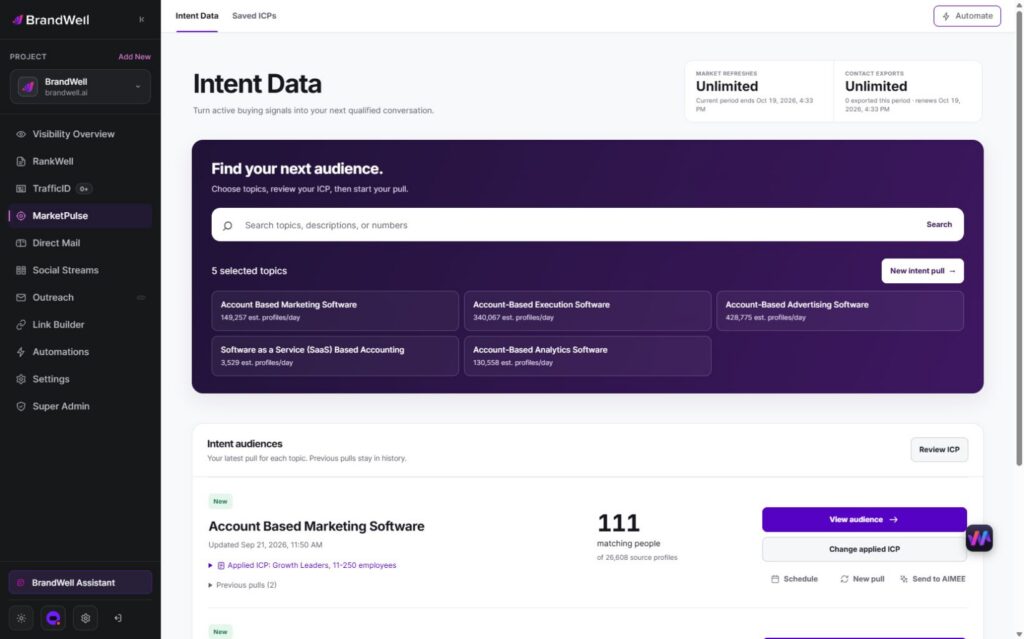
BrandWell MarketPulse: intent data starting at $500/mo. Find people researching topics relevant to what you sell, apply saved ICP filters, and review available contact details before taking action.
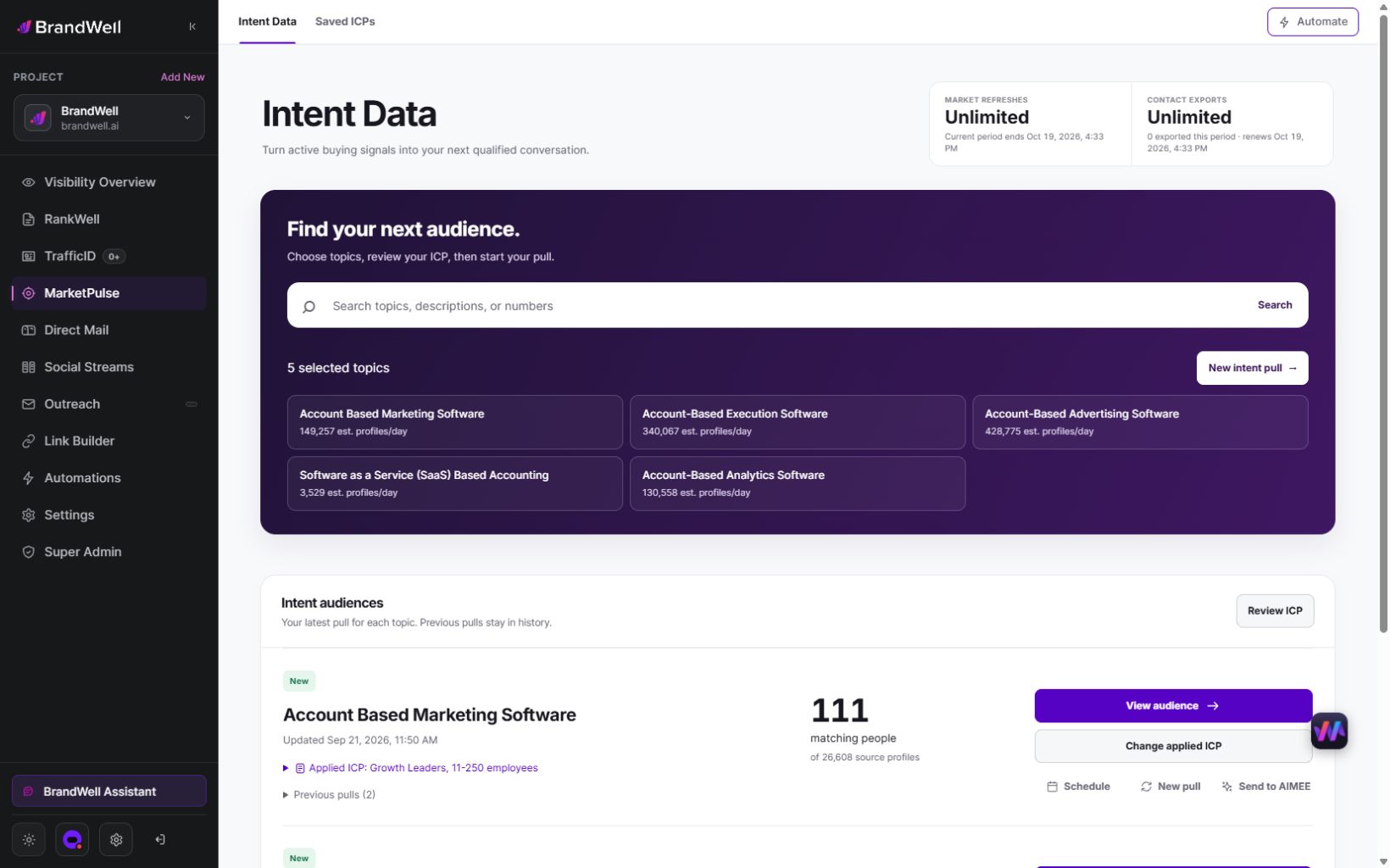
MarketPulse plans are starting at $500/mo. Verify current package scope and offers on the product page.
| Plan | Topics and refreshes | Monthly exports |
|---|---|---|
| Starter | 1 topic, weekly | 25,000 contacts |
| Growth | 3 topics, daily | 100,000 contacts |
| Scale | 10 topics, daily | Unlimited contacts |
Swipe the table to see all columns.
A pull retrieves available data from the previous 24 hours for one topic. Daily use across all included topics provides 90 Growth pulls or 300 Scale pulls in a 30-day month. Weekly Starter pulls vary by calendar month. Available audience size and contact fields vary, and audiences may overlap. Refreshes stop at the plan limit without overage charges.
- Find and qualify: search the topic catalog, save your ICP, and review the people and companies that match.
- Act on the research: export qualified contacts or prepare an Outreach or Direct Mail workflow. Connected products, channel usage, and fulfillment may cost extra.
- Get help from AIMEE: Growth and Scale include AIMEE for the initial user to research accounts and prepare the next step through connected tools.
Agencies and other service businesses can build client deliverables around their available Intent Scans and exports. Keep each client’s scope, permissions, and service fees clear. A subscription is not a promise of a white-label platform or exclusive access to a market.
Explore MarketPulse and watch the demo or compare plans starting at $500/mo. Any early-access discount is a separate, time-limited offer shown to an eligible recipient.
Check actual cross-team readiness
This guide is for B2B revenue teams, agencies, RevOps leaders, demand-generation teams, sales leaders, and data owners deciding who should source, interpret, activate, measure, and retire intent signals. Check whether several teams or clients need the same signal infrastructure but make different market decisions. It is premature when there is no agreed ICP, no downstream owner, no outcome data, or no lawful and policy-compliant activation path.
Define decision rights first
An operating model is not the box where an “intent data manager” sits. It is the set of rules that answers who may make each consequential decision, what evidence that decision requires, and who can stop or reverse it. Start by documenting these decisions:
- Which signal sources and topics may enter the system
- What the observation represents: a person, account, device, page event, or aggregate pattern
- How provenance, freshness, fit, identity confidence, and permitted use are recorded
- Which records may be enriched and which must remain anonymous or account-level
- Who may change scoring rules, exclusions, or thresholds
- Who approves CRM writes, outreach, audience uploads, and campaign spend
- How suppression, deletion, incidents, and vendor changes are handled
- Which downstream outcomes close the feedback loop
Create a signal contract for every use case. It should contain the source, observation unit, topic or event, timestamp, freshness rule, confidence state, fit criteria, permitted action, owner, suppression rule, and intended outcome. Without that contract, a dashboard can make fundamentally different observations look interchangeable.
The first principle is separation of evidence from action. A team may own signal interpretation without being allowed to launch outreach. A data team may maintain the identity layer without deciding which accounts sales should pursue. Automated systems may prepare recommendations, but a named human should approve consequential actions.
Compare three operating models
Microsoft organizational-alignment guidance distinguishes organizational and virtual-team responsibilities. It concerns cloud adoption, not intent-data performance. Use the analogy to document actual roles rather than declare one structure superior.
Centralized operating model
A central RevOps, data, or growth-operations team owns the taxonomy, vendors, identity rules, scoring logic, destinations, QA, and measurement. Business teams request changes and receive approved outputs.
Applicable fit: smaller revenue organizations, regulated contexts, immature teams that need one standard, or companies with many duplicate tools and definitions. Strength: consistency, purchasing leverage, and clear audit ownership. Limitation: the central queue can become a bottleneck, while specialists far from a market may miss local context.
Embedded operating model
Demand generation, regions, product lines, sales groups, or client pods configure and operate their own signal workflows within broad company policies.
Applicable fit: distinct markets with capable operators and rapid experimentation needs. Strength: local context and speed. Limitation: definitions drift, tools multiply, suppression can fragment, and results become difficult to compare. Fully embedded delivery is especially risky for an agency if client data or credentials can cross tenant boundaries.
Hybrid operating model
A central layer owns taxonomy, approved sources, identity and enrichment controls, privacy and security standards, shared infrastructure, suppression, measurement definitions, and change logging. Embedded teams own use-case design, market interpretation, approved activation, and feedback.
Applicable fit: multi-market companies and agencies that need reusable infrastructure with client-specific execution. Strength: shared guardrails without forcing every team into the same playbook. Limitation: the boundary can become ambiguous unless every decision has one accountable owner and a documented escalation route.
Fit-only targeting, engagement-only scoring, and broad lead lists are not operating models. They are input or prioritization approaches. Fit-only targeting is useful when behavioral coverage is weak; engagement scoring is useful for owned interactions with known measurement limits; broad lists can establish a baseline or support market sizing. None answers who governs evidence, activation, exceptions, or outcomes.
Assign accountable owners
For each decision, assign one accountable owner, contributors, the human approver, the evidence required, and the escalation path. A practical matrix covers signal sourcing, topic taxonomy, identity matching, threshold changes, consent and suppression, CRM fields, outreach, audience activation, media spend, measurement, incident response, deletion, and vendor replacement.
A hybrid team topology often includes:
- Executive decision owner: resolves risk, investment, and cross-functional conflicts.
- Central signal owner: maintains sources, taxonomy, provenance, and quality definitions.
- Data or platform owner: manages integrations, access, logging, retention, and reliability.
- Embedded market owner: interprets the account context and proposes actions.
- Sales or media owner: approves and executes outreach or campaign changes.
- Privacy, security, and legal advisers: review purposes, roles, sensitive uses, and controls.
- Measurement owner: connects actions to accepted leads, opportunities, pipeline, and revenue.
- Agency operator: performs only the decisions and processing authorized by the client agreement.
Agency and client labels do not determine legal responsibilities by themselves. Document actual purposes, decisions, means, recipients and processing. Verify applicable jurisdiction and obtain qualified advice for unresolved roles or obligations.
Use an approval ladder. Low-risk analysis can run automatically. Recommendations can enter a review queue. New outreach, audience uploads, spend changes, sensitive-topic use, CRM qualification changes, suppression overrides, and client-facing claims require named human approval.
Choose capabilities for the actual gap
The useful resource stack is a set of capabilities, not a vendor popularity list:
- First-party and external signal capture with provenance
- Account matching and optional identity resolution with confidence states
- Enrichment, validation, deduplication, and suppression
- A governed warehouse, CRM, or client-isolated record system
- Workflow orchestration and an approval queue
- Approved outbound, advertising, reporting, and AI destinations
- Consent, preference, retention, deletion, and incident controls
- Experiment, CRM-outcome, and cost reporting
- A signal contract, decision-rights matrix, service-level definition, exception log, and change record
For each capability, name the owner, input, output, access level, acceptance test, failure mode, and replacement path. An integration is not complete because records move; it is complete when accepted records arrive with their meaning intact, rejected records are explainable, suppression propagates, and outcomes return to the system.
The smallest viable design can be partly manual. A governed sheet, weekly review, and CRM outcome field may be enough to learn. Automate only stable steps. Otherwise automation makes an unclear policy faster and harder to inspect.
Count full operating costs
There is no responsible universal benchmark for the cost of an intent data operating model. Model total cost as:
signal/data + identity and enrichment + integration + internal labor + agency operations + activation or media + privacy/security/legal review + measurement + rework and switching
Separate setup from recurring cost. Setup includes taxonomy, coverage review, role design, field mapping, integration, acceptance testing, training, and controls. Recurring cost includes data and usage, operator time, QA, client or team support, incident handling, reporting, experiments, and recalibration. Track cost per eligible record, accepted account, approved action, reached account, qualified opportunity, and measurable outcome – not cost per raw profile.
Ask every provider or agency for a written scope covering topics, geography, volume, observation unit, match method, freshness, modules, users, clients, destinations, services, term, overages, onboarding, exclusions, exit, and deletion. A low data price can conceal a high operating burden.
Measure five distinct layers
Do not use one blended ROI number. Measure five layers separately:
- Coverage: relevant signal volume, eligible accounts, freshness, and ICP reach.
- Quality: provenance completeness, match acceptance, duplicate rate, suppression accuracy, and rejected-signal reasons.
- Operations: review latency, queue age, service-level attainment, exceptions, and routing success.
- Adoption and action: reviewer use, recommendation-to-approval rate, reached accounts, and seller or media acceptance.
- Outcomes: qualified meetings, accepted opportunities, stage movement, pipeline, revenue, and cost per accepted opportunity.
Every report needs a denominator, time window, baseline, and confidence note. “Twenty opportunities touched intent” does not show whether the workflow caused improvement. Where volume permits, compare a treatment group with a suitable control or holdout. Where it does not, report contribution honestly and avoid causal language.
The feedback loop should preserve negative evidence. Rejected matches, irrelevant topics, sales disqualifications, and suppressed records are how the operating model learns. Report accepted, rejected and unresolved cases; accepted-only results leave selection limits hidden.
Change roles against actual constraints
Test centralized ownership when definitions are unsettled, specialist skills are scarce, risk is high, or only a few workflows exist. Embedded ownership becomes more useful when markets differ materially and local teams can manage data quality, outcomes, and controls. Test hybrid ownership when a shared platform supports multiple capable teams or agency clients.
Transition when evidence – not fashion – shows the current model is failing. Signals include growing queue latency, inconsistent definitions, duplicate spending, poor local adoption, cross-client leakage risk, audit gaps, or inability to connect action with outcome. Reassess roles whenever the company adds a market, source, identity method, activation destination, or agency relationship.
Do not reorganize solely because a tool promises self-service. If the teams cannot define an acceptable match, permitted action, or useful outcome, decentralizing the interface will decentralize confusion.
Control cross-team data risks
Inspect these semantic, operating and governance failures:
- Treating an account signal as proof that a named person performed the research
- Calling a page view or topic spike a purchase decision
- Combining stale and recent evidence without a freshness rule
- Letting every team redefine “high intent” without validation
- Using sensitive topics or inferred attributes for inappropriate targeting
- Failing to propagate preferences, suppression, retention, and deletion
- Allowing one agency client to see another client’s records or configuration
- Automatically changing outreach, audiences, spend, or forecasts without approval
- Reporting matched volume as qualified pipeline
Verify actual source, purpose, recipients, access, retention, correction, suppression, deletion and incident routes. A vendor contract, hashing or consent banner does not certify the whole workflow. Resolve implementation and eligibility before action.
Scope a separate agency operating service
An agency can turn the operating model into recurring revenue by selling design plus managed operations: a signal contract, decision-rights workshop, client-isolated configuration, weekly evidence review, approval queue, quality report, outcome review, and periodic role and threshold recalibration. The service is governance and execution, not a recurring spreadsheet of unexplained “buyers.”
MarketPulse supplies topic research and available match details. AIMEE can organize supplied context through configured tools. An agency operating service, branded weekly report, CRM synchronization or custom client interface needs separately verified implementation, rights, scope and fees. The research subscription does not establish those delivery capabilities.
An agency may separately build client-facing reports or delivery interfaces. Verify actual implementation, rights, client separation, maintenance, support, billing, export and exit terms. A research subscription does not establish a native white-label platform or client entitlements.
AIMEE can prepare a review brief through configured connected tools. Keep proposed actions separate from actual approvals and destination acknowledgements. Confirm the implementation and permissions before execution.
Before operational use, complete product, pricing, privacy, security, compliance, legal, and platform-policy review. A sound operating model makes uncertainty visible, keeps decision rights explicit, and connects every approved action to evidence and outcomes.
Copyable operating-model review record
Decision: [Actual action and consequence.] Accountability: [One owner, contributors, approver and escalation.] Evidence: [Source, unit, period, uncertainty and permitted purpose.] Capacity: [Actual local and shared specialist workloads.] Handoff: [Destination, acceptance, acknowledgement, reconciliation and rollback.] Economics: [Actual shared-cost allocation, labor, exceptions and fee.] Review: [Outcome, unknown cases, stop or repair rule and version.]
Worked example: a named team is not one decision owner
Assume a fictional register has 20 consequential decisions. Eighteen have one accountable owner; two list multiple owners without a tie-break or escalation route. Documented single-owner coverage is 90%, not proof of operational readiness. If either ambiguous decision controls audience upload or suppression, hold that action until accountability and actual approval are resolved. A high average does not remove a critical gap.
Local capacity does not remove a shared bottleneck
Suppose two fictional regions submit eight and four hours of specialist QA work each week to one central reviewer. Combined demand is 12 hours, while that reviewer has ten. The gap is two hours even if local teams have spare clerical time. Check the actual skill, permissions and destination constraint before changing roles or expanding volume. A centralized, embedded or hybrid label alone does not determine throughput.
If regional reports include 500 and 400 account records with 150 shared records in the same period, their union is 750, not 900. Preserve both regional memberships and the unique-account rule. A duplicated account in two reports does not create two new buyers or justify duplicate contact.
Allocate shared costs once
A fictional agency allocates the standard $1,000 Scale subscription evenly across four approved client services, or $250 each. For one service, $500 in review, $200 in QA and $100 in client work bring defined cost to $1,050. A separate fictional $1,500 agency fee leaves $450, or 30%, before setup, acquisition, general overhead, tax and financing. Another $500 in corrections makes the remainder negative $50. The allocation does not establish separate client accounts, seats or platform entitlements. These invented service inputs are not BrandWell agency-service fees or typical margins.
Use the supported research input
Review an available MarketPulse topic, saved ICP and actual preceding-24-hour matches for the approved purpose. Keep client scopes and uncertain company context distinct. TrafficID is separately scoped own-site visitor work. AIMEE can organize supplied context through configured tools. Owners approve exports, messages, Outreach enrollment, audience uploads and CRM writes. Custom reports, client interfaces and synchronization require separately verified implementation, rights, scope and fees.
Frequently asked operating-model questions
Does naming a team assign one accountable decision owner?
No. Record the actual owner, approver and escalation route.
Does local spare time solve specialist overload?
No. Verify the actual skill and shared constraint.
Can regional account counts be added without overlap checks?
No. Preserve memberships and unique-account counts separately.
Does shared subscription allocation create client entitlements?
No. Verify actual access, rights and scope separately.
Review the research product: explore MarketPulse and current plans.
Reviewed and updated October 3, 2026.

Written by