On this page
- MarketPulse supplies the topic research
- Who is this for?
- 1. Define the event before assigning intent
- 2. Score signal strength with six qualitative factors
- 3. Choose the next action with a proportional ladder
- 4. Compare pattern-based, isolated, and manual approaches
- 5. Choose tools and preserve evidence
- 6. Model the full cost of content-signal operations
- 7. Measure signals and business outcomes
- 8. Find good fits and false positives
- 9. Turn interpretation into a service
- Worked example: research is not a sales result
- Content-signal questions
- Start with relevant topic research
Content-consumption intent signals are evidence of research activity, not proof that someone is buying. Interpret specificity, recency, repetition, sequence, fit and match confidence together. Use the pattern to choose a useful next action and preserve what remains unknown.
This guide provides a proposed six-factor rubric, an action ladder, operational templates and a worked example. The rubric is a decision aid to test against your own outcomes, not a certified score or universal conversion benchmark.
MarketPulse supplies the topic research
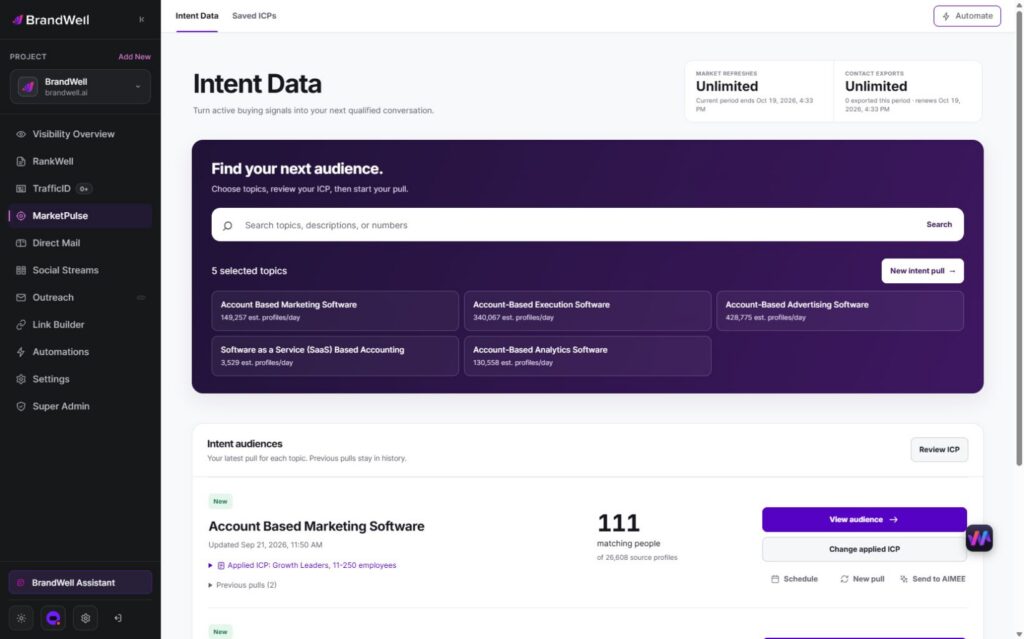
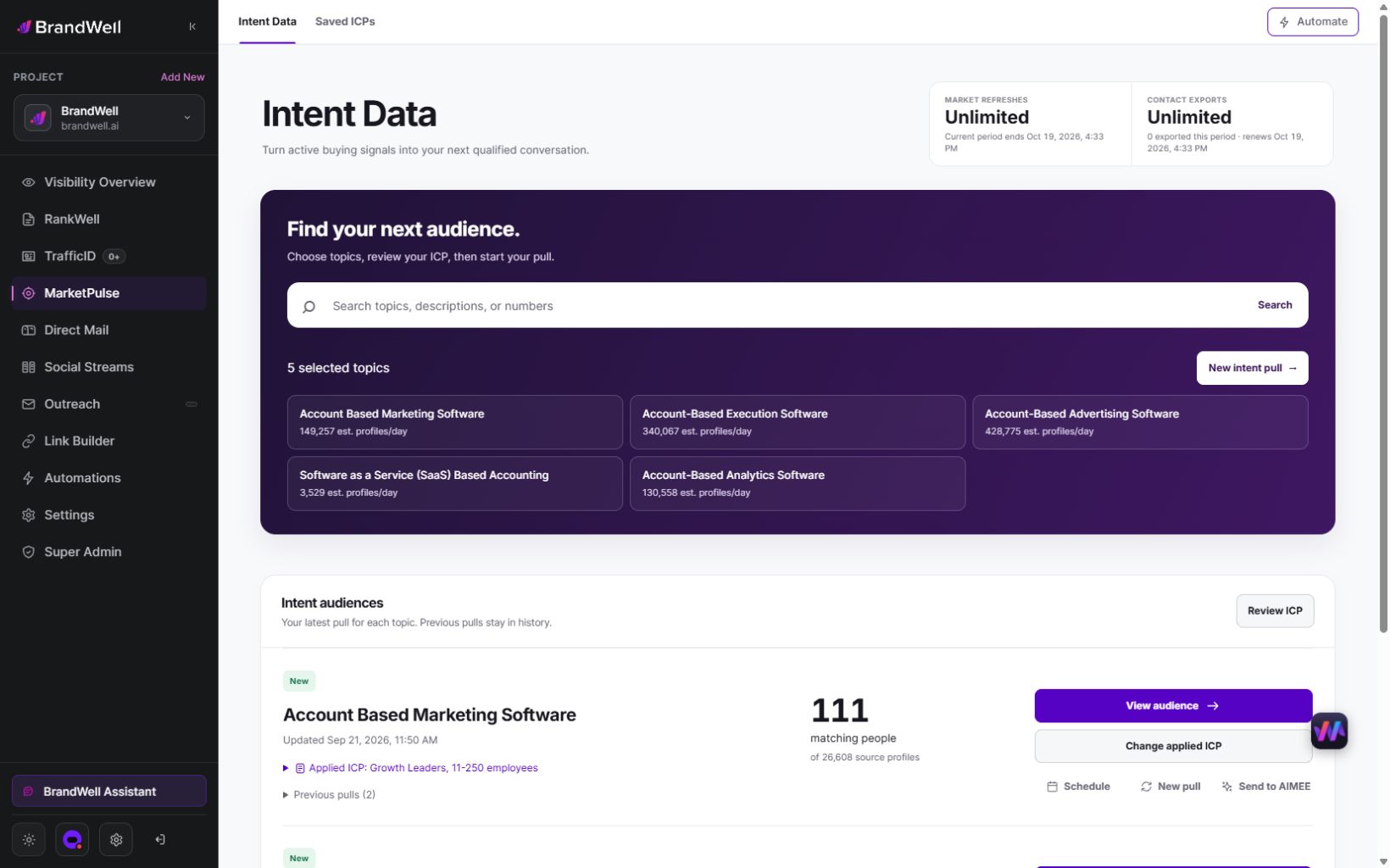
MarketPulse helps you review people researching relevant topics with saved ICP filters and available contact details. Keep the source and entity level attached to the record. A topic match is not a confirmed project, buying role or permission to contact someone.
Standard monthly plans are Starter includes one weekly topic and 25,000 contact exports, Growth includes three daily topics and 100,000 exports, and Scale includes ten daily topics and unlimited exports. Daily use gives 90 or 300 pulls in a 30-day month. Fields, audience size and overlap vary. Review current plan scope; any eligible early-access offer is separate.
Who is this for?
This guide is for B2B marketing, growth, content, communications, and agency teams trying to connect content behavior with durable discovery, trust, demand, and qualified pipeline across search, AI, community, and owned channels. It fits organizations with meaningful consideration cycles, useful content, enough interactions to observe patterns, and a downstream outcome system. It is premature when instrumentation is unreliable, the account universe is undefined, content is too sparse, or the team wants to expose inferred behavior in outreach.
1. Define the event before assigning intent
Google’s GA4 event documentation distinguishes automatically collected, enhanced-measurement, recommended and custom events. Check the setup and parameters for the event you use, then test it in Realtime or DebugView. An event records an interaction, not its motivation, buying authority or project.
Separate content-consumption evidence into clear classes:
- Owned-site events: page views, engaged sessions, scrolls, downloads, video actions, and return visits
- Known-contact engagement: email clicks, webinar attendance, resource use, or form responses with applicable notice and preferences
- Account-level activity: activity associated with a company or domain, with a documented match basis
- External research signals: topic, category, competitor, review, or publisher consumption from another source
- Aggregate discovery: search demand, community discussion, AI referrals, or content trends without a justified person-level join
For each event, store source, observation unit, timestamp, content asset, topic, format, match method, confidence, permitted use, and retention rule. Preserve raw evidence rather than collapsing every interaction into “high intent.”
Content discovery can create value without identity resolution. Aggregate patterns can guide new articles, comparison assets, distribution, and sales enablement. That is often a better response than attempting to name every reader.
2. Score signal strength with six qualitative factors
Use a six-factor rubric as an editorial decision aid, not a universal benchmark. Calibrate it with your own accepted, rejected, and downstream outcomes.
1. Specificity
Problem, implementation, comparison, integration, security, pricing, or procurement content usually carries more decision context than a broad awareness article. Limitation: specificity can indicate deep research for a non-buying purpose.
2. Recency
Recent activity is generally more actionable than an old event, but the useful window depends on the buying cycle and content type. Limitation: a fresh event can still be accidental or irrelevant.
3. Repetition
Repeated relevant activity is more informative than a single interaction, especially when it spans distinct sessions or stakeholders. Limitation: automated traffic, employees, partners, or repeated troubleshooting can inflate frequency.
4. Sequence and depth
A progression from education to implementation and commercial content can suggest developing interest. Treat this as a hypothesis to test with your own outcomes, not a universal B2B buying threshold. People do not follow one linear journey.
5. Fit
An in-market pattern matters more when the account, role, geography, need, and economics fit the offer. Limitation: fit models can encode stale data or exclusion bias and should not manufacture behavior that was never observed.
6. Match confidence
Known first-party consented interaction, account inference, person resolution, and aggregate activity have different confidence and permitted actions. Limitation: identity resolution can be wrong, and account evidence does not prove which person acted.
Record each factor separately. Do not hide uncertainty inside one vendor score. A useful content-consumption intent model can say “recent, repeated implementation research from a strong-fit account; person unknown” rather than “92 intent.”
3. Choose the next action with a proportional ladder
Move from low-intrusion analysis to higher-consequence activation only as evidence quality, eligibility, and human judgment improve.
Level 1: Aggregate content planning
Use topic patterns to improve content, search coverage, AI-answer usefulness, community resources, sales collateral, and editorial priorities. This needs no person-level action. Minimum evidence: repeated aggregate demand or gaps across sources. Limitation: aggregate demand does not identify accounts or guarantee revenue.
Level 2: Owned nurture or eligible remarketing
Use first-party behavior and current preferences to tailor an owned experience or construct an audience through an eligible platform route. Minimum evidence: permitted first-party relationship, sufficient volume, clear inclusion and exclusion rules, and consent or lawful basis as applicable. Limitation: audience membership is not proof of purchase intent, and destination policies may restrict use.
Level 3: Account prioritization
Raise an account for research when specific, recent, repeated signals align with ICP fit and acceptable match confidence. Give sales the source, context, and limitations. Minimum evidence: account-level pattern plus fit and freshness. Limitation: prioritization should not automatically change opportunity stage or forecast.
Level 4: Human-reviewed follow-up
Prepare a relevant, non-creepy next step based on the buyer’s business context rather than disclosing hidden tracking. Minimum evidence: eligible contact route, sufficient confidence, suppression check, approved message, and named human. Limitation: even strong evidence can be wrong; the recipient’s response and preferences control what happens next.
Automatic public posting, spend changes, outreach sends, or CRM qualification updates do not belong on this ladder without a human approval gate.
4. Compare pattern-based, isolated, and manual approaches
Evaluate each approach on evidence depth, speed, cost, identity risk, interpretability, activation eligibility, and measurement.
Cross-format pattern analysis combines relevant evidence across owned content and approved external sources. It is best for higher-consideration buying journeys and recurring optimization. Limitation: joins, identity, governance, and feedback add complexity, and correlation can be mistaken for causation.
Isolated campaign or last-touch reporting is simple and useful for channel operations, creative diagnostics, and short feedback loops. Limitation: clicks and last-touch leads omit earlier learning and can reward easily measured interactions rather than qualified demand.
Manual or non-intent research works for small account lists, strategic accounts, interviews, and early taxonomy design. Limitation: it is slow, inconsistent, and difficult to refresh at scale.
The best design often combines them: manual research defines categories and exceptions; event data observes owned behavior; approved external signals add context; humans review consequential actions; outcome labels recalibrate the model.
5. Choose tools and preserve evidence
Choose capabilities rather than expecting one platform to solve every job:
- Content taxonomy and asset metadata
- First-party analytics and event QA
- Optional external topic or content-research signal
- Account matching and identity confidence
- CRM, warehouse, or CDP with source-level evidence
- Consent, preference, suppression, retention, and deletion controls
- Review queue and approved activation destinations
- Experiment, CRM-outcome, and cost reporting
Useful templates include an event dictionary, content-topic map, signal-evidence card, six-factor review rubric, action ladder, sensitive-context exclusion list, suppression test, and outcome-disposition form. For each tool, state its input, observation unit, output, access, refresh, cost component, and failure mode.
Avoid merging anonymous device events, account activity, and resolved people into one row without preserving the original unit. A tool may identify a likely company while another provides a contact; that does not prove the contact consumed the content.
6. Model the full cost of content-signal operations
Total cost includes instrumentation, taxonomy work, external signals, identity and enrichment, storage, integration, operator review, content production, activation or media, privacy and security controls, measurement, and rework. Split setup from recurring operations.
Setup covers event and topic design, access, field mapping, QA, baseline creation, suppression, and training. Recurring cost covers data and usage, analyst review, content updates, audience or sales operations, reporting, exceptions, and recalibration.
Track unit economics by the stages that matter: cost per captured event, eligible pattern, matched account, accepted pattern, approved action, reached account, qualified opportunity, and useful learning. Optimizing cost per raw event rewards volume rather than usefulness.
Ask for a written scope that defines content sources, topics, units, match basis, coverage, refresh, destinations, services, term, overages, retention, deletion, and export. There is no defensible universal price or ROI benchmark for every content-consumption workflow.
7. Measure signals and business outcomes
Use an evidence chain:
- Instrumentation: event validity, taxonomy coverage, bot or internal-traffic filtering, and missing-data rate
- Signal quality: specificity, freshness, repetition, sequence, fit, match acceptance, and rejection reasons
- Eligibility: consent or lawful basis as applicable, suppression, sensitive exclusions, and destination-policy acceptance
- Activation: reviewed-to-approved rate, reach, latency, delivery, and rollback errors
- Business outcomes: sales acceptance, qualified meetings, accepted opportunities, pipeline, revenue, and cost per accepted opportunity
Measure content’s durable contribution as well: repeat discovery, branded searches, returning accounts, assisted conversions, sales use, citations or referrals you can observe, and content gaps resolved. Do not promise control over search rankings, AI citations, or third-party community distribution.
Use a baseline, cohort, holdout, or controlled experiment where feasible. Avoid evaluating only records the model selected; that selection bias can make the score look more predictive than it is. Keep “influenced,” “sourced,” and “incremental” outcomes distinct.
8. Find good fits and false positives
Content-consumption intent works best for B2B offers with longer consideration, educational or technical research, enough account coverage, and teams able to provide useful next steps. It is useful for content planning, account research, nurture, eligible audiences, and human prioritization. It is less useful for tiny markets, impulse decisions, weak instrumentation, or products whose research occurs mainly offline.
Common false positives include employees, agencies, partners, competitors, students, job seekers, support users, automated traffic, repeat visits caused by confusion, and broad educational research. Sensitive health, financial, employment, political, or other high-risk contexts need additional exclusions and legal review.
Do not assume public or purchasable data can be used for any purpose. Respect preferences, suppressions, retention limits, deletion, and access. A named human should approve outreach, audience activation, spend, CRM changes, and client-facing conclusions.
9. Turn interpretation into a service
An agency can deliver taxonomy maintenance, signal review, client-specific evidence reports, a reviewed action queue, content recommendations and CRM outcome feedback. Define owners, permissions, access, retention and offboarding in the service scope. Keep client records separate and confirm the selected product allowances before promising a deliverable.
MarketPulse supplies relevant topic research. TrafficID concerns eligible visitors to your own website. Neither proves that an added stakeholder consumed a particular article. RankWell can support content production and publishing; editors still check evidence, audience fit and sources. AIMEE can help prepare account research and next steps through connected tools. Do not promise desktop execution, white-label functionality or a native scoring integration without verified scope.
Worked example: research is not a sales result
Fictional example, not a BrandWell benchmark: A team reviews 100 content patterns. It accepts 30 for account research and approves 12 useful follow-ups after eligibility checks. That is a 30% acceptance rate and a 40% approval rate among accepted patterns, or 12% of all reviewed patterns. The 12 actions are not 12 opportunities or sales.
If the illustrative monthly cost is $500 for data plus ten analyst hours at $60, the $1,100 total equals $36.67 per accepted pattern and $91.67 per approved action. Include content, channel and integration costs if incurred. These figures are not customer acquisition cost. Compare later CRM outcomes using the same definitions and reporting window.
Content-signal questions
Does a download show buying intent?
It shows the tracked download occurred. Check the asset, event setup, account fit and subsequent evidence before deciding what it means. Educational research or support needs can explain the same action.
Can I identify the person behind account activity?
Account-level evidence alone cannot establish which individual acted. Keep the original observation unit and matching method. An enriched contact is not automatically the observed reader.
Which signal should I act on first?
Start with recent, specific and repeated evidence from a fitting account, then check match confidence and the permitted contact route. Use low-confidence or anonymous patterns for content planning rather than unsupported personal claims.
How do I use this in BrandWell?
Search relevant MarketPulse topics, apply saved ICP filters and review available audience details. Preserve source context in your working brief. Compare those observations with your separately collected website or CRM evidence before preparing an Outreach or Direct Mail workflow. Connected products, channel usage and fulfillment may cost extra.
Start with relevant topic research
Explore MarketPulse and watch the demo, then compare standard plans starting at $500/mo. Choose topic coverage and export allowances that fit your workflow. More records do not remove the need for interpretation and review.
Reviewed and updated October 3, 2026.

Written by