On this page
- Current MarketPulse research workflow
- Check actual audience and owner readiness
- Calculate four feasibility counts
- Test seven expansion options
- Assign workflow owners
- Choose tools for the actual gap
- Compare four audience approaches
- Count full test costs
- Separate delivery and qualified outcomes
- Check fit and potential failures
- Scope a separate agency service
- Prepare a review-only agent brief
- Audience handoff checklist
- Copyable small-audience test record
- Frequently asked small-audience questions
Intent-led growth for a growth-stage company starts with a bounded test: define fit, evidence, eligibility, owners and follow-up capacity before increasing research volume. Keep signals separate from buyer-confirmed outcomes. Expand only against a written decision rule and measured operating constraints.
Current MarketPulse offer: intent-data plans start at $500/mo. See the product, demo, and current plans. Updated October 3, 2026.
Current MarketPulse research workflow
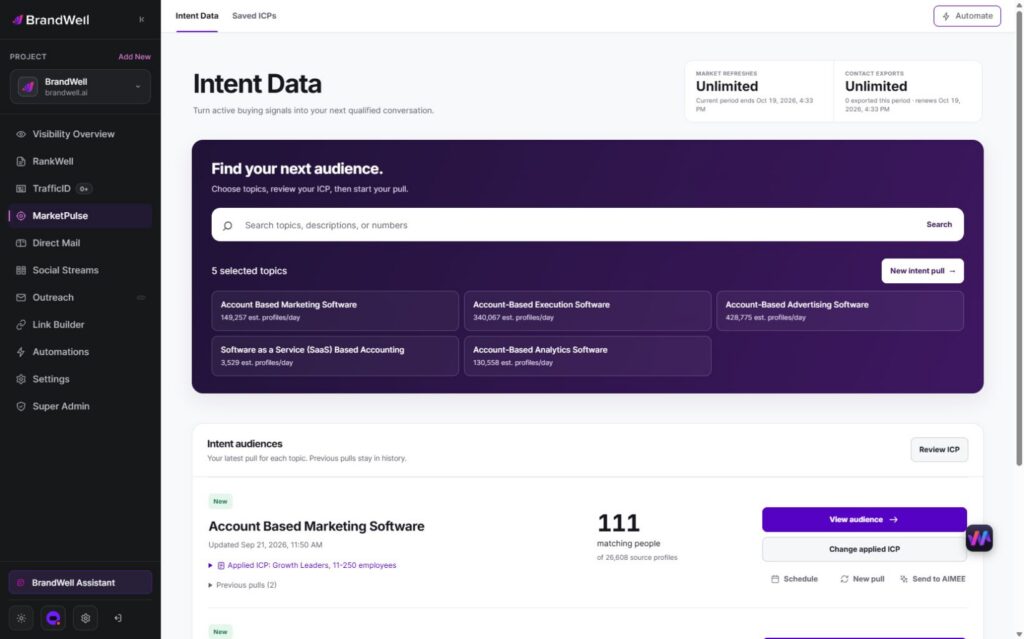
BrandWell MarketPulse: intent data starting at $500/mo. Find people researching topics relevant to what you sell, apply saved ICP filters, and review available contact details before taking action.
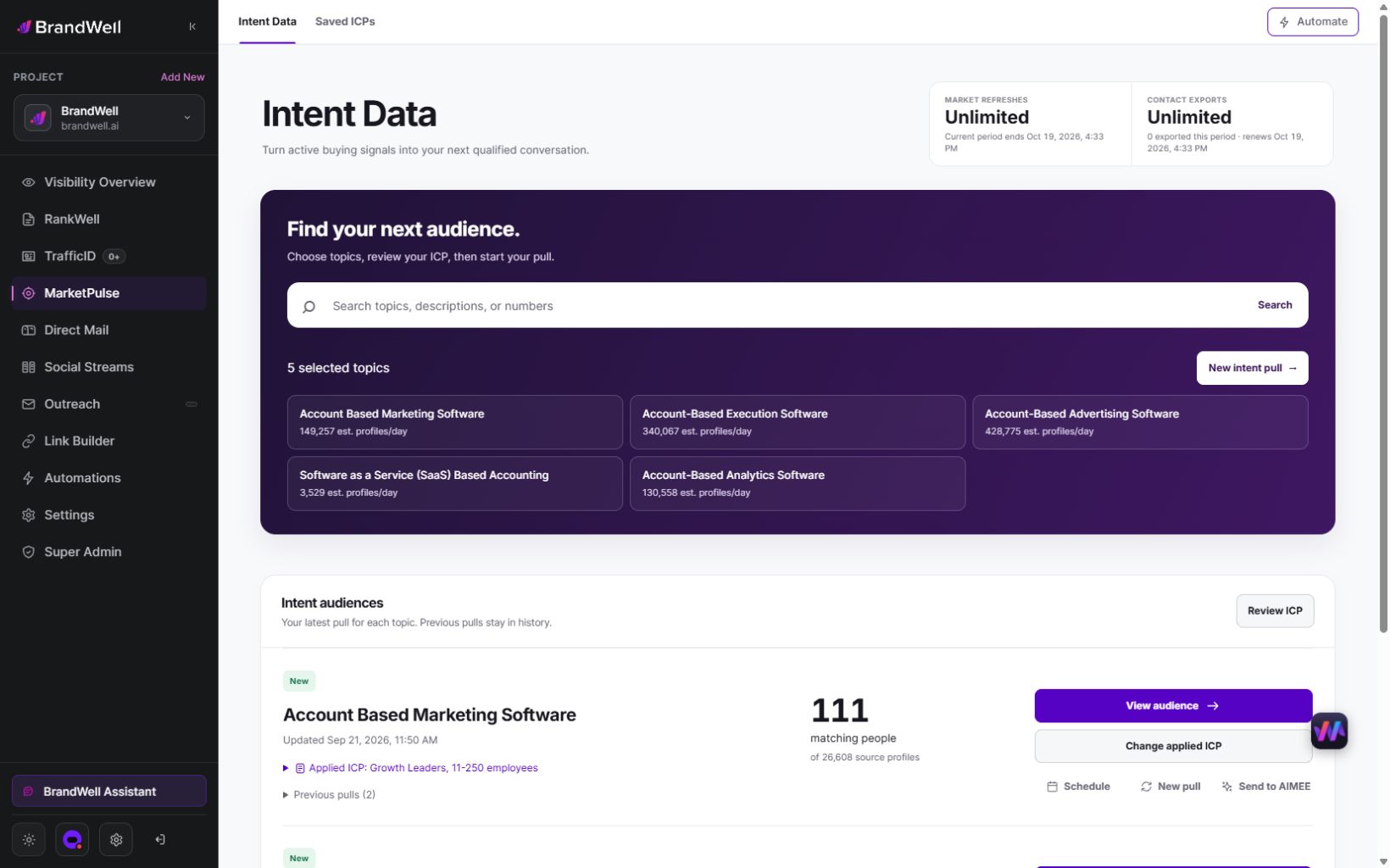
MarketPulse plans are starting at $500/mo. Verify current package scope and offers on the product page.
| Plan | Topics and refreshes | Monthly exports |
|---|---|---|
| Starter | 1 topic, weekly | 25,000 contacts |
| Growth | 3 topics, daily | 100,000 contacts |
| Scale | 10 topics, daily | Unlimited contacts |
Swipe the table to see all columns.
A pull retrieves available data from the previous 24 hours for one topic. Daily use across all included topics provides 90 Growth pulls or 300 Scale pulls in a 30-day month. Weekly Starter pulls vary by calendar month. Available audience size and contact fields vary, and audiences may overlap. Refreshes stop at the plan limit without overage charges.
- Find and qualify: search the topic catalog, save your ICP, and review the people and companies that match.
- Act on the research: export qualified contacts or prepare an Outreach or Direct Mail workflow. Connected products, channel usage, and fulfillment may cost extra.
- Get help from AIMEE: Growth and Scale include AIMEE for the initial user to research accounts and prepare the next step through connected tools.
Agencies and other service businesses can build client deliverables around their available Intent Scans and exports. Keep each client’s scope, permissions, and service fees clear. A subscription is not a promise of a white-label platform or exclusive access to a market.
Explore MarketPulse and watch the demo or compare plans starting at $500/mo. Any early-access discount is a separate, time-limited offer shown to an eligible recipient.
Check actual audience and owner readiness
This guide is for LinkedIn Ads managers, ABM leaders, demand generation directors, RevOps teams, and B2B agency owners working with small, high-intent account or contact lists. It is specifically about the decision to aggregate, expand, sequence, suppress, or avoid a small LinkedIn intent audience. It is not a generic guide to Matched Audiences, bid caps, broad prospecting, or coordinating ads with sales outreach.
The important boundary is simple: intent data is a prioritization input. It is not proof that a person consented to outreach, belongs to a buying committee, or will buy. LinkedIn match rules, audience privacy minimums, inventory, creative, budget, and measurement determine whether a prioritized list can become a viable campaign.
Calculate four feasibility counts
Before choosing an expansion strategy, calculate four different counts:
- Eligible source records: accounts or contacts that satisfy the intended topic, freshness, geography, fit, and suppression rules.
- Uploadable records: eligible records with the fields and permissions required for the selected audience method.
- Matched members: records LinkedIn can associate with member accounts after processing.
- Deliverable members: matched members remaining after required location targeting, exclusions, and any additional facets.
LinkedIn troubleshooting guidance sets a 300-member launch minimum; required location targeting can reduce the audience. This is a platform floor, not a performance benchmark. Verify the actual audience status and restrictions before launch.
Use a traffic-light gate:
- Red: the deliverable audience is below the platform minimum, match quality is unknown, or the team cannot measure downstream outcomes. Do not launch.
- Amber: the audience clears the minimum but forecast reach is thin, concentration is high, or the sales cycle makes outcome measurement slow. Run a capped feasibility test with explicit stop rules.
- Green: the audience clears the minimum with room for exclusions, multiple creative exposures, and a credible comparison. Launch the core and one expansion cell.
Do not combine unrelated topics merely to turn red into green. An audience large enough to serve but too heterogeneous to support a relevant message has not been “scaled”; it has been diluted.
Test seven expansion options
1. Repair matchability before changing the ICP
Normalize company names, domains, country fields, and contact identifiers. Remove duplicates, employees, customers, partners, and known bad records. For company targeting, LinkedIn recommends providing the company’s LinkedIn Page URL to improve the chance of a match. Separate unmatched records and correct them rather than repeatedly uploading the same dirty file.
Test this correction against the actual matching gap. If a list loses most of its volume during matching, broader topics will hide the underlying identity problem instead of fixing it.
2. Combine compatible intent slices
Union segments only when they share the same buyer decision, offer, funnel stage, and measurement plan. Examples include adjacent product topics that lead to the same solution, or several recent research windows that still represent a plausible active evaluation. Keep the original topic and time-window labels in the CRM so results can be broken back out.
Avoid merging early research with late-stage comparison behavior into one message. Those signals can share a campaign group while retaining separate ad sets and creative.
3. Expand the buying committee
Start with the roles directly responsible for the problem, then add credible influencers, technical evaluators, finance, procurement, and executive sponsors. Test whether the additional roles are relevant to the actual account decision.
Create a role map before activation: role, likely question, proof needed, exclusion, and next action. If the ad promises the same thing to every role, the committee expansion is only nominal.
4. Widen freshness carefully
If the original signal window is too narrow, test one older band separately. Never overwrite the event time. Compare fresh and aging cohorts on match rate, reach, engagement, accepted leads, opportunity creation, and unsubscribe or complaint signals. A decaying signal may still be useful for awareness but inappropriate for urgent sales routing.
5. Test a predictive audience as a separate hypothesis
LinkedIn predictive-audience requirements distinguish 300–300,000 company/contact list rows from more than 300 member accounts for conversion, form or retargeting sources. Predictive audiences extend beyond the source; Audience Expansion is disabled for them. Verify actual source type and status.
A predictive audience is not “more intent.” It is a modeled similarity audience derived from a seed. Exclude the seed from the predictive test if the goal is to measure net-new reach, and compare the predictive cell with both the original intent core and a non-intent baseline.
6. Use Audience Expansion only for an explicit upper-funnel test
LinkedIn Audience Expansion guidance describes similar-attribute reach. Expansion can be enabled by default where available, and reporting combines target and expanded activity. Inspect the actual setting; keep an unexpanded comparator and evaluate additional audience fit.
7. Sequence channels instead of forcing LinkedIn volume
Sometimes the right answer is not a larger LinkedIn audience. Keep the high-intent group small and use it for account intelligence, salesperson prioritization, tailored content, direct mail, search, or another permitted channel. LinkedIn can provide air cover while the primary action happens elsewhere. The decision should follow evidence and channel policy, not a need to spend the entire budget.
Assign workflow owners
A reliable activation workflow needs named owners and versioned data:
- Intent operations defines topics, thresholds, freshness, and source fields.
- RevOps or data operations resolves accounts, enriches permitted fields, applies suppression, and records confidence.
- Paid media selects the upload method, creates core and expansion cells, documents exclusions, and checks audience status.
- Creative and content map message and proof to the signal and buying role.
- Sales operations defines acceptance, routing, action latency, and CRM outcomes.
- Analytics freezes metrics, comparison design, attribution windows, and reporting rules.
- Privacy, security, legal, and platform-policy reviewers approve data use, notices, contracts, access, retention, and consequential automations.
The handoff record should contain the source segment ID, intent topic, signal time, fit rule, identity method, confidence, suppression status, LinkedIn audience ID, ad-set ID, creative version, action taken, and downstream outcome. Without that lineage, a scale small LinkedIn intent audiences framework becomes a collection of disconnected dashboard counts.
Choose tools for the actual gap
Choose tools that preserve the actual decision, source and handoff. Use this practical stack:
- Intent and identity source: topic-level research signals, website activity, account fit, and permitted contact enrichment.
- Identity QA worksheet: source record, normalized company, domain, LinkedIn Page URL, contact identifier, confidence, match status, and correction reason.
- Audience registry: source definition, membership rule, refresh cadence, exclusions, platform status, expected use, and owner.
- Experiment register: core and expansion hypotheses, frozen metrics, allocation, budget, stop rule, and decision date.
- CRM or warehouse: accepted-lead, account, opportunity, revenue, and suppression outcomes joined to the audience version.
- Creative matrix: topic, role, stage, promise, proof, CTA, and prohibited claims.
LinkedIn Matched Audiences API guidance restricts access to approved developers and contractual data requirements. Verify actual authorization, supported version and destination behavior; a research subscription does not supply that access.
Compare four audience approaches
Test an intent-led core when the audience represents a clear problem, the signal is fresh enough to influence action, the account fit is known, and the economics support a narrow campaign. Consider manual named-account selection when sales has strong account knowledge but too little observable intent. Broad professional targeting is useful for category creation and learning when the market is larger than the observed signal pool. Website retargeting is appropriate when first-party engagement is the primary qualification event.
Do not call one approach universally superior. A strong campaign often uses all four as distinct cells: intent core, seller-selected accounts, broad ICP, and first-party retargeting. The comparison works only when creative, geography, objective, and conversion definitions are sufficiently aligned.
Count full test costs
Total cost includes intent data, identity resolution and enrichment, audience preparation, LinkedIn media, creative production, landing pages, CRM and warehouse work, analyst time, client service, privacy and security review, and sales follow-up capacity. Keep working media separate from platform and service fees. For a small audience, the binding constraint may be reachable members rather than money, so increasing spend can raise frequency without creating qualified reach.
Set budgets from a feasible impression and frequency range, not from an arbitrary monthly minimum. Use a capped core cell, reserve a smaller amount for one expansion cell, and retain enough budget for the comparison. Stop if delivery stays negligible, frequency climbs without downstream response, match quality deteriorates, or the expansion consumes spend without preserving fit.
Separate delivery and qualified outcomes
Delivery metrics answer whether the audience can run: matched members, deliverable audience, reach, frequency, impressions, spend, CPM, clicks, and conversions. Quality metrics answer whether it should run: ICP-fit rate, buying-role coverage, accepted leads, engaged accounts, qualified meetings, accepted opportunities, pipeline, wins, gross profit, and negative feedback.
LinkedIn conversion metrics include click/view attribution and potentially modeled conversions. ROAS divides recorded conversion value by ad spend. Preserve actual event values and windows; attribution alone does not prove incremental revenue or profit.
Where scale permits, hold out eligible accounts before upload or phase activation across comparable groups. When a randomized holdout is underpowered, report descriptive outcomes with denominators and uncertainty. Never turn an influenced-pipeline total into a causal claim.
Check fit and potential failures
Small-audience LinkedIn intent campaigns fit high-value B2B offers, concentrated account lists, known buying committees, meaningful sales capacity, and messages that can reflect a specific research problem. They are a poor fit when the contract value cannot support the data and media cost, the list is mostly unmatched, the team lacks a compliant use, or outcomes will not be recorded.
Common mistakes include treating the upload count as the reachable audience, stacking filters below the privacy floor, mixing incompatible signals, changing several variables at once, allowing expansion into the core cell, overfunding a tiny audience, ignoring frequency, evaluating on clicks alone, and failing to remove customers or opted-out records.
Verify actual member choices, geography, purpose, source, required permissions, access, retention and suppression before activation. A research match is not verified personal intent or permission to upload a record. Resolve uncertain requirements with qualified advice.
Scope a separate agency service
An agency can sell a managed small-audience LinkedIn intent service as a repeatable monthly operating loop: signal review, audience QA, one controlled expansion, creative refresh, activation, pipeline reconciliation, and a decision memo. Price the client service around operating work and evidence quality, not a guaranteed number of leads.
Before use, require product, pricing, privacy, security, compliance, legal, and platform-policy review.
MarketPulse supplies topic research and available match details. An agency audience operating service, custom client report or integration requires separately verified implementation, rights, scope and fees. Do not promise topic exclusivity or territory protection from the research subscription.
Prepare a review-only agent brief
AIMEE can prepare a review brief through configured connected tools. Keep proposed actions separate from actual approvals and destination acknowledgements. Confirm the implementation and permissions before execution.
A useful prompt is: “Given this approved audience schema and campaign goal, calculate each feasibility count, identify the first failing gate, propose no more than three single-variable expansions, map each to a separate ad set and measurement rule, and return an approval checklist. Treat intent and identity as probabilistic. Do not upload data, change spend, contact anyone, or claim causality.”
Audience handoff checklist
- Define the buyer decision, topic, freshness, fit, and exclusions.
- Calculate eligible, uploadable, matched, and deliverable counts separately.
- Correct identity and company matching before broadening the audience.
- Preserve an unexpanded intent core.
- Test only one expansion dimension per cell.
- Keep predictive and Audience Expansion cells distinct from direct intent.
- Freeze creative, budgets, metrics, attribution windows, and stop rules.
- Join ad outcomes to accepted leads, opportunities, revenue, and negative signals.
- Show denominators, confidence limits, and known contamination.
- Require human approval for data use, uploads, spending, outreach, and claims.
The goal is not to make every small intent audience large. It is to find the smallest defensible audience that can deliver, learn, and create qualified commercial evidence without discarding the relevance that made it valuable.
Copyable small-audience test record
Hypothesis: [One specific expansion and actual buyer decision.] Counts: [Eligible, uploadable, matched and post-targeting audience; actual units.] Source: [Type, period, rights, exclusions and unknown records.] Configuration: [Audience status, location, expansion settings and overlap.] Comparison: [Population, allocation, creative, event values and observation window.] Outcome: [Actual reach, qualified stage, missing matches and uncertainty.] Decision: [Full costs, stop rule and approver.]
Worked example: an upload can clear 300 while delivery does not
Assume a fictional source has 1,000 records. Eight hundred are eligible and 600 have the fields and permissions for the selected upload route. Matching returns 350 member accounts, but actual location and exclusion rules leave 280. The final audience is below the documented 300-member floor even though the upload contains 600 records and matching exceeds 300. This invented example is not a BrandWell match rate or a forecast of LinkedIn delivery.
Preserve overlap when combining lists
Two fictional member lists contain 350 and 250 members, with 100 shared members. Their union is 500, not 600. Apply actual location and exclusion rules after deduplication. Additional buying-group contacts or a predictive audience are not additional observed researchers. A different audience can change delivery and the result population; it does not guarantee continuity of campaign learning.
Check conversion value before claiming returns
Suppose a fictional test spends $1,000 on media and records five lead events valued at an assumed $500 each. Platform conversion value is $2,500 and reported ROAS is 2.5x. That assigned value is not $2,500 in collected sales. Add $500 for the standard Growth research plan, $400 for creative and $600 for review: defined test cost is $2,500, or $500 per lead event. Actual qualified outcomes, delivery contribution and receipts must be measured separately. Setup, acquisition, general overhead, tax and financing are excluded. The invented values are not typical BrandWell results.
Use the research without assuming upload eligibility
Review an available MarketPulse topic, saved ICP and actual preceding-24-hour matches against the approved purpose. Preserve uncertain identity and company context. AIMEE can prepare research through configured tools. Owners verify destination rights and approve actual exports, uploads, messages and CRM writes. Custom LinkedIn integrations require separately verified authorization, implementation, scope and fees.
Frequently asked small-audience questions
Is an upload count the final deliverable audience?
No. Check matching and actual targeting exclusions.
Are predictive source rows always member accounts?
No. Requirements depend on the actual source type.
Does Audience Expansion reporting isolate additional members?
No. Preserve a suitable unexpanded comparison.
Does assigned lead value equal sales revenue?
No. Track actual qualified outcomes and receipts separately.
Review the research product: explore MarketPulse and current plans.
Reviewed and updated October 3, 2026.

Written by