On this page
- BrandWell: MarketPulse intent data and connected growth automation
- Who is this for?
- Define the action before the threshold
- Build a threshold-test dataset without leakage
- Test a threshold grid, not a favorite number
- Use this evidence ladder before automation
- Compare causal, attribution, and observational evidence
- Budget and total cost of threshold testing
- Metrics, confidence checks, and reporting rules
- Combine intent, identity, fit, and activation evidence
- Risks that invalidate a threshold test
- Make the workflow agent-ready without removing accountability
- Incorporate threshold testing into an agency service
- Final threshold-testing checklist
- Separate the score from the decision rule
- A fictional threshold comparison
- Review topic evidence in the current MarketPulse workspace
- Frequently asked questions
Direct answer: Test intent thresholds in shadow mode before they trigger GTM actions. Define the decision and the cost of false positives and false negatives, preserve a baseline group, replay several candidate thresholds on historical data, then run a limited prospective test in which humans review the recommendations. Automate only the lowest-risk action after a threshold performs acceptably across relevant segments and time windows. Every automated rule needs a version, owner, monitoring limit, stop condition, and rollback path.
Current MarketPulse offer: intent-data plans start at $500/mo. See the product, demo, and current plans. Updated October 3, 2026.
BrandWell: MarketPulse intent data and connected growth automation
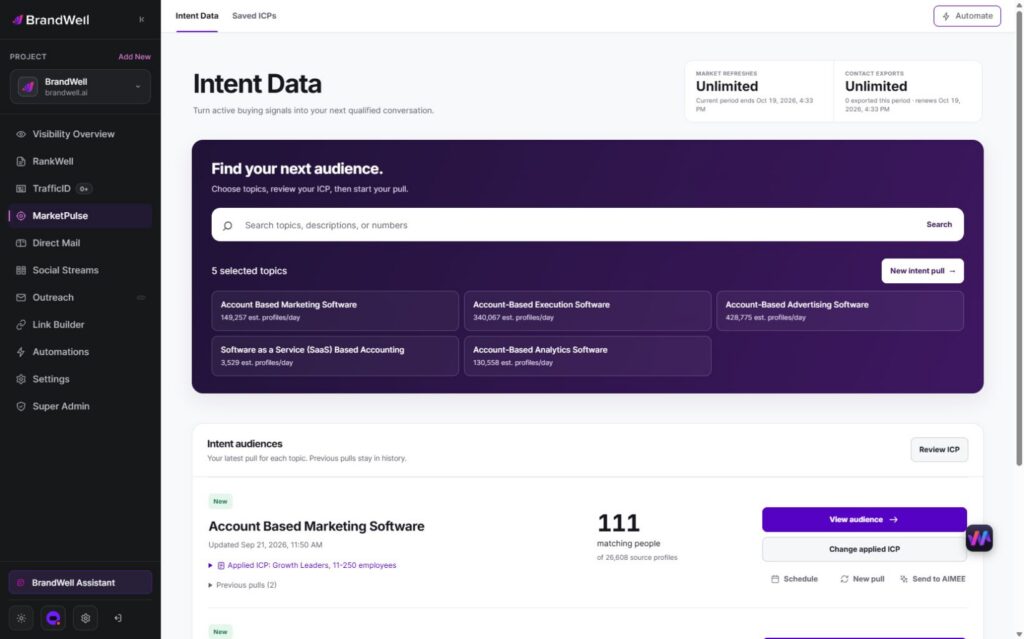
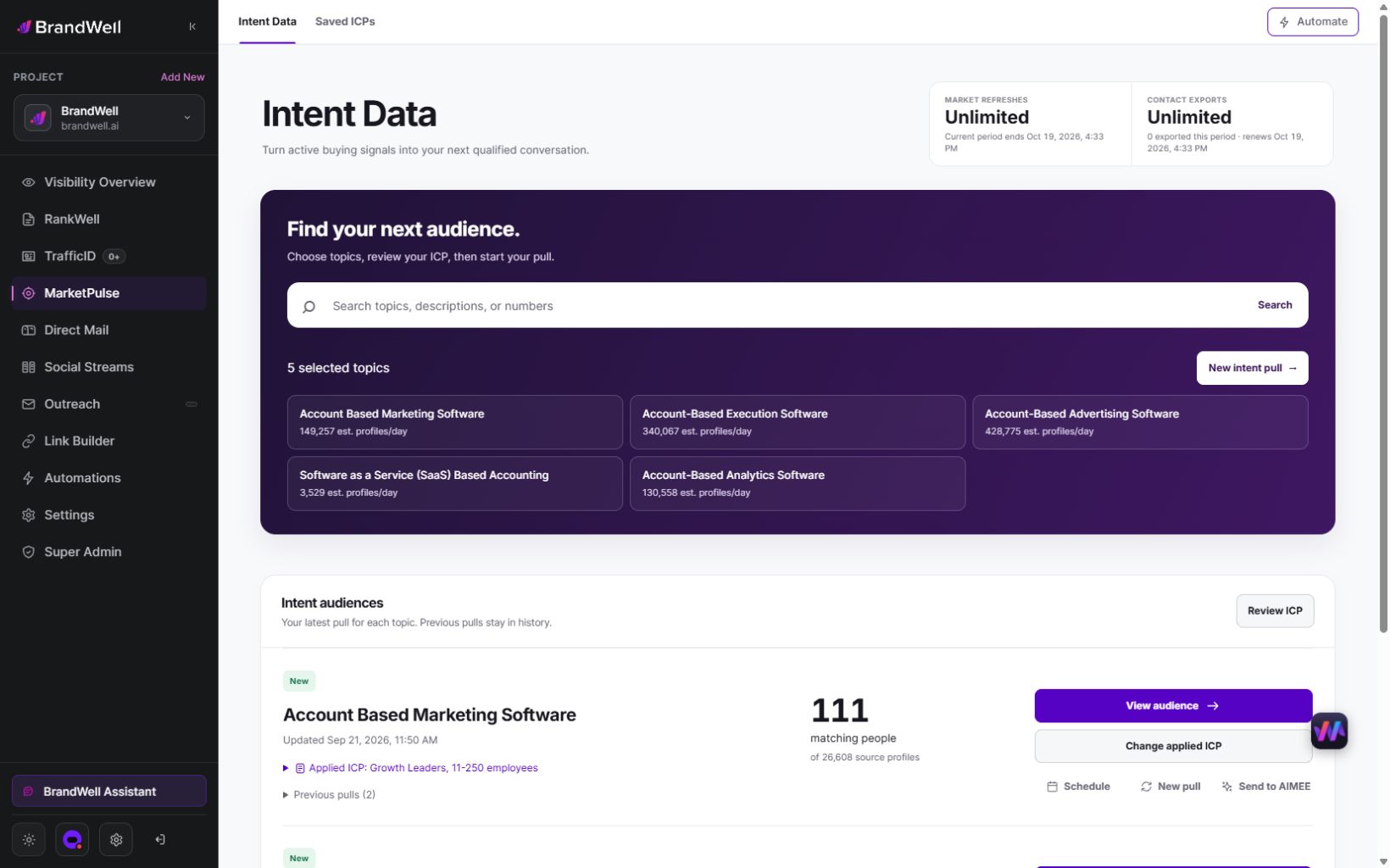
BrandWell MarketPulse: intent data starting at $500/mo. Find people researching topics relevant to what you sell, apply saved ICP filters, and review available contact details before taking action.
MarketPulse plans are starting at $500/mo. Verify current package scope and offers on the product page.
| Plan | Topics and refreshes | Monthly exports |
|---|---|---|
| Starter | 1 topic, weekly | 25,000 contacts |
| Growth | 3 topics, daily | 100,000 contacts |
| Scale | 10 topics, daily | Unlimited contacts |
Swipe the table to see all columns.
A pull retrieves available data from the previous 24 hours for one topic. Daily use across all included topics provides 90 Growth pulls or 300 Scale pulls in a 30-day month. Weekly Starter pulls vary by calendar month. Available audience size and contact fields vary, and audiences may overlap. Refreshes stop at the plan limit without overage charges.
- Find and qualify: search the topic catalog, save your ICP, and review the people and companies that match.
- Act on the research: export qualified contacts or prepare an Outreach or Direct Mail workflow. Connected products, channel usage, and fulfillment may cost extra.
- Get help from AIMEE: Growth and Scale include AIMEE for the initial user to research accounts and prepare the next step through connected tools.
Agencies and other service businesses can build client deliverables around their available Intent Scans and exports. Keep each client’s scope, permissions, and service fees clear. A subscription is not a promise of a white-label platform or exclusive access to a market.
Explore MarketPulse and watch the demo or compare plans starting at $500/mo. Any early-access discount is a separate, time-limited offer shown to an eligible recipient.
Who is this for?
This guide is for RevOps leaders, demand generation teams, sales operations, analysts, agency owners, and executives deciding when an intent score should create a task, change an account stage, add an audience, send an alert, or start another GTM workflow. It owns experimental threshold calibration – not the generic definition of confidence, a broad guide to scoring models, or a claim that any signal proves purchase intent.
Intent and identity data are probabilistic evidence. A high score can mean the available signals are unusual relative to a model or baseline; it does not prove who performed the research, that a buying committee exists, that outreach is permitted, or that a sale will occur.
Define the action before the threshold
A threshold has no business meaning without a specific consequence. “Score above 80” is incomplete. “Create a same-day research task for the account owner when an ICP account crosses the approved score and has no open opportunity” is testable.
Write one decision record for each action:
- Unit: person, account, location, domain, opportunity, or buying group.
- Eligible population: ICP, geography, customer status, consent or suppression state, and data sufficiency.
- Signal window: how recent an event must be and how it decays.
- Action: alert, enrichment, audience inclusion, human research, outreach proposal, or automatic execution.
- Positive label: the downstream event that indicates useful prioritization.
- False-positive cost: wasted research, irrelevant outreach, media waste, trust damage, or compliance exposure.
- False-negative cost: a qualified account receives no timely attention.
- Owner and approver: who monitors the rule and who can expand its authority.
Set stricter evidence requirements as consequences rise. A noisy threshold might be acceptable for ordering an internal research queue. The same threshold should not automatically send a personal message, change a legal status, suppress a customer, or spend a large budget.
Build a threshold-test dataset without leakage
Use a fixed observation window for features and a later outcome window for labels. The feature record might include topic intensity, recency, repeated research, first-party engagement, account fit, role coverage, identity confidence, and prior relationship. The label might be an accepted sales lead, qualified meeting, accepted opportunity, or another event that the operating team actually values.
Prevent leakage by excluding information that became available only after the action would have occurred. An opportunity stage recorded after sales engagement cannot be treated as a feature known when the threshold fired. Preserve the raw event time, processing time, score version, identity version, and any corrections.
Split data by time, not only at random. A model or rule can look strong when the same account patterns appear in both training and evaluation records. Use an earlier development set, a later validation set, and a still-later prospective period. Hold out key segments such as regions, company sizes, industries, and acquisition sources to see whether performance is concentrated in one easy group.
For rare positive outcomes, an always-negative rule can appear accurate while missing every useful case. Define true positives, false positives and false negatives against the same mature outcome window. Precision is true positives divided by all flagged units; recall is true positives divided by all labeled-positive units. Report missing outcomes separately instead of silently treating them as negatives.
Test a threshold grid, not a favorite number
Evaluate a practical grid of candidate thresholds, including the current rule and a no-signal baseline. For each threshold, calculate:
- Number and share of eligible accounts flagged.
- Precision: the share of flagged accounts that later meet the chosen label.
- Recall: the share of all labeled-positive accounts that were flagged.
- False-positive and false-negative counts.
- Workload created by team and day.
- Median and tail action latency.
- Cost per reviewed, accepted, and qualified record.
- Expected gross-profit contribution under clearly labeled assumptions.
- Performance by segment, source, confidence band, and signal age.
- Stability when the window or outcome definition changes.
Then use an expected-value rule rather than choosing the prettiest conversion rate:
For a defined action, compare the expected incremental benefit with all incremental costs and harms on the same population and time horizon. A likelihood of a later outcome is not, by itself, the effect of taking the action. Keep assumed action benefits separate from measured classification results.
The full cost includes labor, media or tooling, opportunity cost, negative customer experience, privacy risk, and correction work. Use ranges rather than pretending each probability is known exactly.
Select a threshold zone, not an eternal constant. For example, scores below the lower boundary remain unactivated; the middle band enters human research; the upper band becomes eligible for a low-risk automated action. Freeze these zones for the prospective test.
Use this evidence ladder before automation
1. Historical replay
Apply every candidate rule to data that would have been available at the time. This identifies impossible workload, obvious bias, label problems, and unstable thresholds. It is observational: historical replay cannot prove what would have happened if the action had changed.
2. Shadow mode
Generate recommendations without executing them. Ask reviewers to accept, reject, or correct each recommendation using predefined reason codes. Measure agreement, review time, missing context, and the number of consequential mistakes avoided. Do not let reviewers see the later outcome while judging the recommendation.
3. Limited prospective test
Randomly assign eligible units to threshold-guided handling and business-as-usual handling where suitable. Use original assignments for the primary comparison and log crossover. A phased rollout or comparable region is not automatically a causal design: specify its identifying assumptions and concurrent changes. A cutoff design likewise needs a credible assignment rule and appropriate analysis.
Protect against contamination. A control account should not receive the same triggered task through a different workflow. Log overrides, manual touches, concurrent campaigns, and stage changes.
4. Low-risk automation
Automate a reversible internal step first: enrichment request, research brief, queue ordering, or draft recommendation. Keep human approval for external outreach, audience uploads, spending, CRM stage changes, and public claims. Monitor volume, error rate, latency, segment drift, complaints, and downstream quality.
5. Scoped expansion
Expand only one dimension – population, action, cadence, channel, or authority – after the prior version passes its gate. Retain a holdout or periodic shadow sample so deterioration remains visible. A threshold that passed for enterprise software accounts does not automatically transfer to small services firms or another geography.
Compare causal, attribution, and observational evidence
Randomized tests provide the strongest estimate of the effect of threshold-guided action when assignment, contamination, and sample size are managed. Quasi-experimental approaches can be useful when randomization is impractical, but their assumptions must be explicit. Before-and-after comparisons are fast and weak because seasonality, staffing, media, market conditions, and pipeline mix can change. Multi-touch attribution describes recorded interactions and can support operations; it does not create an untreated counterfactual.
Use a process evaluation alongside outcome measurement. If the test does not improve opportunities, investigate the rule, data arrival, alert adoption and execution quality. Test important uncertain assumptions before expanding authority or spending.
Budget and total cost of threshold testing
Budget for data ingestion, event storage, identity resolution, enrichment, label cleanup, analyst or data-science time, workflow engineering, CRM administration, experiment design, privacy and security review, reviewer capacity, and ongoing monitoring. Add the opportunity cost of withholding or delaying the action for a comparison group. Include the cost of corrections and false-positive follow-up.
A spreadsheet can support a first intent score threshold test when the rules, volumes, and joins are simple. A warehouse and versioned transformation layer become important when signals change frequently, outcomes arrive from several systems, or multiple thresholds run simultaneously. An experiment platform helps with assignment and exposure logging; it does not fix ambiguous labels or poor operational adoption.
Do not evaluate vendor cost without the operating model. A cheaper signal that creates twice as much review work can have a higher total cost. Likewise, a sophisticated model is wasteful if the team can act on only a small daily queue.
Metrics, confidence checks, and reporting rules
Report counts and rates with denominators. At minimum include eligible units, flagged units, human-reviewed units, accepted recommendations, executed actions, useful outcomes, false positives, false negatives where observable, overrides, complaints, suppressions, and total cost.
Add confidence intervals or uncertainty ranges to material differences. Predefine a minimum sample, a maximum review burden, and the smallest effect worth acting on. Check whether results persist across time bands, industries, company sizes, regions, roles, sources, and identity-confidence levels. A pooled improvement that disappears in the priority segment is not a pass.
Use three gates:
- Stop: privacy or policy failure, material harm, uncontrolled data leakage, workload beyond capacity, or no plausible value at feasible thresholds.
- Revise: promising quality but unstable segments, weak labels, late data, excessive overrides, or an underpowered test.
- Expand: acceptable risk, stable performance, operational adoption, and sufficient evidence that threshold-guided handling improves the decision relative to baseline.
Do not treat a conventional statistical cutoff as the only decision rule. Practical significance, risk, reversibility, evidence quality, and capacity matter too.
Combine intent, identity, fit, and activation evidence
A robust rule separates inputs rather than collapsing every event into an opaque score. Intent indicates observed research or engagement. Fit indicates whether the account resembles the defined customer. Identity links the event to a probable company or person with varying confidence. Freshness indicates whether the evidence is still actionable. Activation data records what the team actually did. Outcome data records what happened later.
Require a minimum fit and identity quality before intent can trigger a consequence. Decay old evidence. Suppress employees, customers, partners, open opportunities, opted-out records, and prohibited categories as appropriate. Preserve source-level evidence so reviewers can see why a recommendation appeared.
Monitor the actual decision in context, record limits, review segment changes and retain an accountable owner. These controls do not validate a score by themselves. A calibrated probability for one label is not a probability that a person will buy.
Risks that invalidate a threshold test
Selection bias appears when sales already favors the most promising accounts. Label bias appears when “qualified” means different things across teams. Survivorship bias excludes corrected or suppressed records. Contamination occurs when control units receive the same treatment elsewhere. Feedback loops occur when the score causes more activity, and the extra activity is then mistaken for independent proof that the score was correct.
Review permitted purposes, notice, applicable legal bases, contracts, access, retention, correction, deletion, suppression and geographic restrictions with qualified reviewers. Do not infer sensitive traits or bypass consent and channel requirements. A high score does not grant permission to contact someone.
Overclaiming is a measurement failure. “High intent” should not be translated into “ready to buy.” “Influenced pipeline” should not be translated into incremental revenue. Report the exact rule, action, comparison, result, and limitation.
Make the workflow agent-ready without removing accountability
AIMEE can prepare research and a review brief through configured connected tools. Supply the approved inputs, event definitions, decision rules and permitted output. Validate calculations and the actual destination before executing a workflow; describing an integration does not establish that it exists.
An agent-ready instruction should specify inputs, allowed transformations, forbidden fields, threshold candidates, evaluation metrics, segment checks, required citations, approval points, and rollback conditions. Require the output to distinguish observed facts, calculations, assumptions, and recommendations. Require a named human to approve external outreach, audience activation, budget changes, CRM writes, and claims.
Example: “Replay thresholds 40 through 90 in increments of 5 on the frozen validation data. For each threshold, return workload, precision, recall, false-positive cost, expected-value range, and segment stability. Flag leakage and missing labels. Do not select a production threshold or execute actions. Recommend stop, revise, or advance to shadow mode with reasons.”
Incorporate threshold testing into an agency service
An agency can package intent threshold testing as a recurring calibration service: data and label audit, monthly replay, shadow-review sample, controlled prospective test, drift monitoring, client decision memo, and change log. Renewal evidence should show whether the system improved prioritization and operations – not merely how many signals crossed a threshold.
before use, require product, pricing, privacy, security, compliance, legal, and platform-policy review.
An agency evaluation can test data usability, review effort and the clarity of client deliverables. Define client permissions, additional services, costs and acceptance criteria separately. A MarketPulse subscription does not promise exclusive topics or a validated scoring model.
Final threshold-testing checklist
- Define one unit, action, label, and eligible population.
- Quantify false-positive and false-negative costs.
- Freeze feature and outcome windows and prevent leakage.
- Compare a threshold grid with business as usual.
- Test by time and priority segment, not only in aggregate.
- Run shadow mode and capture structured reviewer reasons.
- Preserve a counterfactual and log contamination.
- Automate only reversible, low-risk steps first.
- Monitor workload, error, drift, harm, and downstream outcomes.
- Version every rule and require human approval for consequential changes.
The best threshold is not the number that produces the most alerts. It is the narrowest, monitored rule that improves a defined decision enough to justify its cost and risk – and can be stopped safely when the evidence changes.
Separate the score from the decision rule
scikit-learn’s threshold guide distinguishes probability estimation from action selection, supports decision-specific tuning and warns against using the training data to tune the threshold.
This is a proposed evaluation workflow, not a claim that MarketPulse includes this classifier or an automatic scoring integration. Keep a separate final test set after selecting the rule. Repeatedly trying thresholds on that final set makes it part of tuning and can overstate performance.
A fictional threshold comparison
Suppose 1,000 eligible accounts have complete labels and 100 later meet the predefined positive outcome. Rule A flags 200 accounts, including 60 positives and 140 negatives. Its precision is 30% and recall is 60%. Rule B flags 100 accounts, including 45 positives and 55 negatives. Its precision is 45% and recall is 45%.
Rule B creates less work and higher precision, but misses 55 positives compared with Rule A’s 40. These descriptive classification results do not identify which action generates more business.
For an illustrative cost calculation only, assume each true-positive action adds $100 of benefit and each false-positive action costs $20. Rule A yields $6,000 minus $2,800, or $3,200. Rule B yields $4,500 minus $1,100, or $3,400. This deliberately simplified model excludes costs for true-positive actions, missed opportunities, fixed implementation, harm and uncertainty. The assumed incremental benefit needs a defensible experiment; it cannot be inferred from the later positive label.
Review topic evidence in the current MarketPulse workspace
- Select a relevant topic and apply a defined ICP.
- Review the people and company fields available in the actual feed.
- Keep topic research, identity confidence and the proposed action separate.
- Export only the permitted records for an approved evaluation.
- Join outcomes in the authorized system, preserve decision-time evidence and review the calculation.
Watch the demo and compare MarketPulse plans. Standard subscriptions are starting at $500/mo; validate any additional analytics, experiment or CRM implementation separately.
Frequently asked questions
What is the right intent-score threshold?
There is no universal number. Define the action, population, outcome, capacity, costs and acceptable risks, then evaluate candidate rules on separate data.
Can shadow mode show sales lift?
It can reveal workload, reviewer agreement and missing context. Without executing and comparing actions, it cannot establish incremental sales impact.
Does higher precision mean a better business decision?
It can reduce irrelevant work but also miss useful accounts. Evaluate recall, capacity and costs alongside precision.
Can a high score authorize outreach?
No. Review permitted use, channel rules, ownership and suppression separately.
Reviewed and updated October 3, 2026.

Written by