On this page
- Current MarketPulse research workflow
- Check actual decision ownership
- Start with inspectable evidence
- Use nine ICP definition steps
- Choose tools for the actual gap
- Compare four operating approaches
- Price setup and actual refresh work
- Measure versioned errors and outcomes
- Match controls to the action
- Keep fit and signals distinct
- Control bias and silent changes
- Use an approved ICP in MarketPulse
- Prepare a review-only agent brief
- ICP handoff checklist
- Copyable ICP validation record
- Frequently asked ICP questions
An activation-ready ICP is not a persona paragraph or a list of favorite customer logos. It is a versioned set of inclusion, exclusion, priority, confidence, and missing-data rules that two operators can apply to the same account and reach a similar decision.
Define fit first. Add intent, identity confidence, and freshness as separate evidence layers. Then apply permitted-use checks and an explicit activation gate. This prevents a weak but exciting signal from overruling the facts that make an account commercially viable.
Intent and identity are probabilistic evidence. They do not prove who a visitor is, whether someone consented, whether an account is buying, or whether outreach will create an outcome.
Current MarketPulse offer: intent-data plans start at $500/mo. See the product, demo, and current plans. Updated October 3, 2026.
Current MarketPulse research workflow
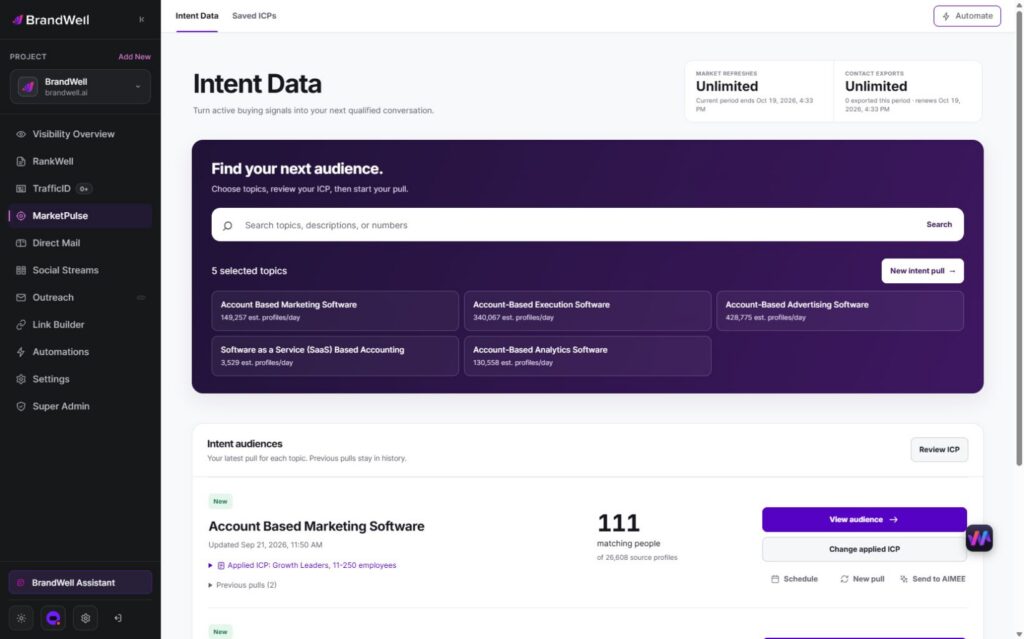
BrandWell MarketPulse: intent data starting at $500/mo. Find people researching topics relevant to what you sell, apply saved ICP filters, and review available contact details before taking action.
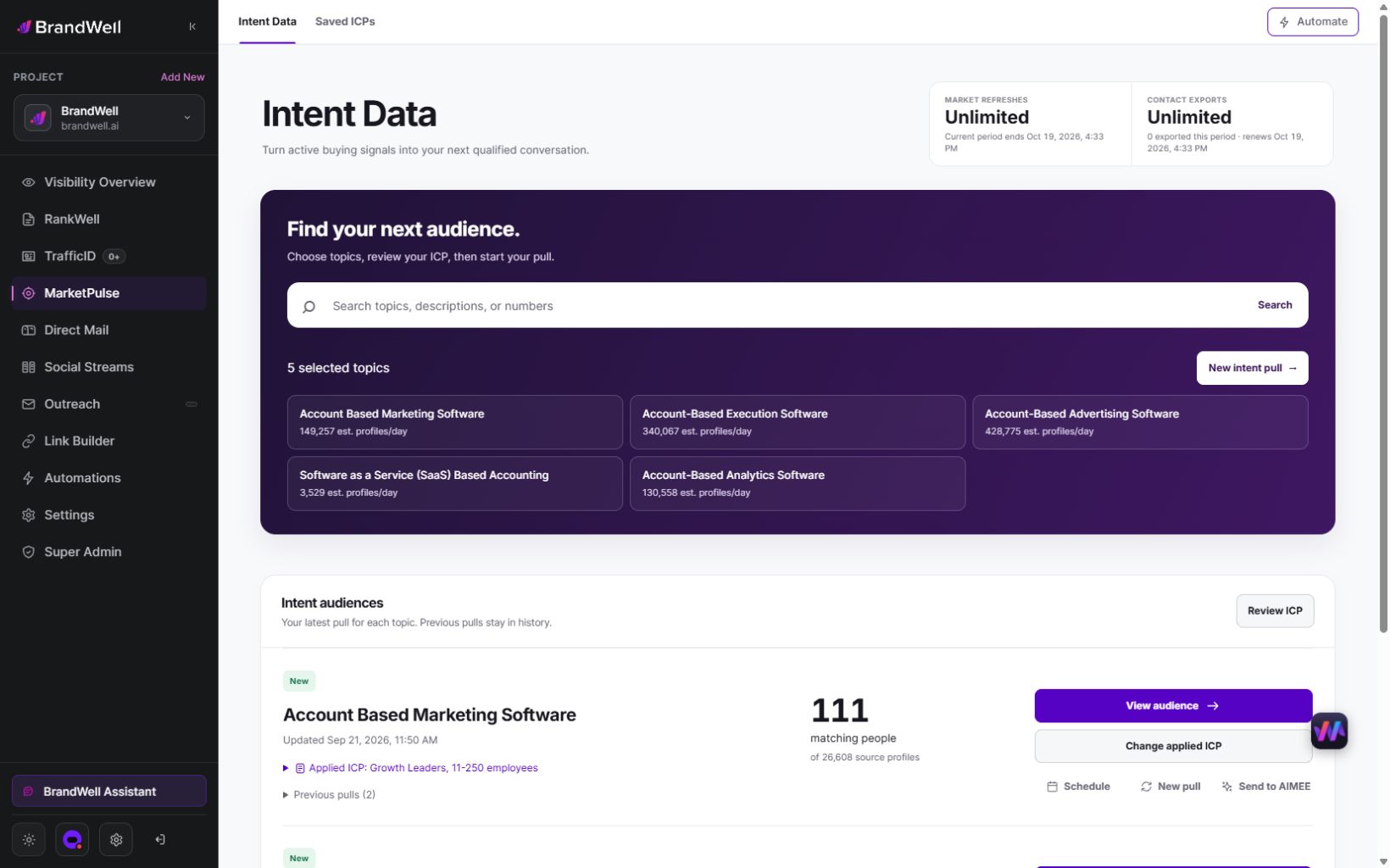
MarketPulse plans are starting at $500/mo. Verify current package scope and offers on the product page.
| Plan | Topics and refreshes | Monthly exports |
|---|---|---|
| Starter | 1 topic, weekly | 25,000 contacts |
| Growth | 3 topics, daily | 100,000 contacts |
| Scale | 10 topics, daily | Unlimited contacts |
Swipe the table to see all columns.
A pull retrieves available data from the previous 24 hours for one topic. Daily use across all included topics provides 90 Growth pulls or 300 Scale pulls in a 30-day month. Weekly Starter pulls vary by calendar month. Available audience size and contact fields vary, and audiences may overlap. Refreshes stop at the plan limit without overage charges.
- Find and qualify: search the topic catalog, save your ICP, and review the people and companies that match.
- Act on the research: export qualified contacts or prepare an Outreach or Direct Mail workflow. Connected products, channel usage, and fulfillment may cost extra.
- Get help from AIMEE: Growth and Scale include AIMEE for the initial user to research accounts and prepare the next step through connected tools.
Agencies and other service businesses can build client deliverables around their available Intent Scans and exports. Keep each client’s scope, permissions, and service fees clear. A subscription is not a promise of a white-label platform or exclusive access to a market.
Explore MarketPulse and watch the demo or compare plans starting at $500/mo. Any early-access discount is a separate, time-limited offer shown to an eligible recipient.
Check actual decision ownership
This guide is for:
- agency strategists translating client strategy into operating rules;
- RevOps and CRM owners who must route and audit accounts;
- demand-generation teams connecting fit to intent activation; and
- client sponsors responsible for exclusions and account-selection decisions.
It is not a generic persona exercise. The output must control a real decision such as research, prioritization, CRM routing, outreach staging, audience creation, or reporting.
Start with inspectable evidence
Start with evidence the client can inspect.
Use this order:
- accepted customers and qualified opportunities;
- disqualifications, losses, churn, and delivery failures;
- expansion, retention, product fit, and support evidence;
- sales and customer-success observations;
- buyer and customer interviews; and
- market hypotheses that still need testing.
Do not study wins alone. That creates survivor bias. Compare good-fit accounts with accounts that looked attractive but stalled, created high delivery cost, churned, or should never have qualified.
Record the actual source, owner, period, missing fields and known sample limitations. Historical association does not establish future causality. Use necessary fields for the defined purpose and keep actual access, retention, correction and suppression responsibilities visible.
Use nine ICP definition steps
This implementation guide produces an ICP that can be tested, approved, and changed without hiding the reasoning.
1. Name the decision the ICP will control
State whether the model controls research, account prioritization, CRM routing, outbound staging, advertising eligibility, reporting, or another action. Name the consequence and the accountable owner.
Deliverable: decision-and-channel scope. Acceptance gate: one owner and one consequence. Failure mode: one threshold is used for every action even though the cost of error differs.
2. Freeze the evidence window
Select relevant customers, opportunities, losses, churn, expansion, retention, and disqualification evidence. Retain source dates internally, but do not let stale evidence silently shape the model. Document missing segments and known bias.
Deliverable: evidence inventory. Acceptance gate: wins and non-wins are represented. Failure mode: a handpicked sample makes the existing theory look correct.
3. Choose the entity unit
Decide whether the unit is a parent company, subsidiary, domain, location, account, buying group, or contact. Define how parent-child relationships and shared domains are handled.
Deliverable: entity-unit rule. Acceptance gate: the CRM and signal sources can represent the same unit. Failure mode: intent from one subsidiary is routed to another or attached to a parent that cannot buy.
4. Define observable fit fields
For every firmographic, technographic, operating, and commercial field, specify the allowed values, source, freshness, missing-data behavior, and owner. Replace adjectives with evidence. “Fast-growing” needs an observable definition or should remain a hypothesis.
Deliverable: field dictionary. Acceptance gate: a second operator can reproduce the value. Failure mode: unobservable descriptions become arbitrary scores.
5. Write exclusions before weights
Document geography, category, size, conflict, customer, partner, legal, capacity, and delivery exclusions. State which rules are hard stops and which require review.
Deliverable: exclusion decision tree. Acceptance gate: hard exclusions override positive scores. Failure mode: an exciting signal bypasses a reason the agency or client cannot serve the account.
6. Score fit transparently
Keep the field values, weights, missing values, evidence, and threshold version visible. It can be a simple rule set; complexity is not a goal. Separate “unknown” from “bad fit.”
Deliverable: fit-score worksheet. Acceptance gate: the client can explain why an account qualified. Failure mode: one opaque composite score hides weak or missing fields.
7. Validate on a labeled sample
Build a sample with obvious and difficult cases. Have reviewers label accounts without seeing the model result, adjudicate disagreements, and report false inclusions, false exclusions, eligible coverage, precision among qualified accounts, and error patterns by segment.
Deliverable: validation report. Acceptance gate: the client accepts the threshold and known errors. Failure mode: the team reports how many accounts matched but not whether they were correct.
Account coverage and selected-sample correctness are different measures. Retain adjudicated labels, false inclusions, missed qualifying accounts, unknown cases and segment-level errors. Do not equate a large matched list with correct qualification.
8. Layer intent and identity separately
Attach signal source, type, freshness, and strength after fit. Attach account or person identity with confidence and no-match state. Define reject, hold, human review, and approved-for-staging outcomes.
Deliverable: fit-intent-identity decision matrix. Acceptance gate: no single weak signal silently overrides fit or exclusions. Failure mode: the team treats a visitor reveal or topic spike as proof of a buyer.
9. Approve and version the model
Record the approver, effective version, destinations, rollback, review triggers, and change history. Each activated record should reference the model version and evidence used.
Deliverable: activation gate and change log. Acceptance gate: the client and delivery owner sign the same rules. Failure mode: silent scoring changes make performance comparisons impossible.
Choose tools for the actual gap
The minimum toolchain supports:
- source extraction from CRM, product, support, finance, and research systems;
- data storage without overwriting raw evidence;
- field normalization and entity hierarchy;
- enrichment and confidence-scored identity resolution;
- labeling and adjudication;
- transparent scoring and version control;
- routing and orchestration with a sandbox; and
- evidence reporting, correction, and rollback.
Useful defining-a-client’s-ICP-for-intent-activation templates include an evidence inventory, field dictionary, exclusion tree, fit-score worksheet, labeled-sample sheet, error log, decision matrix, activation approval, and change-control log.
Do not buy software because it promises to “discover” the ICP automatically. A tool can reveal patterns and apply rules. The client still owns commercial strategy, exclusions, error costs, and approval.
Compare four operating approaches
Copy the current account list
Use the client’s current list as a documented baseline when time is limited and the client needs continuity. Its benefit is speed. Its limitation is inherited bias, missing exclusions, unexplained selections, and stale accounts. Never call it a validated ICP simply because sales recognizes the names.
Rebuild from evidence
Rebuild when teams disagree, the list has poor outcomes, account definitions are unclear, or activation risk is high. Its benefit is an explainable decision model. Its limitation is discovery and labeling work.
Automate the rules
Automate stable collection, normalization, exclusions, scoring, routing, and monitoring after the model passes validation. Its benefit is repeatability. Its limitation is amplification of bad assumptions. Preserve hold and human-review states.
Scope a separate client delivery layer
An agency may separately build a branded client report or delivery interface. Verify implementation, rights, access separation, maintenance, export and fees. Do not assume a research subscription supplies the interface or makes delivery faster.
Compare all four approaches on setup, evidence, reproducibility, control, marginal labor, governance, client experience, and change cost.
Price setup and actual refresh work
Delivery cost includes:
- discovery and decision definition;
- data extraction and preparation;
- account-unit and field design;
- exclusion and scoring rules;
- labeling and adjudication;
- validation and error analysis;
- CRM and workflow configuration;
- client review and documentation; and
- recurring refresh, QA, and change management.
Separate the agency’s ICP service fee from any platform or data cost. Price the work by scope, number of decision units, data readiness, destinations, reviewers, and activation risk – not by the number of slides.
Set change-order triggers before the project: a new geography, entity unit, product, channel, destination, data source, or consequential use can require revalidation.
Measure versioned errors and outcomes
Use technical, operational, and commercial measures together:
- reviewer label agreement;
- eligible account coverage;
- missing-field rate;
- precision among qualified accounts;
- false inclusion and exclusion by segment;
- identity confidence and freshness completeness;
- sales acceptance and rejection reasons;
- stage progression and qualified opportunities;
- cost per accepted account or opportunity; and
- agency exception load and margin.
Track every measure by ICP version. A better outcome after a model change is correlation until the team has a comparison design. Use a phased rollout, holdout, or matched group when practical, and explain limitations.
Use actual labeled evidence, adjudication and error analysis for the defined account unit. Evaluate the model version on a held-out or otherwise separately defined sample. Do not silently treat selected test cases as representative of the entire market.
Match controls to the action
Use three practical tiers:
- Research and reporting: a field dictionary, exclusions, and a human-reviewed account list. For a bounded low-maturity review test. Do not automate production actions.
- CRM prioritization: a validated score, identity and freshness checks, routing, evidence IDs, and rollback. Verify actual RevOps ownership and implementation.
- Consequential activation: stricter thresholds, source and permitted-use review, suppression, channel eligibility, minimum audience considerations, named human approval, and continuous monitoring.
Higher maturity does not remove privacy, security, compliance, legal, or platform-policy obligations. It means the client has stronger controls for the consequences.
Keep fit and signals distinct
Use a field-level evidence record:
- account entity and hierarchy;
- fit fields, source, age, and version;
- hard exclusions and review flags;
- signal type, topic or behavior, source, and freshness;
- identity level, evidence, confidence, and no-match state;
- permitted-use and suppression status;
- proposed play and destination;
- human approver; and
- evidence ID and outcome.
Define the actual population, entity unit and identification basis. An account match does not prove a named person performed research. Collect necessary fields for the approved decision and preserve unresolved identity.
Control bias and silent changes
Common risks include:
- a sample that contains only wins;
- missing or stale fields treated as negative fit;
- parent and subsidiary confusion;
- exclusion rules hidden inside code;
- scores that change without a new version;
- cross-client data mixing;
- excessive collection or access;
- missing correction, suppression, opt-out, or deletion handling; and
- automation that writes or deletes records without human approval.
Verify actual source, purpose, responsibilities, recipient, jurisdiction, channel and rights requirements before action. Keep correction, suppression, opt-out and deletion routes traceable; resolve uncertainty with qualified advice.
Use an approved ICP in MarketPulse
BrandWell MarketPulse is topic-based intent-data software for businesses and agencies. Choose relevant research topics, apply saved ideal-customer-profile filters, review available names, roles, companies and contact details, and export the audience or prepare a connected workflow. Plans start at $500/mo. TrafficID identifies visitors to your own website and is a separate product. A MarketPulse subscription does not by itself promise a white-label portal, custom API implementation, exclusive topics, or managed client delivery.
MarketPulse applies saved ICP filters to available topic research. TrafficID separately supports own-site visitor review. AIMEE can prepare supplied context through configured tools. Custom branded reports, client interfaces and destination routing require separately verified implementation, rights, scope and fees.
Review the actual audience, unknown cases and full operating cost before expanding. Explore MarketPulse and current plans.
AIMEE can prepare a review brief through configured connected tools. Keep proposed actions separate from actual approvals and destination acknowledgements. Confirm the implementation and permissions before execution.
BrandWell does not make probabilistic signals deterministic, supply consent, replace a CRM or ad platform, guarantee identity or outcomes, or eliminate product, pricing, privacy, security, compliance, legal, and platform review. Another tool or a manual process may fit better for a narrow, low-volume project.
Prepare a review-only agent brief
Give Claude or ChatGPT the approved decision scope, account unit, field dictionary, exclusions, weights, missing-data rules, evidence window, identity thresholds, permitted uses, destinations, and model version. Then instruct it to:
- preserve raw values and source fields;
- flag missing, stale, contradictory, or ambiguous evidence;
- apply hard exclusions before scoring;
- calculate fit without blending intent or identity;
- attach intent, identity confidence, and freshness separately;
- classify each account as reject, hold, human review, or approved-for-staging;
- explain every decision with rule and version;
- prepare – but do not execute – the destination action;
- request named human approval; and
- log the action, approver, result, exception, and rollback state.
ICP handoff checklist
Before activation, confirm the final artifact contains:
- the decision and entity unit;
- inclusion, exclusion, and priority fields;
- allowed values, source, freshness, and missing-data rules;
- fit weights and thresholds;
- intent and identity evidence kept separately;
- a labeled validation sample and error log;
- permitted-use, suppression, and rights controls;
- destinations, owners, and rollback;
- human approvers; and
- an effective version and change history.
If an operator cannot explain why an account qualified, the model is not ready. If the client cannot change a rule without losing history, the model is not governable. And if a signal can trigger a consequence without an approval gate, the ICP is not safe for activation.
Copyable ICP validation record
Decision: [Actual action and accountable owner.] Unit: [Account, subsidiary, location or contact; deduplication rule.] Fields: [Source, allowed values, freshness and unknown state.] Rules: [Inclusions, hard exclusions, weights and version.] Validation: [Selection method, independent labels, adjudication and error counts.] Handoff: [Purpose, approval, destination, acknowledgement and rollback.] Decision rule: [Full costs, review trigger, stop or repair condition.]
Worked example: coverage is not precision
Scikit-learn’s classification metrics distinguish precision and recall. They are evaluation measures, not a certification of an ICP or a BrandWell result. Preserve the actual labels and denominator before making a quality claim.
Assume a fictional selected validation set of 100 accounts. Reviewers adjudicate 60 as qualifying and 40 as nonqualifying. The rule selects 50: 40 qualify and ten do not. It also misses 20 qualifying accounts and correctly rejects 30. Precision among selected accounts is 40/50, or 80%; recall among qualifying accounts is 40/60, or 66.7%. Fifty percent selection coverage is neither measure. These selected test results do not establish future outcomes or whole-market performance.
Keep unknown cases outside binary labels
If another 20 accounts lack necessary evidence, retain them as unresolved. Do not silently label them negative or exclude them from a total count. Report the 100 adjudicated cases, 20 unresolved cases, sample method and segment errors. The sample cannot support a population-wide estimate unless its design and uncertainty justify that conclusion. A mandatory exclusion can still block action despite a high fit score.
Price the validation work separately
A fictional test uses the standard $250 Starter subscription, $500 in setup and $1,000 in labeling and review, totaling $1,750 in defined costs. Across the 100 adjudicated accounts, descriptive cost is $17.50 per labeled case. A separate fictional $2,000 agency fee leaves $250, or 12.5%, against those costs; another $400 in correction work makes the remainder negative $150. Acquisition, general overhead, tax and financing are excluded. These invented service inputs are not BrandWell agency-service prices or typical margins.
Use the actual saved ICP
Translate approved observable fields into the actual supported MarketPulse saved ICP filters, then review the available topic matches and unresolved cases. Keep broader client scoring and mandatory exclusions documented separately when the product does not implement them. AIMEE can organize supplied context through configured tools. Owners approve exports, messages, Outreach enrollment, audience uploads and CRM writes; custom scoring, reports and integrations require separately verified implementation and scope.
Frequently asked ICP questions
Does a large matched list prove correct qualification?
No. Review adjudicated labels, errors and unknown cases.
Are precision and recall interchangeable?
No. They use different denominators.
Should missing evidence be treated as bad fit?
No. Preserve an explicit unresolved state.
Does a saved ICP implement every client scoring rule?
Do not assume that. Verify the actual supported filters and separate rules.
Review the research product: explore MarketPulse and current plans.
Reviewed and updated October 3, 2026.

Written by