On this page
- Current MarketPulse research workflow
- Check actual delivery and outcome evidence
- Use seven frequency-policy controls
- Compare four operating models
- Keep research and delivery units distinct
- Measure reach and actual outcomes
- Count full control-program costs
- Scope a separate media operating service
- Catch five delivery-review failures
- Frequency-policy handoff checklist
- Copyable frequency-policy test record
- Frequently asked frequency questions
A narrow intent audience needs a frequency policy, not a magic frequency number. Start with a conservative rule that states who or what is being capped, where the cap applies, the exposure window, the audience’s recency and buying-stage hypothesis, the creative set, and the business outcome you will use to revise the rule. Then judge the full frequency distribution alongside usable reach and qualified pipeline – not click-through rate alone.
DV360 frequency-cap guidance describes scope, identifiers and inventory limits. Verify actual campaign, insertion-order and line-item behavior; a configured cap is not a universal person-level guarantee.
Treat intent, identity, and match data as probabilistic evidence. A topic spike can help prioritize an audience, but it does not prove who a person is, whether they have authority or budget, or whether they intend to buy. Consequential ad, outreach, CRM, or deletion actions still need an accountable human reviewer.
Current MarketPulse offer: intent-data plans start at $500/mo. See the product, demo, and current plans. Updated October 3, 2026.
Current MarketPulse research workflow
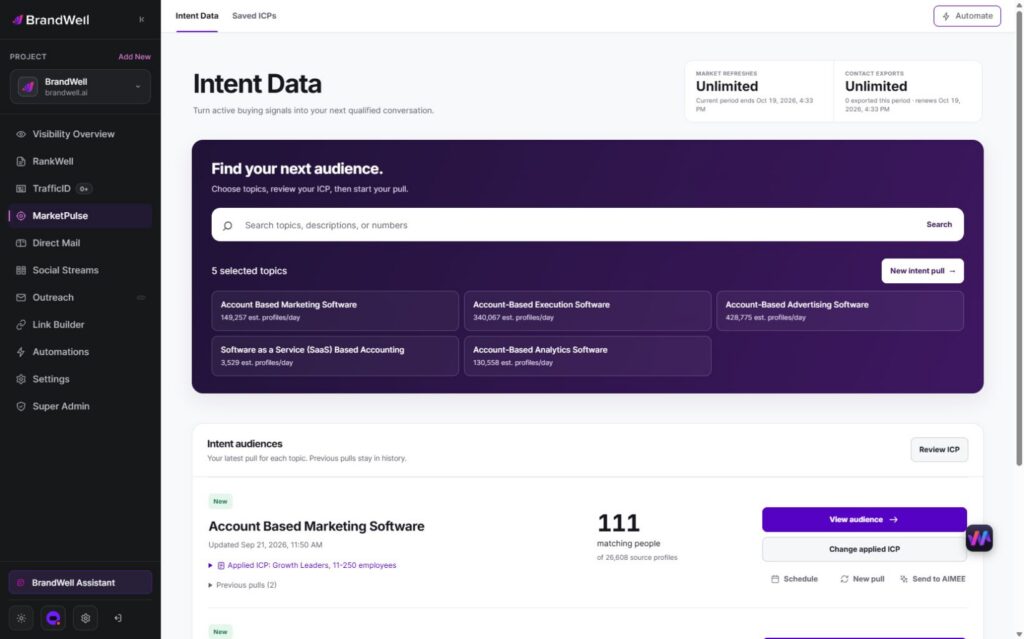
BrandWell MarketPulse: intent data starting at $500/mo. Find people researching topics relevant to what you sell, apply saved ICP filters, and review available contact details before taking action.
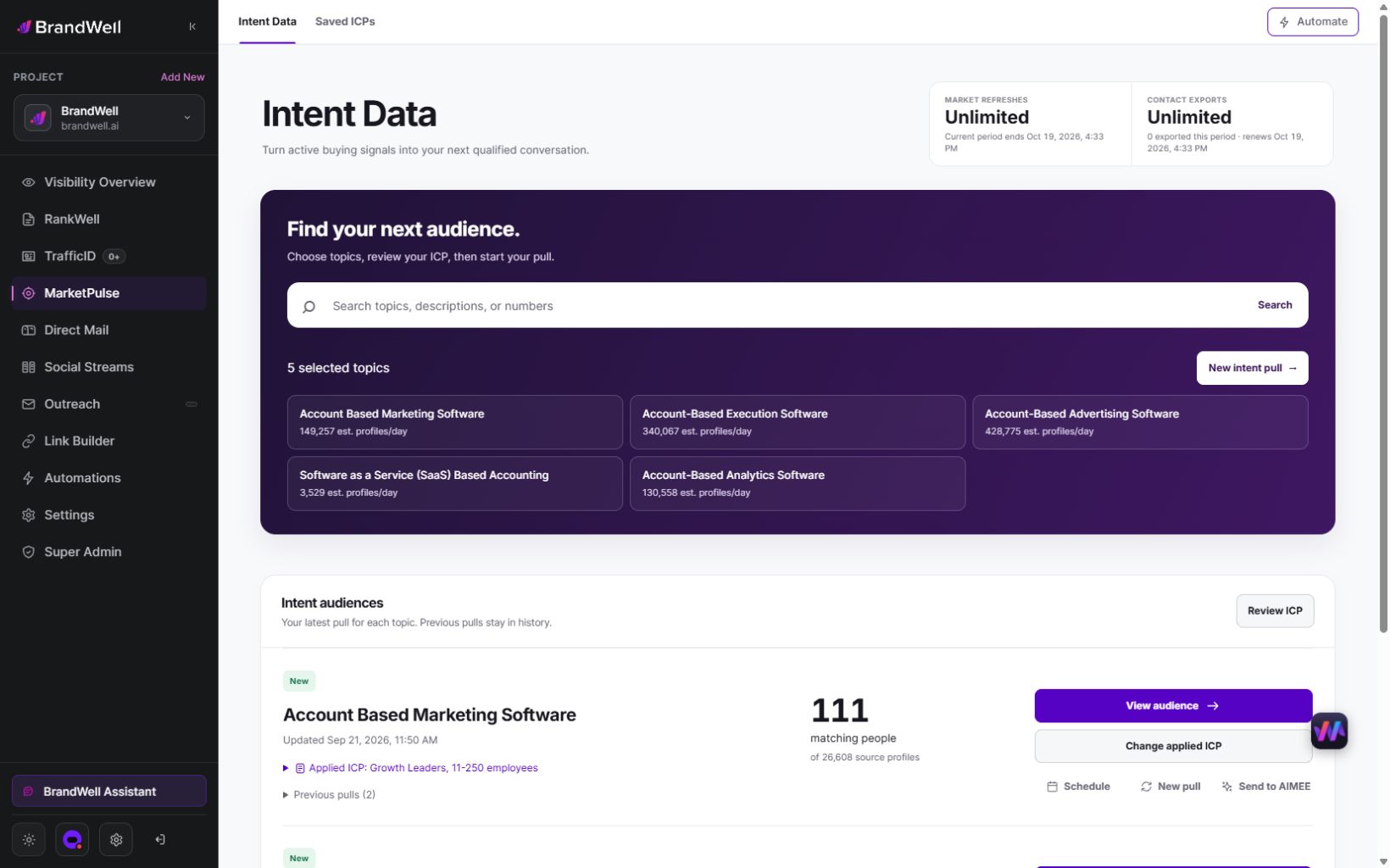
MarketPulse plans are starting at $500/mo. Verify current package scope and offers on the product page.
| Plan | Topics and refreshes | Monthly exports |
|---|---|---|
| Starter | 1 topic, weekly | 25,000 contacts |
| Growth | 3 topics, daily | 100,000 contacts |
| Scale | 10 topics, daily | Unlimited contacts |
Swipe the table to see all columns.
A pull retrieves available data from the previous 24 hours for one topic. Daily use across all included topics provides 90 Growth pulls or 300 Scale pulls in a 30-day month. Weekly Starter pulls vary by calendar month. Available audience size and contact fields vary, and audiences may overlap. Refreshes stop at the plan limit without overage charges.
- Find and qualify: search the topic catalog, save your ICP, and review the people and companies that match.
- Act on the research: export qualified contacts or prepare an Outreach or Direct Mail workflow. Connected products, channel usage, and fulfillment may cost extra.
- Get help from AIMEE: Growth and Scale include AIMEE for the initial user to research accounts and prepare the next step through connected tools.
Agencies and other service businesses can build client deliverables around their available Intent Scans and exports. Keep each client’s scope, permissions, and service fees clear. A subscription is not a promise of a white-label platform or exclusive access to a market.
Explore MarketPulse and watch the demo or compare plans starting at $500/mo. Any early-access discount is a separate, time-limited offer shown to an eligible recipient.
Check actual delivery and outcome evidence
This framework is for programmatic media directors, ABM leaders, paid-media teams, demand-generation leaders, and agencies running small, valuable B2B audiences. Check whether you have a defined account or person-level eligibility rule, more than one creative, a reliable conversion event, and enough delivery to inspect reach and frequency buckets.
It is a poor fit when the audience definition changes every few days, identity resolution is untested, the campaign produces too little volume to learn, or downstream outcomes never make it back from the CRM. In those cases, fix the measurement and data path before fine-tuning the cap.
Use seven frequency-policy controls
1. Lock the decision and baseline
Write down the decision the cap is meant to improve. Examples include preserving unique reach, preventing creative overexposure, increasing qualified visits, or improving the cost per accepted opportunity. “Improve performance” is too vague because it lets the team select whichever metric moves after the fact.
Capture the starting distribution, not just average frequency. Record audience eligibility, unique reach, impressions, viewable frequency buckets, spend, qualified site actions, opportunity creation, complaint or opt-out signals, and the measurement window. Name the media owner and the person authorized to approve a change.
2. Define the audience and identity unit
State whether the audience is built around accounts, known contacts, browser or device identifiers, matched platform users, or a mixture. Then document the identity unit used by the ad platform’s cap. Those units are often not the same.
For example, an account may contain several relevant people, while a browser identifier may represent one device used by one or more people. Do not describe either as a known buyer without evidence. Include match confidence, eligibility rules, exclusions, source, freshness, and permitted use in the audience specification.
3. Estimate usable reach and campaign overlap
Calculate how much of the eligible audience the channel can actually reach. Compare the audience supplied, the platform-matched audience, delivered unique reach, and accounts that receive a qualified action. Keep the denominators separate.
Next, inspect overlap. A cap at one line item may not represent exposure across other line items, campaigns, channels, or agency partners. Create a campaign inventory that records audience, message, cap level, owner, and active window. Without this portfolio view, every campaign can appear compliant while the same account sees a crowded sequence of ads.
4. Weight buying stage, recency, and creative burden
A recent, specific comparison signal can support a different message cadence than an older, broad problem-research signal. That does not mean “late stage equals more impressions.” It means the team should match repetition, message, offer, and review cadence to the evidence available.
Also consider creative burden. Repeating one hard-sell asset is different from sequencing useful category education, proof, comparison guidance, and a direct next step. Record how many materially distinct creatives are active and how quickly each one becomes stale. Creative rotation cannot repair a fundamentally poor audience or offer.
5. Set a conservative starting policy the channel can enforce
Choose the cap level, scope, and time window supported by the actual campaign type. Avoid copying a benchmark from another network, audience size, objective, or buying cycle. The written rationale is more important than pretending the first setting is optimal.
Google Ads frequency guidance supports Display and Video capping, not Demand Gen. Verify the actual campaign settings before implementation.
6. Monitor reach, distribution, and pipeline together
Review unique reach, frequency buckets, marginal qualified actions, cost per qualified outcome, opportunity progression, exclusions, complaints, and creative-level results. Segment by audience recency and stage hypothesis when volume permits.
Do not treat a high-frequency bucket’s higher conversion rate as proof that more impressions caused the result. People who are already engaged may naturally remain eligible longer and receive more impressions. A useful report separates observation from inference and includes the baseline, denominators, identity limitations, and concurrent campaign activity.
7. Change one policy variable, approve it, and keep a rollback
When possible, use a randomized holdout or a staged comparison in which the cap policy changes for one comparable group. When randomization is not practical, document the limitation and use the strongest stable baseline available. Change one major policy variable at a time so the result remains interpretable.
Predefine the review date, minimum usable volume, decision threshold, guardrail metrics, and rollback condition. A human media owner should approve the change. If effective reach collapses, complaints rise, qualified outcomes deteriorate, or the cohort becomes too contaminated to interpret, roll back rather than waiting for a more flattering metric.
Compare four operating models
Compare these four operating models against the actual delivery gap:
- Manual monitoring without a platform cap gives an operator flexibility but is labor-intensive and can react too slowly for narrow audiences. Use it when the platform lacks a relevant control or when delivery volume is too small for automation, but document the review cadence and stop rule.
- Campaign-level platform caps are straightforward when one campaign owns most exposure. Their limitation is overlap elsewhere in the account or across channels.
- Insertion-order or line-item controls allow more granular policies. Their limitation is coordination: a local setting can be overridden or constrained by a higher level, and several local caps can still create excessive portfolio exposure.
- Portfolio governance uses a campaign registry, reach report, creative log, audience-overlap view, and approval workflow. It adds operational cost but makes cross-campaign decisions explainable.
Google Ads frequency-distribution guidance uses cumulative buckets. Reporting windows and identifier differences can produce counts above a configured cap; inspect actual scope before declaring a failure.
Useful resources include an audience specification, campaign inventory, baseline workbook, frequency-bucket report, creative-rotation log, change request, and rollback record. A DSP, ad platform, warehouse, or BI tool can support the process, but none replaces these decisions.
Keep research and delivery units distinct
Use intent data to create testable segments, not to justify unlimited repetition. A practical signal record contains the topic, source, event or aggregation window, recency, account or person unit, identity confidence, firmographic fit, first-party engagement, suppression state, permitted destination, and outcome history.
Combine those fields in a decision ladder:
- Intent indicates possible research attention.
- Fit asks whether the account could reasonably buy and benefit.
- Identity confidence shows how safely the signal can be joined to a person or account.
- Freshness limits how long the evidence should influence delivery.
- Activation history shows which messages and channels already touched the audience.
- Outcome evidence tells the team whether the policy produces qualified progress.
If identity confidence is weak, analyze or activate at the account level where appropriate rather than forcing a person-level conclusion. If lawful use or platform policy is unclear, stop the activation and escalate it.
Measure reach and actual outcomes
Start with exposure and reach, then connect them to business outcomes. At minimum, report eligible audience, matched audience, delivered unique reach, frequency distribution, qualified site actions, accepted leads, opportunities, pipeline value, revenue when mature, and total cost. Show both absolute counts and rates.
Keep actual reach, exposure window, identifiers, unmatched records and downstream outcomes. A delivery report describes exposure rather than proving incremental pipeline or revenue.
A possible decision question is: what happens to qualified outcomes and usable reach when exposure moves from one bucket or policy to another? Pair that with guardrails such as complaints, opt-outs, wasted impressions, and sales rejection. If the sample cannot support that comparison, say the result is descriptive or inconclusive.
Count full control-program costs
The cap setting itself may cost nothing extra, but the operating system around it does. Budget for working media, ad-tech or DSP fees, audience and intent data, topics or keywords, identity resolution, enrichment, usage or credits, creative variants, implementation, integrations, analyst time, campaign operations, reporting, and the minimum contract term.
Compare options using total cost per qualified outcome and cost per usable reached account, not license price or CPM alone. A lower cap may preserve reach but can also reduce eligible impressions, so model the opportunity cost in both directions. Request current, scope-matched written quotes; do not rely on a generic market range for a specific campaign.
Scope a separate media operating service
MarketPulse supplies topic research and available match details. AIMEE can organize supplied context through configured tools. An agency frequency-control service, cross-campaign report or custom destination synchronization needs separately verified implementation, rights, scope and fees. A research subscription does not establish ad delivery or cap enforcement.
Review an available MarketPulse topic, saved ICP and actual preceding-24-hour matches for the approved research purpose. Keep uncertain company context visible. AIMEE can organize supplied context through configured tools; named owners approve actual exports, messages, audience uploads and CRM writes.
AIMEE can prepare a review brief through configured connected tools. Keep proposed actions separate from actual approvals and destination acknowledgements. Confirm the implementation and permissions before execution.
Before operational use, complete product, pricing, privacy, security, compliance, legal, and platform-policy review.
Catch five delivery-review failures
1. Treating a device or account as a known buyer
Identity and intent are probabilistic. State the unit and confidence, and do not turn an inference into a person-level claim.
2. Reviewing one campaign in isolation
Overlapping campaigns and channels can create more exposure than any one cap reveals. Maintain a portfolio inventory.
3. Optimizing only for clicks
Clicks can rise while unique reach, qualified pipeline, or trust falls. Keep downstream quality and guardrails in the same review.
4. Copying a universal benchmark
A number from another platform or audience is a hypothesis, not a policy. Rebuild the rationale for the current objective and available reach.
5. Letting automation change delivery without approval
Agents can assemble evidence and recommend a change. An accountable operator must approve the setting, monitor it, and own the rollback.
Frequency-policy handoff checklist
Before launch or a cap change, confirm:
- The business decision, primary outcome, guardrails, and baseline are written.
- The audience definition, exclusions, signal source, recency, and identity unit are documented.
- The cap level, scope, time window, platform support, and campaign overlap are known.
- The active creative set and buying-stage hypothesis are recorded.
- Reach, distribution, qualified pipeline, and complaint or opt-out measures are available.
- The test or comparison method, minimum usable volume, and interpretation limits are clear.
- A named human has approved the change and the rollback condition.
- The agency and client know who owns data quality, platform execution, reporting, and sign-off.
Define the actual policy, verify enforcement, measure outcomes and preserve the approved change and rollback rule.
Copyable frequency-policy test record
Unit: [Actual platform identifier and research unit.] Scope: [Campaigns, inventory, cap levels and overlapping delivery.] Window: [Cap period and actual reporting period.] Policy: [Supported setting, creative, rationale and approver.] Measurement: [Reach, disjoint or cumulative buckets, actual buyer outcomes and missing matches.] Comparison: [Assignment, overlap, changes and interpretation limits.] Decision: [Full costs, review date, guardrails and rollback.]
Worked example: an average hides concentrated exposure
Assume a fictional 100 measured identifiers receive 500 impressions during one defined window. Ninety identifiers receive two impressions each, or 180 total; ten receive 32 each, or 320 total. Average frequency is five, but 10% of the measured identifiers account for 64% of impressions. This is a distribution example, not a recommended cap or proof of overexposure harm. Preserve actual identifier and window limits before describing these as known people.
For the same example, cumulative 1+ and 2+ buckets each contain all 100 identifiers, while a 10+ bucket contains the same ten high-frequency identifiers. Adding the three buckets gives 210 memberships, not 210 unique identifiers. Do not sum cumulative buckets as if they were disjoint. Keep the actual platform definitions and reports available.
Reconcile cap scope and time before declaring failure
A hypothetical three-per-week cap can allow six exposures across two full weeks under the applicable implementation. A two-week report showing six is not automatically a cap failure. Other campaigns, inventory behavior and identifiers can change the interpretation. Verify actual settings and delivery rather than assuming the example describes every platform.
A high-frequency group’s stronger conversion rate also does not show that extra impressions caused the outcome. Existing interest, eligibility duration, repeated site visits and sales activity can differ. Use a suitable comparison and preserve uncertainty before claiming incremental effects.
Include costs outside media
A fictional campaign spends $1,000 on media, $400 on creative and $300 on review, totaling $1,700 in defined costs. With ten verified qualified outcomes, descriptive full cost is $170 per outcome rather than the $100 media-only figure. A separate fictional $2,000 agency fee against $1,700 in service costs leaves $300, or 15%. Another $400 in correction work makes the remainder negative $100. Setup, acquisition, general overhead, tax and financing are excluded. These invented inputs are not BrandWell agency-service fees or typical margins.
Prepare the supported research input
Review an available MarketPulse topic, saved ICP and actual preceding-24-hour matches for the approved purpose. Verify company context and preserve uncertainty. TrafficID is separately scoped own-site visitor work. AIMEE can organize supplied context through configured tools. Owners approve exports, messages, Outreach enrollment, audience uploads and CRM writes. Campaign caps, cross-channel joins and custom reports require separately verified implementation, rights, scope and fees.
Frequently asked frequency questions
Does average frequency describe the whole distribution?
No. Inspect actual buckets and concentrated exposure.
Can cumulative frequency buckets be summed as unique users?
No. Their memberships overlap.
Does every above-cap report prove enforcement failed?
No. Verify the actual scope, window and identifiers.
Does a MarketPulse subscription enforce ad caps?
No. Verify the actual campaign implementation separately.
Review the research product: explore MarketPulse and current plans.
Reviewed and updated October 3, 2026.

Written by