On this page
- Current MarketPulse research workflow
- Check actual roles and scope
- Use nine deletion-control stages
- Assign client and system handoffs
- Compare four operating models
- Map covered records and derivatives
- Budget exceptions and unsupported systems
- Test five control outcomes
- Keep BrandWell research separately scoped
- Catch five closure failures
- Deletion handoff checklist
- Copyable deletion reconciliation record
- Frequently asked deletion-control questions
An intent-data deletion workflow is not a “delete row” button. It is a governed process that validates the request or internal trigger, determines the applicable scope and exceptions, locates raw and derived copies, propagates the approved action to processors and recipients, prevents reingestion, and records completion without recreating the deleted profile.
Assign a human decision-maker before execution. Deletion can affect raw research signals, identity relationships, derived scores, CRM fields, ad audiences, reports, client exports, caches, and backups. Intent, identity, and match signals are probabilistic evidence rather than proof of a person, consent, or purchase decision. An agent can help map and prepare those steps, but it should not decide identity, authority, legal scope, exceptions, or the final action.
Qualified reviewers determine applicable rights, roles, jurisdiction, scope, exceptions and communications for the actual request. This article supplies an operating checklist rather than a universal legal procedure. Resolve the reviewed decision before execution.
Current MarketPulse offer: intent-data plans start at $500/mo. See the product, demo, and current plans. Updated October 3, 2026.
Current MarketPulse research workflow
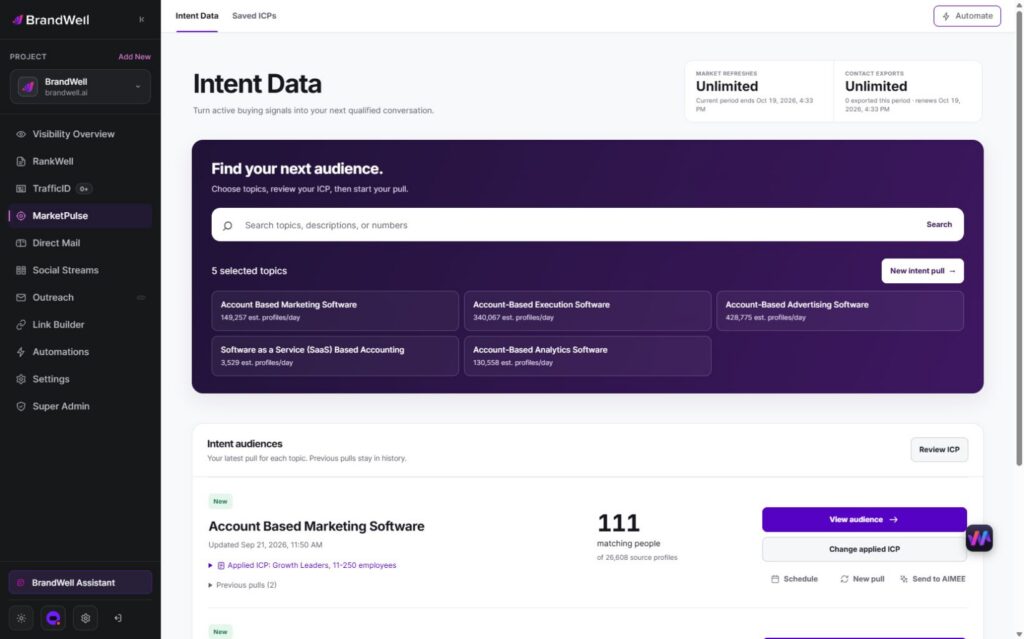
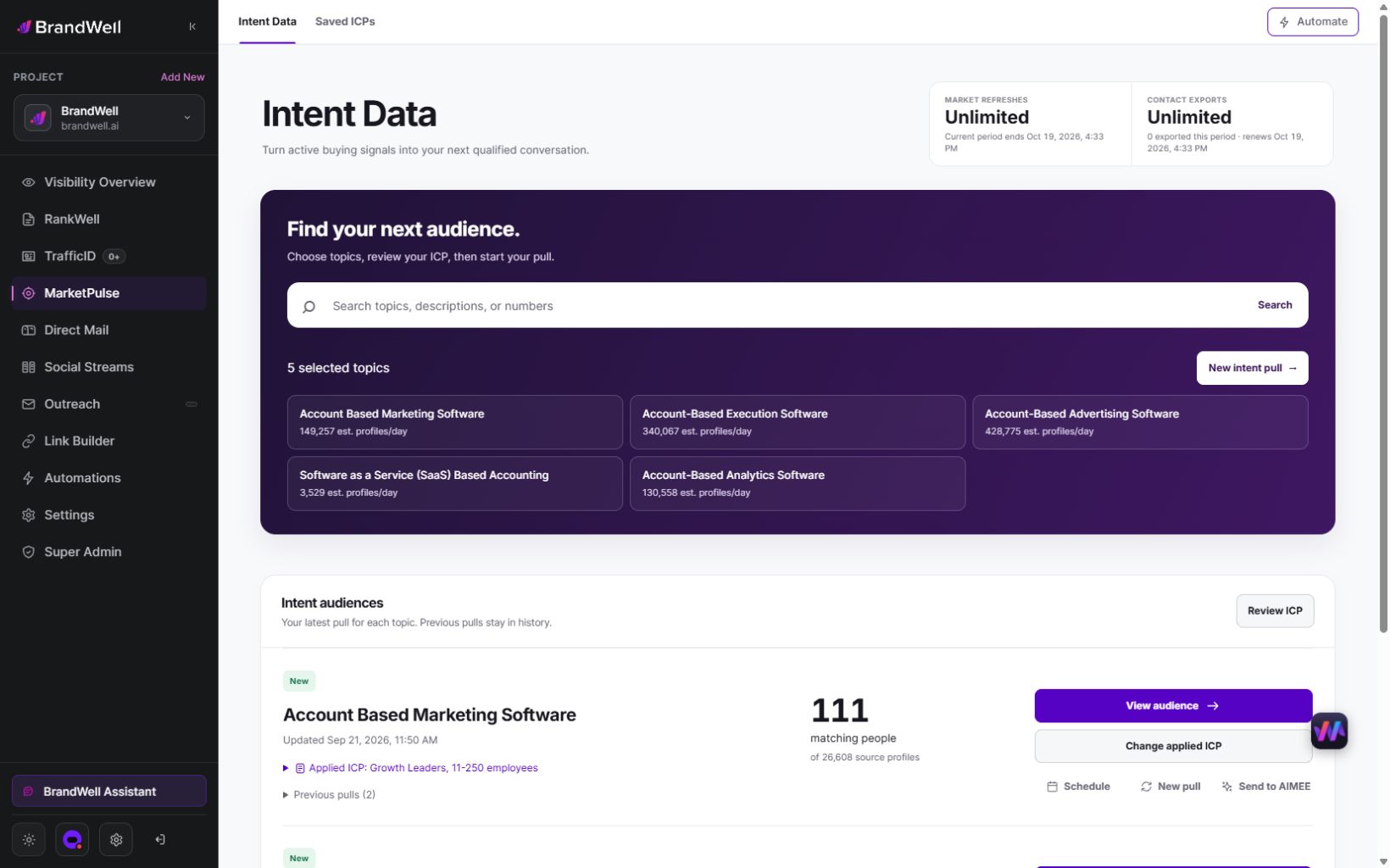
BrandWell MarketPulse: intent data starting at $500/mo. Find people researching topics relevant to what you sell, apply saved ICP filters, and review available contact details before taking action.
MarketPulse plans are starting at $500/mo. Verify current package scope and offers on the product page.
| Plan | Topics and refreshes | Monthly exports |
|---|---|---|
| Starter | 1 topic, weekly | 25,000 contacts |
| Growth | 3 topics, daily | 100,000 contacts |
| Scale | 10 topics, daily | Unlimited contacts |
Swipe the table to see all columns.
A pull retrieves available data from the previous 24 hours for one topic. Daily use across all included topics provides 90 Growth pulls or 300 Scale pulls in a 30-day month. Weekly Starter pulls vary by calendar month. Available audience size and contact fields vary, and audiences may overlap. Refreshes stop at the plan limit without overage charges.
- Find and qualify: search the topic catalog, save your ICP, and review the people and companies that match.
- Act on the research: export qualified contacts or prepare an Outreach or Direct Mail workflow. Connected products, channel usage, and fulfillment may cost extra.
- Get help from AIMEE: Growth and Scale include AIMEE for the initial user to research accounts and prepare the next step through connected tools.
Agencies and other service businesses can build client deliverables around their available Intent Scans and exports. Keep each client’s scope, permissions, and service fees clear. A subscription is not a promise of a white-label platform or exclusive access to a market.
Explore MarketPulse and watch the demo or compare plans starting at $500/mo. Any early-access discount is a separate, time-limited offer shown to an eligible recipient.
Check actual roles and scope
This guide is for privacy, legal, security, data, RevOps, marketing-operations, procurement, and agency teams responsible for buyer-intent and identity data across vendors, warehouses, CRMs, ad platforms, reports, and client systems.
Check whether the organization has a data map, provenance records, system owners, processor or service-provider contacts, and a defined request or retention process. If those foundations are missing, use the first implementation cycle to build them before promising a fast or fully automated response.
Use nine deletion-control stages
1. Receive and classify the trigger
The trigger may be an individual request, a verified agent request, a retention expiry, a contract termination, a client instruction, a consent or objection decision, or an internal correction. Record the source, time received, systems likely affected, intake owner, and the minimum information needed to route it.
Do not collect a full copy of the underlying profile merely to open a ticket. Use an internal request ID and apply access controls from the start.
2. Authenticate identity and authority proportionately
Confirm that the requester is the person involved or is authorized to act, using a method proportionate to the risk. Avoid collecting more identity data than necessary. Define how failed or ambiguous verification is escalated and how the team handles identifiers that do not resolve cleanly.
The authentication decision belongs to the approved privacy or legal process. A match score can support the review, but it does not prove identity.
3. Determine role, jurisdiction, and scope
Identify the relevant legal entities, the person’s jurisdiction where known and appropriate, the organization’s role, the data categories, contracts, processors or service providers, and any applicable response process. Separate the systems in which the organization controls the decision from those it operates on a client’s instruction.
Do not apply one country’s procedure or timeline to every request. Record the accountable legal/privacy determination and any unresolved question before execution.
4. Map raw, resolved, and derived copies
Use provenance and system inventories to locate source events, topic observations, browser or device identifiers, company domains, resolved people or accounts, intent scores, audience memberships, CRM fields, warehouse tables, exports, client reports, and logs.
Keep “not found” results as evidence only after testing likely identifier variants and source-to-destination lineage. A CRM search alone is not a complete data map.
5. Review exceptions, obligations, and legal holds
Qualified reviewers determine whether an exception, legal hold, fraud-prevention need, contractual instruction, or other permitted retention applies. Document the exact subset retained, purpose, access restriction, owner, and review trigger.
Do not let an engineer, agency operator, or AI agent infer the exception. If the decision is unclear, pause execution rather than guessing.
6. Execute the approved action in active systems
For each covered system, specify whether the approved action is deletion, de-identification, unlinking, correction, suppression, or another legally reviewed treatment. Build retries, failure handling, authorization, and transaction evidence into the runbook.
Start with sources and authoritative stores when the architecture permits, then process derivatives and destinations. Otherwise, a downstream feed may recreate the record while the workflow is still running.
7. Propagate to processors and recipients
Send scoped instructions to the processors, service providers, contractors, clients, or other recipients identified by the applicable procedure. Track the request ID, fields or identifiers covered, date sent, acknowledgement, completion evidence, failure, and escalation owner.
The ICO erasure guidance covers UK recipient and backup obligations. It is under review following the Data (Use and Access) Act; verify current applicable requirements.
8. Address backups, suppression, and reingestion
For covered backups, record the reviewed treatment, access restriction, expiry and restoration control. Verify that restoration cannot silently return an approved deleted record to active use. Keep unresolved backup handling visible in the completion record.
Use a minimal suppression token only when the approved process needs it to prevent recollection or reactivation. Keep that token separate from the deleted profile. A marketing suppression flag is not evidence that every covered copy was deleted.
9. Verify, evidence, communicate, and close
Re-run system searches, reconcile recipient responses, test the reingestion path, review failed jobs, and obtain accountable sign-off. Communicate the outcome through the applicable request process, including any approved limitation or exception.
Retain only the evidence needed and permitted to demonstrate the process: request ID, decisions, systems checked, actions completed, exceptions, approvals, and communications. Do not create a new shadow profile inside the evidence file.
Assign client and system handoffs
Separate the jobs so the same person does not silently make every decision:
- Intake owner: receives, logs, protects, and routes the request.
- Privacy or legal reviewer: determines identity requirements, scope, role, exceptions, communications, and evidence retention.
- Data steward: maps raw, resolved, and derived data.
- System owners: execute approved actions, return machine or operator evidence, and remediate failures.
- Security owner: reviews access, authentication, incident risk, logs, and evidence protection.
- Vendor or recipient owner: sends instructions, tracks acknowledgements, and escalates nonresponse.
- Agency and client approvers: follow the contractually defined handoff and decide who communicates with the requester.
For agency work, the statement of work should say who receives requests, who verifies them, who decides exceptions, which systems each party controls, who pays for exceptional engineering, and who signs the closure record. “The platform handles deletion” is not a usable handoff.
Compare four operating models
1. Manual ticket and checklist
This model can work for low volume and a small number of well-known systems. Require dual review, system-specific evidence, recipient tracking, and a closure checklist.
Limitation: Manual execution is vulnerable to skipped systems, inconsistent searches, and lost follow-ups.
2. System-owner runbooks
Each owner maintains precise commands or interface steps, required approvals, retry logic, and evidence. A central coordinator handles dependencies and closure.
Limitation: Local runbooks can be strong while cross-system propagation remains weak. Test the whole chain.
3. API-assisted orchestration
An orchestrator can resolve approved identifiers, call supported systems, collect statuses, retry failures, and route exceptions. Use least privilege, durable request IDs, and idempotent actions where possible.
Limitation: APIs do not cover every export, report, client copy, backup, or legacy system. Human exception handling remains necessary.
4. Privacy or deletion platform
A specialized platform can coordinate intake, identity verification, system connectors, workflows, communications, and evidence. Evaluate actual connector depth, derived-data coverage, security, roles, audit export, and support for client or processor relationships.
Limitation: Software cannot decide legal scope or repair a missing data map. Test a representative request before relying on a coverage claim.
Map covered records and derivatives
A deletion map for an intent program should include:
- First-party site or product events.
- Topic or research observations supplied by a provider.
- Browser, device, domain, email, or other matching inputs.
- Account and person identity relationships with confidence and conflict state.
- Fit, intent, stage, and prioritization scores.
- CRM contacts, accounts, tasks, notes, and campaign memberships.
- Ad-platform audiences and suppression lists.
- Warehouse tables, reverse-ETL destinations, caches, files, and analyst extracts.
- Branded client reports, portal records, and shared exports.
- Model-training, validation, or monitoring datasets where applicable.
For every location, record the owner, identifiers accepted, source, derivatives, retention class, deletion method, evidence, recipient, and reingestion path. Distinguish person-, browser-, device-, and account-level records. A person request may require unlinking or recomputing some derivatives after legal review, but do not assume every account-level aggregate is automatically in or out of scope.
Verify current applicable jurisdiction, entity role, recipient obligations and procedures with qualified reviewers. Do not assume that every operator has the same legal classification or that one workflow satisfies every requirement.
Budget exceptions and unsupported systems
Deletion cost depends on request volume, jurisdictions, entities, data categories, system and recipient count, identity complexity, automation coverage, backup architecture, contract design, and the amount of legal, privacy, security, engineering, and audit work.
Model platform licenses, connectors, implementation, data mapping, runbook development, staff time, vendor coordination, counsel, testing, incident handling, and remediation. Include the cost of unsupported systems and exceptional requests rather than assuming a connector percentage equals real coverage.
Do not publish a universal per-request cost or service level without evidence. Use a written scope, test several representative workflows, and obtain current quotes for tools and professional review.
Test five control outcomes
1. Coverage test
Can the team find raw signals, identity links, derived scores, activated audiences, CRM copies, exports, and reports using the identifiers the intake process accepts?
2. Execution test
Do approved actions complete with authorization, retries, error handling, and evidence? Sample both successful and failed jobs.
3. Recipient test
Can the team show which processors or recipients received an instruction, acknowledged it, completed it, or require escalation?
4. Reingestion test
After the approved action, does a feed, identity graph, backup restoration, or reverse-ETL job recreate the record or linkage?
5. Evidence-minimization test
Can the team demonstrate what it did without retaining unnecessary values from the deleted profile?
Report unresolved requests, failed-job age, recipient exceptions, reingestion failures, coverage gaps, and remediation. Those indicators measure the control process; they are not a legal-compliance guarantee.
Keep BrandWell research separately scoped
MarketPulse supplies topic research and available match details. AIMEE can organize supplied context through configured tools. An agency deletion-coordination service, custom connector, client interface or cross-system audit requires separately verified implementation, rights, scope and fees. A research subscription does not establish deletion coverage, legal decisions or a privacy-management platform.
Review an available MarketPulse topic, saved ICP and actual preceding-24-hour matches for the approved research purpose. Keep uncertain company context visible. AIMEE can organize supplied context through configured tools; named owners approve actual exports, messages, audience uploads and CRM writes.
AIMEE can prepare a review brief through configured connected tools. Keep proposed actions separate from actual approvals and destination acknowledgements. Confirm the implementation and permissions before execution.
Before operational use, complete product, pricing, privacy, security, compliance, legal, and platform-policy review.
Catch five closure failures
1. Deleting only the CRM row
Raw signals, identity links, warehouse records, audiences, and reports remain active.
2. Losing the reingestion path
A provider feed or identity process silently recreates the record after closure.
3. Calling suppression “deletion”
A marketing exclusion is presented as removal from all covered systems.
4. Letting automation decide an exception
An agent or engineer makes a legal determination without accountable review.
5. Over-retaining the evidence file
The completion record includes the very profile and activity history the workflow was meant to remove.
Stop automated execution when identity, authority, scope, exception, system coverage, or approval is unresolved.
Deletion handoff checklist
Before closing a request or internal deletion event, confirm:
- Trigger, intake source, request ID, access, and authentication decision.
- Legal entity, role, jurisdiction, applicable procedure, and approved scope.
- Raw, resolved, derived, activated, shared, cached, and backup locations.
- Exceptions or legal holds with accountable approval and restricted retained subset.
- Actions completed in authoritative and downstream systems with failure handling.
- Processor, service-provider, contractor, client, and recipient instructions reconciled.
- Backup, restoration, suppression, and reingestion controls tested.
- Completion evidence minimized and protected.
- Required communication completed through the approved channel.
- Human sign-off, unresolved gap, remediation owner, and next control-test date recorded internally.
Preserve actual coverage, completed actions, unresolved failures, reviewed exceptions, restoration tests and accountable sign-off. A closure label does not establish that every covered copy was handled.
Copyable deletion reconciliation record
Request: [Internal ID, intake date and restricted access.] Decision: [Verified authority, reviewed scope, exception and named approver.] Coverage: [Actual systems, recipients, identifiers and missing locations.] Execution: [Approved action, observed result, failures and recovery owner.] Recipients: [Instruction, acknowledgement, completion evidence and exceptions.] Restoration: [Reviewed backup treatment and actual reingestion test.] Closure: [Minimal evidence, communication, sign-off and unresolved remediation.]
Use system-specific approved actions and preserve minimal evidence. A suppression flag is not a finding that every covered record was deleted. An acknowledged recipient instruction is not completion evidence.
Worked example: acknowledgement is not completion
Assume a fictional reviewed request covers 12 active destinations. Instructions reach ten; eight acknowledge receipt and six return verified completion evidence. Completion is 50% of all 12 destinations, 60% of those sent instructions or 75% of those acknowledging. Four destinations with sent instructions remain unverified, and two have not yet received instructions. Name the actual denominator, missing evidence and remediation owner rather than reporting 75% as whole-workflow completion.
Suppose six verified destinations pass their immediate reingestion checks, but one fails a later approved restoration test. The immediate result does not establish durable closure. Preserve the failed restoration, restricted treatment and reviewed corrective action. Do not automatically erase a backup or legal-hold record from this example; execute only the actual approved decision.
Price exception work separately
A fictional coordination fee of $1,500 against $1,000 in defined work costs leaves $500, or 33.3%. Another $600 in unsupported-system remediation makes the remainder negative $100. Setup, acquisition, general overhead, tax and financing are excluded and can further change the result. These invented inputs are not BrandWell service fees or a universal per-request cost.
Keep the research product boundary clear
Review the actual MarketPulse source and fields against the approved research purpose. Verify available topic and company context without exporting additional personal details merely to document a deletion case. AIMEE can organize supplied context through configured tools. Named qualified owners determine scope and approve actual actions. Deletion connectors, backup treatment, recipient execution and custom client reporting require separately verified implementation and responsibilities.
Frequently asked deletion-control questions
Does suppression prove all copies were deleted?
No. Verify each covered location and approved treatment.
Does recipient acknowledgement prove completion?
No. Preserve actual completion evidence and exceptions.
Can an immediate check prove restoration is safe?
No. Test the approved restoration and reingestion paths.
Does MarketPulse establish a deletion-management service?
No. Verify and scope custom implementations separately.
Review the research product: explore MarketPulse and current plans.
Reviewed and updated October 3, 2026.

Written by