On this page
- Current MarketPulse research workflow
- Set cash and time ceilings
- Use seven bounded workflow steps
- Test a minimal research setup
- Write the pilot decision record
- Compare tools and operating work
- Separate cash and economic cost
- Track outcomes and stop rules
- Verify purpose and action boundaries
- Scope a separate agency pilot
- Keep assistant work within the cap
- Bootstrapped buyer questions
- Copyable cash-bounded pilot record
- Frequently asked pilot questions
Intent-led growth for bootstrapped B2B companies should be financed by a narrow, measurable use case – not by optimism about a larger database. Put a cash ceiling, weekly labor ceiling, and stop rule in writing before adding third-party intent. Start with first-party evidence and a small manually reviewed queue; graduate only when qualified outcomes can plausibly repay the full workflow cost.
Who this is for: founder-led, self-funded, and cash-constrained B2B teams that need better prospect prioritization without a complex GTM stack. Agencies can also use this model to scope an affordable client pilot.
Intent signals are probabilistic evidence, not proof of identity, consent, need, authority, stage, qualification, purchase, pipeline, or outcome.
Current MarketPulse offer: intent-data plans start at $500/mo. See the product, demo, and current plans. Updated October 3, 2026.
Current MarketPulse research workflow
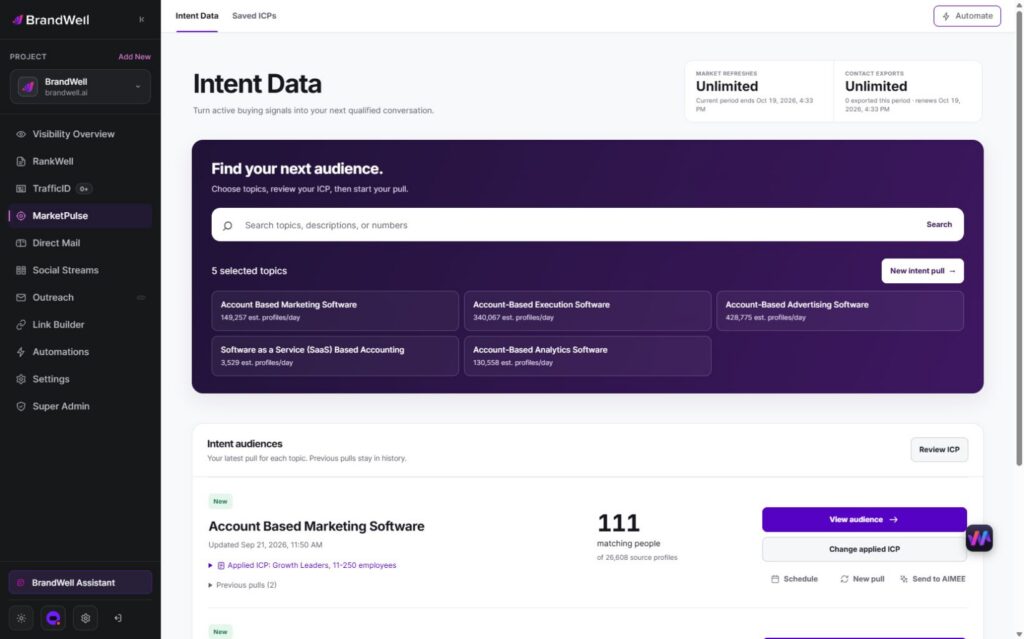
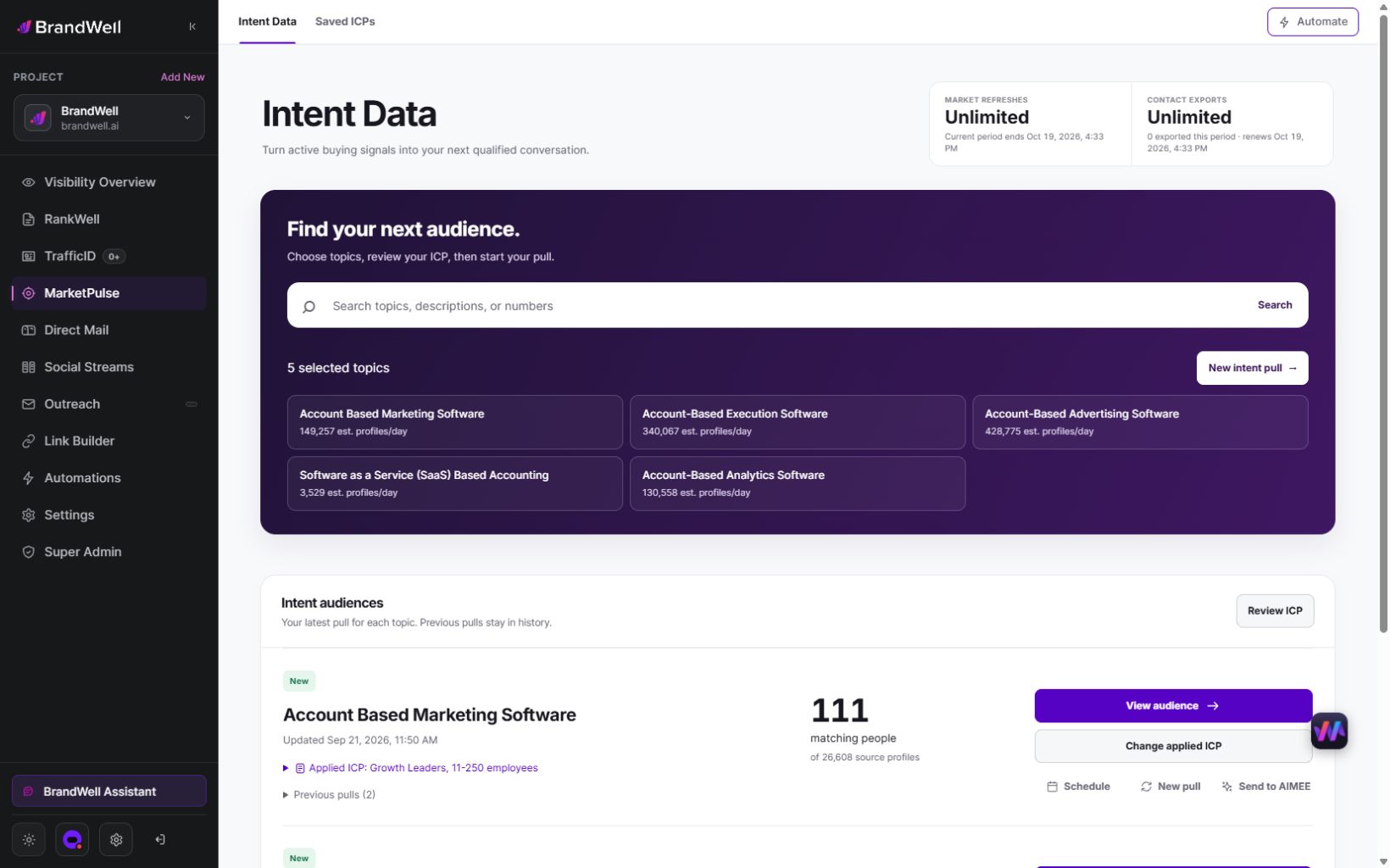
BrandWell MarketPulse: intent data starting at $500/mo. Find people researching topics relevant to what you sell, apply saved ICP filters, and review available contact details before taking action.
MarketPulse plans are starting at $500/mo. Verify current package scope and offers on the product page.
| Plan | Topics and refreshes | Monthly exports |
|---|---|---|
| Starter | 1 topic, weekly | 25,000 contacts |
| Growth | 3 topics, daily | 100,000 contacts |
| Scale | 10 topics, daily | Unlimited contacts |
Swipe the table to see all columns.
A pull retrieves available data from the previous 24 hours for one topic. Daily use across all included topics provides 90 Growth pulls or 300 Scale pulls in a 30-day month. Weekly Starter pulls vary by calendar month. Available audience size and contact fields vary, and audiences may overlap. Refreshes stop at the plan limit without overage charges.
- Find and qualify: search the topic catalog, save your ICP, and review the people and companies that match.
- Act on the research: export qualified contacts or prepare an Outreach or Direct Mail workflow. Connected products, channel usage, and fulfillment may cost extra.
- Get help from AIMEE: Growth and Scale include AIMEE for the initial user to research accounts and prepare the next step through connected tools.
Agencies and other service businesses can build client deliverables around their available Intent Scans and exports. Keep each client’s scope, permissions, and service fees clear. A subscription is not a promise of a white-label platform or exclusive access to a market.
Explore MarketPulse and watch the demo or compare plans starting at $500/mo. Any early-access discount is a separate, time-limited offer shown to an eligible recipient.
Set cash and time ceilings
Intent data is a fit when a bootstrapped team has a defined ICP, enough deal value to fund careful research, more plausible accounts than it can work, and one person who owns follow-up. It is premature when cash runway depends on immediate results, the company has only a handful of targets, the sales motion is unproven, or no one can review the output.
Write four numbers first:
- Maximum cash at risk: the amount the business can lose without changing payroll, runway, or essential acquisition work.
- Maximum operator time: the hours per week available for review, research, corrections, and reporting.
- Minimum economic result: the number and contribution value of qualified outcomes needed to justify the experiment.
- Decision date: when the company will stop, continue manually, or graduate the workflow.
This is the foundation of an intent-led growth for bootstrapped B2B companies planning guide. A vendor demo should not set these numbers for you.
Use seven bounded workflow steps
1. Choose one action worth paying to improve
Good first actions include prioritizing a small target-account list, researching known website visitors, or preparing a founder for timely follow-up with existing relationships. “Generate more leads” is too broad. Name the exact decision, owner, time window, and prohibited action.
2. Use owned evidence before rented evidence
Inventory form fills, reply history, product or trial events, high-value page visits, webinar attendance, CRM stage, and customer state. Clean account domains and contact permissions. Third-party topic data should add a missing view, not replace neglected first-party evidence.
3. Limit the topic dictionary
Define the narrow topic set, actual source, recency, observation unit, synonyms, exclusions and version. A topic label does not establish buyer intent, useful coverage or accuracy. Test the actual records before increasing scope.
4. Produce a weekly evidence queue
Each row needs account, fit, source, observed time, topic or first-party event, identity state, prior relationship, suppression status, suggested low-risk action, and uncertainty. Cap the queue at what the founder or seller can review. Measure whether the accepted queue produces useful completed work.
5. Review manually and record rejection reasons
Reject off-ICP, stale, duplicate, customer, competitor, employee, ambiguous identity, prohibited geography, opted-out, or context-poor records. Do not hide rejects; review them to identify actual rule and evidence problems. Never auto-enroll a person because an IP-to-company match or candidate identity appeared.
6. Take a proportionate action
The action may be account research, a contextual update to an existing relationship, a founder-created resource, or a human-approved ad audience. A single weak signal should not trigger personalized outreach that reveals an inference. Keep normal channel rules and suppression in force.
7. Reconcile cost and outcomes every week
Add cash and labor. Record accepted records, actions, positive replies, qualified meetings, opportunities, revenue, corrections, complaints, and opt-outs. Continue only if the workflow shows a credible path to payback and the team can operate it without starving higher-value work.
Test a minimal research setup
The simplest signal-to-action workflow for a bootstrapped company can run with five components:
- an existing CRM or disciplined spreadsheet;
- first-party website and form events;
- account and contact enrichment only when needed;
- one narrow third-party topic or visitor source;
- a weekly review and outcome column.
Do not buy duplicate sources before testing overlap. Do not add an automation platform simply to move uncertain data faster. Do not maintain a lead score with more fields than the operator can explain. Those are common intent-led growth for bootstrapped B2B companies mistakes.
Write the pilot decision record
Use the charter to record the decision, constraints and evidence required for the bounded pilot. Include the client problem, one eligible market, ICP and exclusions, topic definitions, sources, identity states, weekly record cap, reviewer, allowed and prohibited actions, response window, cash and labor ceiling, baseline, outcome fields, suppression owner, decision date, and exit format. Add a box labeled “what this pilot cannot prove.”
Require the founder, sales owner, operator, and privacy or legal reviewer where appropriate to approve the same version. When a rule changes, write the reason and effective date rather than quietly rewriting history. At the decision meeting, choose stop, repair, continue manually, or graduate. Do not use a vague “extend the test” option without a new ceiling and hypothesis.
Compare tools and operating work
Compare tools against the actual evidence-loop gap: necessary input, verifiable output, operator labor, policy fit, integration burden, exportability and total cost. Verify a representative sample before assuming a subscription will solve an operating constraint.
- Existing tools plus a template: Consider when the company is still defining the decision. Cost is mostly founder or operator time; off-site visibility is limited.
- A single point capability: Consider for a known gap such as email validation, enrichment, visitor qualification, or a small topic feed. Check minimums, credits, export, and integration labor.
- An agency-delivered pilot: Consider when internal time is scarce and an agency can spread platform and operating cost across clients. Require a fixed scope, transparent inputs, and an exit file.
- A reseller platform: Consider for an agency operating several qualifying clients, not automatically for one low-ACV bootstrapped buyer.
- A broad enterprise suite or custom build: Compare actual cost and constraints; consider only if the company already has repeatable volume, multi-team needs, and proven economics.
Software fits an operator who already knows the workflow. An agency fits a founder who needs the workflow run, reviewed, and reported. An in-house build fits a durable proprietary process with engineering capacity. The lowest-cost alternative may be to keep a manual target-account review until deal economics or volume change.
Separate cash and economic cost
Intent-led growth for bootstrapped B2B companies pricing includes data, platform, setup, enrichment, verification, integration, operator time, founder or seller research, outreach tools, media, privacy review, and reporting. Record paid labor and founder opportunity cost separately from actual cash outflows. Exclude hypothetical “time saved” unless the freed capacity is actually used.
A simple planning formula is:
fully loaded pilot cost
÷ contribution per actual incremental closed deal
= incremental closed deals needed to break even, rounded up
For example, if a hypothetical pilot costs $6,000 fully loaded and a qualified closed deal contributes $3,000 after delivery costs, at least two incremental closed deals are needed merely to break even. That is arithmetic, not a forecast; probability, sales cycle, baseline performance, and attribution still matter.
Track outcomes and stop rules
Intent-led growth for bootstrapped B2B companies ROI is not signal volume. Use a weekly scorecard with:
- total cash and labor consumed;
- eligible accounts and signal coverage;
- no-match, stale, duplicate, and off-ICP rates;
- reviewer acceptance and queue age;
- actions completed within the promised response window;
- positive replies, qualified meetings, opportunities, and contribution margin;
- opt-outs, complaints, and correction requests.
Stop when the cash ceiling is reached, the queue displaces proven acquisition work, quality remains poor after one documented adjustment, or the sales cycle makes the decision deadline unknowable. Continue manually when the signal is useful but volume is small. Graduate to automation only when rules are stable, exceptions are understood, and outcomes can flow back.
Benchmarks from another company cannot set your threshold. Use your normal acquisition baseline, a concurrent holdout when feasible, and confidence intervals or wide ranges rather than invented certainty.
Verify purpose and action boundaries
Verify actual recipient, jurisdiction, purpose, channel and opt-out obligations before contact. Resolve missing approval before action; a business contact or research event does not establish permission.
Verify actual source rights, necessary fields, access, retention, suppression, correction, deletion and incident responsibility. Retain only the details needed for the approved purpose.
Scope a separate agency pilot
A right-sized service is a fixed-scope “intent review desk,” not a large platform resale. It can include one client market, a narrow topic dictionary, a capped weekly queue, manual QA, evidence cards, one activation play, outcome reconciliation, and a stop/graduate meeting. Price the agency’s labor and margin separately from data and media.
Here, BrandWell means the MarketPulse intent-data and growth automation platform, connected with the broader BrandWell content and growth tools.
MarketPulse supplies topic research and available match details. AIMEE can organize supplied context through configured tools. An agency operating service, branded weekly report, CRM synchronization or custom client interface needs separately verified implementation, rights, scope and fees. The research subscription does not establish those delivery capabilities.
Review an available MarketPulse topic, saved ICP and actual preceding-24-hour matches for the approved research purpose. Keep uncertain company context visible. AIMEE can organize supplied context through configured tools; named owners approve actual exports, messages, audience uploads and CRM writes.
Keep assistant work within the cap
AIMEE can prepare a review brief through configured connected tools. Keep proposed actions separate from actual approvals and destination acknowledgements. Confirm the implementation and permissions before execution.
Job: prepare this week's bootstrapped account-review queue. No outreach.
Budget constraints: [cash ceiling], [hours ceiling], [weekly row cap].
Inputs: ICP, topic definitions, source/time, identity state, CRM state,
suppression register, and allowed actions.
For each row: preserve provenance; reject if off-ICP, stale, duplicate,
suppressed, or too ambiguous; state what is known versus inferred;
recommend research, defer, or human review; estimate operator minutes.
Stop when the weekly cap is reached. Ask approval before any CRM write,
audience upload, browser submission, or message creation.
A written assistant instruction does not establish that a cap or approval boundary is implemented. Test actual output and stop behavior before action.
Bootstrapped buyer questions
How should a bootstrapped B2B company use intent data?
Start with one cash-bounded prioritization use case, owned signals, and manual review. Do not finance a broad stack before the workflow can repay itself.
What is the simplest workflow?
Combine one source with ICP fit, freshness, identity state, suppressions, a weekly human queue, and an outcome column.
What are the best affordable tools?
Use existing CRM and analytics first, then buy one point capability or an agency-delivered pilot for the proven gap. Compare total cost, not list price.
Software, agency, or in-house?
Software suits an existing operator; an agency supplies scarce operating capacity; a build needs repeatable proprietary volume. Manual work is a valid alternative.
What should the company budget?
Risk only cash and hours the business can lose. Include labor, integration, validation, media, and governance – not just the vendor quote.
How should ROI be measured?
Track fully loaded cost through accepted records, qualified meetings, opportunities, and contribution, against a normal baseline or holdout where feasible.
When is intent data premature?
It is premature without a stable ICP, meaningful deal economics, more plausible accounts than capacity, an operator, or a measurable sales outcome.
Which signals matter most?
Start with known first-party conversions and relationship context. Use narrow third-party topics to prioritize – not to declare purchase readiness.
What risks should the team avoid?
Avoid unclear provenance, broad topics, stale and false matches, missing suppressions, data hoarding, and automated outreach from weak evidence.
What should an agency offer?
Offer a capped review desk with transparent evidence, manual QA, one activation play, cash reporting, and an exit or graduation decision.
A practical next step is to write the cash ceiling, queue cap, first use case, and stop date on one page. If that page cannot be approved, the company is not ready to buy more intent data.
Copyable cash-bounded pilot record
Question: [Actual research decision and owner.] Scope: [Topic, unique account unit, period and exclusions.] Cash: [Actual payments, receipts, ceiling and commitments.] Time: [Paid labor, founder opportunity cost and capacity ceiling.] Action: [Eligibility, approver, implemented route and acknowledgement.] Outcome: [Actual buyer evidence, missing feedback and suitable comparator.] Decision: [Date, stop or repair rule and exit cost.]
The SBA business-management guide distinguishes revenue, expenses and cash records. Keep actual payments and collection timing visible; this general guidance does not validate a campaign return or replace advice for the company’s accounting.
Worked example: founder time is not the same cash outflow
Assume a fictional two-month pilot uses the current standard $250/month MarketPulse Starter plan: $500 in subscription payments. Add $200 in paid review help and $100 in setup, for $800 in cash outflows. Twenty unpaid founder hours valued at $50 each add $1,000 in opportunity cost, making the planning economic cost $1,800. Do not deduct the same unpaid time from bank cash or count paid labor twice.
With $20,000 cash and a hypothetical $5,000 monthly cash burn, simple runway is four months. An additional one-time $800 payment leaves $19,200, or 3.84 months if future burn and receipts remain unchanged. Further renewals, taxes, collection changes and other spending can change that result. This illustration is not a runway forecast.
Use contribution from actual closed deals
Assume an actual incremental closed deal would produce $3,000 revenue and $1,800 in delivery costs, leaving $1,200 contribution before acquisition and other excluded costs. The $1,800 planning cost divided by $1,200 is 1.5 deals: two whole incremental deals would be needed to exceed that defined cost. Two such deals leave $600 after the pilot cost. A qualified meeting, $3,000 of pipeline or an unpaid invoice does not supply that contribution or bank cash. Incrementality remains unproved without an appropriate comparison and assumptions.
Check separately sold service economics
A separate fictional $3,000 agency fee against $1,800 in defined service costs leaves $1,200, or 40%. Another $1,300 in correction work makes the remainder negative $100. Acquisition, general overhead, tax and financing are excluded and can further change the result. These agency inputs are invented and are not BrandWell service fees or typical margins.
Prepare the supported research input
Review an available MarketPulse topic, saved ICP and actual preceding-24-hour matches for the approved purpose. Verify company context and preserve uncertainty. TrafficID is separately scoped own-site visitor work. AIMEE can organize supplied context through configured tools. Owners approve exports, messages, Outreach enrollment, audience uploads and CRM writes. Agency reporting, review desks, custom interfaces and synchronization require separately verified rights, implementation, scope and fees.
Frequently asked pilot questions
Does unpaid founder time reduce bank cash?
No. Record its opportunity cost separately.
Does pipeline repay the cash spent?
No. Preserve actual revenue, costs and collections.
Is break-even arithmetic a sales forecast?
No. Outcomes and incrementality remain uncertain.
Does a subscription include agency delivery?
Do not assume that. Scope services separately.
Review the research product: explore MarketPulse and current plans.
Reviewed and updated October 3, 2026.

Written by