On this page
- Current MarketPulse research workflow
- Calculate actual review capacity
- Use seven queue controls
- Rank work without inventing readiness
- Set routing and no-action rules
- Test representative rule cases
- Compare operator burden
- Count accepted-account and labor costs
- Measure queue use and actual outcomes
- Verify purpose and action boundaries
- Scope a separate agency capacity service
- Keep assistant output within the cap
- Small-team buyer questions
- Copyable weekly queue contract
- Frequently asked queue questions
Intent-led growth for companies with small sales teams should protect rep capacity before it expands coverage. Calculate how many records the team can review, set hard acceptance rules, and route only a small evidence-rich queue. A signal program that creates more work than the team can finish is not growth infrastructure; it is another source of backlog.
Who this is for: founder-led sales teams, small SDR and AE groups, lean RevOps teams, and agencies expected to turn broad intent evidence into a manageable seller queue.
Intent signals are probabilistic evidence, not proof of identity, consent, need, authority, stage, qualification, purchase, pipeline, or outcome.
Current MarketPulse offer: intent-data plans start at $500/mo. See the product, demo, and current plans. Updated October 3, 2026.
Current MarketPulse research workflow
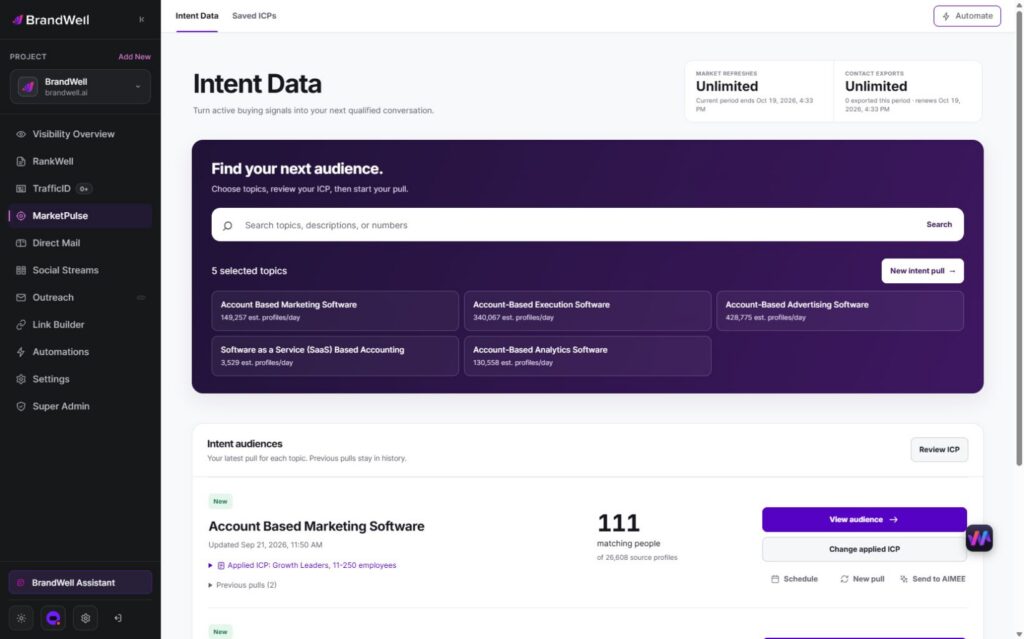
BrandWell MarketPulse: intent data starting at $500/mo. Find people researching topics relevant to what you sell, apply saved ICP filters, and review available contact details before taking action.
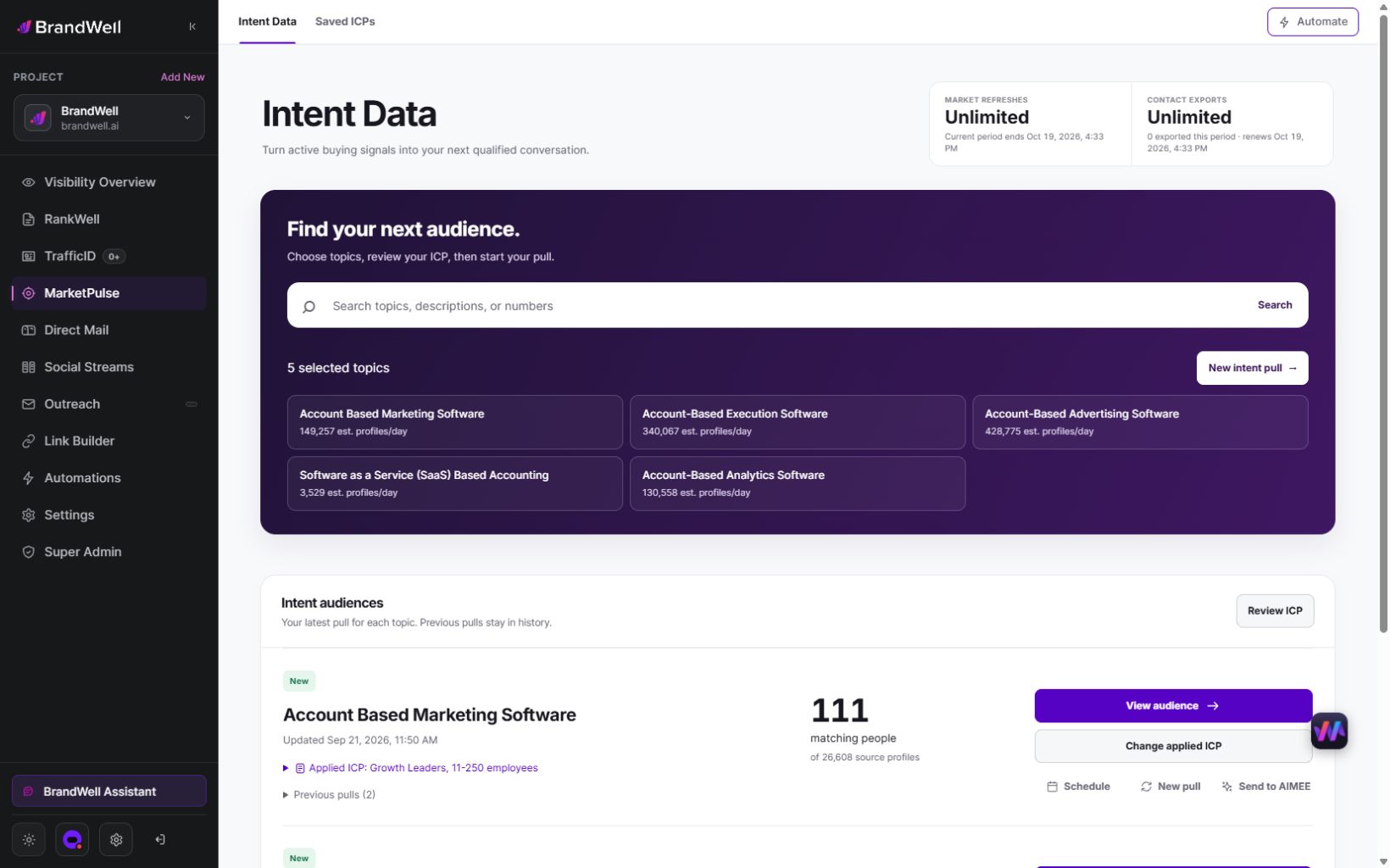
MarketPulse plans are starting at $500/mo. Verify current package scope and offers on the product page.
| Plan | Topics and refreshes | Monthly exports |
|---|---|---|
| Starter | 1 topic, weekly | 25,000 contacts |
| Growth | 3 topics, daily | 100,000 contacts |
| Scale | 10 topics, daily | Unlimited contacts |
Swipe the table to see all columns.
A pull retrieves available data from the previous 24 hours for one topic. Daily use across all included topics provides 90 Growth pulls or 300 Scale pulls in a 30-day month. Weekly Starter pulls vary by calendar month. Available audience size and contact fields vary, and audiences may overlap. Refreshes stop at the plan limit without overage charges.
- Find and qualify: search the topic catalog, save your ICP, and review the people and companies that match.
- Act on the research: export qualified contacts or prepare an Outreach or Direct Mail workflow. Connected products, channel usage, and fulfillment may cost extra.
- Get help from AIMEE: Growth and Scale include AIMEE for the initial user to research accounts and prepare the next step through connected tools.
Agencies and other service businesses can build client deliverables around their available Intent Scans and exports. Keep each client’s scope, permissions, and service fees clear. A subscription is not a promise of a white-label platform or exclusive access to a market.
Explore MarketPulse and watch the demo or compare plans starting at $500/mo. Any early-access discount is a separate, time-limited offer shown to an eligible recipient.
Calculate actual review capacity
Start with available review minutes, not record volume.
weekly review capacity
= active reviewers × protected review hours × reviewed records per hour
If two sellers each protect two hours and can responsibly review six evidence cards per hour, the theoretical ceiling is 24 records. Reduce it for meetings, exceptions, research, and follow-up. The final weekly queue might be 12–18 records. That is a planning example, not a performance benchmark.
Intent data is a fit when the team has more plausible accounts than it can research, a defined ICP, meaningful deal economics, and owners who will accept or reject recommendations. It is premature when the territory is already tiny, every rep is overloaded, routing is disputed, or no outcomes return.
Use seven queue controls
1. Freeze the weekly account ceiling
Set the maximum new accounts per rep and reserve time for follow-up. The queue may not exceed capacity merely because a vendor finds more records. Overflow should expire, defer, or return to an agency review desk – never silently create overdue tasks.
2. Require fit before intent
Apply company, market, role, customer-state, territory, and deal-value rules before scoring research behavior. Intent cannot make an off-ICP account valuable. Keep fit criteria versioned so rejection patterns can improve the market definition.
3. Preserve source, recency, and identity state
Keep actual event source, time, observation unit, topic or page, identity state and uncertainty. A source label does not establish accuracy, usefulness or destination eligibility. Preserve company matches, candidate people and known contacts as distinct evidence.
4. Use acceptance rules that a rep can explain
An example rule might require target-account fit plus either a known first-party decision event or repeated fresh topic evidence with an existing relationship. Define the rule in plain language, test it against positive, negative, stale, duplicate, customer, competitor, employee, and ambiguous cases, and record exceptions.
5. Suppress before routing
Apply opt-outs, customers, partners, competitors, employees, duplicates, restricted geographies, disqualified accounts, open ownership conflicts, and channel-specific permissions. A suppression failure should block the workflow.
6. Route one evidence card to one owner
The card should contain known facts, inferences, missing evidence, CRM history, why it qualified, permitted next steps, and a deadline. The rep chooses accept, reject, defer, research, or act. A small sales team cannot absorb ambiguous alerts across email, chat, CRM, and spreadsheets simultaneously.
7. Feed outcomes into the next queue
Record disposition, rejection reason, action, positive response, qualified meeting, opportunity, correction, complaint, and opt-out. Adjust one rule at a time. Preserve these records for review of the actual queue and outcome trail.
Rank work without inventing readiness
The score should rank work, not claim buyer readiness. Use a transparent queue score built from:
- account fit;
- evidence freshness;
- recurrence or corroboration;
- identity sufficiency for the proposed action;
- relationship and lifecycle context;
- action value;
- review cost;
- suppression and governance status.
Keep the actual source definition and underlying evidence rather than treating every score or research label as the same buyer state.
Set routing and no-action rules
The simplest signal-to-action workflow for a small sales team is:
- ingest the event without erasing provenance;
- resolve account and identity state;
- apply fit, freshness, and suppressions;
- rank within the weekly capacity ceiling;
- send one evidence card to the named owner;
- require a disposition within the SLA;
- return the outcome and expire unactioned evidence.
Use different SLAs for known first-party hand raises, repeat account research, and weak third-party observations. Do not create a task from every event. “No action” is a valuable result because it protects capacity and trains the filter.
Test representative rule cases
Build a 25-record test set that includes obvious positive, obvious negative, borderline, stale, duplicate, customer, competitor, employee, wrong territory, subsidiary, remote-worker, ambiguous domain, candidate person, known contact, opted-out, and missing-owner cases. Hide the expected result from the reviewer, run the proposed rule, and compare decisions. Record disagreement rather than averaging it away.
This selected test set does not establish population accuracy or operational outcome rates. It can expose rule disagreement and specific failures in the tested cases. If reviewers disagree about known versus inferred fields, fix the schema. If they agree on qualification but choose different actions, fix the action matrix. If most records need outside research, reduce the weekly cap or add an agency review step.
Repeat the set after a material topic, source, match, routing, or suppression change. Keep old versions so the team can see whether quality improved or merely changed. This is a practical intent-led growth for companies with small sales teams operational checklist and a prerequisite for automation.
Compare operator burden
Compare tools against the actual evidence-loop gap: necessary input, verifiable output, operator labor, policy fit, integration burden, exportability and total cost. Verify a representative sample before assuming a subscription will solve an operating constraint.
- CRM views and manual evidence cards: Consider for proving rules. Low software cost; limited external visibility and high discipline requirement.
- One modular data tool: Consider for a specific missing capability such as enrichment, validation, visitor qualification, or topic research. The team owns routing and QA.
- A managed agency review desk: Consider when reviewers, not data, are the constraint. Require queue caps, acceptance reasons, client-specific suppression, and export.
- A reseller operating platform: Consider when an agency serves multiple suitable clients and can standardize delivery while preserving separation.
- A broad suite or custom pipeline: Consider only when scale, multi-team coordination, or proprietary logic justifies administration.
Buy software when a named operator has protected time. Hire an agency when the missing resource is review and reporting. Build in-house when a repeated high-value workflow deserves engineering ownership. Keep the manual path when the queue is small.
Count accepted-account and labor costs
Intent-led growth for companies with small sales teams pricing must include platform and data, integration, enrichment and validation, agency or operator labor, rep review, training, media or outreach tools, governance, and measurement. A low per-record price can be expensive if most records are rejected after ten minutes of research.
Track:
fully loaded cost per accepted account
= (data + software + services + integration + review labor) ÷ accepted accounts

rep hours per qualified opportunity
= protected rep hours consumed ÷ qualified opportunities created
Measure queue use and actual outcomes
Intent-led growth for companies with small sales teams ROI begins with operating metrics:
- eligible records, queue cap, and overflow;
- median queue age and SLA compliance;
- acceptance, rejection, defer, and no-action rates;
- reviewer and rep minutes per record;
- completed research and approved actions;
- positive response, qualified meeting, and opportunity rates;
- qualified pipeline and contribution by cohort;
- corrections, ownership conflicts, opt-outs, and complaints.
Compare with normal territory work or a matched/rotating holdout when feasible. Do not call all opportunity value “intent sourced.” The program may influence prioritization alongside brand, seller skill, relationships, media, and timing.
Stop or narrow the program when overflow is chronic, seller acceptance stays low, response time exceeds the signal window, or cost per accepted account rises beyond the deal model. Expand only after the team can finish the current queue and explain its outcomes.
Verify purpose and action boundaries
Verify actual source rights, necessary fields, permitted purpose, access, retention, suppression, correction, deletion and incident ownership. Check recipient, jurisdiction, channel and opt-out obligations before contact. Resolve missing approval before activation.
Verify actual source rights, necessary fields, permitted purpose, access, retention, suppression, correction, deletion and incident ownership. Check recipient, jurisdiction, channel and opt-out obligations before contact. Resolve missing approval before activation.
Scope a separate agency capacity service
A right-sized agency service can absorb raw evidence, apply the client’s rules, deliver a capped seller queue, manage exceptions, maintain suppressions, and report outcomes. The agency should sell protected rep capacity and decision quality – not unlimited leads. Include overflow rules, a client review cadence, transparent rejection reasons, and a clean exit export.
Here, BrandWell means the MarketPulse intent-data and growth automation platform, connected with the broader BrandWell content and growth tools.
BrandWell MarketPulse is topic-based intent-data software for businesses and agencies. Choose relevant research topics, apply saved ideal-customer-profile filters, review available names, roles, companies and contact details, and export the audience or prepare a connected workflow. Plans start at $500/mo. TrafficID identifies visitors to your own website and is a separate product. A MarketPulse subscription does not by itself promise a white-label portal, custom API implementation, exclusive topics, or managed client delivery.
Review an available MarketPulse topic, saved ICP and actual preceding-24-hour matches for the approved research purpose. Keep uncertain company context visible. AIMEE can organize supplied context through configured tools; named owners approve actual exports, messages, audience uploads and CRM writes.
Keep assistant output within the cap
AIMEE can prepare a review brief through configured connected tools. Keep proposed actions separate from actual approvals and destination acknowledgements. Confirm the implementation and permissions before execution.
Objective: produce no more than [weekly cap] seller evidence cards.
Inputs: ICP, territory and owner map, approved signal rules, source/time,
identity state, CRM lifecycle, suppressions, allowed actions, and SLA.
Process: reject off-ICP and suppressed records; preserve known vs inferred;
rank eligible records by freshness, corroboration, relationship context,
action value, and review effort; explain every component; flag conflicts.
Output: capped queue, overflow/defer list, rejection reasons, missing data.
Stop before CRM writes, audience uploads, or outreach; request owner approval.
A written assistant prompt is not evidence that a cap, permission boundary or stop rule is implemented. Test the actual output and approval behavior before action.
Small-team buyer questions
How should a small sales team use intent data?
Use it to reduce a large plausible market to a capped review queue. Protect rep time and preserve uncertainty before adding volume.
What is the simplest workflow?
Ingest, resolve, filter, suppress, rank within capacity, route one evidence card, and return the disposition and outcome.
What are the best affordable tools?
Choose the path with the lowest accepted-account and operator cost: manual CRM, one modular tool, an agency review desk, a reseller platform, or a broader suite.
Software, agency, or in-house?
Software needs an operator; an agency supplies review capacity; a build needs repeated proprietary value. Compare manual work for a small queue against its actual labor and error cost.
What should the team budget?
Budget platform, data, setup, integration, validation, agency time, rep review, activation, and governance. Model cost per accepted account.
How should pipeline impact be measured?
Track queue age, acceptance, time per record, qualified meetings, opportunities, cohort pipeline, corrections, and complaints against normal work.
When is intent data premature?
It is premature when reps cannot finish the queue, ownership is unclear, the ICP is unstable, or territory size is already below capacity.
Which signals matter most?
Prioritize known first-party actions and fresh corroborated account evidence. Require sufficient identity for the proposed action.
What risks should the team avoid?
Avoid alert overload, opaque scores, stale evidence, ownership conflict, false person matches, missing suppressions, and agents that write or send without approval.
What should an agency offer?
Offer a capacity buffer: filter raw signals, deliver a capped explainable queue, maintain suppressions, manage overflow, and reconcile outcomes.
Before requesting a vendor quote, calculate the weekly queue ceiling and run the proposed rule against 25 representative records. If reviewers cannot explain the rejects, the rule is not ready.
Copyable weekly queue contract
Scope: [Unique account unit, topic, period and exclusions.] Capacity: [Actual review, follow-up and exception minutes.] Rules: [Fit, evidence, eligibility and suppression.] Owner: [Reviewer, action approver and destination.] Overflow: [Defer, expire or separately staffed review with owner.] Feedback: [Disposition, actual buyer outcome and missing cases.] Decision: [Full cost, stop rule and next review date.]
Google’s SRE overload guidance measures actual resource constraints. It concerns computing rather than staffing benchmarks. As an operating analogy, check actual task time and constrained roles instead of assuming each record costs the same effort.
Worked example: follow-up changes the queue ceiling
Assume a fictional team has eight protected hours, or 480 minutes, for a weekly queue. Ten cards require ten review minutes plus twenty follow-up minutes each: 300 minutes. Five exception cases require another 30 minutes each: 150 minutes. Total planned work is 450 minutes, leaving 30 minutes. Twelve cards with the same exception workload require 510 minutes, exceeding capacity by 30 minutes. Preserve skill and timing constraints rather than treating all spare time as interchangeable.
If eight of the ten queued accounts receive acceptance, acceptance is 80% of the queue. Feedback exists for six accepted accounts; coverage is 75%, with two unresolved. Four verified meetings are 50% of accepted accounts or 40% of the queue. Do not silently use only the six reported cases to inflate the outcome rate. Meetings still are not purchases or causal revenue.
Check useful-unit cost and extra work
At $900 in defined weekly costs, the fictional queue costs $90 per queued account, $112.50 per accepted account or $225 per verified meeting. A $1,500 agency fee leaves $600, or 40%. Another $650 in exception work makes the remainder negative $50. Setup, acquisition, general overhead, tax and financing are excluded and can further change the result. These invented inputs are not BrandWell service fees or typical margins.
Keep selected-case tests separate from live performance
If a rule produces the expected decision for 22 of 25 deliberately selected test cases, agreement is 88% on that selected set. It does not establish population accuracy, seller acceptance, message permission or conversion. Keep the three disagreements, expected-result rationale and actual retest results. A critical suppression failure can block release regardless of the aggregate agreement.
Prepare the supported research input
Review an available MarketPulse topic, saved ICP and actual preceding-24-hour matches for the approved purpose. Verify company context and preserve uncertainty. TrafficID is separately scoped own-site visitor work. AIMEE can organize supplied context through configured tools. Owners approve exports, messages, Outreach enrollment, audience uploads and CRM writes. Custom reports, review desks and synchronization require separately verified implementation, rights, scope and fees.
Frequently asked queue questions
Should the queue include follow-up time?
Yes. Count actual review, follow-up and exceptions.
Can unresolved feedback disappear from rates?
No. Report missing cases and the denominator.
Does a selected test establish population accuracy?
No. Report it as agreement on the tested cases.
Does a MarketPulse subscription supply a review desk?
Do not assume that. Scope agency work separately.
Review the research product: explore MarketPulse and current plans.
Reviewed and updated October 3, 2026.

Written by