On this page
- Current MarketPulse research workflow
- Assign accountable owners
- Define nine operating controls
- Run one bounded decision loop
- Validate buying-group evidence
- Compare actual delivery scope
- Budget integration and exit
- Measure quality and unique outcomes
- Verify procurement and action boundaries
- Scope a separate agency operating service
- Keep assistant tasks within approval
- Enterprise buyer questions
- Copyable enterprise control-test record
- Frequently asked control questions
Enterprise intent-led growth should be designed as a governed operating system across business units, data sources, buying groups, systems, permissions, suppressions, human approvals, and measurement. The smallest useful enterprise workflow is not necessarily the fewest tools; it is the narrowest end-to-end decision with named accountability, traceable evidence, separated data, and a controlled exit.
Who this is for: enterprise CMOs, CROs, RevOps, marketing operations, data and security teams, procurement, privacy counsel, and agencies or resellers expected to operate intent programs inside enterprise controls.
Intent signals are probabilistic evidence, not proof of identity, consent, need, authority, stage, qualification, purchase, pipeline, or outcome.
Current MarketPulse offer: intent-data plans start at $500/mo. See the product, demo, and current plans. Updated October 3, 2026.
Current MarketPulse research workflow
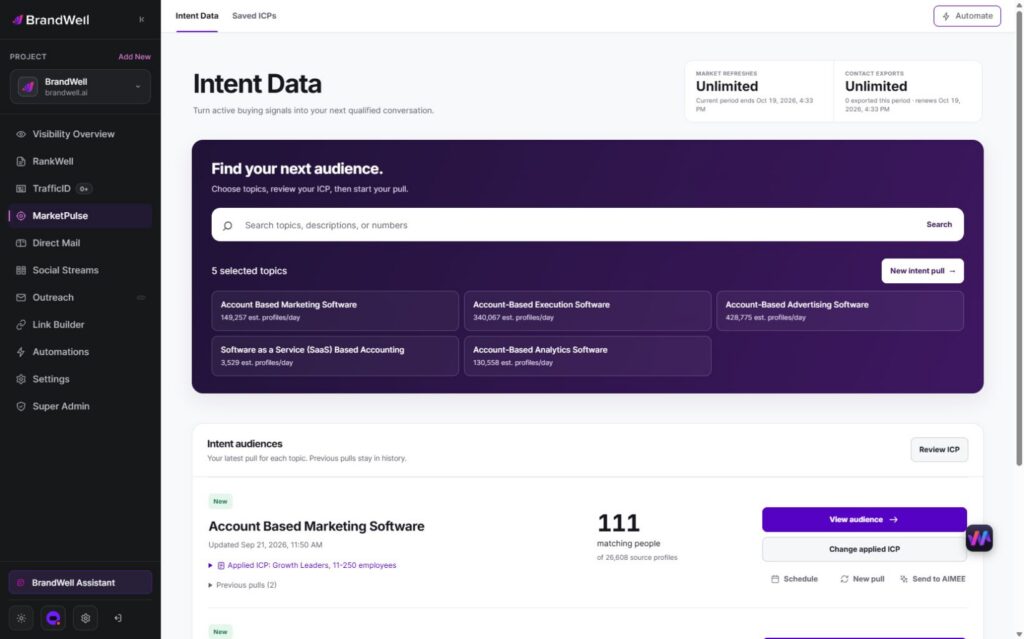
BrandWell MarketPulse: intent data starting at $500/mo. Find people researching topics relevant to what you sell, apply saved ICP filters, and review available contact details before taking action.
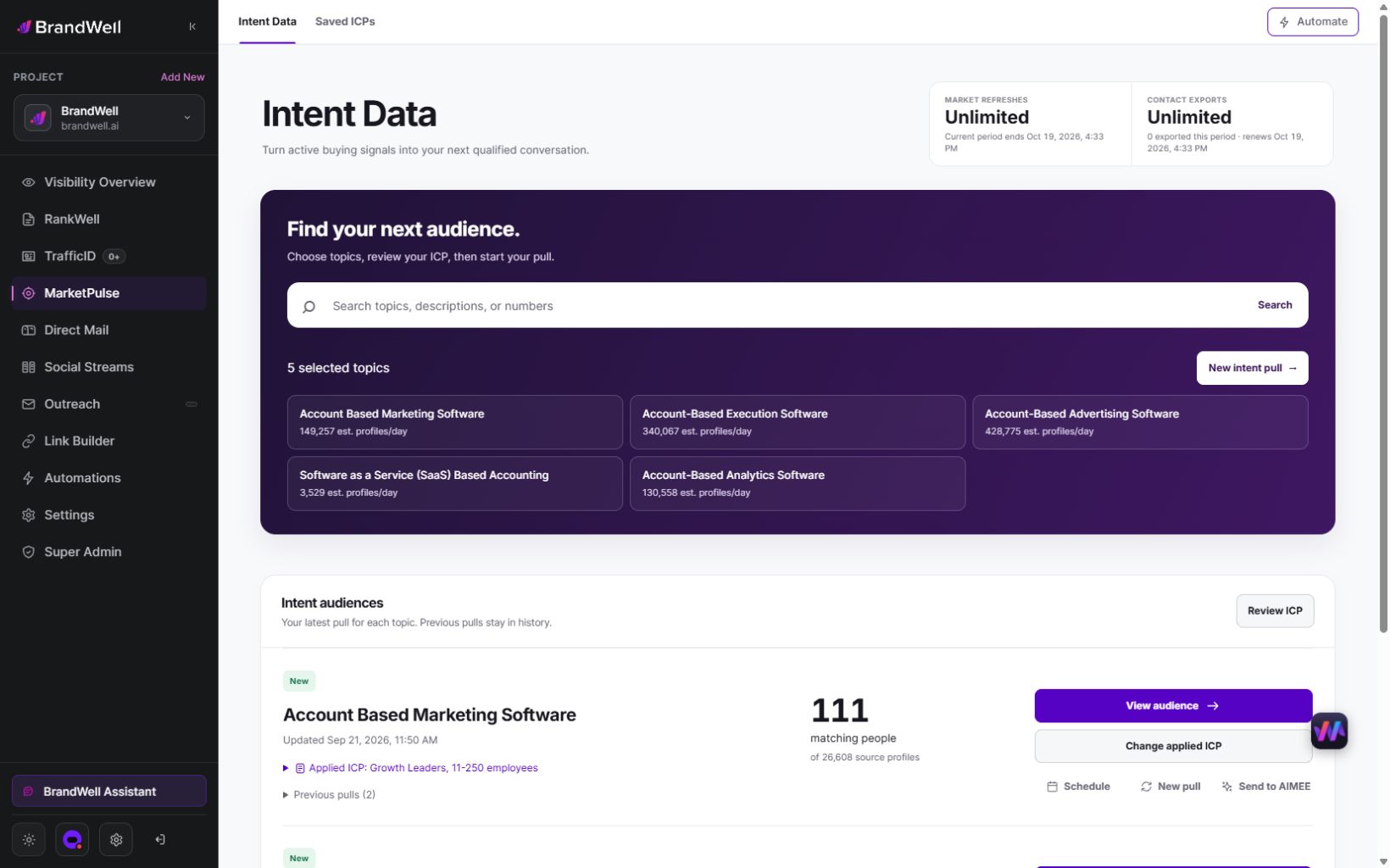
MarketPulse plans are starting at $500/mo. Verify current package scope and offers on the product page.
| Plan | Topics and refreshes | Monthly exports |
|---|---|---|
| Starter | 1 topic, weekly | 25,000 contacts |
| Growth | 3 topics, daily | 100,000 contacts |
| Scale | 10 topics, daily | Unlimited contacts |
Swipe the table to see all columns.
A pull retrieves available data from the previous 24 hours for one topic. Daily use across all included topics provides 90 Growth pulls or 300 Scale pulls in a 30-day month. Weekly Starter pulls vary by calendar month. Available audience size and contact fields vary, and audiences may overlap. Refreshes stop at the plan limit without overage charges.
- Find and qualify: search the topic catalog, save your ICP, and review the people and companies that match.
- Act on the research: export qualified contacts or prepare an Outreach or Direct Mail workflow. Connected products, channel usage, and fulfillment may cost extra.
- Get help from AIMEE: Growth and Scale include AIMEE for the initial user to research accounts and prepare the next step through connected tools.
Agencies and other service businesses can build client deliverables around their available Intent Scans and exports. Keep each client’s scope, permissions, and service fees clear. A subscription is not a promise of a white-label platform or exclusive access to a market.
Explore MarketPulse and watch the demo or compare plans starting at $500/mo. Any early-access discount is a separate, time-limited offer shown to an eligible recipient.
Assign accountable owners
Intent data is a fit when the enterprise has a defined account strategy, governed source and identity layers, named business owners, channel operators, security and privacy review, and outcome data. It is premature when business units disagree about account ownership, personal-data roles are undocumented, the CRM cannot return outcomes, or leaders expect a score to replace opportunity governance.
At minimum, name:
- an accountable revenue owner for the decision and budget;
- a RevOps or data owner for account, identity, routing, and outcome integrity;
- a marketing or sales operator for each activation channel;
- security, privacy, procurement, and legal reviewers;
- business-unit and regional data stewards;
- a vendor or agency service owner;
- human approvers for external actions and material automation changes.
Document the accountable owner, reviewers, actual permissions, evidence, changes and approval boundaries. A governance reference or written role list does not establish that a control is implemented or effective.
Define nine operating controls
1. Freeze the business decision and non-decision
Define one action such as prioritizing account research for a named segment or qualifying a known visitor for an existing-account team. Also define what the system may not do: infer opportunity stage, expose private research behavior, auto-contact a candidate identity, or override account ownership.
2. Create a source and provenance register
Keep actual provenance, recency, segmentation, unit, rights, limitations and uncertainty for each source. A source label is not evidence of useful coverage, accuracy or destination eligibility.
3. Define controller, processor, and operational responsibilities
Verify actual legal and operating roles against the purpose, processing, contracts and jurisdiction. Do not infer rights or responsibilities from a product label. Obtain qualified advice for unresolved requirements.
4. Separate business units, clients, and regions
Use distinct workspaces, access groups, encryption and secret scopes, retention schedules, suppression lists, and exports where required. Prevent one agency client or region from viewing another’s records. Record cross-border transfers and downstream destinations. Test offboarding before onboarding.
5. Maintain a buying-group evidence map
Distinguish target account, company-level research, candidate contacts, known first-party contacts, CRM roles, and seller-confirmed buying participants. Show missing roles and conflicting evidence. Do not convert a list of enriched executives into a “committee” without validation.
6. Apply activation gates by channel and evidence state
An account-level event may support aggregate reporting or account research; a known consented contact may support a different action. Require eligibility, minimum audience rules, opt-out and suppression, brand and legal review, and owner approval before CRM, ads, email, or browser execution.
7. Keep a global suppression and correction service
Opt-outs, deletion requests, do-not-sell/share choices where applicable, employee and customer exclusions, legal holds, restricted sectors, and client-specific prohibitions must propagate to every destination. Define source-of-truth ownership and reconciliation frequency.
8. Log every automated and human decision
Preserve source event, input version, rule version, model or workflow version, decision, approver, destination, time, result, correction, and rollback. Logs must be accessible to the teams accountable for audit and incident response, not only the vendor.
9. Measure and govern change
Review data quality, queue utility, downstream outcomes, privacy and security exceptions, vendor changes, model changes, and business-unit drift. Require approval before changing a topic, threshold, destination, retention rule, or agent permission. This is the operational core of an intent-led growth for enterprise companies framework.
Run one bounded decision loop
Test this bounded enterprise workflow:
- ingest one approved source with provenance;
- resolve account and identity state inside the governed data layer;
- apply business-unit, region, fit, freshness, permission, and suppression rules;
- generate an evidence card with knowns, inferences, and missing evidence;
- route to the accountable owner under an SLA;
- require human approval for external activation;
- write the action and outcome to the audit and measurement layer;
- propagate corrections and suppressions back through every destination.
Run it for one market, business unit, topic family, and action. “Enterprise” does not require that the first release touch every system.
Validate buying-group evidence
First-party activity, third-party research and candidate identity each have different evidential limits. Preserve the actual source definition, observation unit, uncertainty and validation state. A known contact does not establish authority or permission for every proposed action.
Use a “known / inferred / unknown” label for every material field. Seller-confirmed authority is known from a documented interaction. A title suggesting likely influence is inferred. Budget remains unknown until confirmed. Preserve these labels so reviewers can see which buying-group statements remain unverified.
Compare actual delivery scope
Compare tools against the actual evidence-loop gap: necessary input, verifiable output, operator labor, policy fit, integration burden, exportability and total cost. Verify a representative sample before assuming a subscription will solve an operating constraint.
- Existing governed data and first-party stack: Consider when off-site visibility is optional and enterprise data controls are mature. Lowest vendor expansion; may leave research gaps.
- Modular APIs or point products: Consider for a defined identity, enrichment, visitor, validation, or intent gap. Integration, monitoring, and vendor orchestration remain internal.
- Managed agency or reseller service: Consider for a bounded market or business unit needing curated operations and reporting. Require tenant separation, RACI, audit access, and contractual data roles.
- Enterprise orchestration suite: Consider when advertising, sales, marketing, analytics, and multiple business units need coordinated control. Procurement and implementation burden are substantial.
- Custom enterprise pipeline: Consider when proprietary decisions, security requirements, and scale justify engineering, governance, and reliability ownership.
Buy a platform when the enterprise needs coordinated capabilities and owns operations. Use an agency for bounded execution and specialized review. Build when the workflow is strategically proprietary. A possible hybrid combines governed internal data and controls with selected vendor or agency modules. Do not call a reseller service a replacement for a full enterprise ABM suite unless the matched scope supports that claim.
Budget integration and exit
Intent-led growth for enterprise companies pricing should separate data and licensing, users and business units, history, usage and credits, implementation, integrations, identity and enrichment, security and privacy review, agency services, operations, media, creative, support, change management, measurement, and exit. Record commitment term separately from monthly-equivalent cost.
Model at least three scenarios: narrow business-unit pilot, multi-unit managed program, and enterprise orchestration. Include internal engineering, security, procurement, training, data-steward, and seller time. Ask what happens to historical evidence, suppression, audit logs, and exports at termination.
Measure quality and unique outcomes
Intent-led growth for enterprise companies ROI needs measures at four levels:
- Data: coverage, no-match, match-state distribution, freshness, duplicates, correction, and suppression propagation.
- Operations: queue age, acceptance, SLA, exception volume, approval time, routing errors, and audit completeness.
- Buyer process: validated buying-group roles, qualified conversations, opportunity creation, stage progression, no-decision, loss, and expansion.
- Economics and risk: fully loaded cost, qualified pipeline cohorts, contribution, privacy requests, complaints, incidents, and vendor exceptions.
Use business-unit and equal-age cohorts. Maintain a baseline or holdout where practical. Do not award all influenced pipeline to the signal vendor. Attribution is constrained by existing relationships, brand, seller behavior, media, product fit, and market conditions.
Stop or quarantine a workflow when suppressions fail, identity errors exceed the risk tolerance, owners do not use the queue, audits are incomplete, or a vendor cannot explain material changes. Expand only after the narrow loop is controlled and repeatable.
Verify procurement and action boundaries
Verify actual source rights, necessary fields, purpose, access, recipients, retention, correction, deletion, suppression and incident responsibility. Resolve missing approvals before activation. Technical access does not establish marketing permission.
Verify actual recipient, jurisdiction, channel, purpose and opt-out obligations before contact. Keep ownership and exception handling explicit; a vendor feature does not establish legal compliance.
Scope a separate agency operating service
An enterprise agency service should be narrow and contractible: one business unit or region, approved topics, source register, tenant separation, RACI, queue rules, activation matrix, suppression interface, audit export, incident process, outcome report, and change-control meeting. The agency handles operations under documented roles; the enterprise retains accountable approval.
Here, BrandWell means the MarketPulse intent-data and growth automation platform, connected with the broader BrandWell content and growth tools.
BrandWell MarketPulse is topic-based intent-data software for businesses and agencies. Choose relevant research topics, apply saved ideal-customer-profile filters, review available names, roles, companies and contact details, and export the audience or prepare a connected workflow. Plans start at $500/mo. TrafficID identifies visitors to your own website and is a separate product. A MarketPulse subscription does not by itself promise a white-label portal, custom API implementation, exclusive topics, or managed client delivery.
Evaluate MarketPulse with a representative topic and a defined ICP. Review the matching audience, prepare one useful action with BrandWell’s connected tools and AIMEE, and measure the operating effort. MarketPulse plans are starting at $500/mo; agree on the package, evaluation period, and success criteria before expanding.
Keep assistant tasks within approval
AIMEE can prepare a review brief through configured connected tools. Keep proposed actions separate from actual approvals and destination acknowledgements. Confirm the implementation and permissions before execution.
Objective: prepare an enterprise account evidence card. No external action.
Authorized workspace: [business unit / region / client].
Inputs: approved sources and purposes, provenance, topic and rule versions,
identity states, buying-group map, CRM context, permissions, retention,
suppressions, channel policy, and accountable owner.
Tasks: label known/inferred/unknown; apply unit and regional boundaries;
check suppression and conflicts; explain qualification; list missing evidence;
recommend observe, research, or human review; write an audit-ready rationale.
Prohibited: stage inference, cross-tenant joins, new data collection, production
writes, audience upload, or outreach without named approval. Log and stop.
Document the accountable owner, reviewers, actual permissions, evidence, changes and approval boundaries. A governance reference or written role list does not establish that a control is implemented or effective.
Enterprise buyer questions
How should enterprise companies use intent data?
Operate one governed decision loop with RACI, provenance, tenant and regional boundaries, buying-group evidence, approval gates, audit, and outcome return.
What is the simplest signal-to-action workflow?
Ingest an approved source, resolve within the governed layer, filter and suppress, create an evidence card, obtain human approval, activate, and log the result.
What are the best affordable tools?
Compare existing stack, modular products, managed service, enterprise suite, and custom pipeline by total scope, governance, integration, and exit – not list price.
Software, agency, or in-house?
Use software for coordinated capabilities, an agency for bounded operations, and a build for proprietary controlled workflows. Hybrid models can preserve internal governance.
What should an enterprise budget?
Include licensing, usage, users, business units, history, implementation, integration, identity, operations, media, security, privacy, change management, measurement, and exit.
How should pipeline impact be measured?
Track data quality, operating adoption, validated buying groups, qualified opportunities, equal-age cohort pipeline, cost, corrections, requests, and incidents.
When is intent data premature?
It is premature when roles, account ownership, data purposes, suppressions, outcome return, or human approvals are undefined.
Which signals matter most?
Prioritize known first-party and seller-confirmed evidence, then use third-party topics and identity enrichment as transparent hypotheses with freshness and uncertainty.
What risks should the enterprise avoid?
Avoid cross-tenant leakage, opaque provenance, false person and committee inference, stale data, broken suppression, uncontrolled agents, unclear vendor changes, and incomplete exits.
What should an agency offer?
Offer a contractible operating cell with separation, RACI, source register, review queue, activation gates, suppression, audit export, incident handling, and outcome reporting.
The next enterprise step is a one-page control design: decision, RACI, source, data flow, identity states, suppression, approval, audit, outcome, and rollback. If any field lacks an owner, procurement is not the next step – governance is.
Copyable enterprise control-test record
Scope: [Business unit, region, source, period and exclusions.] Decision: [Named owner and proposed action.] Evidence: [Provenance, observation unit and known/inferred/unknown fields.] Controls: [Actual access, suppression, approvals and test cases.] Delivery: [Implemented destination, acknowledgement, retry and reconciliation.] Outcome: [Unique opportunity, actual buyer evidence and missing feedback.] Exit: [Export, deletion, audit access, responsibilities and unresolved dependencies.]
NIST SP 1305 addresses supplier cybersecurity requirements. Use the actual implementation and evidence when reviewing supplier controls; this reference does not certify a BrandWell subscription or establish commercial, privacy or marketing rights.
Worked example: documented controls are not tested controls
Assume a fictional pilot with 20 required controls. Eighteen have documented owners, so ownership coverage is 90%. Twelve controls have been tested: ten pass and two fail. The pass rate is 83.3% of tested controls, or 50% of all required controls. Eight remain untested. Neither rate establishes that the whole workflow is approved. A failed critical suppression test can block the action even when the aggregate rate looks high.
Keep the actual case, input version, observed result, owner and retest evidence. A written procedure is not a successful test, and a passing test is not a promise about every future execution.
Count unique outcomes across business units
Suppose two units report six and five signal-associated opportunities. Three are the same opportunities. The enterprise has eight unique opportunities, not eleven. If each unit reports $60,000 and $50,000 of pipeline with $30,000 overlapping, unique associated pipeline is $80,000. It remains pipeline rather than cash or causal incremental revenue. Preserve opportunity identifiers, value definitions, period and unresolved attribution.
Budget exit and correction work
A fictional $8,000 agency pilot fee against $6,000 in defined costs leaves $2,000, or 25%. An extra $2,500 in corrections and exit work makes the remainder negative $500. Setup, acquisition, general overhead, tax and financing are excluded and can further change the result. These invented inputs are not BrandWell agency-service fees or typical margins.
Prepare supported research without assuming enterprise controls
Review an available MarketPulse topic, saved ICP and actual preceding-24-hour matches for the approved purpose. Verify company context and preserve uncertainty. TrafficID is separately scoped own-site visitor work. AIMEE can organize supplied context through configured tools. Named owners approve exports, messages, Outreach enrollment, audience uploads and CRM writes. Tenant isolation, custom interfaces, cross-region controls, enterprise audit exports and synchronization require separately verified implementation and rights; a research subscription does not establish them.
Frequently asked control questions
Is a named control owner proof of a passing control?
No. Test the actual implementation and preserve results.
Can an aggregate pass rate override a critical failure?
No. Apply the actual blocking requirement.
Can units add their pipeline totals without reconciliation?
No. Deduplicate opportunities and preserve value definitions.
Does a research subscription establish enterprise compliance?
No. Verify actual controls, roles and requirements.
Review the research product: explore MarketPulse and current plans.
Reviewed and updated October 3, 2026.

Written by