On this page
- BrandWell: MarketPulse intent data and connected growth automation
- Who is this for?
- 1. Pass the seed-stage fit gate
- 2. Build a lean signal stack with visible dimensions
- 3. Create a founder-to-rep handoff that survives growth
- 4. Run six seed-stage intent plays in order
- 5. Separate first-party, third-party, and identity evidence
- 6. Pick affordable tools and services by the bottleneck
- 7. Decide whether to buy, hire, build, or use a hybrid
- 8. Budget by milestones and action capacity
- 9. Maintain an experiment backlog and milestone scorecard
- 10. Apply safeguards before automation
- 11. Package a seed-stage agency service
- Put a cash and capacity boundary around the pilot
- Run the research step in MarketPulse
- Frequently asked questions
Direct answer: Intent-led growth for seed-stage startups should focus a small team, not simulate an enterprise stack. Combine evidence from real customer conversations and early wins with a narrow account list, a few fresh signals, human qualification, and one measurable next action. Add data, automation, or agency capacity only after the founder-to-rep handoff works consistently.
Current MarketPulse offer: intent-data plans start at $500/mo. See the product, demo, and current plans. Updated October 3, 2026.
BrandWell: MarketPulse intent data and connected growth automation
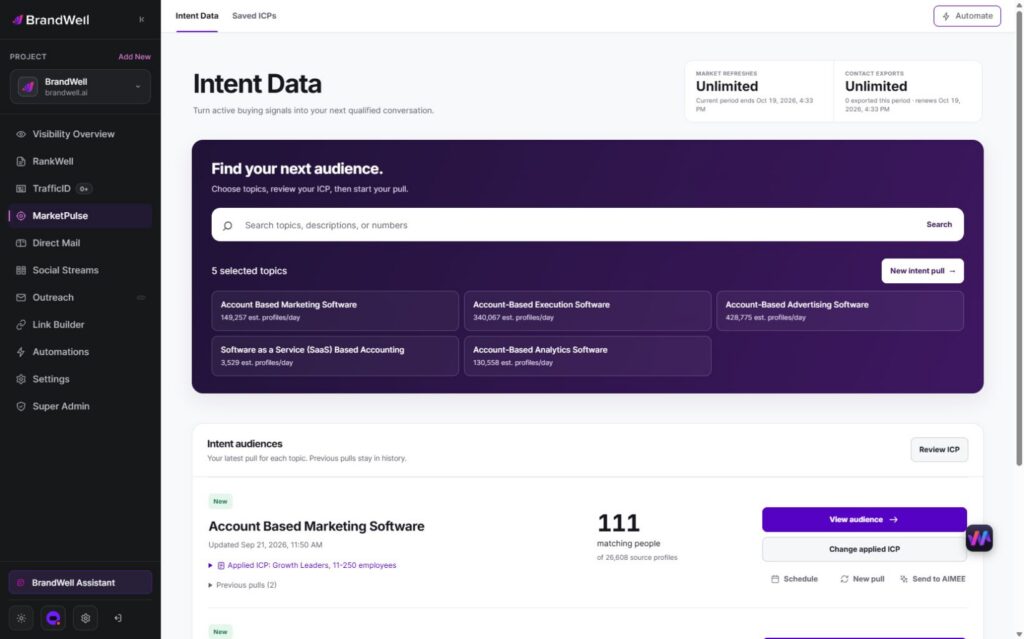
BrandWell MarketPulse: intent data starting at $500/mo. Find people researching topics relevant to what you sell, apply saved ICP filters, and review available contact details before taking action.
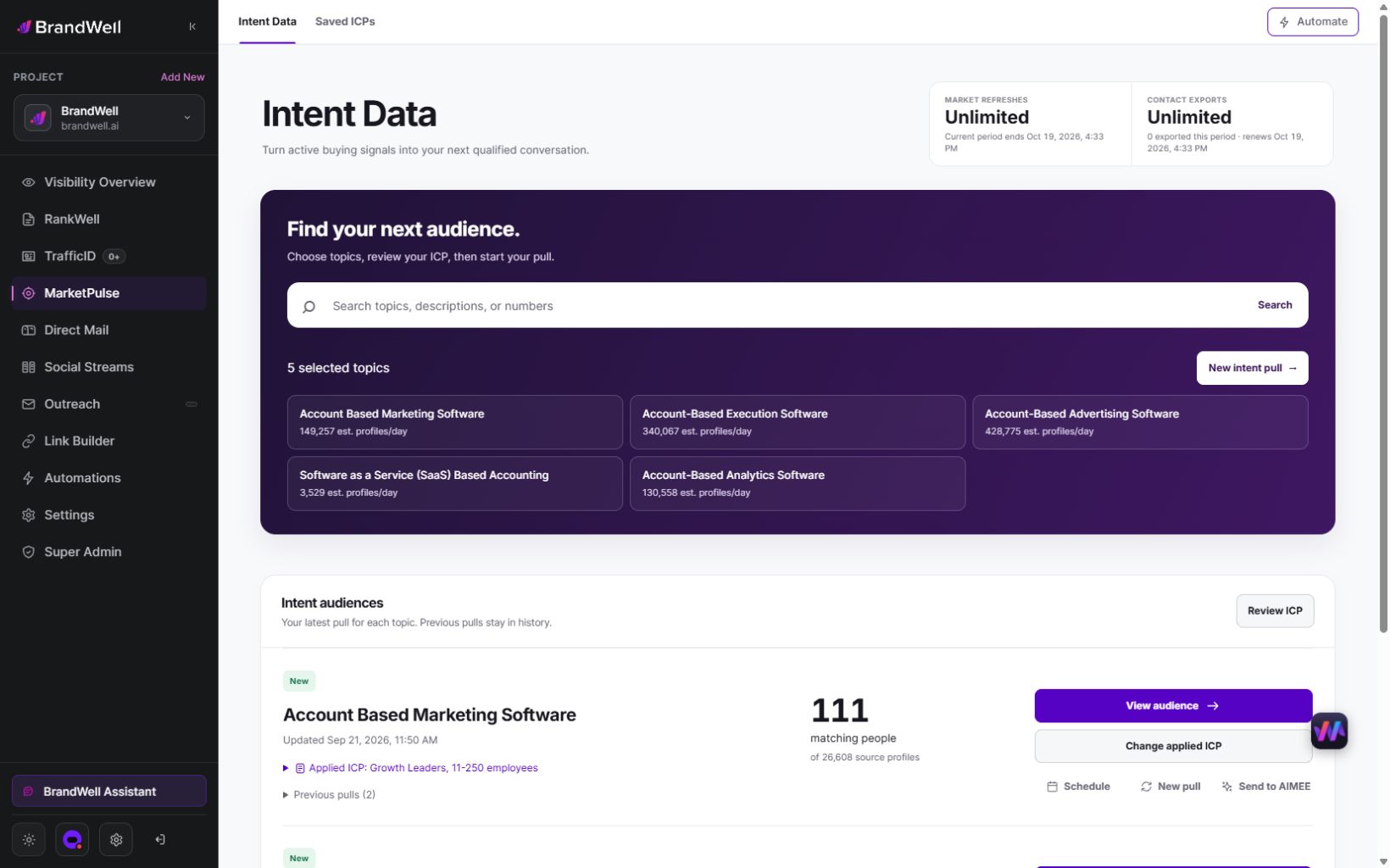
MarketPulse plans are starting at $500/mo. Verify current package scope and offers on the product page.
| Plan | Topics and refreshes | Monthly exports |
|---|---|---|
| Starter | 1 topic, weekly | 25,000 contacts |
| Growth | 3 topics, daily | 100,000 contacts |
| Scale | 10 topics, daily | Unlimited contacts |
Swipe the table to see all columns.
A pull retrieves available data from the previous 24 hours for one topic. Daily use across all included topics provides 90 Growth pulls or 300 Scale pulls in a 30-day month. Weekly Starter pulls vary by calendar month. Available audience size and contact fields vary, and audiences may overlap. Refreshes stop at the plan limit without overage charges.
- Find and qualify: search the topic catalog, save your ICP, and review the people and companies that match.
- Act on the research: export qualified contacts or prepare an Outreach or Direct Mail workflow. Connected products, channel usage, and fulfillment may cost extra.
- Get help from AIMEE: Growth and Scale include AIMEE for the initial user to research accounts and prepare the next step through connected tools.
Agencies and other service businesses can build client deliverables around their available Intent Scans and exports. Keep each client’s scope, permissions, and service fees clear. A subscription is not a promise of a white-label platform or exclusive access to a market.
Explore MarketPulse and watch the demo or compare plans starting at $500/mo. Any early-access discount is a separate, time-limited offer shown to an eligible recipient.
Who is this for?
This guide is for seed-stage B2B founders, early revenue leaders, first marketers, first sellers, RevOps generalists, and agencies supporting a company with some market evidence but limited time, cash, and operating capacity. Funding alone is not readiness. The relevant question is whether the startup has a repeatable enough buyer pattern to benefit from timing evidence.
Intent data is a fit when the team can identify a narrow account universe, describe repeated buyer pain, offer a clear next step, review signals quickly, and capture opportunity outcomes. It is premature when the ICP is still “any company,” sales stages change by rep, or the startup plans to automate outreach before learning what buyers value.
The plan connects a seed-stage fit gate to a lean stack, a founder-to-rep handoff, six proportional plays, milestone budgets, and a learning scorecard. Tool and service choices come after those operating decisions.
1. Pass the seed-stage fit gate
Use six evidence gates:
- Problem repetition: Multiple plausible buyers describe the same costly problem and current alternative.
- Account pattern: The team can explain which organizations fit and why, with concrete disqualifiers.
- Offer clarity: There is a specific next step – trial, assessment, design partnership, demo, or purchase process.
- Commercial evidence: At least some buyers have made meaningful commitments, ideally including payment or formal evaluation.
- Response capacity: A founder or rep can review and act within an agreed window.
- Outcome discipline: Acceptance, qualified opportunity, stage movement, loss, and revenue have explicit definitions.
If the startup fails problem repetition or account pattern, return to discovery. If it fails response capacity, reduce volume. If it fails outcome discipline, repair the CRM or ledger before buying more signals.
The seed-stage benchmark is the team’s current process. Record how accounts are selected, how long review takes, which records sales accepts, why records are rejected, and how many become qualified opportunities. The pilot must improve that baseline without hiding extra labor.
2. Build a lean signal stack with visible dimensions
Use five components:
- Account ledger or CRM: stable account ID, fit facts, exclusions, owner, customer status, opportunity stage, and outcome.
- Owned evidence: forms, product events, authenticated or consented site activity, replies, meetings, and customer conversations.
- Optional external evidence: off-site topics, category research, competitor research, or visitor identification with source, recency, and observation-unit labels.
- Selective enrichment: business and contact facts only after fit and action-value gates.
- Review queue: evidence, separate fit/timing/identity scores, suppression, recommended action, human decision, and reason code.
Do not hide these dimensions inside one number. A perfect-fit account with stale timing should be treated differently from a weak-fit account with high activity. An unresolved identity should stay unresolved.
Use the least complex system that preserves evidence and outcomes. A spreadsheet plus a disciplined CRM may be enough. Orchestration is justified when repeated manual work creates delay or error – not because an integration exists.
3. Create a founder-to-rep handoff that survives growth
The founder often knows why an account matters but stores that reasoning in memory. Turn it into a repeatable record:
- account and fit reason;
- buyer problem and supporting evidence;
- source and freshness of each signal;
- role or buying-group hypothesis with confidence;
- disqualifiers and suppression status;
- recommended next action and why it helps;
- approved message or content angle without exposing inferred surveillance;
- owner and review deadline;
- disposition and reason;
- opportunity or learning outcome.
Run a weekly calibration. The founder and first rep review accepted, rejected, and ambiguous records. Update fit and topic rules at the meeting, not ad hoc after every call. This keeps the process learnable.
A good handoff does not tell the rep “this person is buying.” It says, “this account fits; this recent evidence may indicate interest in this problem; here is what we know, what we do not know, and the next approved research or contact step.”
4. Run six seed-stage intent plays in order
Play 1: Refine the account universe
Use real wins, losses, interviews, and product evidence to define fit. The action is account inclusion, exclusion, or further research – not outreach.
Play 2: Prioritize founder research
Use fresh owned or external evidence to choose which accounts deserve deeper public research. Measure whether prioritized accounts produce better conversations than manual selection.
Play 3: Route high-intent owned behavior
When a known prospect submits a form, returns to a critical page, or reaches a meaningful product milestone, route the context to a human owner. Do not confuse a page view with a qualified opportunity.
Play 4: Prepare signal-specific help
Use a topic cluster to select a comparison, implementation note, security answer, calculator, or case study. The content should solve a plausible buyer question without saying “we saw you researching.”
Play 5: Test human-led outbound
Require strong fit, fresh corroboration, eligible contact data, suppression, jurisdiction review, and sender approval. Measure positive replies and qualified meetings alongside opt-outs and complaints.
Play 6: Test narrow paid activation
Use only destination-eligible data, sufficient audience scale, approved purpose, and a comparison design. Begin with observation or a limited campaign where supported; do not hand an agent autonomous spend authority.
Each implementation example uses the same sequence: evidence, gate, human decision, action, outcome, lesson. That is more useful than a generic “best practices” list.
5. Separate first-party, third-party, and identity evidence
First-party data reflects an interaction the startup observes directly: a form, reply, product event, meeting, customer request, or consented site activity. It usually carries better context but still may not reveal authority or purchase timing.
External topic research concerns activity outside the startup’s properties. Review its source category, observation unit, topic meaning, freshness and permitted uses. A person-level record, an account match and an inferred activity association are different evidence states; do not upgrade any of them into a confirmed purchase intention.
Identity or enrichment evidence attempts to connect a signal with an account or contact. A match has its own confidence and error modes. Keep the source event intact, write the match separately, and allow correction.
Corroboration should strengthen priority. Strong fit plus fresh owned action is different from weak fit plus broad topic activity. A stale signal should decay. A customer, partner, competitor, student, or job seeker may generate activity that is irrelevant to acquisition.
6. Pick affordable tools and services by the bottleneck
The best affordable intent-data and lead-data tools for a seed-stage startup fill one proven gap:
- Account selection: a simple CRM or ledger with fit and exclusion reasons.
- First-party capture: forms and analytics with documented events and consent handling.
- External intent: a bounded source that exposes topic, recency, observation unit, coverage, and correction limits.
- Validation and enrichment: selective checks after the fit gate, not a blanket enrichment bill.
- Review and routing: a transparent queue with approvals and acknowledgements.
- Measurement: stable campaign, account, and opportunity IDs plus a weekly scorecard.
Ask for a representative sample, export, data lineage, deletion, suppression, term, overage, and offboarding. Count founder, rep, analyst, and engineering time. Low license cost does not make a tool affordable if it generates manual cleanup or damages seller trust.
Before any audience upload, confirm the destination’s current eligibility, source, permission, consent, geography and account requirements using its official documentation. A topic-research subscription does not establish that its records are eligible for a particular ad destination. Keep source information and the approval decision.
7. Decide whether to buy, hire, build, or use a hybrid
Buy software when the workflow is already stable and manual collection or routing is the bottleneck.
Hire an agency when the startup needs temporary operating capacity, topic design, data QA, account research, reporting, or campaign coordination. Keep founder access to raw evidence and conversations.
Build internally only when unique first-party data or decision logic is strategically important and engineering can own reliability, security, monitoring, and policy changes. Do not divert the product team for a commodity connector without a strong case.
Use a hybrid when the startup wants a reversible start: modular signals, agency setup or review, internal approvals, and CRM-owned outcomes. This is one option to evaluate against its cost, ownership and exit requirements.
Every alternative needs an exit: export fields, evidence lineage, deletion, replacement path, and documented owners.
8. Budget by milestones and action capacity
Include data, enrichment, implementation, internal time, agency fees, paid media, creative, privacy and legal review, reporting, and offboarding.
Use milestone budgets:
- Milestone 1: prove usable coverage and seller trust with a small account sample.
- Milestone 2: prove the review and handoff work within the SLA.
- Milestone 3: show qualified outcomes improve against a baseline or comparison.
- Milestone 4: add one channel or automation while quality remains stable.
Calculate all-in pilot cost, cost per usable reviewed account, cost per accepted priority, and cost per qualified opportunity. Model breakeven wins from expected gross profit, opportunity-to-win probability, and time to outcome. Do not treat attributed pipeline as revenue or causal ROI.
Limit purchased volume to what the team can review. A feed of 5,000 records is not an asset when two people can thoughtfully handle 50.
9. Maintain an experiment backlog and milestone scorecard
Each experiment should include hypothesis, cohort, evidence gate, action, owner, comparison, metrics, lag window, stop rule, and next decision.
Track:
Signal quality: fit pass rate, freshness, provenance completeness, match confidence, duplicates, and corrections.
Workflow quality: review time, acceptance, suppression conflicts, routing success, retries, and no-action decisions.
Commercial quality: positive replies, qualified meetings, accepted opportunities, stage movement, win/loss, gross profit, and time to outcome.
Learning quality: rejection reasons, topics changed, ICP exclusions added, and experiments stopped because evidence contradicted the hypothesis.
Use consistent campaign labels where supported and record the approved destination. Tracking helps reconcile visits and actions but does not establish incremental impact. A randomized comparison needs suitable assignment and contamination controls. A phased rollout or comparable period requires explicit assumptions and may remain descriptive.
10. Apply safeguards before automation
Signals are probabilistic evidence, not proof of identity, consent, need, authority, buying stage, qualification, purchase, pipeline, or outcome; require human approval before consequential actions.
Review collection purposes, necessary fields, access, retention, correction, suppression, contracts and permitted channels with qualified reviewers. These controls need to fit the actual data, jurisdictions and workflow. A generic checklist does not establish compliance.
Confirm the applicable requirements for the actual sender, recipients and channel before activation. Do not assume business contact details eliminate privacy, notice, suppression or marketing obligations.
Common mistakes include describing account activity as a person’s behavior, enriching every record, retaining stale data, ignoring suppression, uploading ineligible audiences, giving too many people access, automating outreach or spend, and reporting influence as incremental revenue.
Humans should approve outreach, audience activation, campaign budgets, CRM writes, deletion, and client-facing claims. Agents can prepare, validate, and recommend; people remain accountable.
11. Package a seed-stage agency service
A right-sized recurring service includes a finite account universe, approved topic set, branded evidence report, founder-to-rep review, selective enrichment, action register, experiment backlog, and opportunity scorecard. Start with one route. Add volume only after the handoff produces consistent, useful decisions.
Where BrandWell fits
BrandWell MarketPulse is topic-based intent-data software for businesses and agencies. Choose relevant research topics, apply saved ideal-customer-profile filters, review available names, roles, companies and contact details, and export the audience or prepare a connected workflow. Plans start at $500/mo. TrafficID identifies visitors to your own website and is a separate product. A MarketPulse subscription does not by itself promise a white-label portal, custom API implementation, exclusive topics, or managed client delivery.
AIMEE can prepare an account-research brief through configured connected tools. Supply the topic context, ICP, permitted fields and approved next step. Review the output before any consequential action and verify the actual integration. Scope additional agency services separately.
BrandWell is not the ICP, CRM, consent system, ad platform, or proof of product-market fit. Its best seed-stage role is a modular operating layer after the startup has enough evidence – and enough capacity – to use it well.
Next step: Freeze a small account and topic pilot, assign the human reviewer, and request a current written scope only when the handoff and milestone budget are ready.
Put a cash and capacity boundary around the pilot
SBA’s planning guidance includes market research, business planning and startup costs. Use a written budget before committing scarce team capacity.
For a fictional one-month evaluation, allocate $250 for a Starter subscription, eight hours of review at an assumed $75/hour, and $150 of setup. Total planned cost is $1,000, including $600 of review labor. This is an example budget, not a promise that implementation always costs $150 or takes eight hours.
To calculate effective cost per pull, divide the subscription cost by the Intent Scans actually used during the same period. A pull retrieves available data from the previous 24 hours for one topic. Unused allowances increase the effective cost per consumed pull; fields, counts and audience overlap vary.
At an assumed $2,000 contribution from an additional won customer, $1,000 equals half of one customer’s contribution. In whole-customer terms at least one additional win would be needed to cover that pilot cost, if the contribution assumption holds. This does not predict a win or establish that the data generated one.
Keep a cash-spending view and an economic-cost view: founder time may not leave the bank account immediately, but it still has an opportunity cost. Reserve capacity for review, correction and follow-through rather than buying more records than the team can use.
Run the research step in MarketPulse
- Select one relevant topic and a narrow ICP.
- Review the available people and company fields in the actual feed.
- Record what is known, inferred and unresolved before nominating an account.
- Review ownership, freshness and permitted use before the next action.
- Track the approved disposition and later outcome in the authorized account ledger or CRM.
Watch the current MarketPulse demo and compare plans. Standard plans are starting at $500/mo. Topic research, TrafficID own-site identification and an implemented CRM workflow are distinct parts of the process.
Frequently asked questions
Does seed funding mean a startup is ready for intent data?
No. Review its buyer hypothesis, offer, account selection, capacity and outcome definitions first.
Should the team buy software or use an agency?
Compare the actual bottleneck, available expertise, full cost, ownership and exit path. There is no universal choice.
Can a successful before-and-after month prove impact?
No. Demand, staffing, targeting and other activity can change. Report the comparison and its limitations.
What should be automated first?
A well-understood, reversible internal step with monitoring and an owner. Avoid expanding consequential actions before validating the workflow and permitted use.
Reviewed and updated October 3, 2026.

Written by