On this page
- Who is this for?
- 1. Pass a seven-part suitability test
- 2. Set a cost ceiling before requesting quotes
- 3. Choose one minimum viable workflow
- 4. Run a simple weekly signal-to-action process
- 5. Use signals in an evidence hierarchy
- 6. Select affordable tools by function
- 7. Compare software, agency service, internal work, and a hybrid
- 8. Test paid activation only when data and scale qualify
- 9. Use a small-business stop-or-scale scorecard
- 10. Protect trust with proportionate privacy and security
- 11. Package a small-business agency service
- Connect the pilot to a real business plan
- Inspect current MarketPulse output
- Frequently asked questions
Evaluate intent-led growth around your eligible market, contribution per win, full operating cost and capacity to act. Start with one topic or visitor-review workflow, a named reviewer and explicit stop rules. Intent research should support a defined decision rather than replace a working offer or follow-up process.
Current MarketPulse offer: intent-data plans start at $500/mo. See the product, demo, and current plans. Updated October 3, 2026.
Who is this for?
This guide is for owners, small marketing and sales teams, consultants, and agencies evaluating intent data for a focused B2B small business. “Small” describes operating capacity, not a legal or employee-count definition. A ten-person specialist consultancy may have better intent economics than a larger company selling a low-margin consumer product.
This guide emphasizes focused B2B workflows. A local, consumer or low-value offer needs its own audience and cost evaluation rather than an assumption that intent will or will not fit. If capacity, permissions or follow-up are unresolved, fix those dependencies before adding data.
The process starts with suitability and deal economics, then chooses one weekly workflow, an affordable operating model, and a stop-or-scale scorecard. It is written for a B2B company whose stage and operating capacity matter more than a generic employee-count label.
1. Pass a seven-part suitability test
Score each question “yes,” “partly,” or “no”:
- B2B market: Can you name organizations – not just demographics – that could buy?
- Finite target: Can you build a defensible account universe or narrow topic market?
- Deal economics: Is expected gross profit per win large enough to fund data, review, and activation?
- Clear trigger: Do buyers research a recognizable problem, category, competitor, product, or implementation path?
- Action capacity: Can a named person review and act while evidence is fresh?
- Measurable outcome: Are qualified opportunity, win, loss, and revenue defined?
- Data responsibility: Can the business document source, purpose, access, retention, correction, deletion, and suppression?
Proceed to a small pilot only when the first six are mostly “yes” and the seventh has an owner. Repair “partly” answers first. One “no” in action capacity can make a large data feed worthless.
Address positioning, a functional website, offer clarity, CRM records and inquiry response before adding complexity. Choose the next investment based on the actual bottleneck and evidence rather than assuming a data subscription fixes the fundamentals.
2. Set a cost ceiling before requesting quotes
A small business cannot treat pricing as an isolated software line. Calculate:
- Expected first-period gross profit per win = expected revenue × gross margin, adjusted for delivery and collection risk.
- Expected gross profit per qualified opportunity = gross profit per win × realistic opportunity-to-win probability.
- Maximum acceptable cost per incremental qualified opportunity = expected gross profit per qualified opportunity × chosen safety factor.
- All-in pilot cost = data + setup + internal labor + agency + media or outreach + governance + measurement.
- Breakeven incremental wins = all-in pilot cost ÷ gross profit per win.
Use conservative reader-supplied inputs. Do not borrow a benchmark from a company with a different deal size, margin, sales cycle, or opportunity definition.
Add an action-capacity ceiling: the maximum number of records the team can review well each week. Buying more volume than that turns evidence into backlog. Include the owner’s time; it is often the largest hidden cost.
3. Choose one minimum viable workflow
Do not launch website identification, off-site topics, enrichment, outbound, ads, content, and AI automation at once. Pick one.
Workflow A: Known inbound follow-up
Enrich and prioritize form fills or known inquiries. This is usually the strongest first use because the business has direct context.
Workflow B: Website visitor review
Review account- or person-level visitor evidence where available and permitted. Route only strong-fit, fresh, non-suppressed records for human research. Never imply that a match proves who viewed a page.
Workflow C: Off-site topic monitoring
Monitor a narrow problem, category, competitor, or implementation topic. Use the signal to select accounts for research or content – not to claim that a named person is buying.
Workflow D: Opportunity support
For open opportunities, watch for relevant owned engagement and route useful proof, implementation, or objection-handling materials to the owner.
Choose the workflow closest to an existing revenue event. A small business with twenty monthly form fills should improve that handoff before buying thousands of third-party records.
4. Run a simple weekly signal-to-action process
Use this operational checklist:
- Import new evidence without overwriting the raw source fields.
- Validate stable account keys, timestamp, topic or event, and observation unit.
- Apply fit, geography, customer, partner, competitor, and deal-size rules.
- Keep timing, fit, engagement, and identity confidence separate.
- Check permission, suppression, sensitive-topic, and destination eligibility.
- Deduplicate events and recent account/contact actions.
- Assign accept, reject, defer, investigate, or suppress with a reason.
- Approve one proportionate next step: research, helpful content, seller task, eligible audience test, or no action.
- Confirm the destination received the record or action.
- Review replies, qualified opportunities, losses, corrections, and complaints each week.
A spreadsheet can run a modest pilot if access is controlled and one person owns it. A CRM becomes important when relationships, ownership, or history outgrow the sheet. Automation is useful only after the rules stop changing.
The simplest implementation example is ten high-fit accounts, one topic cluster, one reviewer, one weekly report, and one action route. That is enough to expose quality and capacity problems before a long contract.
5. Use signals in an evidence hierarchy
Rank signals by context and action value:
- Direct commercial action: form, proposal request, demo, order, or verified opportunity step.
- Known first-party behavior: repeat authenticated or consented activity connected to a real relationship.
- Strong account fit plus fresh owned-site evidence: useful for prompt human review.
- Strong account fit plus fresh off-site topic evidence: useful for account research or content prioritization.
- Identity or enrichment match: supporting evidence with its own confidence and correction path.
- Broad or stale topic activity: market context, not an individual sales trigger.
First-party does not mean automatically lawful or accurate, and third-party does not mean automatically unusable. The purpose, source, jurisdiction, destination, and platform policy determine what action is allowed.
Do not merge an account signal and a contact match into a statement that a named person performed the activity. Keep “what happened,” “where,” “to which entity,” and “how we matched it” as separate fields.
6. Select affordable tools by function
The best affordable intent-data and lead-data tools for a small business complete the chosen workflow with minimal operator burden:
- CRM or account ledger: stable keys, ownership, stages, suppression, and outcomes.
- First-party capture: forms, call or meeting outcomes, and documented site or product events.
- Intent or visitor source: transparent topic definitions, observation unit, freshness, coverage, and permitted-use boundaries.
- Selective enrichment and validation: only for records that pass fit and action-value gates.
- Review queue: evidence, reason codes, human decision, and no-action option.
- Destination and reporting: acknowledged CRM tasks, outreach, eligible advertising, content actions, and business outcomes.
Compare like-for-like total cost, not logos. Ask for sample records, source lineage, correction, retention, export, deletion, overages, contract term, and offboarding. Count time spent cleaning duplicates and reviewing false positives.
Do not force a vendor listicle. A tool suited to a niche account-based consultancy may fail a local service company. “Affordable” means the full system has a plausible path to incremental gross profit and fits the team’s weekly capacity.
7. Compare software, agency service, internal work, and a hybrid
Software is appropriate when the owner already knows the workflow and needs recurring collection or delivery. The business still owns qualification, permission, action, and measurement.
Agency service is appropriate when expertise or operating time is the bottleneck. A good agency defines topics, reviews quality, prepares reports, manages approved activation, and returns outcomes. It should not hide source or make guaranteed-pipeline claims.
Internal work is appropriate when volume is low, founder learning is valuable, and a spreadsheet or CRM can handle the process. It offers control but consumes scarce time.
A hybrid is one option: use a narrow data input and scoped agency assistance while keeping approval and seller action with the business. Evaluate cost, permissions, workload and exit terms alongside internal operation or software-only delivery.
Choose based on time to first useful decision, all-in cost, owner attention, customization, data control, client or business isolation, export, and exit. Do not build custom infrastructure merely to avoid a modest tool bill.
8. Test paid activation only when data and scale qualify
Intent-informed advertising can prioritize messages, accounts, or content, but the source does not automatically qualify for an audience destination.
Check the current official rules and authorized account settings for the intended advertising destination. Confirm source eligibility, permissions, geography, formatting, minimum size and available access. A supplied contact record is not automatic authorization to upload or advertise to that person.
A small business may not have enough eligible audience size for narrow paid targeting. Alternatives include using aggregate intent to choose search themes, landing-page content, sales enablement, or a broader platform-defined audience with a controlled creative test.
Keep a human in control of audience approval and spend. Track delivery, cost, qualified conversion, downstream gross profit, exclusions, and complaints. Platform attribution is not proof that the audience caused the result.
9. Use a small-business stop-or-scale scorecard
Track five groups:
Coverage: target accounts observed, usable records, segments missing, and action-capacity utilization.
Quality: fit pass, freshness, provenance completeness, identity confidence, duplicates, corrections, and false-positive reasons.
Operations: review latency, accepted/rejected/deferred, routing success, time per record, and unresolved errors.
Commercial outcomes: positive replies, qualified meetings, accepted opportunities, wins, gross profit, and time to outcome.
Risk: opt-outs, complaints, suppression conflicts, unauthorized access, destination rejection, and policy exceptions.
Define stop rules before launch. Stop if source or permitted use cannot be documented. Repair if the same preventable rejection dominates. Scale only when qualified outcomes improve while weekly labor and risk remain within the cost ceiling.
Use a documented campaign-naming scheme where relevant and reconcile destination outcomes to the activity record. Report the sample size and observation window. Tracking labels support reconciliation; they do not establish that the campaign caused a win.
10. Protect trust with proportionate privacy and security
Signals are probabilistic evidence, not proof of identity, consent, need, authority, buying stage, qualification, purchase, pipeline, or outcome; require human approval before consequential actions.
Maintain a purpose-specific register for the source, observation unit, owner, access, destination, retention, correction, deletion, suppression and incident route. Have qualified reviewers assess the actual jurisdiction, channel, contract and processing role. A register or checklist does not establish compliance.
Avoid invasive wording. Contact a prospect because the business has a plausible, helpful reason – not by announcing inferred browsing behavior. Humans should approve outreach, audiences, spend, CRM writes, deletion, and external claims.
11. Package a small-business agency service
A right-sized agency offer can include a suitability assessment, topic and ICP definition, one branded weekly report, human review, selective enrichment, one approved activation route, an outcome register, and a monthly stop-repair-scale decision. Cap volume to client capacity. The recurring value is focus, evidence, and follow-through – not rows delivered.
Where BrandWell fits
Evaluate the actual small-business use case, deal value, audience and capacity. A narrow pilot can test output and operations; it cannot establish that the product fits every business in an industry.
BrandWell MarketPulse is topic-based intent-data software for businesses and agencies. Choose relevant research topics, apply saved ideal-customer-profile filters, review available names, roles, companies and contact details, and export the audience or prepare a connected workflow. Plans start at $500/mo. TrafficID identifies visitors to your own website and is a separate product. A MarketPulse subscription does not by itself promise a white-label portal, custom API implementation, exclusive topics, or managed client delivery.
AIMEE can help prepare configured research or the next approved task through connected tools. Document the tools, permissions and review points, then check the result. Agency scope, client access and commercial rights need separate agreement.
Keep positioning, inquiry response, CRM maintenance, destination eligibility and human review in the operating plan. An intent tool supplies an input, not the complete service or a replacement for business judgment.
Next step: Calculate the cost ceiling and weekly capacity first; if both pass, request a narrow coverage review and a current written quote.
Connect the pilot to a real business plan
SBA’s business-planning resources cover market research, sales planning and startup costs. Use your own market, offer and cost assumptions when evaluating a new growth workflow.
In a fictional evaluation, assume $250 in software, $400 in operator time and $150 in permitted activation costs: $800 total included pilot cost. If contribution per additional won customer is $1,000 after the stated delivery costs, the arithmetic break-even requirement is 0.8 additional wins. Actual wins are whole customers; at least one would cover those included costs under these assumptions.
That is not a forecast or proof of incrementality. If one observed sale would have happened anyway, it cannot establish that the pilot paid for itself. Include acquisition, overhead, refunds and other relevant costs where they belong, state the observation period and model a no-win downside.
Inspect current MarketPulse output
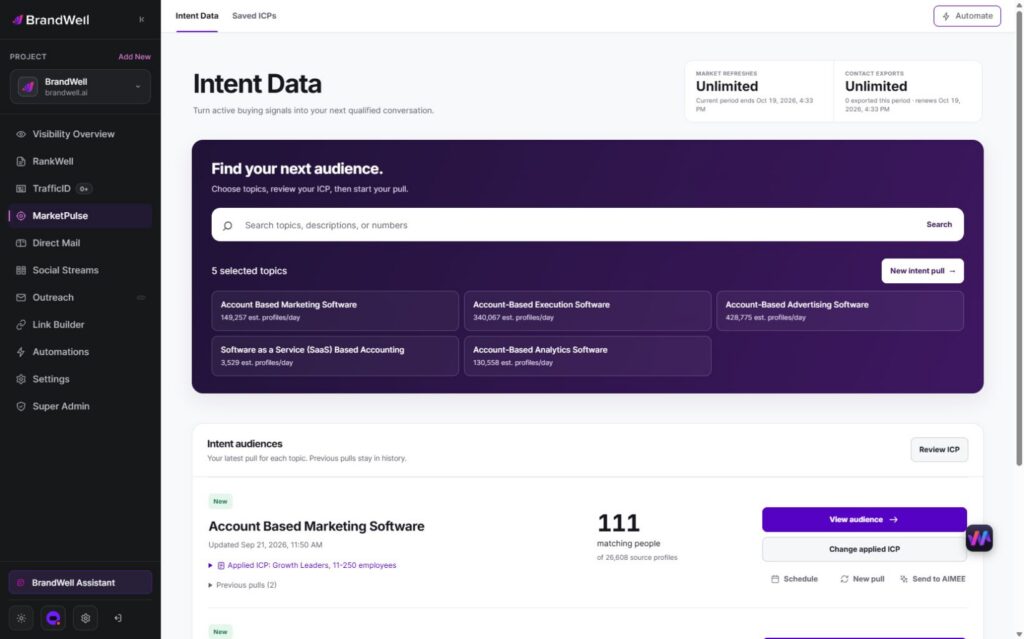
Standard MarketPulse plans are starting at $500/mo for one weekly topic and 25,000 monthly exports. Growth includes three daily topics and 100,000 monthly exports; Scale includes ten daily topics and unlimited exports. Daily use of all topics provides 90 or 300 pulls in a 30-day month; weekly pulls vary by calendar. Available data covers the previous 24 hours for each pull, with variable fields, counts and possible overlap.
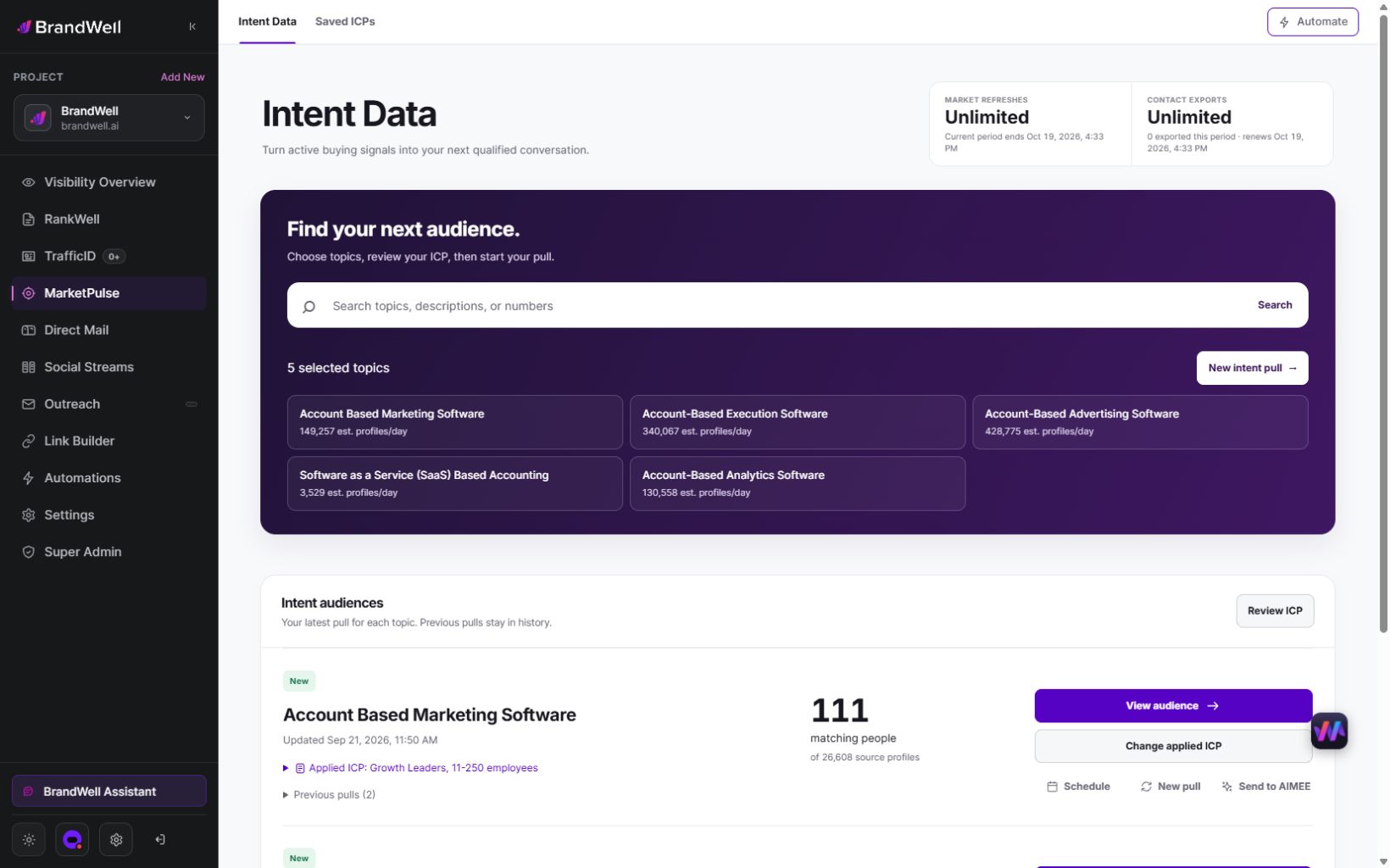
Watch the MarketPulse demo and compare current plans. Research signals do not establish purchase readiness or outreach permission. Review the current guarantee terms before testing; the first-purchase three-day satisfaction guarantee requires no exports and no more than two Intent Scans.
Frequently asked questions
Is intent data suitable for every small business?
No. Evaluate the market, offer, full cost, permissions and follow-up capacity. The size of a business alone does not determine the fit.
What is a sensible first workflow?
Choose one defined task, such as reviewing known inquiries, eligible website visitors or a relevant topic. Assign an owner and a weekly decision process before automating.
Does one sale prove the pilot’s ROI?
No. Separate observed sales from incremental impact and include the relevant costs. Small samples and short windows limit conclusions.
How should a team decide whether to expand?
Review predefined output, cost, capacity and risk criteria. Repair unresolved dependencies and stop when evidence or permitted use does not support continuation.
Reviewed and updated October 3, 2026.

Written by