On this page
- Current MarketPulse research workflow
- Check message readiness and ownership
- Keep hypotheses separate from buyer evidence
- Use six evidence-review steps
- Define traceable CRM evidence fields
- Compare training and workflow options
- Budget preparation and actual use
- Measure adoption and buyer-confirmed outcomes
- Verify source and message boundaries
- Scope a separate agency preparation service
- Copyable assistant message-review brief
- Message readiness checklist
- Copyable message evidence matrix
- Frequently asked questions
Use buyer intent data with Command of the Message to decide where message preparation should begin, not to decide what the customer believes. A signal can help a team prioritize an account, choose a likely business issue to research, and assemble relevant proof. It cannot establish the buyer’s problem, desired outcome, required capabilities, metric, decision criteria, or willingness to change.
Force Management describes Command of the Message around customer problems and differentiation. Its Value Framework FAQ describes a guide for conversation rather than a script. These owner references identify the methodology; they do not establish that intent research improves sales outcomes.
That makes intent data useful as an evidence input to the message workflow. It can indicate which approved value driver, business issue, or proof set might be relevant. The seller must validate that hypothesis in discovery and then document buyer-confirmed language. A sound command of the message with buyer intent data strategy keeps “what the systems observed,” “what the team inferred,” and “what the buyer confirmed” in separate CRM fields.
This is an independent integration guide. BrandWell does not license, certify, or replace Command of the Message training.
Across this guide, intent signals are probabilistic evidence, not proof of identity, need, consent, buying stage, commitment, or a future purchase.
Current MarketPulse offer: intent-data plans start at $500/mo. See the product, demo, and current plans. Updated October 3, 2026.
Current MarketPulse research workflow
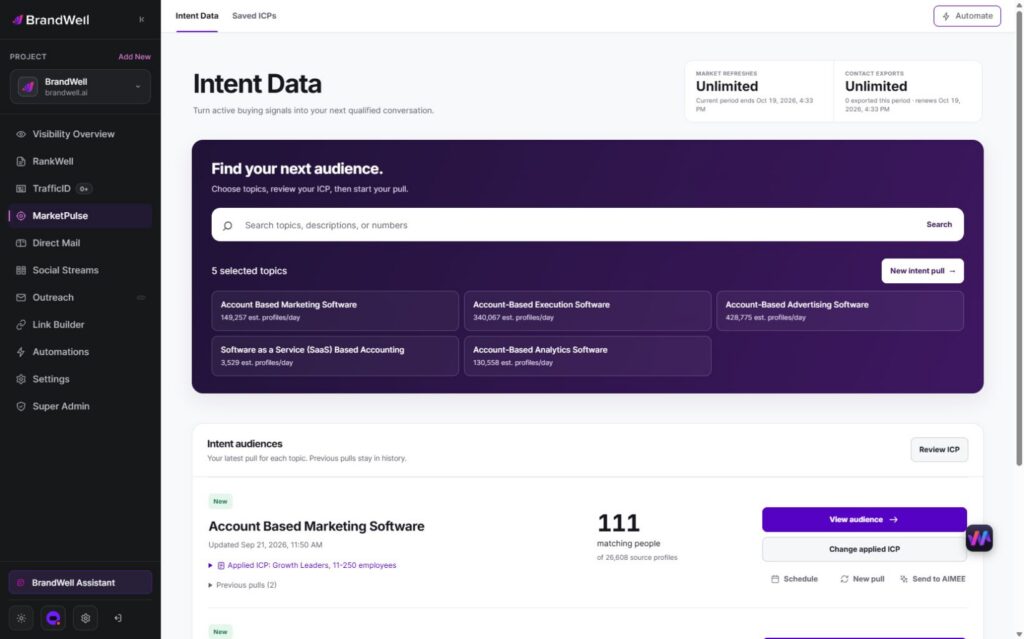
BrandWell MarketPulse: intent data starting at $500/mo. Find people researching topics relevant to what you sell, apply saved ICP filters, and review available contact details before taking action.
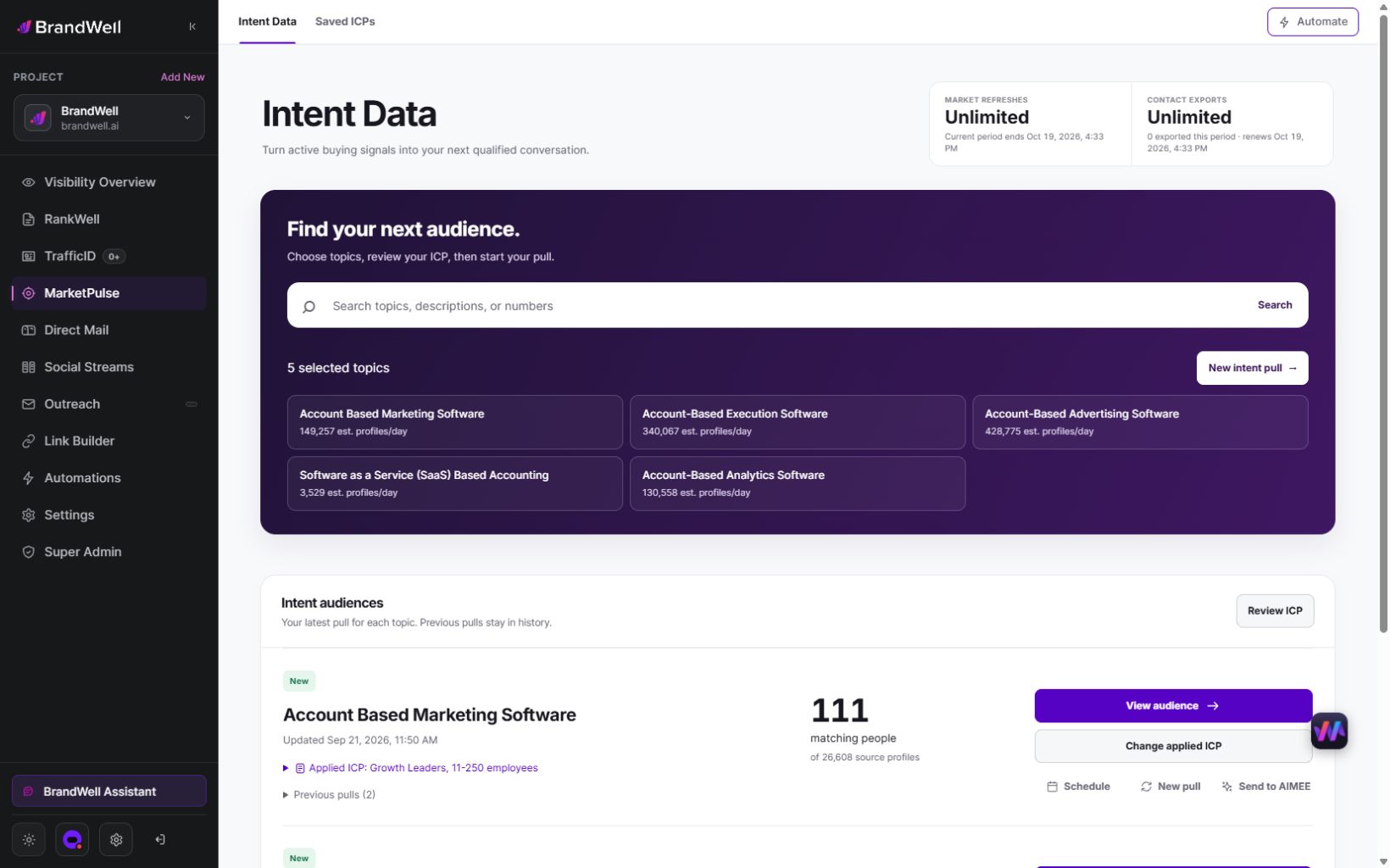
MarketPulse plans are starting at $500/mo. Verify current package scope and offers on the product page.
| Plan | Topics and refreshes | Monthly exports |
|---|---|---|
| Starter | 1 topic, weekly | 25,000 contacts |
| Growth | 3 topics, daily | 100,000 contacts |
| Scale | 10 topics, daily | Unlimited contacts |
Swipe the table to see all columns.
A pull retrieves available data from the previous 24 hours for one topic. Daily use across all included topics provides 90 Growth pulls or 300 Scale pulls in a 30-day month. Weekly Starter pulls vary by calendar month. Available audience size and contact fields vary, and audiences may overlap. Refreshes stop at the plan limit without overage charges.
- Find and qualify: search the topic catalog, save your ICP, and review the people and companies that match.
- Act on the research: export qualified contacts or prepare an Outreach or Direct Mail workflow. Connected products, channel usage, and fulfillment may cost extra.
- Get help from AIMEE: Growth and Scale include AIMEE for the initial user to research accounts and prepare the next step through connected tools.
Agencies and other service businesses can build client deliverables around their available Intent Scans and exports. Keep each client’s scope, permissions, and service fees clear. A subscription is not a promise of a white-label platform or exclusive access to a market.
Explore MarketPulse and watch the demo or compare plans starting at $500/mo. Any early-access discount is a separate, time-limited offer shown to an eligible recipient.
Check message readiness and ownership
This command of the message with buyer intent data framework fits complex B2B teams that have an established value narrative but struggle to apply it consistently to live accounts. It is useful for CROs, sales leaders, enablement, product marketing, RevOps, account teams, and agencies supporting a client’s signal-to-rep workflow.
Consider reviewing selecting the right value-driver research, preparing discovery around a fresh business topic, connecting a known issue to approved required-capability language, finding proof that matches the buyer’s context, and reviewing whether the opportunity record contains buyer-confirmed evidence rather than rep opinion.
It is a poor fit when the company has not aligned on its value framework, differentiation is unproven, managers cannot coach the message, or the CRM has no place to record discovery evidence. In those cases, methodology and message work should precede an intent-data purchase. It is also a do-not-buy condition when a team expects intent scores to generate a personalized message autonomously or to rescue an offer that does not produce a defensible business outcome.
Keep hypotheses separate from buyer evidence
Create an approved library with five connected objects:
- Business issue: A problem the target buyer may recognize, written in buyer language.
- Possible consequence: The operational, financial, strategic, or personal effect that discovery must validate.
- Required capability: What a solution must enable if the issue and consequence are real.
- Differentiated proof: Verifiable evidence that the seller can provide the capability better or differently.
- Buyer confirmation: The exact fact, metric, priority, or decision criterion established in conversation.
Intent belongs before the first object as a routing clue. It may suggest which business issue to investigate. It should not populate the final object. If the team cannot trace a message statement to either approved evidence or a buyer-confirmed fact, remove it from the account brief.
Use six evidence-review steps
1. Define signal acceptance in message terms
Do not route every “intent” event. Accept a signal only when it maps to an approved business issue or value driver and the account passes fit, freshness, identity, and exclusion rules. Document the source, analysis unit, topic, recency, confidence, active-opportunity state, customer state, suppression, and expiration.
The test is practical: can a seller use this evidence to prepare a more relevant, defensible conversation? If the answer is merely “the score is high,” the event is not ready for a message workflow.
2. Generate a business-issue hypothesis
Translate the accepted signal into a short hypothesis that can be disproved. Use this structure:
- Observed: The approved system recorded a defined event at an account or matched-person level.
- Possible issue: The activity may relate to one of the approved business issues.
- Why it could matter: A verified pattern or operating consequence, with its source.
- Unknown: The buyer’s actual situation, impact, priority, role, and decision path.
Avoid a fully formed pitch. The goal is to reduce research time while preserving curiosity. If the agent cannot identify a supporting source, it should return “insufficient evidence” rather than complete the narrative from general knowledge.
3. Prepare discovery that invites correction
Create questions that test the hypothesis without leading the buyer. Begin broad enough to hear a different problem, then move toward consequence and value:
- “How are you handling this process now?”
- “Where does it create friction, if anywhere?”
- “What happens downstream when that friction persists?”
- “Which measures or stakeholders make it important?”
- “What would a useful change need to enable?”
The seller should not say the company “must” have a problem because it researched a topic. Intent-informed discovery succeeds when it makes preparation better while allowing the buyer to replace the hypothesis completely.
4. Map confirmed problems to capabilities and proof
Only after confirmation should the seller connect the problem to required capabilities. For each capability, record why it matters, how the buyer will evaluate it, which proof supports it, and what limitation applies.
Proof should be specific: a verified product behavior, approved customer story, documented implementation path, security artifact, test result, or scoped demonstration. Do not invent an outcome, quote, or benchmark. Do not use a customer story outside the approved scope. If proof is weak, state that weakness and plan a validation step.
5. Tailor the message without changing the truth
Adapt emphasis to the stakeholder, not the underlying evidence. An executive may need the business consequence and decision risk. A functional leader may need process change, capacity, and control. A technical evaluator may need integration, data flow, security, and failure modes.
Each version should use the same buyer-confirmed problem, agreed outcome, and verified proof. Tailoring is not permission to create contradictory promises. Store the message version, stakeholder, approved proof, and unresolved objection so managers can coach consistency.
6. Record message quality and deal evidence separately
Create distinct CRM fields for signal evidence, seller hypothesis, buyer-confirmed problem, stated impact, required capabilities, proof used, differentiation, stakeholders, next step, and confidence. A message-quality score can show whether the rep used the framework. A deal-confidence score should depend on buyer-confirmed evidence and completed milestones.
This separation helps reviewers distinguish message completeness from buyer evidence. It also creates a feedback loop: RevOps can see which signals produce confirmed issues, enablement can see which proof gets used, and product marketing can see where the message library lacks evidence.
Define traceable CRM evidence fields
For each opportunity or reviewed account, capture:
- Signal ID, source, unit, topic, recency, confidence, and expiry.
- Fit result, identity conflicts, customer/opportunity state, and suppression.
- Approved business issue mapped to the signal.
- Hypothesis text and human reviewer.
- Buyer-confirmed problem in the buyer’s words.
- Consequence, metric, priority, and confidence source.
- Required capability and evaluation criterion.
- Proof asset, proof limitation, and stakeholder shown.
- Differentiation claim and substantiation owner.
- Next step, owner, buyer confirmation, and disposition.
Do not overwrite the raw signal when the hypothesis changes. Version both. That makes command of the message with buyer intent data implementation examples inspectable instead of anecdotal.
Compare training and workflow options
A useful command of the message with buyer intent data decision guide compares operating models by the same criteria: evidence quality, workflow adoption, message governance, CRM traceability, human review, privacy, total cost, and the ability to learn from outcomes.
- Methodology training and facilitation: Builds the value framework and coaching discipline. Limitation: a workshop alone may not connect to current account evidence.
- Intent, identity, and enrichment data: Adds topical and account context. Limitation: it produces probabilistic evidence, not a confirmed problem.
- CRM and enablement tooling: Places fields, proof, prompts, and coaching in the rep workflow. Limitation: poor field definitions create false completeness.
- AI research assistants: Drafts hypotheses, discovery questions, and proof options from approved sources. Limitation: generated content can hallucinate or overstate evidence.
- Agency or expert services: Supplies recurring research, reporting, and workflow operations. Limitation: it cannot replace client message ownership, seller skill, or legal review.
- Manual templates: A hypothesis-to-discovery worksheet, evidence-and-proof matrix, and CRM checklist can support a small pilot. Limitation: manual quality and access controls require an accountable owner.
Methodology training disconnected from live account evidence is still the right choice when message fundamentals are weak. Data and workflow services are more useful after the team can execute the method but lacks timely preparation or operational capacity. “Software versus agency versus in-house” is therefore not one winner; choose the model that fixes the actual constraint.
Budget preparation and actual use
Command of the message with buyer intent data pricing includes more than a data subscription. Budget separately for methodology licensing or facilitation, cross-functional message development, intent and identity data, enrichment, CRM fields and integrations, evidence-library maintenance, rep and manager time, agency services, privacy and legal review, and measurement. Separate one-time design work from recurring operations.
For a pilot, calculate capacity as well as cash. If thirty account briefs create fifteen hours of review and the sales team can use only five, the excess is not value. Put limits on queue size, proof maintenance, and manager review before buying more coverage.
Measure adoption and buyer-confirmed outcomes
Command of the message with buyer intent data KPIs should cover four layers:
- Signal quality: eligibility, match confidence, freshness, conflicts, expiry, duplicates, and suppressions.
- Workflow adoption: briefs reviewed, time to review, hypotheses accepted or rejected, discovery fields completed, proof used, and manager coaching.
- Buyer confirmation: confirmed problems, consequences, metrics, required capabilities, stakeholders, and agreed next steps.
- Commercial outcomes: meetings accepted, qualified opportunities, stage movement, cycle time, win/loss, pipeline, revenue when mature, and full cost.
For command of the message with buyer intent data ROI, compare suitable cohorts and disclose selection, overlap, maturation, and concurrent programs. A signal-assisted opportunity can have higher value because the account was already different; the signal workflow may not have caused the difference. Use randomized or staged tests where feasible, otherwise label the result descriptive.
Stop when the message library has no substantiated proof, seller rejection stays high, the process encourages scripted surveillance, or privacy controls fail. Expand when signal acceptance, buyer-confirmed evidence, message consistency, opportunity quality, economics, and buyer experience improve together.
Verify source and message boundaries
Risks in this workflow include auto-filling buyer pain, confusing account activity with person identity, presenting an agent-generated metric as buyer evidence, and allowing different teams to make incompatible promises.
Keep only necessary research details in the buyer-visible plan. Verify actual source rights, access, retention, deletion, sharing and client responsibilities. Preserve the restricted signal ledger separately from approved buyer commitments.
Before contact, verify the actual jurisdiction, recipient, purpose, opt-out status and channel requirements. A work address, public record or research signal does not itself establish permission for the proposed message. Resolve missing approval before any action.
Scope a separate agency preparation service
An agency can package command of the message with buyer intent data services around a weekly evidence workflow: topic and ICP design, signal review, fit and identity checks, business-issue hypothesis briefs, approved proof selection, CRM routing, seller feedback, and a monthly message-to-pipeline review. The agency should not claim to certify the methodology unless it has the relevant rights and authorization.
MarketPulse supplies topic research and available match details for businesses and agencies. AIMEE can organize supplied context through configured tools. An agency message-preparation service, branded report, CRM synchronization or custom client interface needs separately verified rights, implementation, scope and fees. The research product does not confirm buyer problems, required capabilities, metrics or decision criteria.
Review an available MarketPulse topic, saved ICP and actual preceding-24-hour matches for the agreed research purpose. AIMEE can organize supplied context through configured tools. Keep research inputs separate from the shared plan; named sellers and buyers confirm actual commitments.
The recurring deliverable should show observed signals, hypotheses accepted or rejected, buyer-confirmed evidence, proof gaps, seller dispositions, qualified outcomes, costs, risk flags, and policy changes. Evaluate whether that recurring deliverable is actually used and useful before claiming improved preparation or outcomes.
Copyable assistant message-review brief
AIMEE can prepare a review brief through configured connected tools. Preserve observed fields, uncertain matches, missing evidence and proposed questions. It does not establish buyer commitment or permission to alter a shared plan. Named humans approve messages and actual edits.
- Use only approved signal records, the client’s locked value framework, substantiated proof library, CRM context, and permitted-use rules.
- Return separate sections for observed evidence, business-issue hypotheses, unknowns, neutral discovery questions, possible required capabilities, and approved proof options.
- Cite the source and limitation for every proof or factual claim.
- Mark buyer-confirmed fields as blank until a human enters conversation evidence.
- Flag stale signals, conflicts, active customers, open opportunities, suppressions, opt-outs, unsupported claims, and inconsistent value language.
- Do not send messages, change opportunity stages, populate buyer-confirmed facts, or expose browsing details.
- Route the draft to the named seller and manager for approval and later disposition.
An accountable human approves every consequential outreach, CRM change, client-facing claim, and activation. The agent prepares evidence; it does not manufacture customer truth.
Message readiness checklist
Before rollout, verify:
- The official methodology, licensing, training, and enablement ownership.
- Approved business issues, outcomes, capabilities, differentiation, proof, and limitations.
- Signal source, unit, fit, identity, freshness, confidence, expiry, and suppressions.
- Separate hypothesis and buyer-confirmed CRM fields.
- Rep queue, manager coaching, disposition, and feedback standards.
- Total cost, baseline, maturation window, ROI language, and stop-or-expand rules.
- Privacy, security, retention, deletion, channel, and human-approval controls.
- Current BrandWell package pricing, usage, access, evaluation terms, and required connections if used.
Measure the actual time to a useful message review. Only verified proof and buyer dialogue can make it true.
Copyable message evidence matrix
Research: [Actual source, unit, time, match state and uncertainty.] Hypothesis: [Possible business issue for neutral discovery.] Buyer evidence: [Actual statement, date and confirmation source, or unknown.] Capability: [Verified product behavior addressing the confirmed issue.] Proof: [Current approved artifact, owner, audience, limitations and expiry.] Message: [Stakeholder emphasis consistent with the same evidence.] Review: [Approver, next action and unresolved question.]
For a BrandWell example, a company page describing an actual service can inform a discovery question about how its team prioritizes accounts. Show the current MarketPulse topic, saved ICP and actual preceding-24-hour matches as product behavior. Do not turn a research match into proof of a buying project, or describe custom reporting as a native feature.
Worked example: a complete message is not buyer confirmation
Assume a fictional group of 30 account briefs. Ten are reviewed by sellers, seven lead to discovery, four buyers confirm the hypothesized issue, two reject it and one leaves it unresolved. Seller review is 33.3% of all briefs. Confirmed issues are 57.1% of discovery conversations, 40% of reviewed briefs or 13.3% of all briefs. Three reviewed briefs have no discovery evidence; keep them separate from the one unresolved conversation.
Two of the four confirmed buyers agree a next action: 50% of confirmed buyers or 6.7% of all briefs. An approved message, completed CRM field or agreed next action is not a held meeting, qualified opportunity, purchase or causal lift. These invented rates are not industry benchmarks.
Price the usable queue and unused preparation
Suppose the 30 briefs require 30 minutes each: 15 preparation hours, but sellers can use only five hours of equivalent brief review. The ten-hour gap cannot be treated as consumed value. Reduce the queue or verify additional capacity before expanding.
At $100 per preparation hour plus $500 in allocated tools and support, costs are $2,000. Cost is $66.67 per produced brief or $200 per seller-reviewed brief. A fictional $2,500 agency fee leaves $500, or 20%, before setup, acquisition, general overhead, tax and financing. Six additional $100 correction hours create a negative $100 remainder. These figures are invented inputs, not BrandWell fees or typical margins.
Prepare the supported BrandWell research input
Review an available MarketPulse topic, saved ICP and actual preceding-24-hour matches against the agreed research purpose. Verify public company context and preserve uncertainty. TrafficID is separately scoped own-site visitor work. AIMEE can organize supplied context through configured tools. Owners approve exports, messages, Outreach enrollment, audience uploads and CRM writes. Message workshops, agency reports and custom interfaces require separately verified implementation and rights. BrandWell does not license or certify the third-party methodology.
Frequently asked questions
Can intent research populate buyer-confirmed pain?
No. Record the actual buyer statement and its source.
Is a polished message evidence of a stronger deal?
No. Keep message completeness and buyer evidence distinct.
Does a case study establish every customer’s result?
No. Preserve its actual conditions, approval and limitations.
Does BrandWell certify the messaging methodology?
No. Verify methodology rights and training separately.
Review the research product: explore MarketPulse and current plans.
Reviewed and updated October 3, 2026.

Written by