On this page
- MarketPulse supplies the topic research
- Map signals to questions, never answers
- An eight-step SPICED intent workflow
- CRM schema for a defensible SPICED overlay
- Tools, templates, services, and alternatives
- Pricing, cost, and total budget
- Tie signal quality to confirmed evidence and pipeline
- Mistakes, privacy risks, and governance
- A recurring agency service and BrandWell’s bounded role
- Agent-ready SPICED workflow instructions
- SPICED intent-data checklist
- A source-to-question example
- Measure adoption and confirmation separately
- Frequently asked questions
- Prepare discovery around a relevant topic
Use buyer intent in SPICED to prepare research hypotheses and discovery questions, then validate them with the buyer. A topic match cannot confirm a customer’s pain, business impact, deadline or decision process by itself.
Winning by Design’s SPICED framework organizes customer understanding around Situation, Pain, Impact, Critical Event and Decision. This is an independent application guide, not official training or certification. The eight-step workflow below is a proposed way to keep intent evidence separate from buyer-confirmed facts.
Use three statuses in the research brief: observed evidence, possible hypothesis and buyer-confirmed fact. Preserve disconfirmations and unknowns. Do not fill an empty confirmation field with generated text to make the record look complete.
MarketPulse supplies the topic research
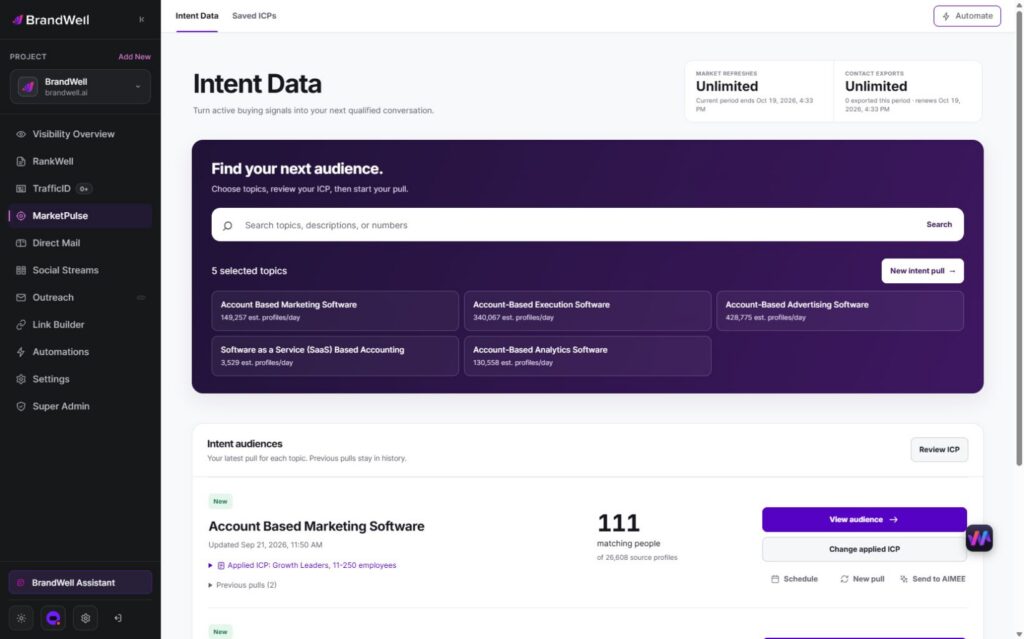
MarketPulse helps you review people researching relevant topics with saved ICP filters and available contact details. Keep the source and entity level attached to the record. A topic match is not a confirmed project, buying role or permission to contact someone.
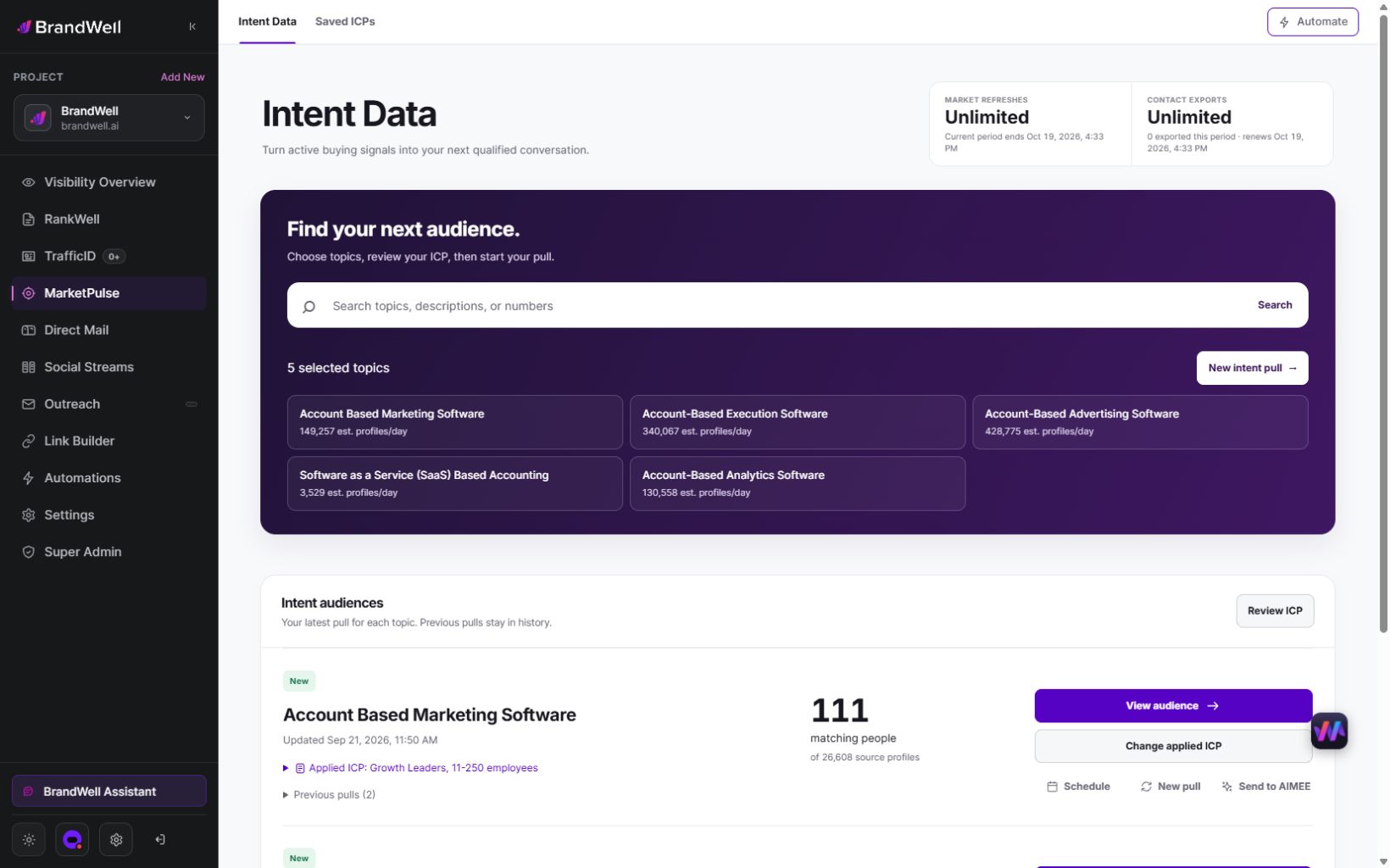
Standard monthly plans are Starter includes one weekly topic and 25,000 contact exports, Growth includes three daily topics and 100,000 exports, and Scale includes ten daily topics and unlimited exports. Daily use gives 90 or 300 pulls in a 30-day month. Fields, audience size and overlap vary. Review current plan scope; any eligible early-access offer is separate.
Map signals to questions, never answers
Use this SPICED signal-to-question matrix:
- Situation: Firmographic change, technology research, or first-party behavior may suggest a changed context. Ask how the current environment works and what changed.
- Pain: Problem-topic research may suggest a friction area. Ask whether the issue exists, where it appears, and who experiences it.
- Impact: Repeated or specific research may justify consequence questions. Ask what happens if the issue continues and which outcomes matter.
- Critical Event: Time-sensitive or implementation topics may suggest a milestone. Ask whether any real deadline, dependency, or external event exists.
- Decision: Comparison, security, pricing, or integration activity may suggest evaluation. Ask who is involved, which criteria matter, how tradeoffs will be resolved, and what process remains.
Never write “confirmed” because a query mapped neatly to a letter. The matrix controls the next question, not the field value.
An eight-step SPICED intent workflow
1. Define signal acceptance and the analysis unit
Specify the ICP, topic taxonomy, source, account-versus-person unit, identity confidence, freshness, repetition, opportunity state, customer state, exclusions, permitted uses, expiry, and review capacity. An account signal must remain account-level unless the matching method and use case support something more specific.
Write the decision each signal may change: research priority, question preparation, coaching attention, or review cadence. Prohibit automatic stage movement, forecast change, outreach, and SPICED-field confirmation.
2. Create a source-aware account brief
The brief needs signal ID, raw event or topic, normalized category, source, first and latest observation, confidence, fit, identity conflicts, CRM context, existing SPICED evidence, suppressions, and expiry. Preserve what is missing.
Use three columns for each SPICED element:
- Observed evidence from approved systems.
- Possible hypothesis proposed by a human or agent.
- Buyer-confirmed fact with source and owner.
A blank confirmation column is honest. Do not fill it with generated text simply to make the opportunity record look complete.
3. Prepare Situation hypotheses
Prepare questions about the buyer’s current context. Ask how the process works, whether anything changed and who is affected. Verify public company facts against current evidence rather than assuming an old firmographic or technology observation remains correct.
Ask neutral questions: “How does this work today?” “What changed, if anything?” “Who is affected?” Public company facts and first-party CRM history can enrich the hypothesis, but the seller must verify current context. Avoid presenting old firmographics or an inferred technology as fact.
4. Test Pain and distinguish symptom from cause
Problem-related intent may suggest a friction area, but it does not establish pain. Ask whether the issue exists, where it occurs, how often, who experiences it, and what causes it. Invite a disconfirming answer.
Record the buyer’s language, not a product category label. “Researching data quality” is not pain. “Sales operations spends time reconciling duplicate records before routing” may be a confirmed problem if the buyer says so. Keep the source of confirmation.
5. Validate Impact without inventing a number
Ask the buyer which consequences and measures matter. Keep qualitative statements, buyer-supplied figures and independently checked measurements separate. A seller’s model remains an assumption until its inputs are verified.
Do not let an AI assistant calculate a business case from unsupported assumptions. Separate buyer-provided numbers, internally measured numbers, model inputs, and illustrative scenarios. If no credible metric exists, state that impact is qualitative or unconfirmed.
6. Confirm a Critical Event rather than manufacturing urgency
A fresh signal or implementation topic may justify a timing question. It does not create a critical event. Ask whether a deadline, launch, renewal, board commitment, regulatory change, resource window, or dependency exists; what happens if it is missed; and who owns it.
Record date or sequence, consequence, owner, and evidence only after the buyer confirms them. “High recent intent” must never become a deadline. If no event exists, keep the field unknown and adjust the deal plan accordingly.
7. Map the Decision with actual stakeholders and criteria
Comparison, pricing, security, or integration signals may suggest evaluation, but they do not identify the committee or process. Confirm stakeholders, roles, criteria, tradeoffs, approvals, procurement, legal/security work, and the method for reaching a decision.
Preserve account and person boundaries. A matched director is not automatically the champion. A senior title is not automatically the economic buyer. A return visit is not approval. Buyer conversation and completed steps establish the decision path.
8. Review evidence, choose an action, and learn
In deal review, show each SPICED element with label, source, confidence, freshness, owner, and next validation step. A manager should see exactly which items are buyer-confirmed and which remain hypotheses.
After action, record accepted, rejected, stale, duplicate, wrong account, wrong person, confirmed, disconfirmed, no current project, meeting, qualified opportunity, stage movement, loss, win, opt-out, complaint, and cost. Use that feedback to improve signal policy and question prompts – not to backfill missing SPICED evidence.
CRM schema for a defensible SPICED overlay
Create fields for:
- Signal ID, source, unit, topic, recency, repetition, confidence, and expiry.
- Fit result, identity conflicts, opportunity/customer state, and suppression.
- Situation observation, hypothesis, buyer-confirmed fact, confirmation source, and confidence.
- Pain observation, hypothesis, buyer-confirmed fact, confirmation source, and confidence.
- Impact observation, hypothesis, buyer-confirmed fact, metric source, and confidence.
- Critical Event hypothesis, buyer-confirmed milestone, consequence, owner, and evidence.
- Decision hypothesis, stakeholders, criteria, process, unresolved tradeoffs, and confirmation.
- Human reviewer, approved action, disposition, outcome, and policy version.
Do not collapse these into one free-text summary. A summary can help a seller, but structured source and status fields make the evidence inspectable and coachable.
Tools, templates, services, and alternatives
A SPICED intent program comparison should evaluate classes by methodology fit, source transparency, structured evidence, CRM integration, coaching, privacy, human review, and outcome feedback.
- SPICED training and enablement: Builds shared language and behavior. Limitation: training alone may not provide live account context.
- Intent, identity, and enrichment data: Prioritizes records and topics. Limitation: signals are probabilistic and matches can conflict.
- CRM and workflow automation: Stores labels, questions, owners, and outcomes. Limitation: required fields can encourage invented completeness.
- Conversation and coaching tools: Helps review discovery and evidence. Limitation: summaries and transcripts require accuracy, access, and privacy controls.
- AI research assistants: Drafts briefs and question paths from approved sources. Limitation: it must not populate buyer-confirmed facts autonomously.
- Agency or expert services: Runs recurring signal, QA, routing, and reporting work. Limitation: client teams still own training, discovery, and governance.
- Manual templates: A signal-to-question matrix, confidence rubric, account brief, and deal-review checklist support a bounded pilot. Limitation: version, retention, and access need disciplined owners.
Methodology training disconnected from live evidence is the better choice when adoption is weak. An in-house build suits teams with RevOps, data, and enablement capacity. Software suits a stable process. An agency suits teams that need operating support. These are SPICED intent program alternatives, not a provider ranking.
Pricing, cost, and total budget
SPICED intent program pricing includes methodology education or licensing, signal and identity data, enrichment, CRM design and integration, enablement, conversation or coaching tools, rep and manager review, agency services, privacy and legal work, and ongoing QA. Separate one-time setup from recurring operations and count the cost of maintaining field quality.
Pilot with a topic set and account queue the team can review. Budget for manager inspection and privacy controls. A lower platform fee can create a higher SPICED intent program cost when bad matches, stale evidence, or required-field cleanup consume seller time.
Tie signal quality to confirmed evidence and pipeline
SPICED intent program KPIs should include:
- Eligible, accepted, expired, duplicate, conflicted, and suppressed signals.
- Match coverage, wrong-account and wrong-person rates, and freshness.
- Time to review, seller acceptance, and action rate.
- Situation, Pain, Impact, Critical Event, and Decision hypotheses confirmed, disconfirmed, or unknown.
- Completeness backed by source – not just non-empty fields.
- Meetings accepted, qualified opportunities, progression, cycle time, pipeline, and mature revenue.
- Opt-outs, complaints, negative replies, access issues, and cleanup.
- Full program cost, cost per buyer-confirmed SPICED element, and cost per qualified opportunity.
SPICED intent program ROI is not total pipeline touched by a signal. Signal accounts may be different before activation. Use suitable baselines, staged rollout, or randomized tests where feasible; disclose selection, overlap, and maturation. Treat observational differences as descriptive.
Stop when provenance is weak, reps reject the records, CRM fields become generated fiction, privacy controls fail, or signals never lead to useful confirmation. Expand only when data quality, SPICED adoption, buyer-confirmed evidence, buyer experience, qualified outcomes, and economics improve together.
Mistakes, privacy risks, and governance
The biggest SPICED intent program mistakes are mapping a topic directly to Pain, converting recency into a Critical Event, assigning a matched contact a Decision role, inventing Impact, and allowing an agent to write confirmed fields.
For this proposed workflow, record the approved source, intended use, access, retention and suppression requirements. Have the responsible client owners review channel and jurisdiction requirements before activation. A signal does not settle those decisions.
For this proposed workflow, record the approved source, intended use, access, retention and suppression requirements. Have the responsible client owners review channel and jurisdiction requirements before activation. A signal does not settle those decisions.
A recurring agency service and BrandWell’s bounded role
An agency can package SPICED intent program services around topic and ICP design, signal QA, weekly SPICED hypothesis briefs, CRM routing, confidence review, seller dispositions, coaching inputs, and monthly signal-to-confirmed-evidence reporting. The agency should not imply that its intent service provides SPICED certification.
Use MarketPulse topic matches as inputs to an independently reviewed discovery brief. AIMEE can help prepare account research and questions through connected tools. This is a proposed operating method, not a claim of a native SPICED integration, certification, white-label report or autonomous confirmation of buyer facts.
The recurring report should show observed signals, inferred hypotheses, buyer-confirmed facts, disconfirmations, missing evidence, seller action, qualified outcomes, cost, risk flags, and policy changes. That makes the service useful for coaching and decisions rather than another source of non-empty CRM fields.
Agent-ready SPICED workflow instructions
- Read only approved signal records, ICP and exclusion rules, CRM context, verified evidence, and permitted-use policy.
- For each SPICED element, return Observed evidence, Possible hypothesis, Neutral question, and Unknowns.
- Leave every Buyer-confirmed field blank unless the CRM includes an attributable buyer confirmation.
- Cite the source and limitation for company or market facts.
- Flag stale events, identity conflicts, active customers, open opportunities, suppressions, opt-outs, and unsupported metrics.
- Do not send outreach, change stages or forecasts, write commitments, or reveal browsing details.
- Route the packet to the named seller and manager for approval, then log disposition and buyer-confirmed updates.
An accountable human approves consequential messages, CRM changes, activation, and client-facing claims. The agent can organize the path to discovery; it cannot perform discovery without the buyer.
SPICED intent-data checklist
Before rollout, verify:
- Official methodology ownership, training, and adoption plan.
- Signal source, unit, fit, identity, freshness, confidence, expiry, and exclusions.
- Observed, inferred, buyer-confirmed, disconfirmed, and unknown labels.
- Signal-to-question matrix and structured CRM schema.
- Rep queue, manager review, routing, disposition, and feedback.
- Costs, baseline, maturation, KPIs, and stop-or-scale rules.
- Provenance, permitted use, access, retention, deletion, suppression, and channel controls.
- Human approval for outreach, fields, stages, activation, and claims.
- Current BrandWell package, pricing, data scope, and evaluation terms if used.
Use intent data to ask a better SPICED question. Let the buyer supply the answer.
A source-to-question example
Suppose a fictional account appears in a relevant data-quality research audience. The observed field records that topic and its timestamp. The hypothesis is that the team may be investigating a data-quality issue. The neutral question is “How do you check records before routing them today?” The buyer-confirmed Pain field remains blank until the buyer supplies relevant information.
If the buyer says the current process works well, retain the disconfirmation. Do not convert the topic match into a replacement deadline. If the buyer describes a problem, record their account of it and the source before asking about its consequences.
Measure adoption and confirmation separately
In a fictional test, sellers receive 40 briefs, use 20 in discovery and confirm a relevant hypothesis in eight conversations. Brief use is 50% of delivered briefs. Confirmation is 40% of the 20 conversations, or 20% of all briefs. Those figures do not measure opportunity creation or sales.
If software costs $500 and preparation and review cost $600, listed monthly cost is $1,100, or $55 per used brief. Keep disconfirmed and unused briefs in the report. This is a planning calculation, not a customer result or acquisition-cost benchmark.
Frequently asked questions
Can intent data fill in SPICED automatically?
It can inform a proposed question or hypothesis. Buyer-confirmed facts require attributable buyer evidence and review. Keep stage changes and forecasts subject to the team’s actual rules.
Does repeated research create a Critical Event?
No. Ask whether a real deadline or milestone exists and what happens if it is missed. Preserve an unknown answer when there is no confirmed event.
Does this workflow include SPICED certification?
No. This guide applies intent research to discovery preparation. It does not provide or imply official methodology training, licensing or certification.
How should an agency report its contribution?
Show observed signals, reviewed hypotheses, seller use, confirmed and disconfirmed evidence, outcomes, costs and limitations. Do not claim every touched opportunity was caused by the research.
Prepare discovery around a relevant topic
Explore MarketPulse and current plans starting at $500/mo. Select topics relevant to the offer, check audience fit and prepare questions that let the buyer supply the answers.
Reviewed and updated October 3, 2026.

Written by