On this page
- Define the prospect and client decision
- Use seven new-client qualification steps
- Preserve the versioned decision log
- Compare five new-business plays
- Current MarketPulse research workflow
- Separate product and agency responsibilities
- Count acquisition and delivery costs
- Review evidence and action boundaries
- Copyable assistant account-review brief
- Answers to ten new-client questions
- Review a bounded research workflow
- Copyable prospect qualification brief
- Frequently asked questions
To win new clients with an intent-data service, target agencies’ natural advantage: interpreting evidence and operating the next step. Test a bounded service against the actual prospect acquisition problem and capacity; do not assume its positioning increases purchase likelihood. Show the workflow, the evidence card, the approval boundary, the economics, and the measurement plan before discussing scale.
Who this is for: Agency founders, new-business teams, GTM consultants, and specialist service firms building an intent-led client acquisition offer.
Define the decision intent data is intended to inform. It should never be presented as proof that a person is ready to buy or as permission for an unreviewed action.
Current MarketPulse offer: intent-data plans start at $500/mo. See the product, demo, and current plans. Updated October 3, 2026.
Define the prospect and client decision
Prioritize prospects that sell into a definable market, have enough potential accounts, spend on demand generation, possess follow-up capacity, and can return CRM outcomes. Scope the service around reviewed prioritization and decision context; verify outcomes before claiming improvement. It should not promise guaranteed buyers, meetings, pipeline, or revenue.
Use seven new-client qualification steps
- 1. Define the narrow market and client problem the agency can serve repeatedly.
- 2. Use intent data internally to prioritize plausible agency prospects without exposing their behavior.
- 3. Open with a market observation, useful artifact, or diagnostic question instead of a surveillance claim.
- 4. Run discovery on ICP, traffic, sales capacity, data governance, economics, and measurement.
- 5. Demonstrate the signal-to-action workflow using representative or consented evidence.
- 6. Offer a paid validation with a cost ceiling and conversion criteria.
- 7. Convert qualified clients into a recurring package and calibrate from outcome data.
Preserve the versioned decision log
Maintain one versioned record from the first client question through the final commercial decision. Record the eligible market, topic definition, signal source, observed time, identity state, validation state, fit decision, suppressions, reviewer, approved next action, downstream disposition, and fully loaded cost. Do not overwrite rejected, expired, duplicated, or corrected evidence. Preserve the original record and add a reason-coded disposition so the agency can explain what changed. Review the log with the client at an agreed cadence, then use the evidence to tighten qualification, remove noisy topics, revise service scope, and decide whether to stop or expand. This operating record is also the source for renewal reporting, exception handling, and any claim about adoption or outcomes. A polished dashboard without this audit trail can hide weak process quality instead of improving it.
The first control for this workflow is: Define the narrow market and client problem the agency can serve repeatedly. The final control is: Convert qualified clients into a recurring package and calibrate from outcome data. Those bookends keep the service tied to a buyer decision rather than raw signal volume.
Add a short review note whenever the policy, topic definition, client scope, source, identity rule, activation path, or outcome definition changes. The note should identify who approved the change, which records or clients it affects, and whether earlier results remain comparable. This helps expose process changes that might otherwise be mistaken for performance improvements. It also gives account teams a plain-language explanation when volume, acceptance, cost, or outcomes move between reporting periods.
Compare five new-business plays
1. Market coverage diagnostic
Create a scoped view of the topics, accounts, and roles relevant to the prospect’s category.
Watch-out: Coverage is a planning input, not proof that any named person is ready to buy.
2. Campaign audience review
Compare current audience logic with a governed fit-plus-intent layer.
Watch-out: The ad platform’s policies and minimum audience rules still control.
3. Competitor-research brief
Summarize category and competitor research patterns without revealing private behavior in the pitch.
Watch-out: Avoid fear-based claims or assertions about a specific person’s hidden activity.
4. Website demand leak review
Map high-value pages, anonymous exits, known contacts, and responsible follow-up options.
Watch-out: Do not present every visitor as identifiable or contactable.
5. Signal-to-pipeline workshop
Build the CRM fields, decision rules, and outcome loop with the prospect.
Watch-out: A workshop is not evidence of incremental pipeline until the workflow is tested.
Current MarketPulse research workflow
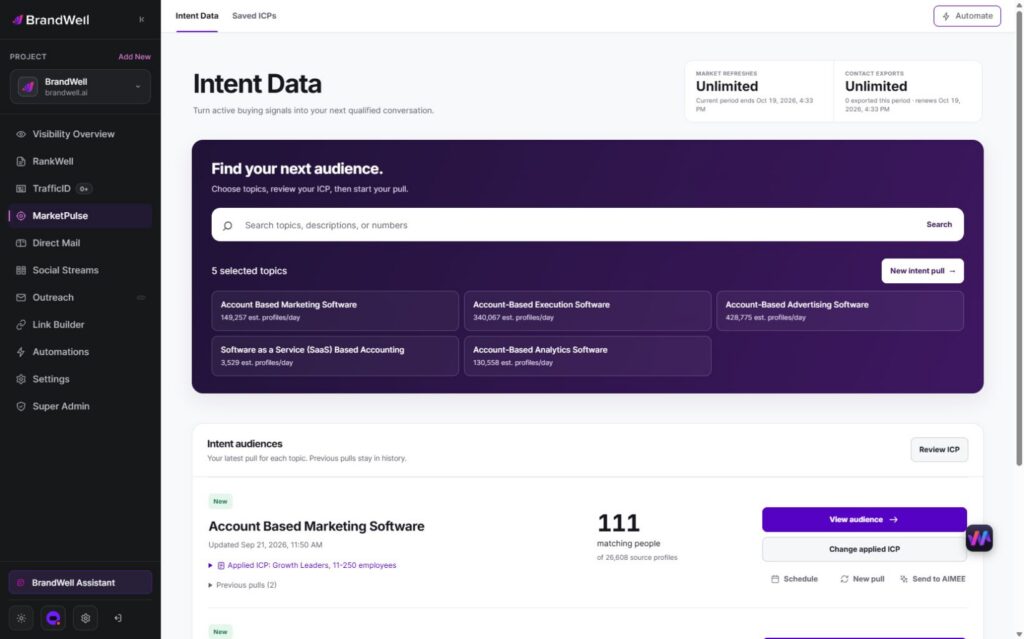
BrandWell MarketPulse: intent data starting at $500/mo. Find people researching topics relevant to what you sell, apply saved ICP filters, and review available contact details before taking action.
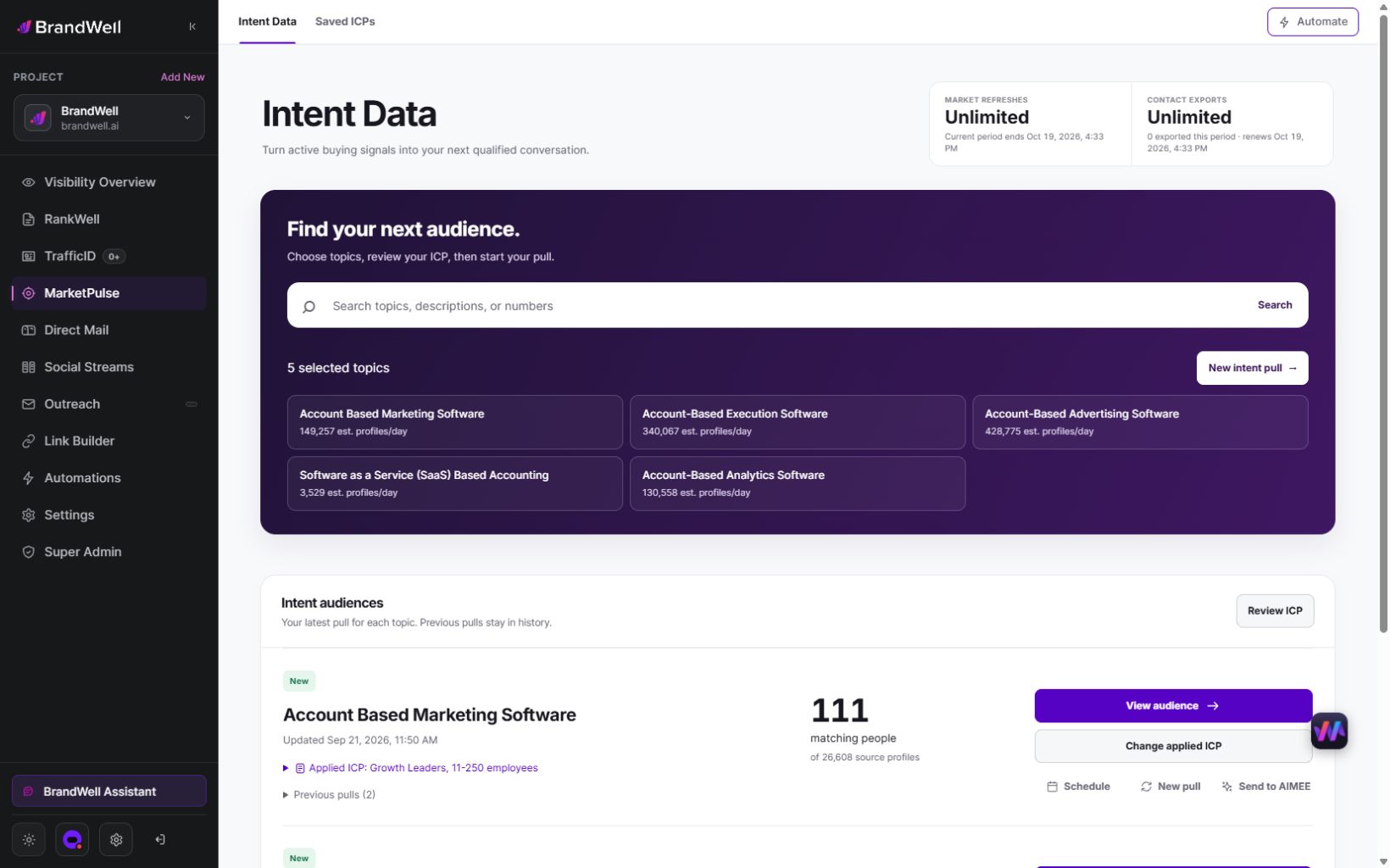
MarketPulse plans are starting at $500/mo. Verify current package scope and offers on the product page.
| Plan | Topics and refreshes | Monthly exports |
|---|---|---|
| Starter | 1 topic, weekly | 25,000 contacts |
| Growth | 3 topics, daily | 100,000 contacts |
| Scale | 10 topics, daily | Unlimited contacts |
Swipe the table to see all columns.
A pull retrieves available data from the previous 24 hours for one topic. Daily use across all included topics provides 90 Growth pulls or 300 Scale pulls in a 30-day month. Weekly Starter pulls vary by calendar month. Available audience size and contact fields vary, and audiences may overlap. Refreshes stop at the plan limit without overage charges.
- Find and qualify: search the topic catalog, save your ICP, and review the people and companies that match.
- Act on the research: export qualified contacts or prepare an Outreach or Direct Mail workflow. Connected products, channel usage, and fulfillment may cost extra.
- Get help from AIMEE: Growth and Scale include AIMEE for the initial user to research accounts and prepare the next step through connected tools.
Agencies and other service businesses can build client deliverables around their available Intent Scans and exports. Keep each client’s scope, permissions, and service fees clear. A subscription is not a promise of a white-label platform or exclusive access to a market.
Explore MarketPulse and watch the demo or compare plans starting at $500/mo. Any early-access discount is a separate, time-limited offer shown to an eligible recipient.
Separate product and agency responsibilities
BrandWell MarketPulse is topic-based intent-data software for businesses and agencies. Choose relevant research topics, apply saved ideal-customer-profile filters, review available names, roles, companies and contact details, and export the audience or prepare a connected workflow. Plans start at $500/mo. TrafficID identifies visitors to your own website and is a separate product. A MarketPulse subscription does not by itself promise a white-label portal, custom API implementation, exclusive topics, or managed client delivery.
Review an available MarketPulse topic, saved ICP and actual preceding-24-hour matches for the agreed research purpose. AIMEE can organize supplied company context through configured tools. Custom portals, CRM work, managed outreach and agency reporting require separately verified rights, implementation, scope and fees.
Use the current plan table above for standard topic, refresh and export allowances. Eligible early-access pricing is separate. Quote actual agency setup, review, reporting, support and channel usage separately from a software subscription.
Scope the implementation around defined research inputs, human review, a client action and actual outcome return. MarketPulse supplies research. Custom interfaces, scoring rules, CRM joins and managed delivery need separate implementation; a product subscription does not establish those agency capabilities.
Count acquisition and delivery costs
Count the entire acquisition cohort, setup, allocated tools, review, reporting, support and correction work. The SBA business-finance guidance emphasizes recording income and expenses. Keep actual agreements, invoices and collected funds distinct. The worked estimates below are operating examples rather than certified accounting treatments.
Use a stop-or-expand scorecard
Track diagnostic-to-discovery conversion, pilot acceptance, pilot-to-plan conversion, sales-cycle time, expected contribution margin, accepted-signal rate, qualified meetings, opportunities, client adoption, and churn. Separate agency sales metrics from the client’s downstream outcome metrics.
Important: Intent signals are probabilistic evidence. They do not prove identity, consent, need, authority, budget, stage, qualification, purchase, pipeline, or revenue. Report association and uncertainty honestly.
Review evidence and action boundaries
Risks include intrusive outreach, weak prospect fit, sample data presented as guaranteed coverage, an undefined pilot, unlicensed resale, and attribution claims that exceed the evidence. Use plain-language disclosures and a human approval gate.
Review actual source rights, necessary fields, permitted purposes, access, retention, destinations and suppression rules. Keep a named approver for client-facing promises and external actions. A research match does not establish contact permission or actual purchase readiness.
- Preserve source, observed time, identity state, confidence, and validation status.
- Separate known people, candidate people, companies, domains, and unresolved visitors.
- Apply customer, employee, competitor, duplicate, geography, consent, and opt-out suppressions before action.
- Require a named human approval before CRM writes, audience uploads, spend, or outreach.
- Give clients correction, export, deletion, escalation, and offboarding paths.
Copyable assistant account-review brief
AIMEE can prepare an account brief through configured connected tools. Preserve actual client prerequisites, missing evidence and blocked actions. Named owners approve scope, destinations and external actions; a proposed offer does not establish native platform capability.
Objective: Prepare a new-business account brief using public company facts, approved intent evidence, fit criteria, likely use cases, exclusions, and open questions. Draft a non-creepy value hypothesis and a discovery agenda. Do not state that a named person searched, infer sensitive attributes, or send outreach without approval.
Inputs: approved ICP, topic dictionary, signal source and time, identity state, CRM lifecycle, suppressions, permitted-use policy, and current written commercial scope.
Rules: preserve provenance and uncertainty; never infer budget, authority, consent, or purchase readiness; never expose private behavior in messaging; stop before external action.
Output: decision, reason codes, missing evidence, recommended next step, and audit log.
Keep actual sources, unknowns, proposed account dependencies and reviewer together. Reconcile the brief against current product capabilities and client scope. Do not invent an integration, budget or approval to fill a missing prerequisite.
Answers to ten new-client questions
What should an agency decide before winning new clients with an intent-data service, and what client outcome can it responsibly promise?
Prioritize prospects that sell into a definable market, have enough potential accounts, spend on demand generation, possess follow-up capacity, and can return CRM outcomes. Scope the service around reviewed prioritization and decision context; verify outcomes before claiming improvement. It should not promise guaranteed buyers, meetings, pipeline, or revenue.
What workflow, owners, SLA, quality checks, approvals, and client handoff does an intent-data offer for a new agency client require?
Assign a named agency owner, client owner, operator, and technical or CRM owner. The operating sequence is: 1) Define the narrow market and client problem the agency can serve repeatedly. 2) Use intent data internally to prioritize plausible agency prospects without exposing their behavior. 3) Open with a market observation, useful artifact, or diagnostic question instead of a surveillance claim. 4) Run discovery on ICP, traffic, sales capacity, data governance, economics, and measurement. 5) Demonstrate the signal-to-action workflow using representative or consented evidence. 6) Offer a paid validation with a cost ceiling and conversion criteria. 7) Convert qualified clients into a recurring package and calibrate from outcome data. Set the response SLA, log exceptions, preserve uncertainty, and require a client handoff with permitted next steps and ownership.
Which platforms, tools, templates, calculators, and integrations best support winning new clients with an intent-data service?
Start with the operating resources described in this guide: Market coverage diagnostic, Campaign audience review, Competitor-research brief, Website demand leak review, Signal-to-pipeline workshop. Support them with a qualification scorecard, topic dictionary, evidence card, cost model, proposal, CRM disposition fields, client report, and approval checklist. Software should support the workflow rather than define it.
How do diagnostic, workshop, paid-pilot, and recurring-service approaches compare for winning new clients with an intent-data service?
A diagnostic identifies a bounded gap and needs actual coverage limits. A workshop develops rules with client owners and incurs preparation costs. A paid pilot tests a defined workflow under written scope, fee, cap and acceptance. A recurring service adds delivery, review, support, feedback and exit obligations. Compare the decision, buyer capacity, evidence and full costs; interest in one stage does not establish readiness for the next.
How should an agency price an intent-data offer for a new agency client, and which setup, usage, labor, support, and risk costs determine gross margin?
Count the entire acquisition cohort, setup, allocated tools, review, reporting, support and correction work. The SBA business-finance guidance emphasizes recording income and expenses. Keep actual agreements, invoices and collected funds distinct. The worked estimates below are operating examples rather than certified accounting treatments.
Which quality, adoption, meeting, opportunity, pipeline, cost, margin, and retention metrics show whether an intent-data offer for a new agency client is working?
Track diagnostic-to-discovery conversion, pilot acceptance, pilot-to-plan conversion, sales-cycle time, expected contribution margin, accepted-signal rate, qualified meetings, opportunities, client adoption, and churn. Separate agency sales metrics from the client’s downstream outcome metrics.
Which clients are ready for an intent-data offer for a new agency client, and which prospects should the agency exclude?
Agency founders, new-business teams, GTM consultants, and specialist service firms building an intent-led client acquisition offer. Best-fit clients also have a clear ICP, sufficient addressable market or qualified traffic, relevant commercial topics, a named action owner, measurable CRM outcomes, conservative economics, and privacy readiness. Exclude clients demanding guaranteed leads, universal identity, prohibited use, or automation without review.
Which signal sources, identity checks, qualification rules, activation steps, and outcome evidence matter most for an intent-data offer for a new agency client?
Combine relevant topic or first-party behavior with fit, recency, recurrence, identity state, enrichment and validation, suppressions, human acceptance, an approved activation path, and outcome return. Keep every evidence type separate so an inference does not become a false fact.
Which data-quality, privacy, security, scope, billing, delivery, and client-trust risks must the agency control for an intent-data offer for a new agency client?
Risks include intrusive outreach, weak prospect fit, sample data presented as guaranteed coverage, an undefined pilot, unlicensed resale, and attribution claims that exceed the evidence. Use plain-language disclosures and a human approval gate.
What should the first recurring package include after a new client validates fit?
A recurring package should connect the client decision to the operating path described in five intent-led new-business plays for agencies. Define the eligible market, topics, signals, identity states, qualification policy, branded deliverable, portal or export, action SLA, approvals, usage, pricing, scorecard, governance, support, change control, and offboarding. Expand only after the client uses the first module well.
Review a bounded research workflow
Assess the audience and the operating cost before expanding the service. Explore MarketPulse with the data, tools, and client delivery scope you need.
Copyable prospect qualification brief
Public context: [Verified offer, market and company source.] Decision: [Client problem and named owner.] Research: [Actual topic, ICP, period and uncertain fields.] Capacity: [Approved action channel, reviewer and client follow-up.] Evidence: [Useful artifact and unanswered question.] Economics: [Full acquisition, setup and delivery cost.] Next step: [Bounded discovery or written pilot scope.] Stop: [Missing permission, evidence, owner or viable budget.]
Use public company context in a discovery opening: “Your site describes [verified offer]. Which accounts are hardest for your team to prioritize, and who reviews the next action?” Do not say a named person privately searched a topic or infer an unverified budget. Review the actual outreach channel rules and permitted purpose before contact.
Worked example: acquisition costs include prospects who do not buy
Assume a fictional group of 100 eligible prospects. Twenty take discovery, eight request proposals and four buy validation. Discovery is 20% of the original group; proposals are 40% of discovery or 8% of the group. Validation is 50% of proposals or 4% of the group. Two later sign recurring agreements: 50% of validation buyers or 2% of the original group. Keep unknown outcomes visible; these invented rates do not establish causal lift or industry benchmarks.
If the acquisition effort costs $4,000, cost is $1,000 per validation buyer or $2,000 per signed recurring client. Dividing only the winning proposal effort by two would omit the rest of the cohort’s work.
Check the full recovery period
Suppose four $1,000 validation fees collect $4,000 and delivery costs $3,200, leaving $800 before acquisition. Two recurring clients then pay $2,000 each for one period, with $1,200 in delivery cost each: $4,000 receipts minus $2,400 costs leaves $1,600. Across the validation and recurring period, $8,000 receipts minus $5,600 delivery and $4,000 acquisition leaves a negative $1,600 remainder.
If both clients remain and the next period repeats the $1,600 remainder without new acquisition or setup costs, cumulative recovery reaches zero. Retention and stable delivery are assumptions, not guaranteed lifetime value. General overhead, tax, financing and further corrections are excluded and can change recovery. These figures are fictional agency inputs, not BrandWell service prices.
Prepare the supported BrandWell research input
Review an available MarketPulse topic, saved ICP and actual preceding-24-hour matches against the client purpose. Verify public company context and preserve uncertainty. TrafficID is separately scoped own-site visitor work. AIMEE can organize supplied context through configured tools. Owners approve exports, Outreach enrollment, audience uploads and CRM writes. Agency diagnostics, reports and custom interfaces require separately verified implementation and source rights.
Frequently asked questions
Does topic research confirm a prospect will buy?
No. Keep research evidence and actual buying statements separate.
Should lost prospects be excluded from acquisition cost?
No. Count the full eligible cohort and actual sales work.
Can recurring contracts be counted as collected cash?
No. Track agreement, invoice and receipt separately.
Does a profitable recurring period recover acquisition immediately?
No. Calculate the full pilot, setup and recovery period.
Review the research product: explore MarketPulse and current plans.
Reviewed and updated October 3, 2026.

Written by