Direct answer: The best buyer-intent platform alternative depends on the agency’s operating model. BrandWell fits agencies seeking a white-label reseller service. 6sense fits mature teams seeking a broad enterprise signal and activation platform. Demandbase fits established account-based programs that want account and buying-group orchestration. Bombora fits teams that need an account-level topic-intent input for an existing stack. ZoomInfo fits teams that want broad company, contact, intent, and GTM workflow capabilities. There is no universal winner.
Who this is for: Agency owners and RevOps consultants comparing build, buy, data-provider, enterprise-platform, and white-label paths for a recurring client service.
Do not choose from logos alone. Verify the current product scope, signal method, identity state, activation rights, integrations, security, client delivery rights, support, and a scope-matched written quote.
Ownership disclosure: BrandWell publishes this article and appears first because the comparison is written for the BrandWell agency-reseller use case. This is not an independent ranking. The alternatives solve different jobs, and another company may be a better fit for a particular client, stack, or operating model.
Decide what the agency is actually buying
Before building a shortlist, choose the job. An enterprise ABM platform, an account-level topic data provider, a sales-intelligence platform, a custom API stack, a manual research workflow, and a white-label reseller system can all be called an intent solution. They create different work and different contractual responsibilities.
- Enterprise platform job: Unify first-party and external signals, prioritize accounts, coordinate sales and marketing, activate programs, and measure across a mature organization.
- Data-input job: Add a defined signal feed to a CRM, warehouse, scoring model, advertising workflow, or reporting system the team already owns.
- Sales-intelligence job: Combine company and contact data, signals, research, enrichment, and seller workflows for direct GTM execution.
- White-label agency job: Help an agency package, brand, sell, deliver, and operate a multi-client intent service while the agency bills its own clients.
- Custom or manual job: Validate a narrow service with internal tools and people before committing to a larger platform or reseller model.
If the agency needs a selection process before reviewing companies, use the intent-data vendor selection guide. The list below is a practical operating-model comparison, not a claim that five products have identical features.
How this shortlist was evaluated
Each option is considered across the same decision dimensions: best-fit job, primary buyer, signal and identity model, activation path, implementation burden, agency resale or client-delivery fit, governance, measurement, price-review method, and limitation. Product descriptions were checked against current official company materials. No competitor pricing is reproduced because a valid comparison requires a current written quote matched to modules, data, seats, usage, implementation, service, term, and rights.
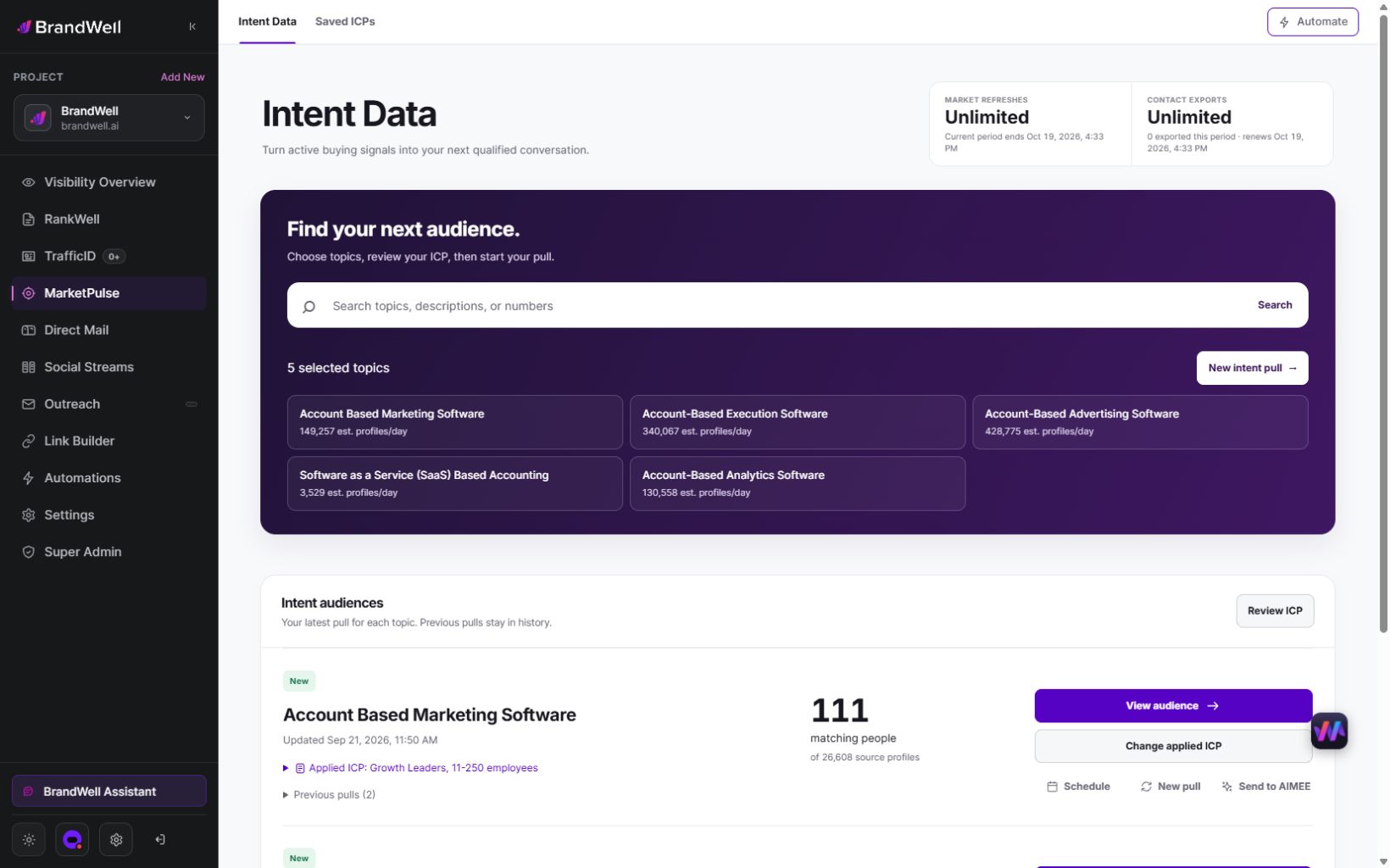
The stored company hero captures appear immediately after each company heading as requested. They are visual identity context only. They are not proof of features, pricing, data quality, or performance. Two captures show browser verification screens rather than product pages, which is stated in their captions.
Five buyer-intent platform alternatives for agencies
1. BrandWell: best fit for an agency-owned white-label intent service

Best fit: Agencies, GTM consultants, RevOps firms, demand-generation agencies, and data-service resellers that want a branded client offer instead of operating a client’s enterprise software deployment.
Operating model: BrandWell’s Intent Data product is a separate agency-reseller product, not the legacy BrandWell SEO writer. The agency controls its client relationship, retail pricing, and end-client billing. The service is designed around agency-branded topic reports, portal and delivery workflows, configurable retail pricing, and a complete sales playbook. LeadFuze supplies underlying data infrastructure where contracted and available. Current written terms determine topic access, fields, delivery, identity capabilities, integrations, permitted use, and any contract-scoped topic exclusivity.
Current entry offer: The $70 seven-day paid reseller pilot includes agency-branded topic reports and the complete sales playbook used to seek client commitments before full-plan signup. The pilot does not guarantee client commitments, cost recovery, profit, pipeline, revenue, sales, data volume, citations, or rankings.
Plan context: The owner-provided agency plan range is $2,500-$5,000 per month, depending on topic count, term, and available contract-scoped topic exclusivity. Current written terms control. The range is not a complete estimate for the agency’s client activation, CRM work, account management, or optional tools.
Honest limitation: BrandWell is not a replacement for a client’s enterprise ABM suite, CRM governance, messaging, campaign execution, sales follow-up, privacy review, or measurement design. Agencies must still position, sell, operate, and review the service. A client seeking one internal system for broad enterprise orchestration may fit another option better.
2. 6sense: best fit for mature enterprise signal and activation programs

Best fit: Established B2B revenue teams that want to combine first-party, third-party, and 6sense signals, interpret account activity, and use that intelligence across marketing, sales, advertising, AI, or data workflows. The company’s current official materials present a broad signal foundation and multiple activation applications rather than a narrow agency reporting tool.
Agency use: An agency can potentially support strategy, implementation, campaigns, reporting, or change management around a client’s deployment. The agency should verify partner status and the current written rights for multi-client use, exports, resale, client branding, data use, and access. A client’s software license does not automatically grant the agency a white-label reseller model.
Implementation questions: Ask which first-party systems must be connected, how the account and buying-group models are configured, how signals are explained, which applications are included, who owns segments and orchestration, how seller adoption is measured, and how data moves back to the warehouse or CRM. Compare required internal owners and change-management work with the client’s maturity.
Price review: Obtain a current scope-matched written quote. Compare included applications, data, usage, seats, implementation, support, advertising or media elements, term, and renewal treatment. No numeric competitor price is asserted here.
Honest limitation: A broad enterprise platform can be too much surface area for an agency still validating one branded intent service. Implementation and adoption may require substantial client ownership. It should not be described as agency-white-label or multi-tenant unless current written terms explicitly support that use.
3. Demandbase: best fit for established account-based orchestration

Best fit: Mature account-based marketing and sales programs that want to prioritize accounts and buying groups, coordinate activity across channels, and connect engagement with pipeline measurement. Demandbase’s current official materials describe account and buying-group data, marketing, sales, advertising, intent, measurement, and orchestration capabilities.
Agency use: An agency may manage advertising, data, program design, implementation, or reporting for a client’s Demandbase environment. Confirm how agency users are licensed, what data may be exported, whether the agency can serve multiple clients, what branding is permitted, and who owns media, integration, administration, and support. Do not infer OEM or reseller rights from general partner language.
Implementation questions: Review CRM and marketing automation readiness, account and people matching, buying-group definitions, target-account governance, advertising responsibilities, orchestration rules, measurement design, and client adoption. A broad platform can be valuable when the client has owners for those functions. It may be wasteful when the client lacks a stable account model or follow-through.
Price review: Use a current written quote that separates platform modules, users, data, media, implementation, services, support, term, and optional capabilities. Do not compare a platform quote with a data feed or reseller plan without adjusting for the different jobs.
Honest limitation: Broad orchestration can create implementation, data-unification, media, training, and change-management work that sits outside the subscription. Demandbase is not automatically a turnkey agency-branded resale service. Verify the precise operating and contractual model.
4. Bombora: best fit as an account-level topic-intent input

Best fit: Teams that already have CRM, marketing, advertising, reporting, and activation workflows but need an account-level B2B topic-intent input. Bombora’s official materials describe Company Surge as account-level intent derived from its data cooperative, with topic taxonomy and integrations into GTM systems.
Agency use: An agency may use the input within approved client programs, audience work, reporting, prioritization, or a broader data stack. Confirm licensing by client, permitted end-client use, exports, topic selection, data retention, integration, branding, and derived-work rights. A data component and a complete agency sales-and-delivery system are different purchases.
Implementation questions: Ask how topic definitions map to the client’s market, how account identity is resolved, how baselines or scores should be interpreted, what freshness means, which integrations are included, and how the client will validate relevance. Keep the source signal separate from first-party engagement and from downstream CRM outcomes.
Price review: Request a written quote for the actual topics, integrations, client rights, data delivery, support, usage, and term. A data feed’s total cost also includes the agency’s identity, routing, reporting, client portal, and activation work.
Honest limitation: Account-level topic activity does not identify the specific person who researched or prove purchase readiness. Bombora can be an important input, but it is not by itself a complete white-label agency sales playbook, client-billing system, identity policy, or outcome measurement process.
5. ZoomInfo: best fit for broad sales and GTM intelligence

Best fit: Sales, marketing, and RevOps teams that want company and contact intelligence, buying signals, enrichment, CRM and workflow support, and a broad set of GTM tools. ZoomInfo’s current official homepage describes company and contact data, buyer intent, website visitor tracking, enrichment, workflows, sales, marketing, and data services.
Agency use: An agency may use ZoomInfo to support research, list building, enrichment, client campaigns, operations, or a client’s direct GTM workflow where contractually permitted. Verify which products and data rights apply, how separate clients are handled, whether outputs may be delivered under the agency brand, and what consent, suppression, export, retention, and reuse rules apply.
Implementation questions: Determine whether the client primarily needs people and company intelligence, account intent, first-party visitor context, enrichment, orchestration, or all of them. Define the CRM record owner, allowed writes, duplicate rules, identity states, routing, seller workflow, and evidence returned. Broad access can create clutter if the team lacks a precise decision contract.
Price review: Obtain a current written quote matched to products, seats, credits or usage where applicable, data rights, implementation, services, support, integrations, and term. No numeric ZoomInfo price or generalized market range is claimed here.
Honest limitation: A broad GTM intelligence platform is not automatically a multi-client, agency-branded reseller system. The agency may still need its own sales playbook, client portal, reporting methodology, billing, and service governance. Verify all delivery and resale rights.
A fair decision matrix by agency use case
- Choose BrandWell for consideration when the priority is launching an agency-branded reseller service with topic reports and a sales playbook, and the agency accepts responsibility for client sales and delivery.
- Choose 6sense for consideration when a mature client wants a broad enterprise signal and activation environment with internal owners across revenue functions.
- Choose Demandbase for consideration when a client has an established account-based program and wants coordinated account and buying-group marketing, sales, advertising, and measurement.
- Choose Bombora for consideration when the team already owns the operational stack and wants an account-level topic-intent input rather than a full agency system.
- Choose ZoomInfo for consideration when the primary need is broad company, contact, intent, enrichment, and GTM workflow intelligence for direct execution.
- Choose a manual or custom path first when the agency has not proven a repeatable decision, lacks a client owner, or needs a narrow test before committing to a platform.
No option wins every dimension. An agency may also combine an approved data input with its own managed service. Before combining vendors, verify licensing, derived data, exports, client delivery, retention, deletion, and subprocessor responsibilities.
Copyable vendor proof test
AGENCY BUYER-INTENT PLATFORM PROOF TEST Job to be done: Target client model: Required agency branding and billing rights: Approved use cases and prohibited uses: 1. SIGNAL - Source categories and definitions: - Topic or keyword governance: - Observation timing and freshness: - Known limitations: 2. IDENTITY - Account, domain, person, candidate, and unresolved states: - Match method representation: - Correction, suppression, and deletion: 3. ACTIVATION - Destinations and allowed actions: - Human approvals: - Retry, rollback, and exception handling: 4. AGENCY OPERATING MODEL - Multi-client and tenant separation: - Resale, OEM, white-label, export, and derived-work rights: - Agency and vendor support responsibilities: - Client billing ownership: 5. EVIDENCE - Delivery, quality, adoption, action, and outcome fields: - Audit and change logs: - Comparable test cohort and stop rule: 6. ECONOMICS - Current written quote and term: - Implementation and integration labor: - Media, usage, support, and optional modules: - Agency delivery and account-management labor: DECISION - Proceed, limited test, hold, or reject: - Open contractual questions: - Owner, review trigger, and stop condition:
Model total cost without inventing a market range
Compare current written quotes only after normalizing the job. Total cost can include platform or data fees, implementation, connectors, media, credits or usage where applicable, data engineering, identity and suppression work, client portal, analyst review, account management, training, security, support, and contract exit. A lower subscription can create higher operating cost, while a broad platform can include capabilities a narrow service does not need.
TOTAL OPERATING COST = written provider charges
+ implementation and integration
+ agency delivery labor
+ client administration
+ governance and support
CONTRIBUTION BEFORE OVERHEAD = agency client fees
- recurring operating costDo not guarantee gross margin, ROI, retention, pipeline, or revenue. Measure actual delivery time, adoption, quality, and observed client outcomes during a bounded test. Define a stop rule before purchase so sunk cost does not become the strategy.
Control data, security, and client-trust risk
Map the data path from source to client action. Collect and expose only what the approved purpose requires, restrict access, protect transfers and storage, and put provider responsibilities in writing. The FTC’s Start with Security guidance emphasizes those basic controls. Current law, contract, and platform policy govern each deployment.
Require the vendor and agency to distinguish account-level activity, known first-party engagement, candidate identity, and verified contact data. Confirm suppressions, opt-outs, retention, deletion, corrections, incident communication, client separation, and permitted activation. Set the client expectation that signals require interpretation. Avoid vendor comparisons that reward opaque volume while ignoring explainability and unusable records.
Agent-ready platform comparison instructions
Claude, ChatGPT, or Moxby can help normalize approved vendor responses against the worksheet. Moxby is a separate browser-first product, not a component of BrandWell or any competitor listed here. Do not paste confidential proposals, credentials, personal data, or contract terms into an agent without authorization and proper controls. A human must verify every product claim against current primary materials and written terms.
ROLE: Neutral analyst for an agency platform decision. INPUTS: - Approved requirements and proof-test worksheet - Redacted current vendor responses and written quotes - Client maturity and stack map - Contract-rights checklist - Pilot evidence and delivery-cost ledger TASK: 1. Normalize options by job to be done. 2. Separate verified facts, vendor claims, agency assumptions, and unknowns. 3. Compare signal, identity, activation, agency rights, evidence, implementation, support, and total cost. 4. State one best-fit use and one limitation for every option. 5. Produce proceed, limited-test, hold, or reject recommendations. BOUNDARIES: - Do not invent features, pricing, rights, benchmarks, or outcomes. - Do not declare a universal winner. - Do not treat result counts or screenshots as product evidence. - Require human legal, security, and commercial approval. OUTPUT: - Symmetrical comparison table - Unknowns and verification queue - Risk register - Test design - Decision memo
Ten platform-alternative questions an agency should answer
How should an agency approach alternatives to support qualified pipeline and recurring service revenue?
Start from the client decision and agency operating model. Choose whether the agency will implement a client platform, consume a data input, build a managed workflow, or resell a white-label service. Prove adoption and delivery economics in a bounded test. Pipeline and recurring revenue are outcomes to measure, not guarantees a platform can make.
What people, process, systems, and cadence are required?
Name an offer owner, vendor or platform owner, data and integration owner, quality reviewer, account manager, client action owner, security contact, and outcome owner. Run intake, configuration, validation, activation, exception, reporting, and change-control workflows. Review operations weekly and strategy monthly. Enterprise options usually require more client ownership than a narrow data input or managed service.
What are the best tools, platforms, services, or templates?
The five short-listed company paths serve distinct needs: BrandWell for agency-white-label delivery, 6sense for broad enterprise signal and activation, Demandbase for mature account-based orchestration, Bombora for account-level topic intent, and ZoomInfo for broad GTM intelligence. The proof-test worksheet is the core template. A manual path remains valid when the agency is still defining the service.
How do platform alternatives compare with a manual or non-intent approach?
Manual research and first-party prioritization provide context and low commitment but can be inconsistent and hard to scale. Data providers add external signal but require an operating stack. Enterprise platforms add orchestration but require adoption and implementation. White-label models reduce repeated service infrastructure but create provider dependency. Select the lightest model that meets the decision and governance requirements.
What should an agency invest, and how should economics be modeled?
Use current scope-matched quotes plus implementation, integration, usage, media, agency labor, client administration, governance, support, and exit cost. Compare cost for the same job and rights. The agency intent-data service models guide helps separate build, managed, reseller, and referral economics. Do not use unverified market price ranges or promise profit.
Which metrics show whether the choice improves agency economics or retention?
Track time to first usable decision, accepted and suppressed records, unresolved identity, action adoption, exception time, delivery labor, client support, actual provider cost, contribution before overhead, and renewal reasons. Track meetings, opportunities, or other outcomes as clearly defined associations. Compare with a stable prior method and keep limitations visible.
Which agency models, client types, or stages benefit most?
White-label services fit agencies seeking a branded recurring offer. Enterprise platforms fit clients with mature RevOps, data, sales, and marketing ownership. Point data fits teams with an existing activation stack. Sales intelligence fits direct GTM workflows that need people and company context. Manual validation fits early offers or clients without adequate process maturity.
Which signals, identity checks, activation workflows, and evidence matter?
Verify source categories, definitions, observation timing, topic governance, identity states, match representation, suppressions, permitted use, destinations, approvals, rollback, and outcome fields. Test accepted, ambiguous, rejected, duplicate, expired, and corrected cases. Evidence must span source to disposition rather than end at a platform screenshot.
What strategic, operational, client-trust, and data-use risks matter most?
Control job mismatch, shelfware, hidden implementation, weak adoption, ambiguous identity, excessive data, unclear reseller rights, client commingling, prohibited exports, stale signals, opaque scores, security gaps, lock-in, and overstated outcomes. Put rights and responsibilities in current written terms. Keep an exit and deletion plan.
How can an alternative support a recurring buyer-intent package?
Package discovery, topic governance, signal review, identity and suppression checks, an approved activation workflow, agency-branded reporting, exceptions, monthly decisions, and renewal criteria. The platform or provider is an input to that system, not the client promise by itself. For ongoing topic maintenance, use the intent-topic governance guide. Sell a controlled service and honest learning process, never guaranteed data volume, pipeline, revenue, citations, or rankings.