On this page
- Current MarketPulse research workflow
- Keep three signal layers separate
- Start with the decision and source meaning
- Assign source and identity owners
- Maintain four source-control templates
- Compare owned, external and manual inputs
- Budget collection and integration costs
- Measure source lanes before combining them
- Choose a model that fits client readiness
- Preserve identity and permitted action state
- Review source quality and conflicting evidence
- Scope recurring source maintenance
- Copyable assistant source review
- Keep BrandWell product scope clear
- Maintain source versions and reporting
- Complete the source register first
- Worked example: separate overlap from incremental value
- Frequently asked questions
Direct answer: First-party intent shows behavior within the client’s own approved properties and systems. Third-party intent adds research context observed outside those properties under a provider’s methodology and contract. Start with first-party evidence because the client can usually interpret it more directly. Add third-party signals when earlier or broader account research would change a real action. Combine them only through a documented identity, permission, freshness, and activation model.
Current MarketPulse offer: intent-data plans start at $500/mo. See the product, demo, and current plans. Updated October 3, 2026.
Neither source proves purchase intent on its own. The best design treats source, identity, and uncertainty as visible features, not details to hide inside a score.
Who this is for: Agency strategists and client buyers choosing a signal architecture, delivery model, and recurring service scope for B2B intent programs.
Current MarketPulse research workflow
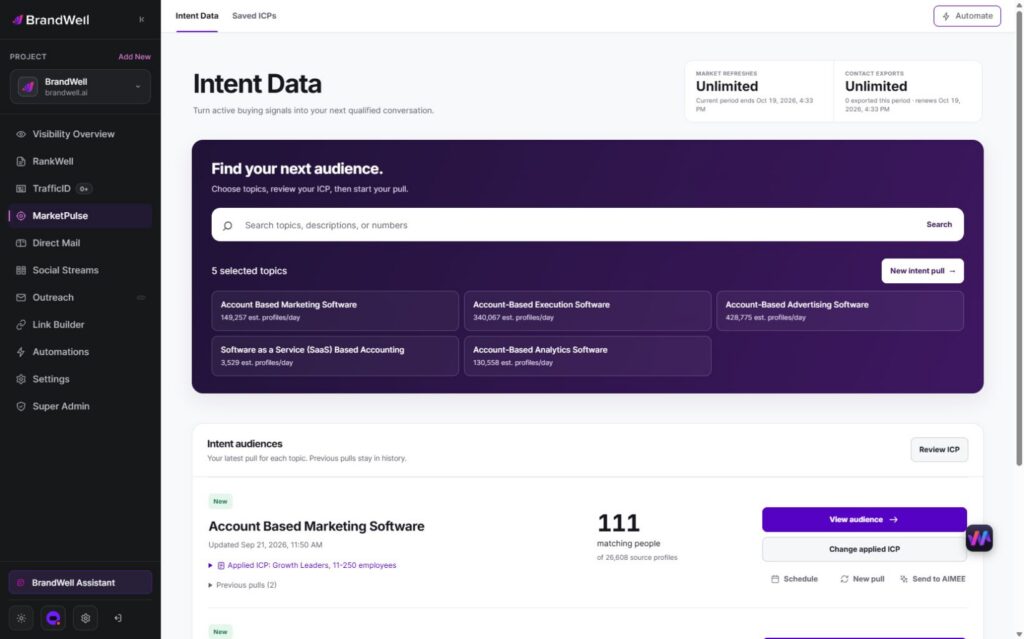
BrandWell MarketPulse: intent data starting at $500/mo. Find people researching topics relevant to what you sell, apply saved ICP filters, and review available contact details before taking action.
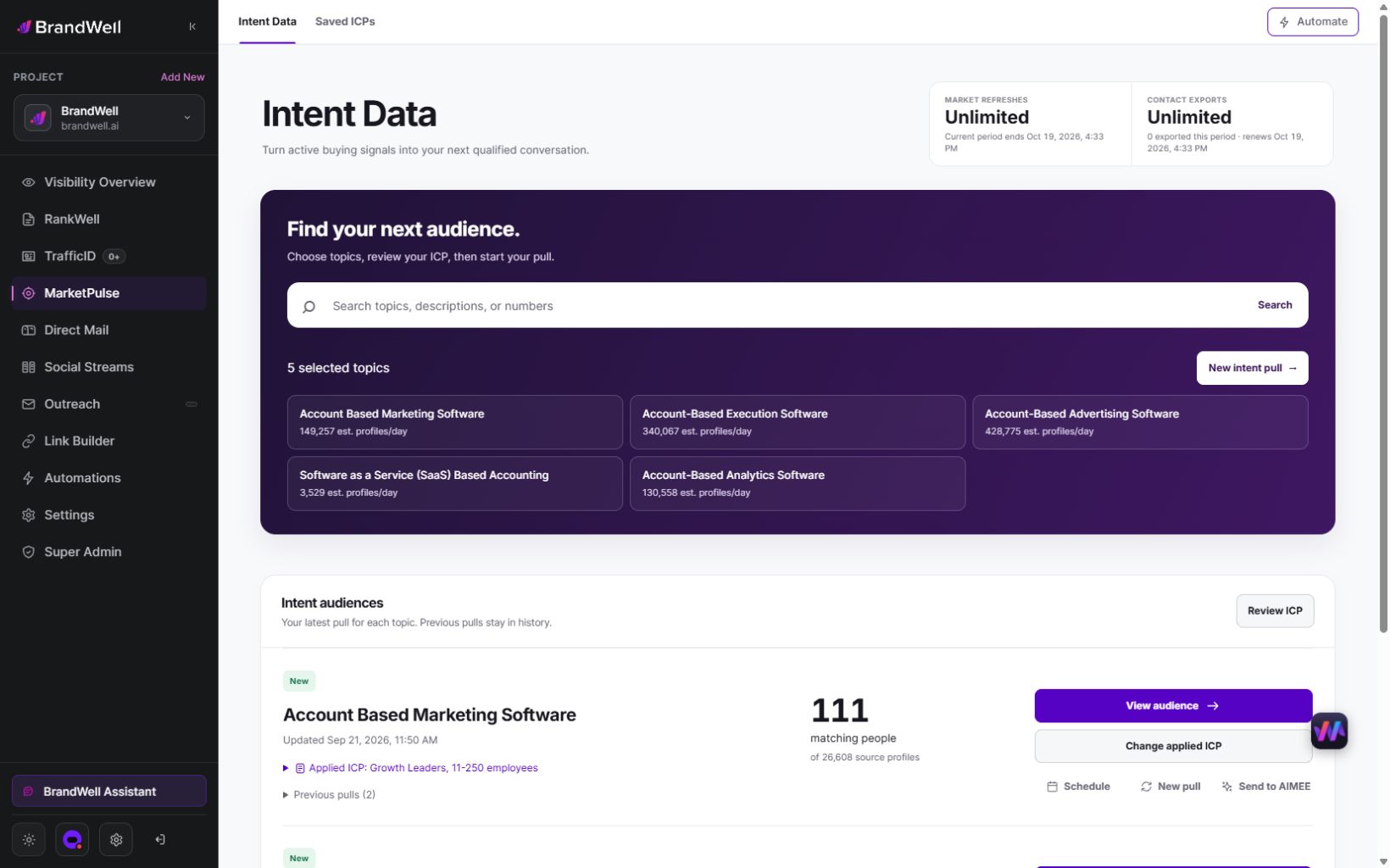
MarketPulse plans are starting at $500/mo. Verify current package scope and offers on the product page.
| Plan | Topics and refreshes | Monthly exports |
|---|---|---|
| Starter | 1 topic, weekly | 25,000 contacts |
| Growth | 3 topics, daily | 100,000 contacts |
| Scale | 10 topics, daily | Unlimited contacts |
Swipe the table to see all columns.
A pull retrieves available data from the previous 24 hours for one topic. Daily use across all included topics provides 90 Growth pulls or 300 Scale pulls in a 30-day month. Weekly Starter pulls vary by calendar month. Available audience size and contact fields vary, and audiences may overlap. Refreshes stop at the plan limit without overage charges.
- Find and qualify: search the topic catalog, save your ICP, and review the people and companies that match.
- Act on the research: export qualified contacts or prepare an Outreach or Direct Mail workflow. Connected products, channel usage, and fulfillment may cost extra.
- Get help from AIMEE: Growth and Scale include AIMEE for the initial user to research accounts and prepare the next step through connected tools.
Agencies and other service businesses can build client deliverables around their available Intent Scans and exports. Keep each client’s scope, permissions, and service fees clear. A subscription is not a promise of a white-label platform or exclusive access to a market.
Explore MarketPulse and watch the demo or compare plans starting at $500/mo. Any early-access discount is a separate, time-limited offer shown to an eligible recipient.
Keep three signal layers separate
Build the program as three distinct layers. The layers may inform each other, but they should remain separable in the data and in client reporting.
Layer 1: Owned engagement
Approved website activity, forms, content, events, email, CRM, product, customer, or sales records. Store the event, property, time, account or person state, and permitted purpose.
Layer 2: External research context
Contracted topic or account signals from outside the client’s properties. Store the provider, methodology field, topic, time window, granularity, coverage note, and permitted use.
Layer 3: Decision and action
Fit, exclusions, identity resolution, reason codes, score or tier, recommended treatment, approval, destination, expiration, and outcome evidence.
The architecture prevents a convenient but dangerous shortcut: blending every event into one number and then forgetting what the number represents. A score may summarize evidence. It should not erase provenance.
Start with the decision and source meaning
Begin with the client decision, then ask which source can improve it. If the client wants to prioritize known site visitors, content engagers, or open accounts, first-party evidence may be sufficient. If the client needs awareness of account research before people reach its properties, third-party signals may add useful context. If the objective is coordinated account treatment, the sources can be combined after their meanings are defined.
Create separate queues before creating a combined score: first-party only, third-party only, both, and neither. Compare their fit, freshness, identity state, activation, and client disposition. This makes it possible to discover whether one source is useful for a particular segment without making a universal claim.
Recurring agency revenue comes from maintaining that source-to-decision system: topic review, source QA, identity rules, prioritization, activation, evidence, and client decisions. It should not be justified by an unsupported promise of more pipeline.
Assign source and identity owners
Name a source owner, identity owner, activation owner, and client decision owner. The source owner documents collection or provider terms, freshness, and availability. The identity owner manages joins and confidence states. The activation owner maps qualified states to destinations and suppressions. The client owner accepts actions and records outcomes. Privacy, security, and legal reviewers should approve material data-use choices for the actual markets and systems involved.
Operate a weekly exception review for missing provenance, stale signals, duplicate identities, destination failures, and urgent account changes. Use a monthly source review to compare adoption and signal usefulness. Use a scheduled methodology review to revisit topics, time windows, scoring, access, retention, providers, and client purpose. A source that no longer changes a decision should be reduced, repaired, or removed.
The systems need a source register, event or account store, identity state, rules layer, destination log, approval history, and outcome ledger. A portal is useful only if the client can see what action a signal supports and who owns it.
Maintain four source-control templates
Evaluate tools by the layer they serve. First-party collection needs consent-aware instrumentation and reliable event definitions. Third-party data needs source transparency, topic controls, time windows, identity granularity, export rules, and continuity. The joining layer needs reversible matching, confidence states, exclusions, and versioning. Activation needs permissions, expiration, suppression, and evidence that the destination accepted the record.
Use four templates before selecting software:
- Source register: owner, purpose, fields, collection or provider, permitted use, retention, deletion, security contact, and change notice.
- Identity map: identifiers, matching rule, confidence state, conflict handling, and fields that may not be joined.
- Action matrix: evidence state, fit, exclusion, treatment, approval, destination, and expiration.
- Evidence ledger: audience version, action, delivery, client disposition, business event, limitation, and next decision.
Agencies can use this intent-data vendor evaluation guide to convert those requirements into due-diligence questions.
Compare owned, external and manual inputs
| Input | What it can add | Use it when | Do not assume |
|---|---|---|---|
| First-party engagement | Specific context on the client’s own properties and relationships | Event definitions and identity are reliable enough to change treatment | A visit or click equals buying readiness |
| Third-party intent | Broader or earlier account research context | Provider terms, topics, granularity, and activation fit the use case | Coverage is complete or a person is identified |
| Manual research | Human interpretation for named strategic accounts | Account count is small and nuance matters | Analyst judgment is consistent without a rubric |
| Fit-only or non-intent model | Stable account prioritization without behavioral claims | Signals are weak, unavailable, or not allowed | Fit shows timing |
Swipe the table to see all columns.
Use first-party only when the client has enough owned engagement to make useful decisions. Add third-party context when it fills a specific timing or coverage gap. Use manual research when the market is narrow or the stakes justify depth. Use fit-only prioritization when behavior data cannot be supported. A simpler model with clear meaning is better than a blended model nobody can audit.
Budget collection and integration costs
First-party cost is not zero. Include instrumentation, event governance, consent and preference handling, identity work, CRM hygiene, storage, analysis, maintenance, and client coordination. Third-party cost can include platform or wholesale access, topics, usage, enrichment, exports, destinations, onboarding, and analyst interpretation. Combined programs also carry integration, conflict-resolution, and quality-review costs.
Build the model by source and by client. Record fixed costs, usage-sensitive costs, operator hours, security or legal review, expected rework, support, and optional activation. Then calculate delivery cost for the agreed cadence and compare it with the agency’s retail price. Stress-test low adoption, weak match, topic changes, rising volume, and extra client requests.
Do not estimate ROI by assigning an invented dollar value to every signal. Use a decision case: Which action changes, how often, what evidence will the client record, and what would the team do without the source? The source earns its place when the observed decision value and service economics justify another cycle.
Measure source lanes before combining them
Report each source lane before reporting the combined lane. Source health includes eligible records, coverage within the defined market, freshness, duplicate rate, missing provenance, identity-state distribution, and exception rate. Activation metrics include records accepted by destinations, suppressions, time to action, client disposition coverage, and treatment completion.
Decision metrics include the share of accounts whose treatment changed, accepted versus rejected recommendations, reasons for rejection, and whether the client used the report. Business movement may include opportunities or stage changes under client definitions, but should remain separate from causal claims. Agency health includes delivery hours, wholesale cost, support, rework, defined delivery contribution, renewal, and scope changes.
Benchmarks should begin with the client’s own baseline and stated conditions. Public averages rarely share the same topics, market, identity rules, sales cycle, and activation. A transparent local baseline is more useful than a precise-looking number with the wrong denominator.
Choose a model that fits client readiness
First-party programs fit clients with meaningful owned traffic, engagement, customer data, or seller activity and enough operational discipline to define events. Third-party programs fit B2B clients with identifiable account markets, longer research journeys, and a reason to act before a direct conversion. Combined programs fit teams with both signal types, a stable identity model, and coordinated marketing and sales owners.
Early-stage clients may start with fit and a small number of first-party events. Adding broad external data before the offer, ICP, and follow-up path are clear can create noise. Mature clients may benefit from more topics, regions, destinations, and source comparisons, but maturity does not excuse weak controls.
Avoid the service when the client cannot state a permitted use, will not maintain exclusions, expects person-level certainty from account-level evidence, or lacks an owner for action. In those cases, fix readiness before expanding data.
Preserve identity and permitted action state
For first-party evidence, preserve the property, event, time, consent or preference state where applicable, person or account link, and campaign context. For third-party evidence, preserve provider, topic, observation window, account or person granularity, score or threshold definition, and any coverage limitation available under contract.
Identity checks should be source-aware. Do not upgrade an account signal to a named person unless the permitted matching path supports it. Retain verified, deterministic, inferred, ambiguous, and unresolved states. When sources conflict, pause the higher-risk action and send the record to review.
Map each evidence state to an approved owner, treatment, expiration and feedback field. Strong fit and owned engagement may prompt seller review. External account research may prompt additional research. Neither a score nor topic activity establishes advertising or outreach permission; hold weak or conflicting records for review.
Review source quality and conflicting evidence
Strategic risk begins when “third party” is treated as one uniform category or “first party” is treated as automatically accurate. A poorly defined first-party event can be misleading. A third-party signal can be incomplete, delayed, account-level, or method-dependent. Operational risks include broken tagging, source outages, silent field changes, topic drift, overmatching, duplicate accounts, missing consent states, excessive retention, and exports that outlive the original purpose.
Review actual source rights, purpose, fields, identity boundaries, access, retention and destination approvals. An owned event is not automatically accurate or permitted for every use, and a provider contract is not proof of a downstream outcome.
Scope recurring source maintenance
Productize the source governance as part of the service. A recurring package can include source-register maintenance, topic and event review, identity QA, account qualification, action routing, client reporting, and a monthly decision session. The report should show source lanes, combined evidence, exceptions, actions, and changes from the prior cycle.
Scope modules explicitly: owned-event design, external topic feeds, visitor identity, enrichment, audience activation, seller routing, portal access, and analyst review. Bound topics, destinations, refreshes, report variants, and custom work. This lets the client buy the useful layer without forcing every account into the most complex package.
An agency intent-data compliance program can sit beside delivery so source and activation changes receive the right review before they become client-facing work.
Copyable assistant source review
AIMEE can help classify approved source records and flag conflicting identity states through configured connected tools. Preserve source meaning and missing evidence. Human owners approve joins, destinations and actual actions.
ROLE: Intent source and activation reviewer.
INPUTS: source register, approved purpose, field dictionary, identity states, ICP, exclusions, action matrix, retention rules, and new records.
TASK:
1. Label every record first-party, third-party, combined, or unresolved.
2. Check provenance, freshness, identity state, fit, exclusions, and permitted destination.
3. Recommend one treatment, expiration, and evidence field for each eligible record.
4. Route conflicts and missing fields to a human exception queue.
5. Draft a source-lane report with limitations and change notes.
DO NOT: infer consent, resolve identity beyond approved rules, export data, contact anyone, change a source, or make an outcome claim.
HUMAN APPROVAL REQUIRED: purpose, source, data field, match rule, retention, destination, audience upload, outreach, methodology change, and client report.
Keep BrandWell product scope clear
MarketPulse supports external topic research and saved ICP review. TrafficID addresses activity on your own website. Custom source joins, client portals and agency implementation services are separately scoped work; verify actual permissions, fields and supported destinations.
Start with MarketPulse topic research starting at $500/mo or review TrafficID for your own-site use case. AIMEE can help organize an approved account brief through configured tools. Combining sources requires a separately approved identity and action specification.
Maintain source versions and reporting
Give every source an owner, next review trigger, and retirement rule. Recheck it after a provider notice, field change, consent or preference change, material coverage shift, new destination, client-purpose change, or quality failure. Test proposed joins on a limited sample before changing the production route. Archive the prior field dictionary and action matrix so old reports remain explainable.
In the client report, show the first-party, third-party, and combined lanes before summarizing recommendations. Include new exceptions, expired records, source changes, client dispositions, and the decisions required for the next cycle. This makes maintenance part of the product instead of invisible overhead.
Complete the source register first
Choose one client and complete the four templates before adding a provider or integration. If the team cannot state source, purpose, identity, action, retention, and owner for a field, that field is not ready for activation. Clear source boundaries make a combined program more useful, not less ambitious.
Worked example: separate overlap from incremental value
Suppose a fictional agency has 80 eligible owned-engagement accounts and 120 eligible external-research accounts. An approved account-level join finds 30 in both groups. The union is 170 accounts, not 200: 50 owned-only, 90 external-only and 30 combined. The overlap rate is 37.5% of the owned set or 25% of the external set. State the denominator. An account join does not prove the same named person performed both activities.
Suppose reviewers accept 20 of the 50 owned-only accounts, 18 of the 90 external-only accounts and 18 of the 30 combined accounts. Acceptance rates are 40%, 20% and 60%, with 56 accepted out of 170 overall, or 32.9%. These invented results describe this rubric and cohort; they do not show buying probability, causal lift or that combined signals are always better. Missing identities and disallowed uses stay out of activation.
A fictional owned-source workflow costs $600. Adding an external source costs $400 and the approved join and review cost another $500. The combined $1,500 is $8.82 per unique account or $26.79 per accepted account. With a $2,000 service fee, the $500 delivery remainder is 25% before acquisition, overhead, tax and financing. Eight extra review hours at $75 add $600, creating a $100 delivery loss. These are planning assumptions, not BrandWell package prices or typical agency returns.
Cookie context is not an intent-source definition
Google’s cookie and user-identification documentation describes cookies used to recognize users across sessions. Cookie behavior, data provenance, identity scope and permission are distinct questions. A first-party cookie does not turn every signal into verified first-party buying intent.
Use the relevant BrandWell input
For external topic research, review MarketPulse with the saved ICP and preserve the actual preceding-24-hour window and available fields. For own-site activity, inspect TrafficID’s actual visitor evidence separately. AIMEE can help prepare an approved comparison brief through configured tools. A human owner verifies the join, source rights and supported next action.
Frequently asked questions
Does first-party mean accurate?
No. Event definitions, identity and data quality still need review.
Does an overlapping account identify the same person?
No. Account-level overlap is not person-level evidence.
Is a higher combined acceptance rate proof of lift?
No. That requires a suitable comparison and outcome design.
Does MarketPulse replace own-site visitor tracking?
No. MarketPulse topic research and TrafficID own-site activity address different inputs.
Review the supported research product: explore MarketPulse and current plans.
Reviewed and updated October 3, 2026.

Written by