On this page
- Current MarketPulse research workflow
- Publish a ten-part methodology card
- Explain the supported decision
- Assign methodology and change owners
- Maintain five reproducible artifacts
- Compare published and private approaches
- Price implementation and ongoing maintenance
- Measure rule health and actual adoption
- Choose clients with maintainable inputs
- Preserve input meaning and identity state
- Review false precision and unsupported claims
- Make maintenance a scoped deliverable
- Copyable public methodology card
- Copyable assistant methodology review
- Keep custom service and product scope clear
- Maintain versions and effective dates
- Publish meaning before adding complexity
- Worked example: disclose a cap and the version boundary
- Frequently asked questions
Direct answer: Publish enough of an intent-scoring methodology for a client to understand the inputs, identity state, weights or tiers, time decay, exclusions, validation, uncertainty, activation, versioning, and limitations. Keep exact code, provider-confidential fields, security-sensitive logic, and abuse controls private. Transparency should make the score challengeable without making the implementation easy to game.
Current MarketPulse offer: intent-data plans start at $500/mo. See the product, demo, and current plans. Updated October 3, 2026.
An intent score is a prioritization aid, not a prediction of certain purchase. Publish the decision logic and evidence standard, not a promise of pipeline or revenue.
Who this is for: Agency strategists and product leads turning a private scoring process into a client trust asset and a maintained recurring service.
Current MarketPulse research workflow
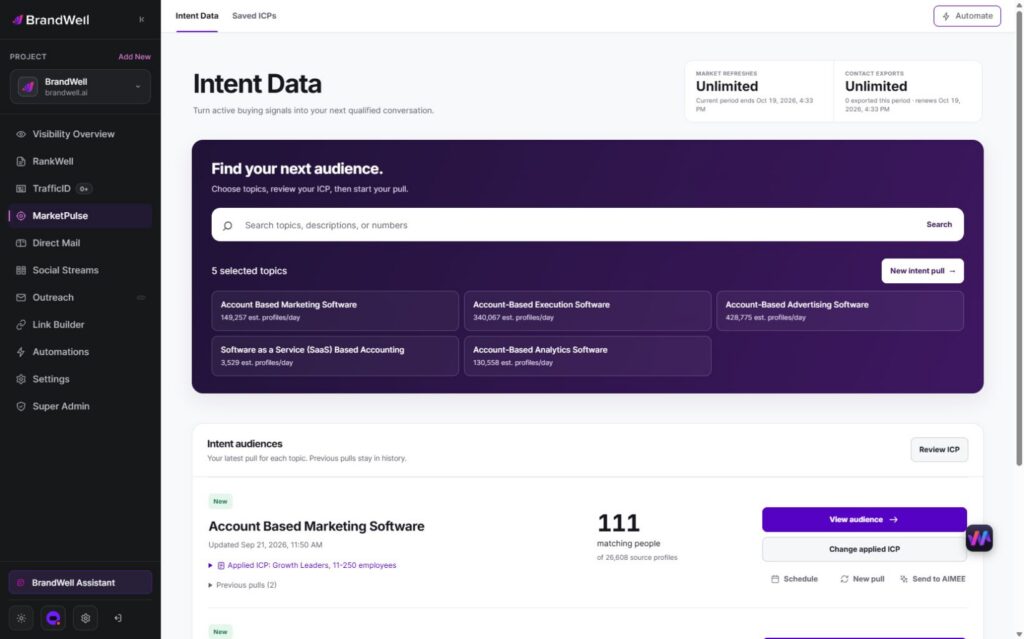
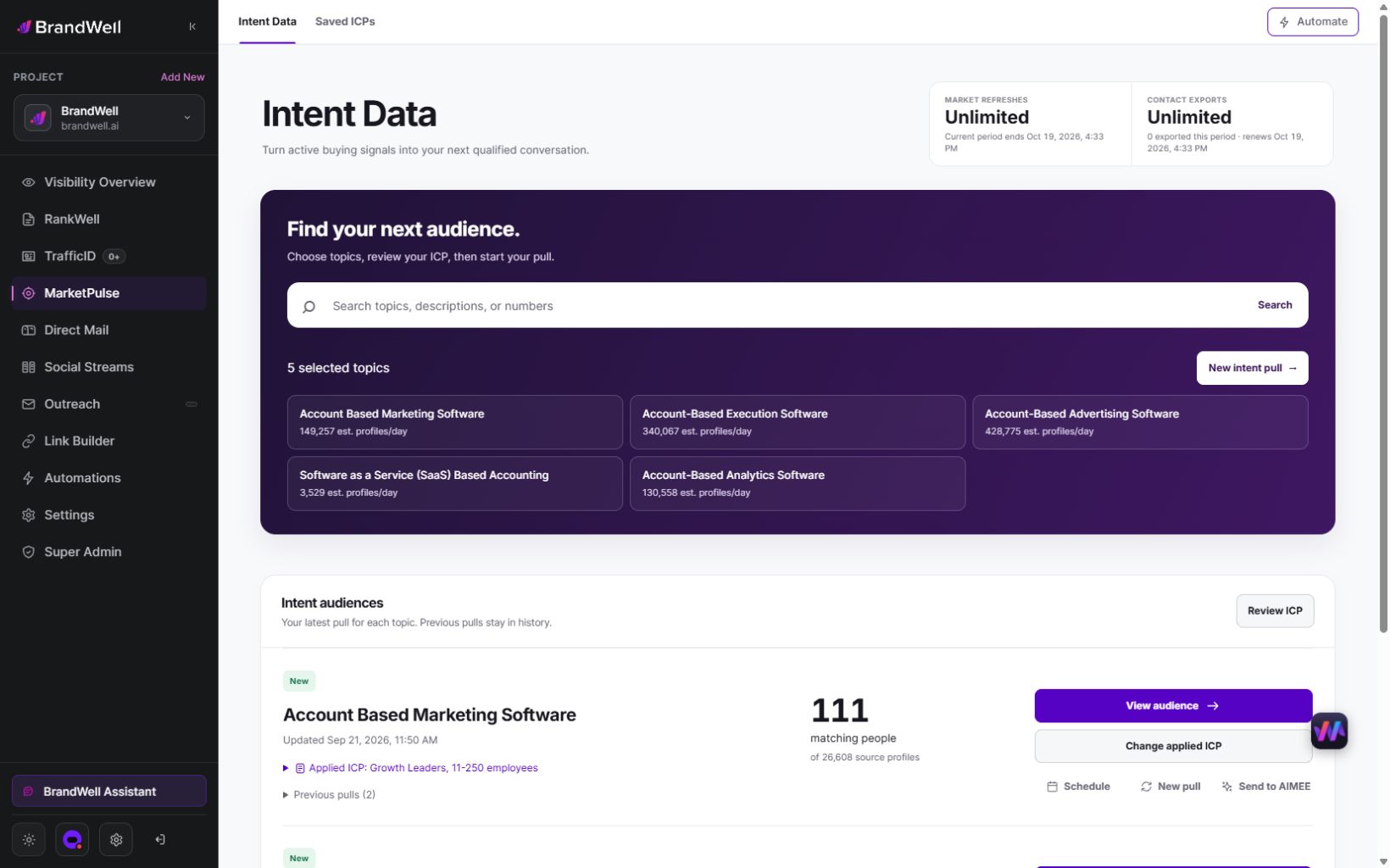
BrandWell MarketPulse: intent data starting at $500/mo. Find people researching topics relevant to what you sell, apply saved ICP filters, and review available contact details before taking action.
MarketPulse plans are starting at $500/mo. Verify current package scope and offers on the product page.
| Plan | Topics and refreshes | Monthly exports |
|---|---|---|
| Starter | 1 topic, weekly | 25,000 contacts |
| Growth | 3 topics, daily | 100,000 contacts |
| Scale | 10 topics, daily | Unlimited contacts |
Swipe the table to see all columns.
A pull retrieves available data from the previous 24 hours for one topic. Daily use across all included topics provides 90 Growth pulls or 300 Scale pulls in a 30-day month. Weekly Starter pulls vary by calendar month. Available audience size and contact fields vary, and audiences may overlap. Refreshes stop at the plan limit without overage charges.
- Find and qualify: search the topic catalog, save your ICP, and review the people and companies that match.
- Act on the research: export qualified contacts or prepare an Outreach or Direct Mail workflow. Connected products, channel usage, and fulfillment may cost extra.
- Get help from AIMEE: Growth and Scale include AIMEE for the initial user to research accounts and prepare the next step through connected tools.
Agencies and other service businesses can build client deliverables around their available Intent Scans and exports. Keep each client’s scope, permissions, and service fees clear. A subscription is not a promise of a white-label platform or exclusive access to a market.
Explore MarketPulse and watch the demo or compare plans starting at $500/mo. Any early-access discount is a separate, time-limited offer shown to an eligible recipient.
Publish a ten-part methodology card
A public methodology does not need to expose every coefficient. It needs to answer the questions a reasonable client would ask before relying on the score.
- Decision: State what the score helps prioritize and what it does not decide.
- Unit: Define whether the score applies to a person, account, domain, visit, or buying group.
- Inputs: Name signal families, source classes, time windows, and required provenance.
- Identity: Publish matching states, confidence handling, conflicts, and unresolved records.
- Fit: Explain account criteria, exclusions, and whether fit is separate from behavior.
- Weight and decay: Describe relative influence, caps, recency, repetition, and negative evidence.
- Output: Define bands, reason codes, and the approved action for each band.
- Validation: Explain holdout, historical, sampling, adoption, or outcome reviews and their limits.
- Governance: Name owners, approvals, version history, review cadence, and change notice.
- Limitations: Disclose uncertainty, bias, coverage, gaming, privacy, and attribution boundaries.
This is the useful middle ground between a black box and a complete implementation dump. It gives the client informed trust and gives the agency a maintenance standard.
Explain the supported decision
Publish the methodology around a decision, not around a claim of superior prediction. For example: “This score orders qualified accounts for weekly review using fit, recent relevant activity, identity state, exclusions, and client feedback.” That statement remains useful even when an account does not buy.
Separate the public card from the private implementation. The public layer explains meaning, input classes, relative logic, actions, validation, and limitations. The private specification contains exact formulas, code, provider-confidential fields, security controls, and analyst procedures. Contract exhibits can sit between the two when a client needs details that should not be public.
The methodology supports pipeline quality only when the client uses it, records dispositions, and changes action. Recurring agency revenue comes from maintaining signals, topics, rules, validation, reporting, and client decisions. Do not claim that publication itself creates revenue or that the score identifies certain buyers.
Assign methodology and change owners
Name a methodology owner, data owner, activation owner, client outcome owner, and change approver. The methodology owner maintains definitions and versions. The data owner manages source and identity quality. The activation owner keeps score bands aligned with treatments. The client owner gathers dispositions and business context. Privacy, security, legal, and contract reviewers should participate when changes affect data, claims, or permitted use.
Operate three loops. The weekly loop reviews exceptions, missing provenance, unusual volume, identity conflicts, and action failures. The monthly loop reviews score distribution, client adoption, overrides, dispositions, and segment performance. The scheduled methodology loop reviews inputs, weights, decay, thresholds, exclusions, providers, retention, and public documentation.
Use versioned source registers, field dictionaries, rule specifications, test cases, change requests, approvals, score outputs, overrides, and outcome ledgers. Every client-facing score should point to a methodology version. If the team cannot reproduce why an account received a tier, the method is not ready to publish.
Maintain five reproducible artifacts
The tool stack should make the method reproducible and reviewable. It needs version control for specifications, a structured source and field catalog, a test environment, a decision or rules layer, an exception queue, a client-facing explanation, and an audit trail. The scoring engine may be a controlled worksheet, CRM automation, warehouse model, or purpose-built service. Complexity should follow the decision, not precede it.
Use five templates: the public methodology card, private technical specification, validation plan, change request, and client score explanation. The explanation should show the account’s tier, reason codes, relevant time window, identity state, approved next step, and caveat. It should not expose provider-confidential data or imply a named person when the evidence is account-level.
Source and field quality still determine whether the method is worth automating. The lead and intent-data quality assurance guide provides the upstream control layer.
Compare published and private approaches
| Approach | Strength | Best fit | Limitation |
|---|---|---|---|
| Published methodology | Repeatable client understanding and challenge | Recurring services with stable inputs and actions | Needs maintenance and can expose weak reasoning |
| Private black-box score | Protects implementation detail | Internal triage where users understand the operator | Clients cannot assess meaning or change |
| Manual prioritization | Captures nuance for a small strategic market | Low volume and high account value | Consistency, scale, and reproducibility may suffer |
| Fit-only tier | Simple, stable, and easy to explain | Behavioral evidence is weak or unavailable | It does not represent timing |
Swipe the table to see all columns.
Use a published method when clients rely on the output repeatedly and need to understand changes. Use manual review where account nuance matters more than scale. Use fit-only tiers when the agency cannot support behavioral claims. A black box may protect intellectual property, but it is a poor client trust strategy if the agency cannot explain decisions, limitations, or version changes.
Price implementation and ongoing maintenance
Budget for discovery, source documentation, rule design, historical review, test cases, writing, client explanation, legal or privacy review where needed, implementation, versioning, monitoring, recalibration, and support. The expensive part is rarely the public page. It is maintaining a method that still matches the data and action.
Model fixed setup separately from recurring maintenance. Then estimate operator hours by client, topic count, source count, score volume, exception rate, validation cadence, report depth, and custom change requests. Include the cost of poor inputs, provider changes, identity conflicts, and client-specific thresholds. Price any bespoke methodology work separately from the base service.
Do not invent an ROI multiple for the score. Build a decision case around adoption, prioritization changes, time saved under an agreed method, downstream movement, delivery cost, and client willingness to continue. A method that nobody uses has no operational value, regardless of its mathematical sophistication.
Measure rule health and actual adoption
Track method health first: missing provenance, identity-state distribution, score or tier distribution, reason-code coverage, exception rate, overrides, threshold stability, source drift, and time since review. Track adoption next: accounts reviewed, recommendations accepted, actions completed, feedback returned, and time from score to decision.
Validation can include rank usefulness, band differences, historical backtesting, holdout or comparison designs where appropriate, sampled record review, and calibration over time. Each method has limits. Historical patterns may not persist. Observational groups may differ before scoring. A small sample can look stable while remaining uncertain. Publish the validation design and caveat, not just the favorable number.
Agency health includes maintenance hours, support, rework, defined delivery contribution, renewal, and expansion tied to documented client use. Measure whether the methodology reduces disputes and accelerates decisions. Do not promise that it will cause a revenue outcome.
Choose clients with maintainable inputs
The approach fits RevOps, ABM, demand-generation, data-service, paid-media, and outbound agencies with recurring prioritization work, stable enough inputs, clear actions, and clients willing to provide feedback. It is useful when different operators need the same decision rule or when the agency wants its expertise to be more than a hidden analyst habit.
It is a poor fit when data sources change constantly, identity is mostly unresolved, the market is too small for anything beyond expert review, the client wants a universal benchmark, or the agency cannot maintain versions. Early-stage programs may publish a qualitative tier rubric before a numeric score. A simple high, medium, and monitor model with reason codes can be more trustworthy than false precision.
Topic design is part of fit. Use the guide to choosing and maintaining intent topics before assigning weights to vague or overlapping concepts.
Preserve input meaning and identity state
Publish signal families and meaning: owned engagement, contracted external research, fit, relationship, recency, repetition, negative evidence, and exclusions. State which inputs are required and which are optional. Explain caps so repeated low-value activity cannot overwhelm fit or a stronger negative rule.
Identity must be part of the method. Define person, account, domain, inferred company, and unresolved states. State whether a score can cross identities or aggregate to an account, and how conflicts are handled. A website visit inferred to an account should not be described as a verified person action.
Map each output band to an approved treatment, owner and expiration. An appropriate band may request human research; insufficient identity or channel permission must remain a hold. A lower confidence label does not by itself authorize advertising or outreach.
Review false precision and unsupported claims
Strategic risks include false precision, calling the score predictive without support, optimizing to an easy proxy, and publishing a method that no longer matches delivery. Operational risks include silent source changes, broken fields, identity leakage, stale weights, threshold drift, inconsistent overrides, absent versioning, and a client action that no longer matches the band.
Bias can enter through market definitions, source coverage, historical outcomes, account size, geography, language, and who is easier to identify. Gaming can occur when staff or clients learn which activity inflates a score. Privacy and security risks grow when transparency reveals sensitive data flows or encourages broader collection than the purpose requires.
Review the actual purpose, source rights, fields, identity boundaries, access, retention and change approvals. A public methodology card does not certify the process, establish legal suitability or validate its performance.
Make maintenance a scoped deliverable
Make maintenance a visible deliverable. A recurring service can include source and topic review, score generation, exception handling, reason codes, client activation, outcome collection, methodology monitoring, and version updates. The public card helps sales explain the service, delivery operate it, and clients challenge it using the same language.
Bound the package by topics, source classes, score frequency, account volume, client-specific rules, destinations, validation depth, and change requests. Keep custom model development separate from routine operation. Publish an update trigger for provider changes, new sources, material drift, client strategy changes, or an approved validation finding.
Copyable public methodology card
Purpose: [decision the score supports]
Unit: [person, account, domain, or other]
Inputs: [source classes, topics, windows, and required fields]
Identity: [states, conflicts, and unresolved handling]
Logic: [relative influence, caps, decay, exclusions, and bands]
Action: [approved treatment and expiration by band]
Validation: [method, comparison, sample, and limitation]
Governance: [owner, version, approval, and review trigger]
Not claimed: [certainty, causal proof, guaranteed outcome, or unsupported coverage]
Copyable assistant methodology review
AIMEE can help compare an approved public methodology card with its private rule specification through configured connected tools. Preserve the rule version, missing evidence and proposed changes. Human owners approve publication, scoring rules and actions.
ROLE: Intent-scoring methodology reviewer.
INPUTS: public methodology card, private rule specification, source register, identity definitions, test cases, prior version, current score distribution, overrides, client dispositions, and change requests.
TASK:
1. Map every public statement to a private rule or documented limitation.
2. Test required fields, caps, decay, exclusions, identity conflicts, and band actions.
3. Compare distributions and overrides with the prior version; flag material drift.
4. Draft a change log, client explanation, validation questions, and rollback criteria.
5. Identify details that should remain private for confidentiality, security, or anti-gaming reasons.
DO NOT: change weights, approve a version, merge identities, activate an audience, contact prospects, or publish a performance claim.
HUMAN APPROVAL REQUIRED: methodology owner, data owner, client outcome owner, privacy or security reviewer when relevant, qualified counsel for claims or terms, and final client approver.
Keep custom service and product scope clear
MarketPulse supports topic research and saved ICP review. A proprietary agency scorecard, custom client portal and model-development service are separately scoped work. Verify actual permissions, fields, destinations and terms; do not present them as included BrandWell capabilities.
Start with supported MarketPulse research starting at $500/mo and preserve the actual topic, available fields and pull window. AIMEE can help organize an approved account brief through configured tools. The agency owns any separate methodology, implementation, evaluation and client agreement.
Maintain versions and effective dates
Publish one canonical methodology card and point proposals, reports, training, and portal explanations to it. Review the card after a source, identity rule, weight, threshold, action, provider, or validation change. Preserve the prior version and effective boundary so an older client report can still be interpreted. Notify affected clients before a material change reaches production.
Measure whether readers understand the method through client questions, overrides, adoption, and dispute reasons. Rescan the buyer questions that shaped the article and update sections when new evidence or product terms require it. Publication can improve clarity and discoverability, but it cannot guarantee a search ranking, recommendation, or citation.
Publish meaning before adding complexity
Draft the ten-part card for the current score. If the team cannot define the unit, inputs, identity, action, validation, owner, version, and limitation, keep the score out of client decisions until those gaps are resolved. A methodology earns trust by being understandable, challengeable, and maintained.
Worked example: disclose a cap and the version boundary
A fictional scorecard gives fit 40 points, a recent permitted signal 20 and a separately verified repetition condition 20. Version one totals 80. Version two caps the combined behavior component at 25, producing 65; with a written review threshold of 70, the band changes. This cap does not replace event deduplication or make the score a probability of buying. Explain the reason, effective date, intended action and rollback boundary.
Suppose 50 of 200 fixed approved test accounts change tier under the new version. The 25% movement rate describes that test set; it does not establish improved outcomes, fairness or stability in every market. Show the changes, missing fields and action capacity before approving release. Preserve old reports with their actual rule version rather than silently recalculating their history.
The Model Cards for Model Reporting research paper proposes documenting trained models’ intended uses and evaluation context. This article adapts the documentation idea to a separate agency rulebook; its ten-part card is not a validated BrandWell machine-learning model or proof of scoring performance.
Suppose recurring tools, review and reporting cost $1,300 against a $2,000 fee, leaving $700 or 35% before acquisition, general overhead, tax and financing. Recovering a $900 methodology update over three months adds $300 per month and reduces the remainder to $400, or 20%. Four extra review hours at $100 consume that remainder. These are invented planning inputs, not typical outcomes or BrandWell methodology-service prices.
Document the actual BrandWell input
Review an available MarketPulse topic with the saved client ICP and preserve the actual preceding-24-hour window and permitted fields. Document how the separate agency scorecard uses that input and handles missing information. AIMEE can help check the explanation against an approved rule specification through configured tools. Human owners verify source rights and approve the method, publication and actual next action.
Frequently asked questions
Does publishing a method validate its performance?
No. Documentation and evaluation are different tasks.
Does a scoring cap replace deduplication?
No. Repeated records and repeated independent signals need distinct handling.
Should old reports silently use a new rule version?
No. Preserve their actual version or clearly label an approved recalculation.
Is a proprietary scoring model included in MarketPulse?
Do not assume that. This article describes separately scoped agency methodology work.
Review the supported research product: explore MarketPulse and current plans.
Reviewed and updated October 3, 2026.

Written by