On this page
- Use the six FIT-ACT review inputs
- Current MarketPulse research workflow
- Promise an explained priority queue
- Version the rules and client handoff
- Evaluate transparent scoring capabilities
- Compare build, service and referral models
- Price maintenance and recalibration work
- Separate adoption from associated revenue
- Choose clients with an approved marketing decision
- Keep fit, identity and behavior distinct
- Review missing data, drift and expectations
- Scope the recurring scoring service
- Copyable scorecard QA review
- Test explanations before automating actions
- Worked example: points are not purchase probabilities
- Frequently asked questions
Direct answer: Productize intent-based lead scoring as a transparent prioritization service, not a prediction machine. Combine documented fit criteria with time-bounded behavioral signals, identity confidence, exclusions, and a specific action for each tier. Let the client inspect why a record moved, correct the inputs, and recalibrate the rules.
Current MarketPulse offer: intent-data plans start at $500/mo. See the product, demo, and current plans. Updated October 3, 2026.
The responsible promise is a maintained, auditable queue that helps a team decide what to review next. Do not promise that a score identifies a buyer or produces pipeline or revenue.
Who this is for: RevOps and growth agency owners turning scattered fit and intent inputs into a recurring client service.
Use the six FIT-ACT review inputs
- Fit: test contracted account criteria such as industry, size band, geography, and exclusions.
- Intent: classify approved research or website behavior without overstating what it proves.
- Time: apply an agreed recency window and decay rule so old activity does not remain hot forever.
- Assurance: attach company, person, contact, and source confidence separately.
- Context: add CRM stage, ownership, suppression, relationship, and campaign eligibility.
- Trigger: map the resulting tier to a permitted human-reviewed action, evidence requirement, and feedback field.
FIT-ACT keeps the arithmetic visible. The score prioritizes review; it does not certify identity, authority, budget, purchase intent, or future performance.
Current MarketPulse research workflow
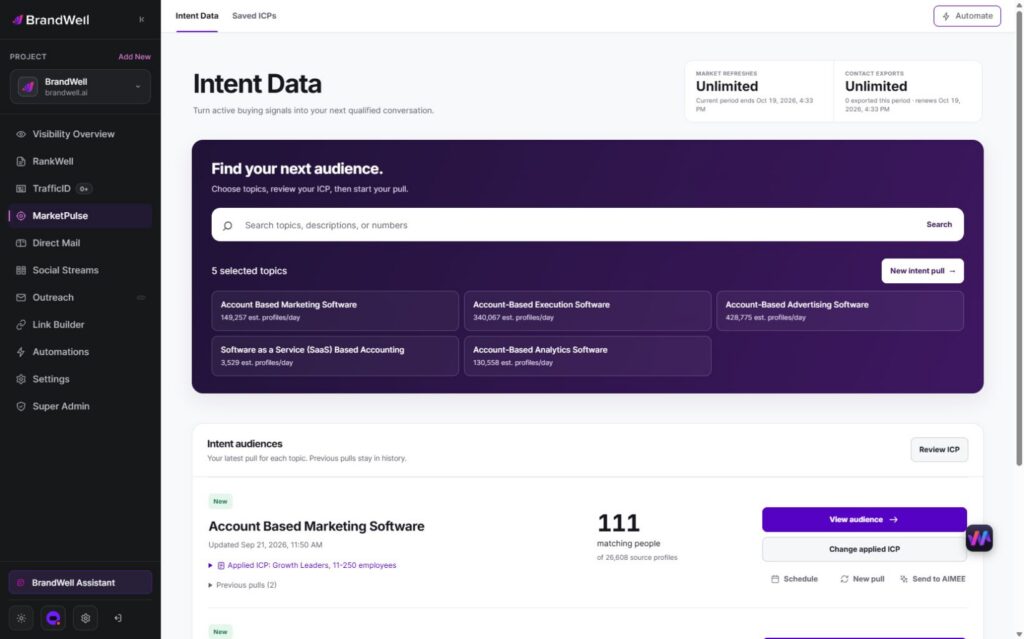
BrandWell MarketPulse: intent data starting at $500/mo. Find people researching topics relevant to what you sell, apply saved ICP filters, and review available contact details before taking action.
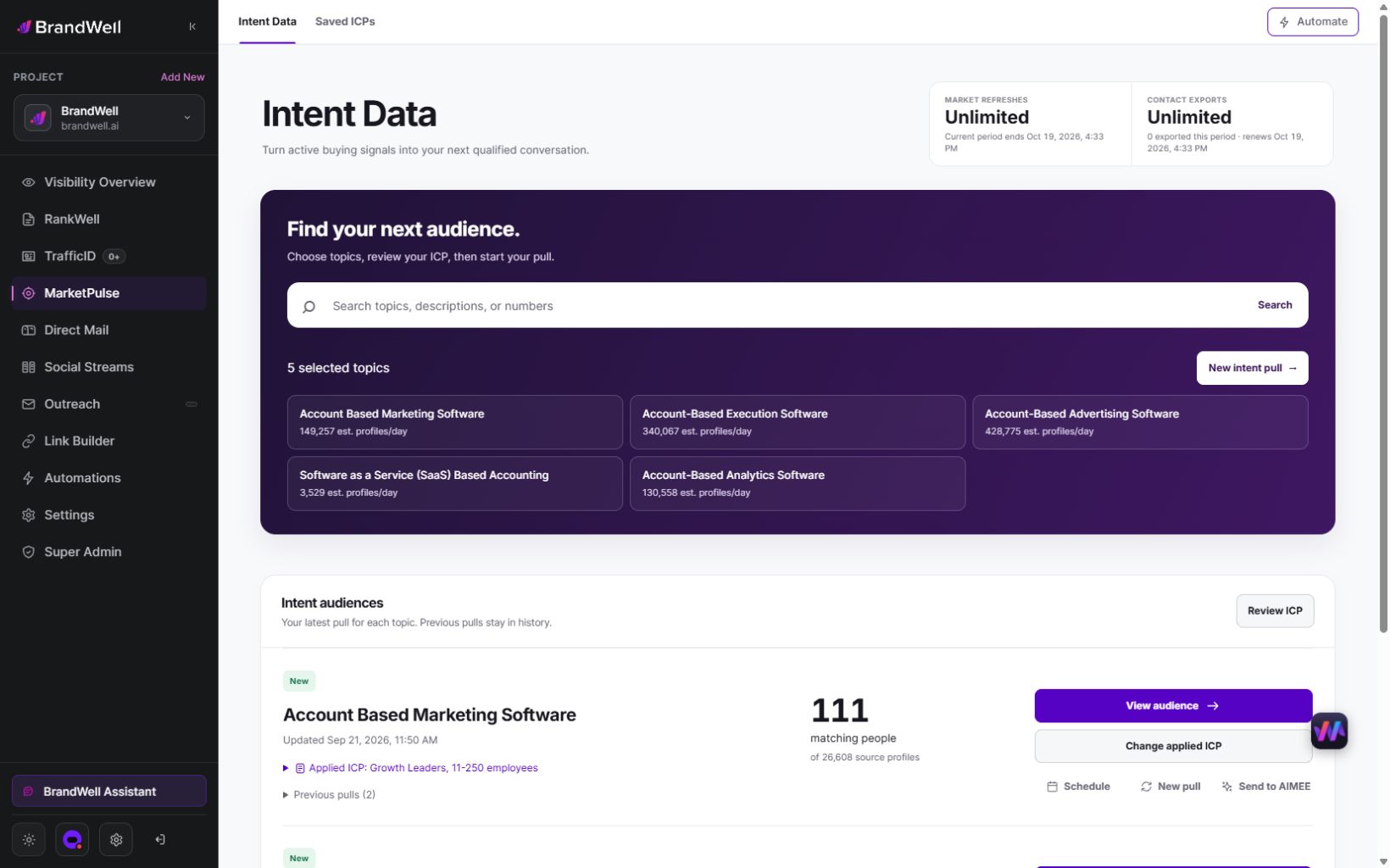
MarketPulse plans are starting at $500/mo. Verify current package scope and offers on the product page.
| Plan | Topics and refreshes | Monthly exports |
|---|---|---|
| Starter | 1 topic, weekly | 25,000 contacts |
| Growth | 3 topics, daily | 100,000 contacts |
| Scale | 10 topics, daily | Unlimited contacts |
Swipe the table to see all columns.
A pull retrieves available data from the previous 24 hours for one topic. Daily use across all included topics provides 90 Growth pulls or 300 Scale pulls in a 30-day month. Weekly Starter pulls vary by calendar month. Available audience size and contact fields vary, and audiences may overlap. Refreshes stop at the plan limit without overage charges.
- Find and qualify: search the topic catalog, save your ICP, and review the people and companies that match.
- Act on the research: export qualified contacts or prepare an Outreach or Direct Mail workflow. Connected products, channel usage, and fulfillment may cost extra.
- Get help from AIMEE: Growth and Scale include AIMEE for the initial user to research accounts and prepare the next step through connected tools.
Agencies and other service businesses can build client deliverables around their available Intent Scans and exports. Keep each client’s scope, permissions, and service fees clear. A subscription is not a promise of a white-label platform or exclusive access to a market.
Explore MarketPulse and watch the demo or compare plans starting at $500/mo. Any early-access discount is a separate, time-limited offer shown to an eligible recipient.
Promise an explained priority queue
Offer it when the client already has more possible accounts or leads than the team can review consistently, and when the client will participate in defining fit, exclusions, actions, and feedback. The productized outcome should be an explained priority queue, a repeatable operating cadence, and a record of why each tier changed. That is useful even when downstream conversion is uncertain.
Avoid the claim that the model knows who will buy. Intent inputs can indicate research or engagement under defined conditions. Fit inputs describe whether an account resembles the agreed market. Neither proves a named person’s motives. Phrase the client promise around decision support: faster review, consistent rules, visible confidence, and a mechanism for learning from accepted and rejected recommendations.
The package is strongest when it changes behavior. A high tier should cause a specific review, assignment, research step, or approved campaign action. A score with no owner or destination is a decorative field.
Before selling the service, ask the client to rank three frustrations: inconsistent prioritization, slow response, and unclear reasons. The score should solve at least one in a way users can observe. If the real issue is insufficient demand, an uncompetitive offer, or no sales capacity, scoring is unlikely to be the appropriate first intervention.
Version the rules and client handoff
Start with a scoring contract, even if it is an operational appendix rather than a legal agreement. Define eligible records, fit fields, signal sources, identity levels, weights, caps, decay, exclusions, tie handling, destinations, actions, feedback, and recalibration authority. Version the model so a score can be reproduced after a change.
- Discover: document the client’s decision, baseline workflow, available fields, prohibited uses, and system owners.
- Profile: audit completeness, duplicates, timestamps, taxonomies, consent or rights, and identity state.
- Configure: create the scoring matrix, tier thresholds, suppression rules, and action playbook.
- Test: run a shadow sample, review false positives and exclusions, and obtain client acceptance.
- Release: route only approved tiers to named owners and monitor delivery exceptions.
- Learn: collect dispositions, inspect drift, and approve controlled rule changes.
Typical roles are a RevOps owner, analyst, client success lead, activation owner, and privacy or security reviewer. The SLA should cover agency-controlled work such as refresh completion, exception response, or approved handoff timing. It should not promise sales outcomes. At handoff, provide the current rulebook, version log, field dictionary, tier actions, unresolved issues, and rollback method.
Evaluate transparent scoring capabilities
Choose capabilities before vendors. The service needs a source layer for permitted signals and enrichment, an identity and quality layer, a rules engine or maintainable calculation, a client-facing explanation layer, CRM or marketing destinations, an exception queue, and an evidence ledger. A white-label option should also preserve the agency’s brand, client entitlements, exports, access roles, and change history.
Evaluate whether the tool exposes inputs, weights, thresholds, decay, and reason codes. Confirm the agency can suppress records, separate company from person identity, correct data, limit access, and export evidence without exposing another client’s information. Test failure paths: stale timestamps, missing domains, conflicting matches, duplicate contacts, integration outages, and a client changing its ICP.
No platform should be selected from a generic “best tools” list alone. Use a controlled sample and score the option against rights, transparency, integration effort, operations, support, and total cost. BrandWell’s lead and intent data quality assurance checklist provides tests that belong in that evaluation.
Compare build, service and referral models
| Model | Choose it when | Tradeoff |
|---|---|---|
| Build | The agency needs distinctive logic, owns technical maintenance, and can govern data and integrations | Highest control and highest ongoing engineering burden |
| Resell | The agency wants faster packaging, a branded delivery surface, and predictable platform operations | Requires careful entitlement, wholesale-cost, rights, and provider-dependency review |
| Refer | The client can operate the scoring program and the agency does not want delivery responsibility | Lower service control and less recurring operational value |
| Avoid | Inputs are unreliable, use is sensitive or prohibited, no team will act, or the client demands opaque outcome claims | Protects trust and capacity but gives up the project |
Swipe the table to see all columns.
A hybrid is common: resell or license the signal infrastructure, then own the transparent rulebook, QA, activation design, and client cadence. The contract must say which party owns each component and what happens when a source or integration changes. Do not market a proprietary prediction if the service is actually a configurable prioritization matrix.
Price maintenance and recalibration work
There is no universal responsible setup fee, retail price, or gross-margin range. Model the package from actual inputs: discovery, data audit, source and usage, configuration, testing, integration, documentation, training, account service, recalibration, exception handling, security review, and allocated overhead. Separate one-time implementation from recurring maintenance.
Copyable scoring-service price floor
Setup floor = discovery + audit + model configuration + integration + testing + documentation + risk review
Recurring delivery cost = wholesale and usage + analyst time + QA + client service + support + allocated overhead
Price floor = recurring delivery cost / (1 - chosen contribution rate)
Stress case = source change + integration repair + extra recalibration cycle
Use the agency’s chosen contribution target, not an invented market benchmark. Validate capacity and cash timing, and price custom destinations or accelerated reviews explicitly. A discount should reduce scope or service, not erase hidden labor.
Separate adoption from associated revenue
First prove delivery and adoption: records scored, reasons available, tiers accepted, actions assigned, and destination receipts. Then measure workflow movement: response time, completed reviews, disposition quality, progression among comparable cohorts, and exceptions. Only after the CRM definitions and match method are reliable should the agency report associated opportunities, pipeline, or revenue.
Write the measurement plan before rollout. Define the eligible population, comparison method, time window, source of truth, duplicate handling, attribution label, and minimum evidence needed to make a statement. A holdout or phased rollout may improve learning when operationally and ethically appropriate, but it still does not prove that every difference came from the score.
Do not cherry-pick a successful record. Show exclusions, unresolved identities, missing fields, and the effect of model changes. The strongest evidence packet distinguishes sourced, influenced, associated, and unknown outcomes.
Use a pre-change and post-change comparison only when definitions remain stable. If the team changed topics, thresholds, routing, market, or follow-up, show the break and explain it. The goal is a reliable decision, not a flattering retrospective. Keep the comparison method available to the client reviewer.
Choose clients with an approved marketing decision
Good-fit clients have a defined B2B market, sufficient eligible activity, usable account identifiers, a maintained CRM, named owners, capacity to act, and a willingness to record dispositions. They understand that prioritization supports human judgment. They can approve the data purpose, sources, destinations, retention, and access model.
Exclude or pause clients that lack a stable business question, cannot identify an activation owner, will not correct the CRM, demand certainty about individuals, or want the marketing score used for employment, credit, insurance, housing, suitability, or another consequential decision without specialist governance. Also pause when rights are unclear, fields are systematically missing, or the model would encode an inappropriate proxy.
A small account list can still benefit from a manual scorecard, but a complex automation may not be justified. Conversely, high volume does not excuse weak identity or unexplained ranking. Fit is about the decision and control environment, not record count alone.
Keep fit, identity and behavior distinct
Separate inputs into firmographic fit, first-party engagement, company-level research, permitted third-party signals, CRM relationship, and exclusions. For every input, record its owner, timestamp, permitted purpose, confidence, failure mode, and decay. A website-visitor event may be useful, but a company match does not identify the person who browsed. A verified contact does not prove that contact produced the activity.
Identity should be layered: company resolution, person resolution where permitted, contact validation, role relevance, and duplicate resolution. Never fill an unresolved layer with inference and present it as fact. At activation, assign a human-readable reason code and a proportionate action. A lower-confidence signal may prompt account research, while a validated combination may support an approved outreach workflow.
Use the client CRM or agreed warehouse as the outcome record and preserve destination receipts. BrandWell’s intent-data CRM and marketing-stack integration guide covers handoff states and failure handling.
Review missing data, drift and expectations
Data-quality risks include missing timestamps, duplicated entities, inconsistent domains, changed taxonomies, stale stages, and false identity matches. Delivery risks include silent integration failures, unowned queues, uncontrolled model edits, and tiers without actions. Expectation risk appears when a score is described as buying certainty or a universal benchmark.
Review purpose, permitted fields, source terms, corrections, access, retention and destinations for the actual service. Keep the accountable reviewer and change record visible. This framework does not establish legal suitability for a client use.
When an assistant proposes a rule change, preserve its approved inputs, rule version, test cases, expected actions and human review. Do not accept a change merely because it produces a more favorable retrospective chart.
Run a score stability and drift review
Compare the current and proposed rules on the same approved sample. Inspect how many records change tier, which fields cause the movement, whether one source dominates, and whether the action capacity can absorb the new distribution. Review examples at each boundary instead of judging only an average metric.
Set explicit reasons for recalibration: an approved ICP change, source change, taxonomy change, persistent client dispositions, or a broken operational threshold. Document the old and new versions, intended effect, sample results, approver, release point, and rollback. Never tune weights merely to make a favorable outcome chart.
Scope the recurring scoring service
Package the service around maintained decision infrastructure: approved inputs, a versioned scorecard, reason codes, identity and quality checks, tier actions, destination monitoring, a client review, recalibration, exceptions, documentation, and a change allowance. State what is not included, such as custom model development, unlimited integrations, or regulated decisioning.
AIMEE can help audit an approved scorecard and prepare explanations through configured connected tools. Preserve the written rule version, missing values, reviewer and proposed change. Do not assume a custom scoring engine, automated recalibration or white-label service is included.
Start with supported MarketPulse research starting at $500/mo. Review the actual topic and saved client ICP, then prepare an approved next action. A separately maintained agency scorecard is a service design, not a claim that MarketPulse includes a custom prediction model.
Topic quality materially affects scoring, so use BrandWell’s guide to choosing and maintaining intent topics before assigning behavioral weight.
Copyable scorecard QA review
ROLE: Act as a scoring operations reviewer. Do not make final sales, privacy, legal, or model approvals.

INPUTS:
- client business question and approved use
- fit fields, signal fields, timestamps, and identity states
- weights, caps, decay, thresholds, and exclusions
- tier actions and destination rules
- sample records with permitted data minimized
- evaluation and disposition results

TASK:
1. Reproduce each sample score from the written rules.
2. Flag missing, stale, conflicting, or proxy-like inputs.
3. Explain every tier in plain language.
4. Find cases where confidence and score are being confused.
5. Draft a recalibration proposal with a rollback plan.
6. Produce a human-approval checklist.

STOP CONDITIONS:
- Do not infer identity, authority, intent, budget, suitability, or creditworthiness.
- Do not invent missing values, benchmarks, prices, or outcomes.
- Do not change production rules, route records, or contact anyone.

HUMAN APPROVAL REQUIRED:
The client RevOps owner approves fit and actions. The agency owner approves scope and price. Authorized privacy, security, legal, and sector reviewers approve applicable uses. A human approves release and rollback.
Claude, ChatGPT, or AIMEE can audit the rulebook and prepare a change proposal. Keep production changes behind explicit human approval.
Test explanations before automating actions
Take a small permitted sample, reproduce every score by hand, and ask client users what action each tier should cause. If the team cannot explain or act on the result, improve the rulebook before scaling the feed.
Worked example: points are not purchase probabilities
A fictional rulebook gives a fit account 50 points and a recent approved research signal 30 points. Its 80-point total ranks review priority; it does not mean an 80% chance of buying. If the chosen aging rule reduces that signal to 15 points, the new total is 65. With a written tier threshold of 70, the record changes tier, but the rulebook must still preserve its evidence, missing fields and permitted action.
Probability calibration documentation compares predicted probabilities with observed class frequencies. That is a different evaluation from assigning points. This distinction does not establish a BrandWell probability model, a validated buying label or a reliable forecast from the example.
Suppose 1,000 distinct eligible accounts include 200 above the threshold. Reviewers assess 150 and accept 60 under the written marketing-fit rule. Acceptance is 40% of reviewed accounts. The 50 unreviewed accounts remain unknown, so 60 / 200 = 30% is the known accepted share of flagged accounts, not measured precision for all flagged accounts. Without reviewing the relevant unflagged population, the example cannot establish recall.
Suppose tools cost $500, review costs $500 and reporting costs $200. Defined recurring cost is $1,200, or $20 per accepted account. At a $2,000 fee, the $800 remainder is 40% before acquisition, setup recovery, general overhead, tax and financing. Eight additional recalibration hours at $75 add $600 and reduce the remainder to $200, or 10%. These are invented planning inputs, not typical outcomes or BrandWell scoring-service prices.
Prepare the scored review from BrandWell research
Review an available MarketPulse topic with the saved client ICP and retain its actual preceding-24-hour pull window. Apply a separately approved scorecard to permitted fields in the agency’s chosen worksheet or system. AIMEE can help reproduce the arithmetic and flag missing inputs through configured tools. A human approves the explanation, destination and tier action before release.
Frequently asked questions
Does 80 points mean an 80% chance of purchase?
No. A point total is a ranking rule unless a separately evaluated probability model establishes that meaning.
Can unreviewed records be treated as rejected?
No. Keep their outcome unknown and show the review coverage.
Does the flagged subset establish recall?
No. Recall requires evidence about the relevant positive population, including missed positives.
Is a custom scoring engine included in MarketPulse?
Do not assume that. This article describes a separately scoped agency scorecard using permitted research.
Review the supported research product: explore MarketPulse and current plans.
Reviewed and updated October 3, 2026.

Written by