On this page
- Current MarketPulse workflow
- Define a useful problem-and-fit brief
- Assign six owners and a review cadence
- Evaluate seven workflow capabilities
- Compare topic research with other approaches
- Model costs and client capacity
- Measure quality and observed outcomes
- Choose suitable clients
- Use six evidence states
- Manage trust and data-use risks
- Package the recurring service
- Worked example: useful account review without incident claims
- Frequently asked questions
Direct answer: An MSP or cybersecurity intent service should prioritize companies researching approved business problems, then verify account fit and contactability before outreach. It must never tell a seller that a company was breached, is vulnerable, or has a known incident. The package earns trust through separate evidence states, conservative messages, suppressions, and client-approved handoffs.
Current MarketPulse offer: intent-data plans start at $500/mo. See the product, demo, and current plans. Updated October 3, 2026.
Who this is for: IT-services, MSP, MSSP, and cybersecurity marketing agencies whose clients have defined offers, territories, response capacity, and reviewers for sensitive security messaging.
Cybersecurity research can be commercially relevant and still be easy to misread. A topic signal may help decide which account deserves research. It does not reveal the account’s security posture, incident history, systems, credentials, or urgency. An agency should design the service so that the system cannot silently promote that weak observation into an alarming claim.
That principle changes topic selection, copy, routing, metrics, and client reporting. It also makes maintenance part of the product. For a deeper method, start by learning how to choose and maintain intent topics that map to a business problem without implying a failure.
Current MarketPulse workflow
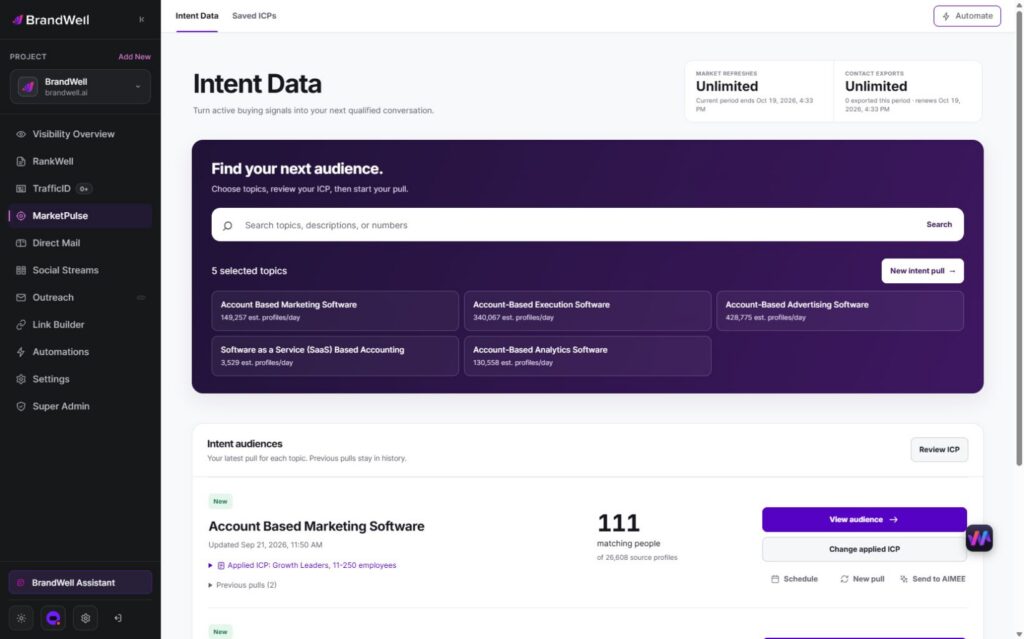
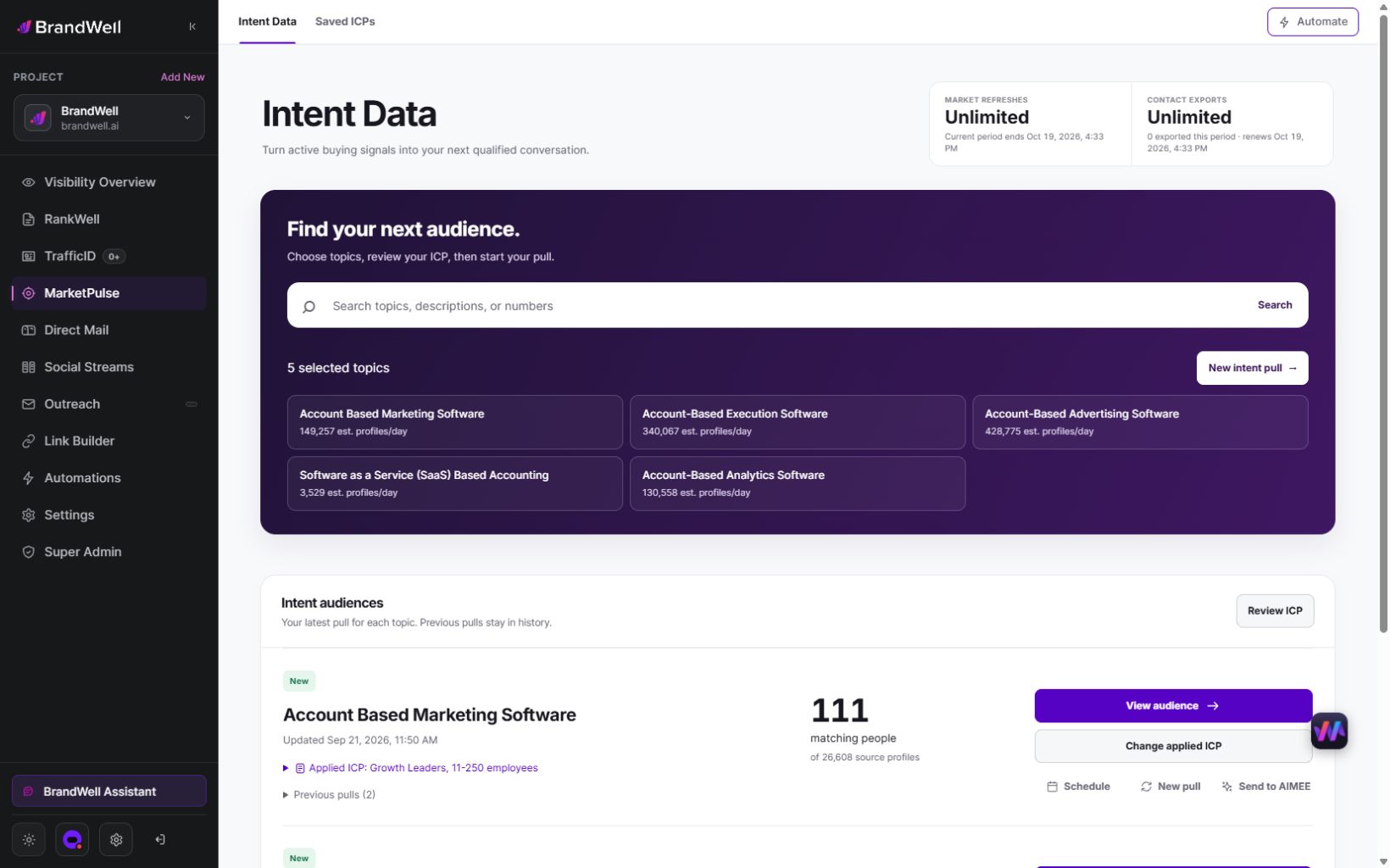
BrandWell MarketPulse: intent data starting at $500/mo. Find people researching topics relevant to what you sell, apply saved ICP filters, and review available contact details before taking action.
MarketPulse plans are starting at $500/mo. Verify current package scope and offers on the product page.
| Plan | Topics and refreshes | Monthly exports |
|---|---|---|
| Starter | 1 topic, weekly | 25,000 contacts |
| Growth | 3 topics, daily | 100,000 contacts |
| Scale | 10 topics, daily | Unlimited contacts |
Swipe the table to see all columns.
A pull retrieves available data from the previous 24 hours for one topic. Daily use across all included topics provides 90 Growth pulls or 300 Scale pulls in a 30-day month. Weekly Starter pulls vary by calendar month. Available audience size and contact fields vary, and audiences may overlap. Refreshes stop at the plan limit without overage charges.
- Find and qualify: search the topic catalog, save your ICP, and review the people and companies that match.
- Act on the research: export qualified contacts or prepare an Outreach or Direct Mail workflow. Connected products, channel usage, and fulfillment may cost extra.
- Get help from AIMEE: Growth and Scale include AIMEE for the initial user to research accounts and prepare the next step through connected tools.
Agencies and other service businesses can build client deliverables around their available Intent Scans and exports. Keep each client’s scope, permissions, and service fees clear. A subscription is not a promise of a white-label platform or exclusive access to a market.
Explore MarketPulse and watch the demo or compare plans starting at $500/mo. Any early-access discount is a separate, time-limited offer shown to an eligible recipient.
Define a useful problem-and-fit brief
Organize the offer around problem-and-timing segments, not breach detection. Approved topics might describe governance, resilience, identity, infrastructure, risk management, or a service category the client can address. The agency then combines the observation with independently defined account fit, service territory, client exclusions, and a human-reviewed next action.
Give the seller an honest account brief: what topic was observed, what company match exists, why the account fits, what remains unknown, and which helpful resource or discovery question is approved. Ban phrases such as “we noticed your breach,” “your environment is vulnerable,” or any variation that asserts a private incident. Even softer scare language can damage trust when the evidence only supports a general problem area.
Recurring value comes from weekly prioritization, evidence labeling, message guardrails, suppression, feedback, and monthly topic decisions. The agency can help the client spend time on a more relevant queue, but it cannot promise qualified pipeline, revenue, or sales. The service is defensible when its conclusions remain narrower than its evidence.
Assign six owners and a review cadence
Define six owners. A topic owner maintains the approved taxonomy. An analyst reviews account fit and anomalies. An identity QA owner verifies company, domain, role, and contact evidence. A security or privacy reviewer approves source, destination, retention, and sensitive-message rules. A client sales owner accepts handoffs. A delivery lead coordinates reporting, exceptions, and economics.
At intake, record the client’s actual offers, territories, account profile, exclusions, content resources, prohibited claims, and response capacity. The weekly process should ingest observations, apply fit, resolve companies, validate contacts where appropriate, run suppressions, label evidence, and send only approved records for client review. Feedback returns as accepted, rejected, duplicate, existing relationship, out of territory, wrong topic, or needs more research.
Run a monthly learning review by topic and evidence state. Retire noisy topics. Adjust identity thresholds. Reconcile suppressions. Inspect whether approved copy remained non-alarmist. Review destination access and retention. Any source, purpose, topic, or system change should trigger a documented approval before the new configuration is used.
Evaluate seven workflow capabilities
Choose a stack that preserves the evidence ladder. The essential capabilities are:
- Problem-topic taxonomy: approved meanings, exclusions, example language, owner, and version.
- Company and domain resolution: match method, confidence, ambiguity, and source kept visible.
- Contact validation: role fit and contactability treated as distinct from account interest.
- CRM routing: field-level mapping, ownership rules, reversal, and auditable handoff.
- Message library: approved educational angles, discovery prompts, and prohibited incident language.
- Suppression controls: customers, active opportunities, partners, exclusions, opt-outs, and sensitive records.
- Evidence log and report: observation, review decision, action, outcome, uncertainty, and owner.
Templates should include a topic card, evidence-state rubric, account brief, message approval sheet, handoff form, false-positive log, and monthly decision memo. Avoid a tool that obscures source rights, identity method, access, deletion, or field provenance. Security buyers will reasonably ask how the service itself is governed.
Compare topic research with other approaches
Intent-enriched segmentation is valuable when approved topics are specific enough to inform a problem cohort and the client can review records quickly. Manual account research is stronger for strategic named accounts, complex environments, specialized services, and situations where public context matters more than volume. Referrals and existing relationships carry context that a topic observation does not, so they should not be displaced by an automated priority.
Firmographic lists answer whether a company could fit by size, sector, territory, or technology context. They do not supply timing evidence. Broad campaigns can build familiarity across that market without suggesting surveillance. A useful hybrid sends high-confidence topic and fit combinations to analyst review while lower-confidence accounts remain in education or manual research.
Compare the approaches on context, scale, source sensitivity, identity confidence, research effort, message options, false-positive cost, and client follow-up capacity. When the team cannot explain why an account entered the queue, manual research is the safer choice. When the client wants incident certainty, neither approach can meet the request responsibly.
Document the choice in an account-segmentation note that names the method, reason, owner, review date, and evidence limits. This stops a temporary manual exception from becoming an invisible permanent workflow and gives the client a clear basis for comparing quality across cohorts.
Model costs and client capacity
Model economics from the delivery workflow. Include platform and source cost, approved topic count, account-resolution work, contact validation, analyst review, security and privacy review, message approval, CRM handoff, reporting, client meetings, false-positive handling, and change control. Add a risk allowance for unusually sensitive topics or fragmented territories.
Cyber intent cost model
- Fixed monthly work: governance, topic maintenance, system access, base report, and client review.
- Variable work: records reviewed, identity exceptions, contacts checked, routing actions, and feedback reconciliation.
- Capacity constraint: maximum accounts the client’s sales team can accept and follow up under the agreed SLA.
- Quality allowance: rework for false matches, prohibited messaging, duplicate ownership, and unverified destinations.
- Scenario result: proposed retail fee minus direct delivery cost, with assumptions visibly labeled.
Use low, expected, and high-effort cases. Do not import an unsupported MSP margin benchmark or promise that the service pays for itself. If acceptable margin depends on an assumed lead volume, redesign the package around a smaller queue, clearer topics, or a different cadence before selling it.
Measure quality and observed outcomes
Measure the evidence chain before measuring commercial effects. Track usable-account rate, identity-confidence distribution, analyst rejection, sensitive-message flags, client acceptance, follow-up coverage, activation latency, suppression, and the share of records with a complete evidence trail. These KPIs show whether the service is operating as promised.
Monitor replies by problem cohort, logged discovery conversations, qualification, observed opportunities, cost per accepted account, delivery hours, renewal and cancellation reasons. Define which costs enter the service margin. Attribute outcomes using an explicit method; a topic observation does not get sole credit for a later deal.
Review each metric by topic, client segment, and evidence state. A high response rate cannot rescue a topic that prompts misleading copy. A low response rate may reflect offer fit, sales speed, or message quality rather than source failure. Maintenance decisions should state which evidence supports keeping, revising, pausing, or retiring a topic.
Choose suitable clients
Best-fit clients sell a specific managed service, assessment, platform, or advisory outcome to a defined account set. They have adequate contract value, geographic coverage, content or discovery offers, a sales owner, and reviewers who can approve sensitive topics and messages. Agencies with RevOps or demand-generation capability can connect the evidence to routing and feedback rather than handing over an unexplained list.
Exclude clients that want breach lists, victim identification, fear-based outreach, guaranteed meetings, or claims about an account’s controls. Also decline cases with unclear service ownership, poor follow-up capacity, no suppression process, or a market too broad for useful topic design.
For an early offer, use a small topic set and review every handoff. Mature clients can support more segments, but only when their destination access, feedback, and retention controls scale with them. Client sophistication never changes what a signal can prove.
Use six evidence states
The signal source should disclose enough context to interpret the observation and its allowed use. Company fit should be evaluated separately against industry, size, territory, offer, and exclusions. Account resolution should preserve domain and confidence evidence. Contact validation should state role relevance and contactability, not buying authority. This separation is the basis of an auditable service.
The 6-state Cyber Intent Evidence Ladder
- Topic observed: an approved business topic appears, with no conclusion about the company’s security condition.
- Company fit checked: firmographic, service-area, and client exclusion rules are applied separately.
- Account resolved: company identity and domain confidence are recorded without inventing a person or incident.
- Contact validated: role relevance and contactability are checked, not assumed as authority.
- Message posture approved: outreach offers a relevant resource or question and never names a supposed breach or failure.
- Outcome logged: acceptance, delivery, reply, qualification, progression, rejection, and suppression retain attribution limits.
Use a lead and intent data QA checklist to inspect each state before routing. Activation should follow evidence: analyst research for ambiguity, client review for sensitive cohorts, educational nurture for lower-confidence interest, and sales handoff only when the account, contact, ownership, and message are approved.
Manage trust and data-use risks
The largest trust failure is false incident inference. Other risks include false positives, sensitive personalization, tenant leakage, broad system access, unapproved destinations, retention without purpose, stale contacts, weak suppressions, and copy that converts a topic into a threat claim. Keep the intent workflow outside client security systems unless a separately governed need exists. The service should not require credentials or technical telemetry to prioritize public business research.
The NCSC guide to choosing an MSP recommends explicit responsibilities, incident procedures and contract boundaries for SME technology services. Use it as relevant governance context, not certification of this marketing workflow. Review the actual source, use and contract with qualified owners.
Maintain a client-specific compliance and control layer for source rights, purpose, security, retention, message rules, complaints, and incidents. If a source, account, or message cannot pass review, suppress it. A missed handoff is less damaging than a fabricated security conclusion.
Include a quality incident path. If a message implies an incident, a destination receives an unapproved field, or records cross a client boundary, pause the affected flow, preserve evidence, notify the designated owners, correct the configuration, and require approval before resuming. The response should be written into the service procedure rather than improvised after a client complaint.
A quarterly client review should compare topic definitions with current offers and seller language. Ask whether a topic still maps to a service the client can deliver, whether the approved resource is useful, whether the target role remains relevant, and whether repeated rejection points to a taxonomy problem. Record the answer as a versioned topic decision.
Distribution should remain bounded to approved destinations and people. If the client wants a new advertising audience, enrichment field, sales tool, or partner handoff, treat it as a new activation case. Reconfirm purpose, access, retention, suppression, and message posture rather than assuming the original approval follows the data.
Package the recurring service
A recurring package can include topic maintenance, prioritized account briefs, evidence labels, message guardrails, CRM handoff, suppression, seller feedback, client reporting, and a monthly review. Scope each module and its acceptance criteria. The agency should price for review and learning, not simply for row count.
AIMEE can help prepare a reviewed brief through configured connected tools. Check the supported destination and actual result. It does not turn topic research into a security assessment or replace the client owner.
Copyable agent-ready workflow: security-message evidence checker
This can run in Claude, ChatGPT, or AIMEE. Every handoff remains subject to human approval.
Goal: Label candidate account records through the six cyber evidence states.
Inputs: approved problem-topic taxonomy; ICP; service territory; exclusions; suppressions; evidence-state definitions; approved resources and message patterns; account and contact evidence.
For each record: show observed topic, company fit, resolution confidence, contact evidence, missing proof, safe next-action options, prohibited language, and reviewer.
Stop if: a message asserts a specific account suffered an incident, is vulnerable or is noncompliant without independent evidence; account evidence is missing; source rights are unclear; destination is unapproved; or personalization uses fear.
Output only: a review table and draft-safe message options. Do not send outreach, write to a CRM, upload an audience, classify an incident, or perform a security assessment.
Approvals: security or privacy owner approves evidence rules; client approves posture and exclusions; data owner approves identity threshold; sales owner approves handoff.
Test evidence and workflow before expanding
Start with an available MarketPulse topic and saved ICP. Review the matching audience, verify relevant account context and prepare an educational next step with AIMEE through configured connected tools. Separately scope agency delivery, additional integrations and commercial rights.
MarketPulse plans are starting at $500/mo. Starter includes 1 topic, weekly refreshes, and 25,000 exportable contacts per month. Growth includes 3 topics, daily refreshes, and 100,000 exportable contacts. Scale includes 10 topics, daily refreshes, and unlimited contact exports. AIMEE for the initial user is included with Growth and Scale. Compare MarketPulse plans and current offers.
Worked example: useful account review without incident claims
A fictional MSP campaign reviews 100 distinct candidate accounts. Forty pass its territory and service-fit review, and the client accepts 20 for a useful next step. Fit is 40 / 100 = 40%. Client acceptance is 20 / 40 = 50% of fitting accounts, or 20 / 100 = 20% of the original queue.
Assume $250 in software allocation, $600 in analyst labor and $150 in message review. Defined cost is $1,000, or $50 per accepted account. Repeated contacts at one account do not increase the distinct-account count. These invented inputs demonstrate the worksheet; they are not expected MarketPulse output, an identification rate or proof of sales impact.
Example message: offer a useful resource
“We help regional businesses plan backup and recovery processes. We have a short checklist for reviewing recovery priorities and ownership. Would it be useful for your team?”
Use that only when it truthfully describes the sender’s service and resource, the account fits, and the channel is appropriate. It offers a relevant next step without claiming knowledge of a private security problem. A topic match is a reason to research fit, not a sentence to insert as surveillance-style personalization.
Frequently asked questions
Does cybersecurity topic interest mean a breach occurred?
No. Research can have many purposes. Do not infer a security condition or incident from the topic.
Can MarketPulse replace a vulnerability assessment?
No. Topic research is not technical testing or evidence of a system’s security posture.
Should every match receive outreach?
No. Check the available record, market fit, exclusions, ownership and proposed channel before approving a next step.
What should the agency sell?
A scoped research and review process with useful briefs, approved messaging, feedback and cost reporting. Avoid guaranteed meetings, pipeline or revenue promises.
Reviewed and updated October 3, 2026.

Written by